

Receiving an interview invite from an Indian Institute of Management (IIM) is a significant milestone in your MBA journey. Whether you’re interviewing for IIMA PGPX, IIM Bangalore EPGP, IIM Calcutta MBAEx, IIM Lucknow IPMX, IIM Kozhikode PGP-BL, or another one-year MBA program, the interview is designed to assess much more than your resume. The interview panel wants to understand who you are as a professional, why you’re pursuing an MBA now, and whether your goals align with the program.
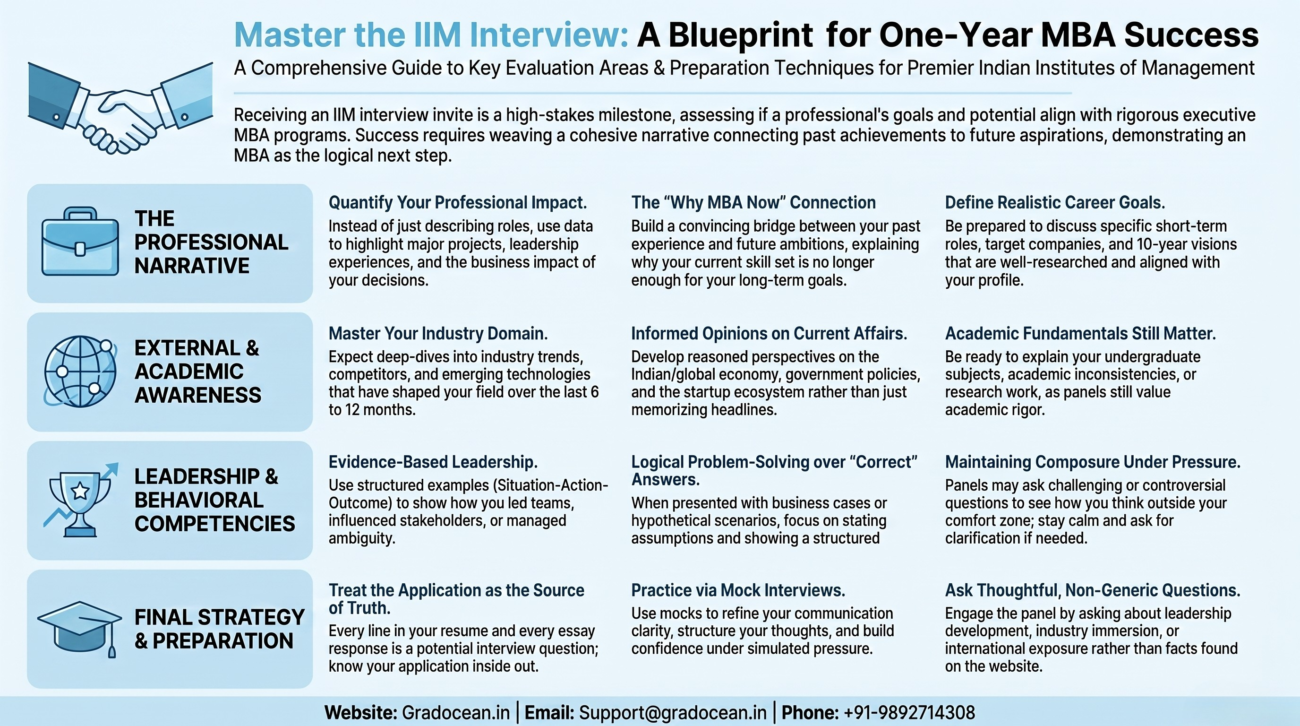
1. Your Professional Experience
For one-year MBA programs, your work experience is often the most important part of the interview. Interviewers expect you to discuss your current role and responsibilities, major projects, leadership experiences, challenges you’ve faced, business impact, and key learnings. Rather than simply describing your job, explain why your work mattered. Quantify your achievements wherever possible and be prepared to discuss the reasoning behind important decisions.
Preparation Tips
- Know every line of your resume.
- Prepare detailed stories around your biggest achievements.
- Be ready to explain failures and what you learned from them.
- Demonstrate ownership, initiative, and leadership through real examples.
2. Why Do You Need an MBA Now?
Almost every IIM interview includes some variation of this question. Interviewers want to understand why you’ve chosen to pursue an MBA at this stage of your career, why your current experience alone isn’t enough, why now is the right time, and how the MBA fits into your long-term plans. A convincing answer connects your past experience with your future ambitions and explains why an MBA is the logical next step. Avoid generic responses such as “I want to become a global leader.” Instead, focus on the specific skills, exposure, and opportunities you need to achieve your career goals.
3. Career Goals
Expect detailed questions about both your short-term and long-term plans. Interviewers may ask what role you want immediately after graduation, which companies you’re targeting, why you’ve chosen a particular function, and where you see yourself in ten years. Your goals should be realistic, well researched, and aligned with your previous experience. Candidates who present vague goals often struggle during follow-up questions.
4. Why This Particular IIM?
Every school expects applicants to understand its program thoroughly. Research the curriculum, electives, leadership initiatives, student clubs, exchange opportunities, industry projects, career services, and alumni network. Your answer should clearly explain why the program is the best fit for your goals instead of listing generic features available at every MBA program.
5. Technical and Industry Knowledge
One-year MBA interviews frequently test your understanding of your current role and industry. Expect questions about industry trends, business challenges, competitors, recent developments, emerging technologies, and future opportunities. If you claim expertise in a domain, the panel expects you to demonstrate it. Stay updated with major developments affecting your industry over the past six to twelve months.
6. Current Affairs and Business News
Interviewers often discuss recent events to evaluate your awareness of the broader business environment. Focus on topics such as the Indian economy, global economy, government policies, AI and emerging technologies, geopolitics, financial markets, major mergers and acquisitions, and the startup ecosystem. Don’t just memorize headlines. Develop informed opinions supported by logical reasoning.
7. Academic Background
Although professional experience carries greater weight in executive MBA interviews, your academic background still matters. Interviewers may ask about your undergraduate subjects, academic projects, low grades, favorite courses, or research work. Review the fundamentals of your academic discipline and be prepared to explain any inconsistencies in your academic performance.
8. Leadership and Teamwork
Leadership is a core evaluation criterion for one-year MBA programs. Prepare examples where you led a team, influenced stakeholders without authority, resolved conflicts, managed ambiguity, took ownership during difficult situations, or drove change within your organization. Use structured examples that clearly explain the situation, your actions, and the outcome.
9. Problem-Solving and Analytical Thinking
Some interviewers may present business situations, caselets, or hypothetical scenarios. They’re usually less interested in the “correct” answer and more interested in understanding your thinking process. Structure your thoughts, state your assumptions, explain your reasoning, and consider multiple perspectives before reaching a conclusion. A logical approach matters more than arriving at a perfect answer.
10. Ethics and Decision-Making
Business leaders frequently encounter ethical dilemmas, and interviewers want to understand how you think under such circumstances. You may be asked about workplace ethics, integrity, conflicts of interest, difficult decisions, or professional values. Use practical examples from your own experience whenever possible.
11. Personal Interests and Extracurricular Activities
Everything mentioned in your application is open for discussion. If you’ve listed sports, music, reading, volunteering, entrepreneurship, or creative pursuits, be prepared to discuss them in depth. Panels often use these conversations to understand your personality beyond work.
12. Communication Skills
Throughout the interview, your communication is being evaluated. Interviewers assess whether you can communicate clearly, structure your thoughts, listen carefully, answer concisely, and remain confident under pressure. Practicing mock interviews is one of the best ways to improve both clarity and confidence.
13. Handling Pressure
Many candidates receive unexpected or challenging questions. You may be asked to defend a controversial opinion, explain a career decision, discuss a failure, justify an employment gap, or explain your backup plan. The objective isn’t to intimidate you but to understand how you think when you’re outside your comfort zone. Stay calm, think before answering, and don’t hesitate to ask for clarification if needed.
Be Thorough With Your Application
One of the biggest mistakes applicants make is treating the application and interview as separate stages. They’re not. Everything you’ve written in your application—including your resume, essays, achievements, extracurricular activities, career goals, and leadership examples—can become an interview question. If you’ve claimed an achievement, be prepared to explain what happened, your role, the challenges involved, the impact you created, and what you learned. Strong candidates know their applications inside out.
Ask Thoughtful Questions
Towards the end of the interview, you’ll often be invited to ask questions. Avoid generic questions that can easily be answered on the school’s website. Instead, ask thoughtful questions about leadership development opportunities, industry immersion, experiential learning, international exposure, career outcomes, or student-led initiatives. Good questions demonstrate genuine interest and thorough preparation.
Final Thoughts
Success in an IIM interview isn’t about memorizing answers. It’s about presenting a clear, authentic, and well-supported story about your professional journey, leadership experiences, and future ambitions. The strongest candidates are those who understand their own career narrative, communicate it confidently, and can defend every claim they make in their application. If you invest time in preparing your stories, researching the program, staying informed about current affairs, and practicing mock interviews, you’ll be well positioned to perform confidently on interview day.
Need Help Preparing for Your IIM Interview?
At Gradocean, we help applicants prepare for interviews across India’s leading one-year MBA programs, including ISB PGP, IIMA PGPX, IIM Bangalore EPGP, IIM Calcutta MBAEx, IIM Lucknow IPMX, IIM Kozhikode PGP-BL, SPJIMR PGPM, XLRI PGDM (GM), and more. Our interview preparation includes personalized mock interviews, detailed feedback from experienced MBA admissions consultants, application-based interview preparation, current affairs and industry discussions, career goal refinement, and communication coaching. Whether you’ve already received an interview invite or are preparing in advance, we’ll help you present your best self with confidence.
Book a mock interview with Gradocean today and maximize your chances of converting your MBA interview into an admission offer.
Your Complete Guide to IIM Admissions: IIMA PGPX, IIMB EPGP, IIM Calcutta MBAEx, IIM Lucknow IPMX, IIM Kozhikode PGP-BL, and Other One-Year MBA Programs.
General IIM Guidance:
1. Indian MBA Programs Are Rising Fast in Global Rankings — Here’s Why It Matters
2. Top Executive MBA Programs in India
3. ISB vs IIM One-Year MBA (2026): Fees, Placements, Rankings, ROI & Which is Better?
4. The Real Role of Extracurriculars in MBA Admissions (ISB, IIMA PGPX, IIMB EPGP)
5. What Should a Strong Letter of Recommendation Include? (ISB, IIMA PGPX, IIMB EPGP Guide)
6. Career Pathways for Chartered Accountants After a One-Year MBA (ISB, IIMA PGPX, IIMB EPGP)
8. IIM Mumbai One-Year MBA (PGPEx): Everything You Need to Know
9.IIM Calcutta PGPEX-VLM Program: A Comprehensive Guide
13. IIM Ahmedabad PGPX Extempore Preparation Guide: Topics, Strategy & Tips
14. IIM Bangalore EPGP WAT Preparation Guide: Topics, Strategy & Sample Questions
15.One-Year MBA Programs in India: Placement Report, Salary & Recruiters (2026)
16. Real Career Transitions After a One-Year MBA: What They Reveal About Changing Careers in India