


“Can someone from my background really transition into consulting, product management, strategy, or technology after an MBA?”
This is probably the single most common question we hear from professionals considering one-year MBA programs like ISB, IIMA PGPX, IIM Bangalore EPGP, XLRI GMP, SPJIMR PGPM, and similar executive MBA programs.
In this blog post, I will share a summary of more than 40 real post-MBA career transition stories from professionals who successfully reinvented their careers.
Some came from public sector organizations.
Some from manufacturing.
Some from the armed forces.
Some from engineering.
Others from banking, shipping, education, healthcare, infrastructure, sales, or entrepreneurship.
On paper, many of these transitions looked impossible.
In reality, they all followed the same principles.
This article brings together the biggest lessons from these real career journeys—and explains what every MBA applicant should understand before applying.
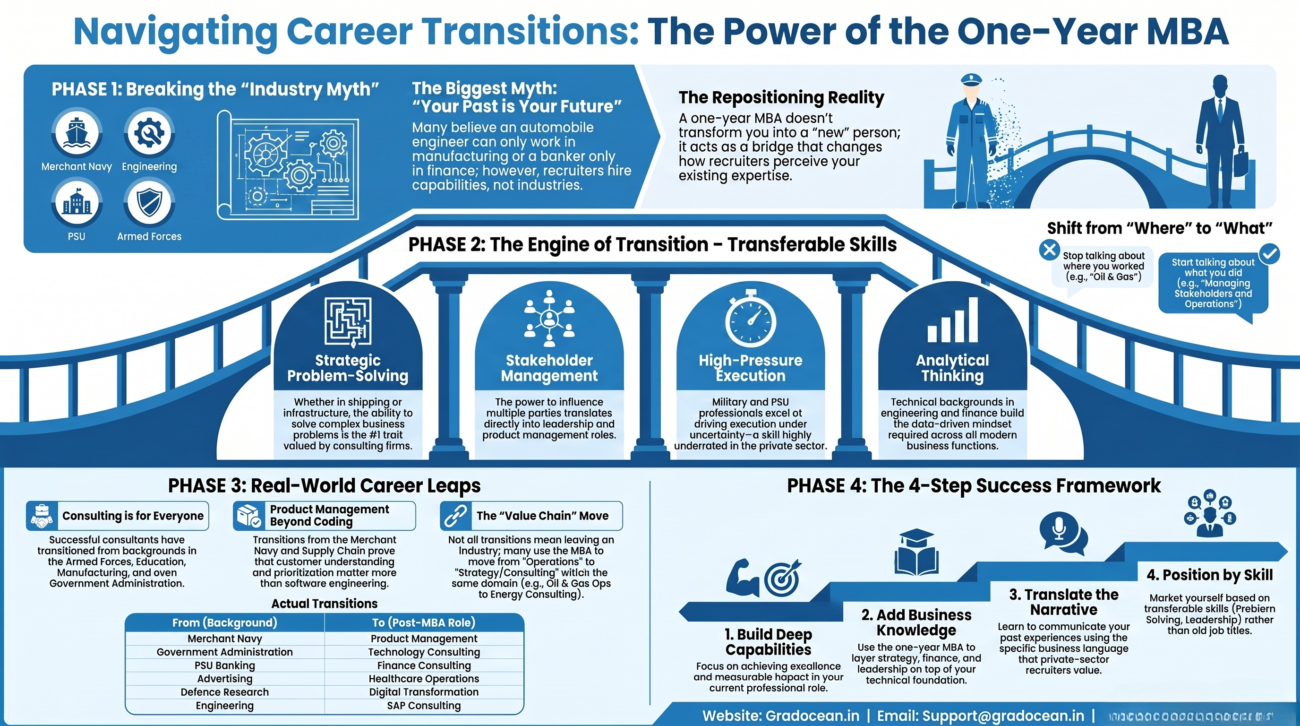
The Biggest Myth About Career Transitions
Most professionals believe their future is determined by their past.
An automobile engineer thinks they can only work in manufacturing.
A PSU employee believes private sector recruiters won’t value their experience.
A banker assumes consulting firms only hire consultants.
A Merchant Navy officer thinks product management belongs exclusively to software engineers.
None of these assumptions are true.
Recruiters rarely hire industries.
They hire capabilities.
The professionals who make the biggest career transitions aren’t the ones with the “perfect” background.
They’re the ones who understand how to position the experience they already have.
The One-Year MBA Doesn’t Erase Your Past—It Repositions It
One misconception about MBA programs is that they completely transform someone into a different professional.
That’s not what happens.
A one-year MBA acts as a bridge between:
- your existing experience
- your transferable skills
- your future aspirations
Instead of changing who you are, it changes how recruiters perceive your experience.
That’s why professionals from completely different industries often compete successfully for the same post-MBA roles.
What Really Makes Career Transitions Possible?
Across all 44 career stories, one pattern emerged repeatedly.
The professionals who succeeded stopped talking about where they worked.
They started talking about what they had actually done.
For example:
An Oil & Gas professional wasn’t “working in energy.”
They were:
- managing stakeholders
- solving operational problems
- leading projects
- making decisions under uncertainty
An Army officer wasn’t simply leading soldiers.
They were:
- managing teams
- making high-pressure decisions
- driving execution
- coordinating complex operations
A teacher wasn’t “just teaching.”
They were:
- communicating complex ideas
- managing relationships
- understanding customer needs
- influencing outcomes
Once these experiences were translated into business language, recruiters saw entirely different possibilities.
Transferable Skills Matter More Than Industry
Across every successful transition, the same skills appeared repeatedly.
Strategic problem-solving
Whether someone came from manufacturing, shipping, defence, education, banking, or infrastructure, they had spent years solving real business problems.
Consulting firms value that.
Stakeholder management
Almost every successful applicant had experience influencing multiple stakeholders.
That capability translates directly into consulting, product management, strategy, operations, and leadership roles.
Leadership
Leadership isn’t limited to people with “manager” in their designation.
Army officers demonstrated it.
PSU professionals demonstrated it.
Project managers demonstrated it.
Entrepreneurs demonstrated it.
Even teachers demonstrated it.
Analytical thinking
Engineers.
Bankers.
Government officers.
Financial professionals.
Operations managers.
Every one of them built analytical capabilities that became valuable across industries.
Execution
Perhaps the most underrated skill.
Ideas matter.
Execution matters more.
Organizations consistently hire professionals who know how to get things done.
Industries Change. Skills Don’t.
Perhaps the biggest lesson from these career transitions is this:
Your industry changes.
Your functional expertise evolves.
Your transferable skills remain valuable.
This explains why professionals successfully moved:
- Automobile Engineering → Technology Consulting
- Oil & Gas Operations → Sustainability Business Development
- Merchant Navy → Product Management
- Banking → AI Consulting
- Infrastructure → BFSI Sales
- Manufacturing → Financial Services Operations
- Education → Consulting
- Advertising → Healthcare Operations
- Government Administration → Technology Consulting
- Defence Research → Digital Transformation Consulting
- Shipping → Energy Consulting
- PSU Banking → Finance Consulting
- Oil & Gas Sales → Growth & Strategy
- Engineering → SAP Consulting
Each transition looked different.
The underlying skills were remarkably similar.
Consulting Isn’t Reserved for Consultants
One of the biggest surprises throughout these stories was the diversity of professionals entering consulting.
Successful transitions included professionals from:
- Engineering
- Government
- PSUs
- Banking
- Infrastructure
- Education
- Shipping
- Manufacturing
- Defence
- Entrepreneurship
Consulting firms weren’t looking for identical resumes.
They were looking for people who could:
- solve problems
- communicate clearly
- analyze situations
- influence stakeholders
- manage ambiguity
Those capabilities exist in almost every profession.
Product Management Isn’t Reserved for Software Engineers
Another misconception we consistently encountered was around Product Management.
Many applicants believed only software developers could enter product roles.
Real transitions proved otherwise.
Successful Product Managers came from:
- Merchant Navy
- Supply Chain
- IT Analysis
- Armed Forces
What mattered wasn’t coding.
It was:
- customer understanding
- ownership
- prioritization
- stakeholder management
- structured thinking
- decision-making
Technology can be learned.
Product thinking can be developed.
Leadership already exists.
Public Sector Professionals Have More Transferable Skills Than They Realize
Many PSU and government professionals worry that recruiters won’t appreciate their experience.
In reality, they often possess highly valuable capabilities:
- large-scale project management
- governance
- compliance
- stakeholder management
- operational excellence
- execution under complexity
Throughout these career stories, professionals from government organizations successfully transitioned into:
- Technology Consulting
- Financial Consulting
- Strategy
- Sales
- Product
- SAP Consulting
- Growth & Strategy
- Operations Leadership
The challenge wasn’t their experience.
It was learning how to communicate it.
Sometimes the Best Transition Isn’t Changing Industries
Not every successful MBA graduate leaves their domain.
Many simply move higher up the value chain.
Examples include:
- Oil & Gas Operations → Oil & Gas Consulting
- Chartered Accountant → Financial Consulting Leadership
- Infrastructure Projects → Infrastructure Finance
- Automobile Engineering → Automotive Consulting
These professionals didn’t abandon their expertise.
They amplified it.
The MBA added business strategy, finance, communication, and leadership to an already strong technical foundation.
AI Is Creating New Opportunities for Domain Experts
Several recent career transitions reflected another growing trend.
AI isn’t replacing domain expertise.
It’s increasing its value.
Professionals from banking, infrastructure, government, and operations successfully moved into AI-focused consulting and technology transformation roles.
Why?
Because organizations don’t just need AI engineers.
They need professionals who understand industry problems and know where technology creates business value.
The future belongs to professionals who combine domain expertise with business thinking.
What These Career Stories Really Teach Us
Despite spanning dozens of industries and job functions, every successful transition followed the same framework.
Step 1: Build strong capabilities in your current role.
Step 2: Use a one-year MBA to add business knowledge.
Step 3: Learn to communicate your experience in terms recruiters value.
Step 4: Position yourself around transferable skills—not job titles.
That’s the formula.
Your Current Designation Is Not Your Career Identity
The professionals featured throughout these stories weren’t defined by their job titles.
They were defined by their potential.
An engineer became a consultant.
A teacher became a Customer Success Manager.
A Merchant Navy officer became a Product Manager.
A PSU professional became a strategy leader.
A defence researcher became a technology consultant.
Their careers didn’t change because they abandoned their experience.
They changed because they finally understood how valuable that experience already was.
Frequently Asked Questions (FAQs)
1. Can I change my career after a one-year MBA in India?
Yes. A one-year MBA can be an excellent platform for experienced professionals looking to transition into consulting, product management, strategy, general management, finance, technology, operations, or leadership roles. Your success depends less on your previous industry and more on how effectively you position your transferable skills and career narrative.
2. Is prior consulting experience required to get into consulting after an MBA?
No. Consulting firms recruit professionals from diverse backgrounds, including engineering, manufacturing, banking, healthcare, government, defence, energy, and education. They look for structured problem-solving, analytical thinking, communication skills, leadership, and the ability to work with ambiguity rather than previous consulting experience alone.
3. Can PSU or government employees transition into the private sector after an MBA?
Absolutely. Many professionals from public sector organizations successfully transition into consulting, strategy, technology, operations, finance, and product roles after completing a one-year MBA. Their experience in project management, stakeholder management, governance, and execution often becomes a significant advantage when presented effectively.
4. Is Product Management only for software engineers?
No. While technical knowledge can be helpful, Product Management is fundamentally a business role. Companies also hire professionals from operations, supply chain, merchant navy, consulting, banking, and other industries who demonstrate customer focus, strategic thinking, prioritization, leadership, and stakeholder management.
5. How important are transferable skills for MBA career transitions?
Transferable skills are often more important than industry experience. Recruiters consistently value capabilities such as problem-solving, leadership, stakeholder management, analytical thinking, communication, and execution because these skills apply across industries and business functions.
6. Can I switch industries completely after a one-year MBA?
Yes. Many MBA graduates successfully move from manufacturing to consulting, banking to technology, defence to strategy, education to customer success, shipping to product management, or government to digital transformation. However, successful transitions are built on transferable skills rather than simply changing industries.
7. Do I need to leave my industry to benefit from a one-year MBA?
Not necessarily. Many professionals use an MBA to move into more strategic roles within their existing industry. For example, an oil and gas professional may transition into energy consulting, or an infrastructure professional may move into infrastructure finance or corporate strategy. Staying within your domain while moving up the value chain can be equally rewarding.
8. How do recruiters evaluate experienced MBA candidates?
Recruiters generally evaluate candidates based on the scale of responsibility, leadership experience, business impact, problem-solving ability, communication skills, and evidence of career progression. They are often more interested in what you have accomplished than where you have worked.
9. Which professionals benefit the most from a one-year MBA?
One-year MBA programs are particularly well suited for experienced professionals with 4–12 years of work experience who want to accelerate their careers, move into leadership roles, switch functions, or expand into new industries without taking an extended career break.
10. What are the most common career transitions after a one-year MBA?
Some of the most common post-MBA transitions include Engineering to Consulting, Manufacturing to Strategy, Banking to Product Management, Oil & Gas to Sustainability or Energy Consulting, Merchant Navy to Product or Operations, Government and PSU to Technology Consulting, Healthcare to General Management, Sales to Growth Strategy, Defence to Program Management, and Finance to Corporate Strategy.
11. What makes a successful MBA career transition?
Successful career transitions usually follow four key steps: build meaningful experience in your current role, develop business and leadership skills through a one-year MBA, position your experience around transferable skills rather than job titles, and clearly communicate your career story through applications, networking, and interviews
Other Articles of Interest:
1. ISB vs International MBA: How to Choose the Right Path for Your Career
2. Indian MBA Programs Are Rising Fast in Global Rankings — Here’s Why It Matters
3. Top Executive MBA Programs in India
4.GMAT Waiver for MBA: A Complete Guide to Test-Optional Business Schools
5.Top Global One-Year MBA Programs for Experienced Professionals: A Comprehensive Guide
6.Best MBA Programs for Healthcare: Top Schools, Curriculum & Career Scope (2026 Guide)
7. Best MBA Programs for Sustainability & ESG: Top Schools, Curriculum & Career Scope (2026 Guide)
8. ISB vs IIM One-Year MBA (2026): Fees, Placements, Rankings, ROI & Which is Better?
9. MBA ROI vs Rankings: How to Choose the Right MBA Program in 2026
10. ISB PGP Curriculum Breakdown: What You Actually Learn (And Why It Matters)
11. The Real Role of Extracurriculars in MBA Admissions (ISB, IIMA PGPX, IIMB EPGP)
12. What Should a Strong Letter of Recommendation Include? (ISB, IIMA PGPX, IIMB EPGP Guide)
13.Career Pathways for Chartered Accountants After a One-Year MBA (ISB, IIMA PGPX, IIMB EPGP)
15. ISB PGP Essay Analysis 2026–27: How to Write Winning ISB Essays (With Expert Tips)
16. IIM Mumbai One-Year MBA (PGPEx): Everything You Need to Know
17.IIM Calcutta PGPEX-VLM Program: A Comprehensive Guide
21. IIM Ahmedabad PGPX Extempore Preparation Guide: Topics, Strategy & Tips
22. IIM Bangalore EPGP WAT Preparation Guide: Topics, Strategy & Sample Questions
23. One-Year MBA Programs in India: Placement Report, Salary & Recruiters (2026)