

Professionals coming from family businesses or entrepreneurial backgrounds often approach an MBA with a different set of questions from candidates who have spent their careers in large corporations.
Some want to return to their family business and scale it. Others want to professionalise the organisation, expand into new markets or launch a new business. There are also candidates who have spent several years in a family enterprise but now want to build an independent corporate career.
Entrepreneurs face similar choices. Someone who has spent four or five years building a startup may want to continue as an entrepreneur, while another founder may decide that the next stage of their career should be in consulting, strategy, product management or general management.
Programs such as the ISB PGP, IIM Ahmedabad PGPX, IIM Bangalore EPGP, IIM Calcutta MBAEx and IIM Lucknow IPMX can provide routes to these transitions.
However, family-business and entrepreneurial experience needs to be evaluated differently from conventional corporate experience.
The important question is not simply whether you worked in a family business or founded a company. What matters is what you actually did, the scale at which you operated, the decisions you made and the results you produced.
Why Family Business Professionals Pursue a One-Year MBA
Family businesses can provide unusually broad exposure at an early stage of a career.
Someone working in a family-owned manufacturing company, for example, might simultaneously deal with production, procurement, customers, finance and employees.
A professional in a family trading business may manage suppliers, distributors, working capital and business development.
Similarly, an entrepreneur may have experience across:
- Sales
- Marketing
- Finance
- Operations
- Hiring
- Product development
- Fundraising
- Customer acquisition
- Vendor management
- Strategy
This breadth can be valuable.
However, working primarily within one organisation can also limit exposure to structured management practices, other industries and different organisational environments.
A one-year MBA can help candidates develop stronger capabilities in finance, strategy, marketing, analytics, leadership and organisational management while also expanding their professional network.
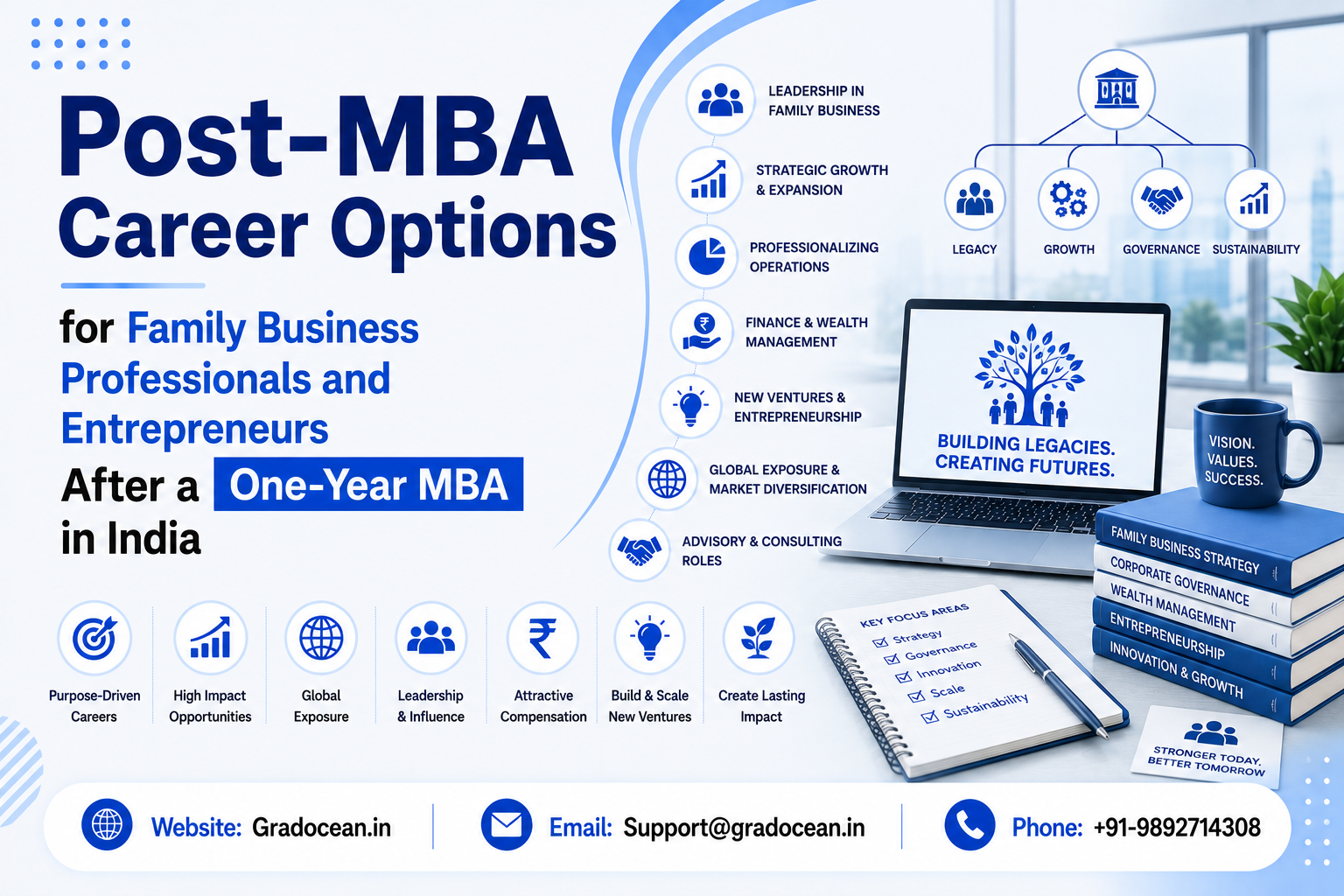
There are broadly three post-MBA directions for such candidates:
- Return to the family business and take on greater responsibility.
- Continue entrepreneurship or launch another venture.
- Move into a corporate career.
The right choice depends heavily on what the candidate was doing before the MBA.
1. Returning to and Scaling the Family Business
For many candidates, the most logical post-MBA outcome is not a career switch at all.
It is returning to the family enterprise with the ability to manage it differently.
The MBA can help professionals move from day-to-day execution towards questions such as:
- Which markets should we enter?
- Should we launch new products?
- How should we finance expansion?
- Should we professionalise the management team?
- How can technology improve operations?
- Should we expand internationally?
- How should responsibilities be divided between family and professional managers?
- How should the company evaluate acquisitions or partnerships?
Consider someone working in a second-generation manufacturing business.
Before the MBA, the candidate may have primarily managed production and procurement. After returning, the candidate could take responsibility for overall business strategy, expansion, profitability and organisational development.
The value of the MBA in this situation is therefore not obtaining a different job. It is developing the capabilities required to take the business to its next stage.
Areas Where the MBA Can Help
Family-business professionals can use the MBA to strengthen:
- Corporate strategy
- Financial management
- Marketing
- Digital transformation
- Organisational design
- Governance
- Leadership
- International expansion
- Mergers and acquisitions
- Entrepreneurship
This path is particularly relevant for candidates who already know that their long-term career lies within the family enterprise.
Transition Difficulty
Low
The challenge is not obtaining the role but demonstrating that the MBA produces meaningful changes in how the candidate manages and grows the organisation.
2. Management Consulting
Management consulting can be an attractive corporate transition for family-business professionals and entrepreneurs.
Running a business requires solving problems with limited information and resources. Entrepreneurs may have worked on pricing, customer acquisition, operations, fundraising, hiring and market expansion.
These experiences can be relevant to consulting.
Family-business professionals may similarly have experience with:
- Cost reduction
- Market expansion
- Procurement
- Supply chain
- Sales
- Operations
- Organisational problems
- Business transformation
A professional who helped expand a family manufacturing business into three new markets, for example, can demonstrate analytical thinking, execution and commercial responsibility.
An entrepreneur who built a startup from the ground up may bring experience in market sizing, product development, customer acquisition and resource allocation.
Potential Employers
Depending on the school and recruiting year, opportunities can exist with firms such as:
- McKinsey
- BCG
- Bain
- Accenture Strategy
- Deloitte
- EY-Parthenon
- Kearney
- PwC
- Other strategy, operations and transformation consulting firms
Consulting is also a significant recruiting sector across leading one-year MBA programs.
How Difficult Is the Transition?
Transition difficulty: Moderate
Family-business candidates need to demonstrate that their experience involved genuine business responsibility rather than simply holding a title in a family-owned company.
Entrepreneurs need to translate startup experiences into structured business problems and outcomes.
Case-interview preparation, structured problem-solving and executive communication become particularly important.
3. Corporate Strategy
Corporate strategy can be another option for candidates who have already been involved in business-level decision-making.
Potential roles include:
- Strategy Manager
- Business Strategy Manager
- Corporate Planning
- Growth Strategy
- CEO’s Office
- Chief of Staff
- Transformation Strategy
- New Business Strategy
A family-business professional who has evaluated new markets, launched products, managed expansion or analysed investments may already possess some relevant experience.
Similarly, entrepreneurs routinely make strategic decisions involving customers, products, competitors and capital.
The challenge is demonstrating that these decisions were made systematically and at meaningful scale.
Where Previous Experience Helps
Candidates from industries such as manufacturing, retail, real estate, industrial products, consumer businesses or technology may have particularly strong opportunities when targeting strategy roles in related industries.
Industry knowledge provides credibility.
For example, someone who has spent six years helping manage a family-owned chemicals business may have a stronger case for strategy roles within chemicals, manufacturing or industrial companies than for an unrelated strategy role in financial services.
Transition Difficulty
Within the same or a related industry:
Low to Moderate
Into an unrelated industry:
Moderate to High
4. General Management
Family-business professionals often have broader cross-functional exposure than their job titles suggest.
Someone called Director or Business Head in a relatively small organisation might actually be responsible for:
- Sales
- Operations
- Procurement
- Employees
- Finance
- Customers
- Vendors
This experience can potentially translate into general-management positions.
Possible roles include:
- General Manager
- Business Manager
- Business Unit Manager
- Regional Business Manager
- P&L Manager
- Commercial Manager
However, candidates need to be realistic about seniority.
Being a Director in a family company does not automatically make someone suitable for a Director position in a large multinational.
Recruiters will evaluate the actual scale of responsibility.
A candidate who managed a ₹20 crore business with 30 employees and another who managed a ₹500 crore division with 500 employees may have similar titles but very different experience.
Transition Difficulty
Into a similar industry:
Moderate
Into an unrelated industry:
Moderate to High
The strongest candidates can demonstrate measurable P&L responsibility, team leadership and business growth.
5. Operations and Supply Chain
Operations can be one of the strongest corporate career options for family-business candidates from manufacturing, trading, logistics and product-based businesses.
A family-business professional may already have experience with:
- Manufacturing
- Procurement
- Vendors
- Logistics
- Inventory
- Quality
- Distribution
- Cost management
- Production planning
Potential post-MBA roles include:
- Operations Manager
- Supply Chain Manager
- Procurement Manager
- Strategic Sourcing Manager
- Category Manager
- Operations Excellence Manager
- Manufacturing Manager
- Supply Chain Consultant
Someone who managed procurement and production for a family-owned manufacturing company already possesses experience that corporate recruiters can understand.
The MBA can add knowledge of analytics, strategy, finance and modern supply-chain practices.
Transition Difficulty
Same or related industry:
Low
Different industry but similar function:
Low to Moderate
Operations or supply-chain consulting:
Moderate
This can therefore be one of the more practical ways for family-business professionals to establish an independent corporate career.
6. Sales, Business Development and Commercial Roles
Sales and business development are also natural transitions because many family-business professionals are directly involved with customers.
Someone working in a family-owned distribution company, for example, may have spent several years developing dealer networks, negotiating with customers and managing key accounts.
Entrepreneurs also spend substantial time selling, even when their formal title is Founder or CEO.
Potential roles include:
- Business Development Manager
- Enterprise Sales Manager
- Regional Sales Manager
- Key Account Manager
- Partnerships Manager
- Channel Manager
- Commercial Strategy Manager
- Go-to-Market Manager
These skills can transfer across industries more easily than highly specialised technical capabilities.
Transition Difficulty
Related industry:
Low
Different industry:
Low to Moderate
Candidates should quantify outcomes such as revenue generated, customers acquired, markets entered, distribution expanded and partnerships developed.
7. Product Management
Product management can be relevant for entrepreneurs, particularly those who have built technology or digital businesses.
A startup founder may already have experience identifying customer problems, defining products, working with developers, prioritising features, analysing customer behaviour and developing go-to-market strategies.
This can provide a credible foundation for product-management recruiting.
Family-business professionals can also make this transition if they have been involved in product development, customer research, digital transformation or technology-enabled businesses.
Potential sectors include:
- Technology
- SaaS
- Fintech
- E-commerce
- Consumer internet
- B2B platforms
- Digital businesses
Transition Difficulty
Technology entrepreneur with direct product experience:
Low to Moderate
Family-business professional with relevant digital/product experience:
Moderate
Traditional family-business professional with no technology or product exposure:
High
An MBA alone does not make someone a credible technology Product Manager. Relevant experience remains important.
8. Finance and Investment Roles
Family-business professionals frequently deal with financial decisions.
They may manage:
- Working capital
- Bank relationships
- Business loans
- Cash flow
- Budgets
- Capital expenditure
- Financial planning
This experience can support transitions into certain corporate-finance positions.
Potential options include:
- Corporate Finance
- Business Finance
- FP&A
- Commercial Finance
- Project Finance
- Financial Strategy
However, candidates should distinguish corporate finance from specialised investment careers.
Moving from managing finances in a family manufacturing business into corporate finance within another manufacturing company can be realistic.
Moving directly into investment banking, private equity or institutional investing is considerably harder without prior transaction or investment experience.
Transition Difficulty
Corporate finance with relevant experience:
Moderate
Project or sector-specific finance with relevant experience:
Moderate
Investment banking or private equity without relevant experience:
High
Candidates targeting finance should use the MBA to build strong capabilities in accounting, valuation, financial modelling and corporate finance.
9. Entrepreneurship and Startups
For entrepreneurs, an MBA does not necessarily represent an exit from entrepreneurship.
It can provide an opportunity to evaluate what went right and wrong in the previous venture before starting again.
Similarly, family-business professionals may use the MBA to launch a new venture either within or outside the existing family enterprise.
ISB reports more than 1,200 alumni entrepreneurs and 175+ alumni startups within its broader PGP ecosystem, while IIMA describes PGPX as a platform from which graduates have also launched entrepreneurial ventures.
Potential paths include:
- Returning to scale an existing venture
- Starting a new company
- Launching a new division within the family business
- Building a digital business around an existing traditional company
- Joining an early-stage startup in an operating role
For entrepreneurs whose previous ventures shut down, this experience does not necessarily have to be hidden.
What matters is explaining what was built, what was achieved, why the business did not continue and what was learned.
A failed startup with customers, employees, revenue and meaningful operating experience can still provide substantial professional learning.
Transition Difficulty
Returning to entrepreneurship:
Low to Moderate
Joining a startup in a relevant operating role:
Low to Moderate
Starting a completely new venture:
Moderate, with the outcome naturally dependent on the business itself.
Can You Move Completely Away From the Family Business?
Yes, but this is where candidates need to think carefully about transferable experience.
Consider someone who managed manufacturing operations in a family business and moves into corporate manufacturing operations. The employer changes, but the function remains similar. This is relatively straightforward.
Someone who handled sales in a family enterprise and moves into corporate business development is making a similar transition.
Moving from running a family manufacturing company into management consulting is a bigger change but can still be credible because the candidate has substantial business experience.
Moving from a traditional family trading business into technology product management changes both industry and function and provides considerably less overlap.
The difficulty therefore increases as the candidate moves further away from previous experience.
Choosing Your Post-MBA Career Based on Your Previous Experience
| Pre-MBA Background | Strong Post-MBA Options |
|---|---|
| Family Business Owner/Partner | Strategy, General Management, Consulting, Entrepreneurship |
| Manufacturing/Operations | Operations, Supply Chain, Consulting, General Management |
| Procurement/Supply Chain | Strategic Sourcing, Supply Chain, Operations, Consulting |
| Sales/Business Development | Corporate Sales, BD, Partnerships, Commercial Strategy |
| Finance in Family Business | Corporate Finance, Business Finance, Strategy |
| Retail/Distribution | Sales, Category Management, Operations, Business Development |
| Real Estate Family Business | Real Estate Strategy, Development, Consulting, Investment Analysis |
| Technology Entrepreneur | Product Management, Consulting, Strategy, Startups |
| Non-Tech Entrepreneur | Consulting, Strategy, Operations, Business Development |
| Startup Founder with Product Experience | Product Management, Strategy, Entrepreneurship |
The objective is not to create the most dramatic career change possible.
It is to identify where your previous experience gives you credibility and then use the MBA to broaden your opportunities.
A Particular Challenge: Proving the Quality of Family Business Experience
Family-business candidates face a challenge that corporate candidates generally do not.
If someone works at Amazon, Tata Steel or Deloitte, recruiters have a basic understanding of the organisation, hierarchy and recruitment standards.
The same may not be true for a family business.
Recruiters may therefore ask:
How large is the company?
What exactly did you manage?
Were you given responsibility because you were a family member or because you performed well?
How many people reported to you?
What decisions did you personally make?
What measurable impact did you create?
Did your responsibilities increase over time?
This makes evidence particularly important.
Instead of relying on titles such as Director, Vice President or Head of Business, candidates should quantify:
- Annual revenue
- Revenue growth
- Number of employees
- Customers
- Markets served
- Manufacturing capacity
- Vendors managed
- Budget responsibility
- Cost reductions
- New products launched
- New markets entered
- Distribution expansion
- Profitability improvements
The objective is to make the scale and complexity of the experience understandable to someone who knows nothing about the company.
How Entrepreneurs Should Position Their Experience
Entrepreneurs face a similar challenge.
Founder or CEO by itself tells a recruiter very little.
There is a significant difference between someone who registered a company and experimented with an idea for six months and someone who spent four years building a company with employees, customers and revenue.
Candidates should therefore explain:
- What problem the company solved
- What product or service was built
- Revenue generated
- Customers acquired
- Employees managed
- Capital raised, if applicable
- Partnerships established
- Markets entered
- Operational challenges solved
- Why the company succeeded, failed or was closed
If the venture failed, the candidate should avoid becoming defensive about it.
A business can fail while the founder still develops valuable experience in product development, sales, hiring, operations and leadership.
The important issue for recruiters is what the candidate can bring to the next organisation.
Which One-Year MBA Programs Can Family Business Professionals Consider?
ISB PGP
ISB can be particularly relevant for candidates who want to use their family-business or entrepreneurial experience to move into consulting, technology, product, strategy or general-management positions.
It also has a substantial entrepreneurship ecosystem. ISB currently reports more than 1,200 alumni entrepreneurs and more than 175 alumni startups.
Candidates whose primary objective is specifically to return to their family enterprise should also understand that ISB separately offers PGP MFAB, a 15-month modular program designed specifically for next-generation family-business members.
The regular PGP and PGP MFAB therefore serve different objectives. A candidate seeking a conventional corporate career pivot may find the regular PGP more aligned, while someone committed to managing the family enterprise should evaluate the specialised option as well.
IIM Ahmedabad PGPX
IIMA PGPX can be particularly relevant for experienced family-business professionals and entrepreneurs.
IIMA’s own material has historically identified members of family-owned enterprises seeking general-management and global-business capabilities among the profiles suited to PGPX. Its current PGPX career process is designed around middle and senior-management opportunities across sectors including consulting, financial services, IT, manufacturing and diversified businesses.
This can make it relevant for candidates with substantial operating experience who want to move into corporate leadership or return to their businesses with broader management capabilities.
IIM Bangalore EPGP, IIM Calcutta MBAEx and IIM Lucknow IPMX
These programs can similarly be considered by experienced family-business professionals seeking a transition into consulting, operations, strategy, technology, general management or other corporate roles.
The more important consideration is not simply whether a program accepts family-business experience. It is whether its recruiter base and typical post-MBA roles align with the candidate’s experience and career objective.
Candidates should therefore evaluate recent placement reports, alumni outcomes and recruiter participation before deciding where to apply.
Skills to Build During the MBA
Family-business professionals often arrive at business school with considerable practical experience but less exposure to formal management frameworks.
The MBA should therefore be used to fill specific gaps.
For consulting, candidates should develop structured problem-solving, case-interview skills, financial analysis and presentation capabilities.
For corporate strategy, financial modelling, competitive analysis, market sizing and corporate finance become important.
For general management, candidates should strengthen organisational behaviour, leadership, finance, marketing and P&L management.
For operations and supply chain, analytics, operations strategy, procurement and process improvement can complement existing experience.
For product management, customer discovery, product analytics, technology fundamentals, pricing and go-to-market strategy become important.
Candidates returning to their family businesses should pay particular attention to governance, organisational design, finance, digital transformation and professional management.
The MBA Should Build on Your Business Experience
Family-business and entrepreneurial candidates sometimes assume that they need to distance themselves from their previous experience to compete with candidates from established corporations.
Usually, the opposite approach is more effective.
Running or helping manage a business can provide experience that many corporate professionals do not receive early in their careers: direct exposure to customers, cash flow, employees, suppliers, pricing and business survival.
The challenge is making that experience credible and understandable.
For one candidate, the right post-MBA outcome may be returning to a family manufacturing business and expanding it nationally.
For another, it may be moving from family-business operations into management consulting.
An entrepreneur may transition into product management, while someone who managed sales for a family enterprise may move into corporate business development.
All can represent successful MBA outcomes.
The strongest career strategy usually lies at the intersection of three factors: your existing experience, the capabilities developed during the MBA, and realistic recruiter demand.
A one-year MBA can significantly broaden the options available to family-business professionals and entrepreneurs. But the MBA works best when it builds on genuine operating experience rather than attempting to replace it.
The more useful question is therefore not simply what jobs are available after an MBA.
It is which career path allows you to turn the business experience you already have into the next stage of your professional growth.
Other Articles of Interest:
1. ISB vs International MBA: How to Choose the Right Path for Your Career
2. Indian MBA Programs Are Rising Fast in Global Rankings — Here’s Why It Matters
3. Top Executive MBA Programs in India
4.GMAT Waiver for MBA: A Complete Guide to Test-Optional Business Schools
5.Top Global One-Year MBA Programs for Experienced Professionals: A Comprehensive Guide
6.Best MBA Programs for Healthcare: Top Schools, Curriculum & Career Scope (2026 Guide)
7. Best MBA Programs for Sustainability & ESG: Top Schools, Curriculum & Career Scope (2026 Guide)
8. ISB vs IIM One-Year MBA (2026): Fees, Placements, Rankings, ROI & Which is Better?
9. MBA ROI vs Rankings: How to Choose the Right MBA Program in 2026
11. HEC Paris MBA Essays 2027 Intake: A Complete Guide to Writing Winning Essays
16.MBA University of Virginia Darden MBA Admissions Guide (2026–2027 Intake)
18. MBA Letters of Recommendation (LOR): Complete Guide for Applicants
19.2026 IIM Ahmedabad PGPX Extempore Topics: Latest Questions & Preparation Guide
20. 18 Key Insights About ISB PGP Admissions
21.ISB PGP R1: What to Focus on Before You Submit Your Application
22. IIM Indore EPGP 2027–28: Admissions, Eligibility, Placements, Fees, Programme & Application Guide
24. IIM Lucknow IPMX 2027–28: Admissions, Eligibility, Placements, Batch Profile & Application Guide
25. Post-MBA Career Options for Fashion Professionals After a One-Year MBA in India
26. Post-MBA Career Options for Lawyers After a One-Year MBA in India
28. Post-MBA Career Options for PSU Professionals After a One-Year MBA in India
31. Post-MBA Career Options for Civil Engineering Professionals After a One-Year MBA in India