

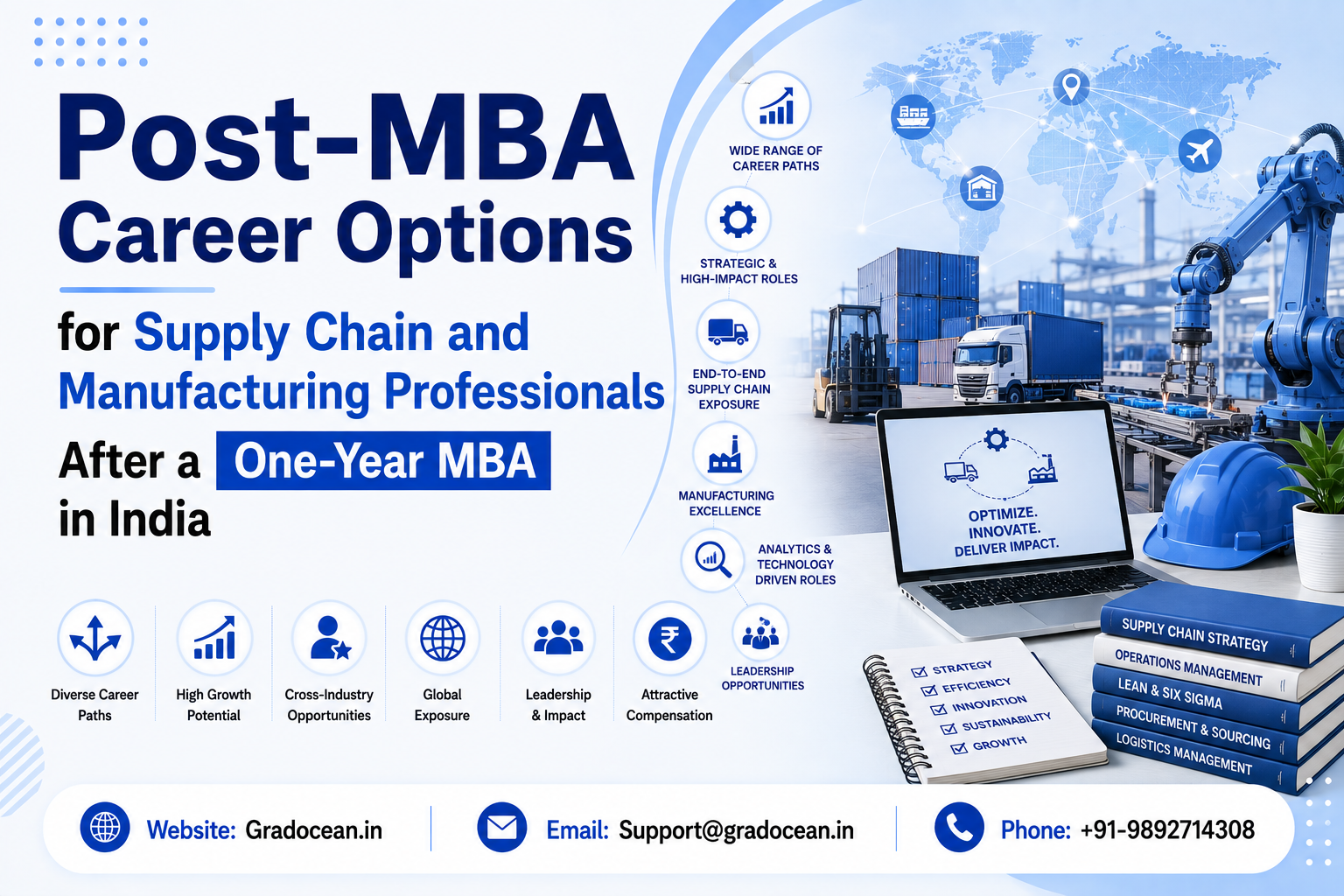
Professionals from manufacturing, supply chain, plant operations, procurement, engineering, logistics and the Merchant Navy are well positioned to benefit from a one-year MBA in India.
By the time they consider an MBA, many have already managed teams, vendors, equipment, budgets, projects, safety, quality, inventory or complex operations. They know how businesses work at the execution level and have often handled responsibilities that directly affect cost, productivity and business continuity.
What they may not have had enough exposure to is the broader commercial side of the business, including strategy, finance, marketing, business development and corporate decision-making.
A one-year MBA from ISB, IIMA, IIMB, IIM Calcutta, IIM Lucknow or another leading business school can bridge this gap and open career opportunities well beyond traditional plant or supply chain roles.
The objective does not have to be to leave manufacturing or operations behind. For many professionals, the MBA is a way to move from managing operations to managing businesses.
Why Do Manufacturing and Supply Chain Professionals Pursue an MBA?
A manufacturing professional may start as a graduate engineer or management trainee and gradually move into production, maintenance, quality, procurement, supply chain, projects or plant management.
As experience increases, the roles become larger, but career growth can also become increasingly specialised.
An MBA can help broaden this trajectory.
A production manager can move towards consulting or general management. A procurement professional can transition into strategic sourcing or supply chain strategy. An engineer can move into corporate strategy or program management. A logistics professional can enter e-commerce or technology-led operations.
Merchant Navy professionals can use an MBA to transition from sea-based operational careers into shore-based corporate roles across logistics, consulting, operations, infrastructure, shipping and general management.
The common thread across these transitions is that the MBA adds commercial and strategic capabilities to an already strong operational foundation.
1. Management Consulting
Management consulting is one of the strongest post-MBA career options for experienced manufacturing and supply chain professionals.
Potential roles include:
- Management Consultant
- Operations Consultant
- Supply Chain Consultant
- Procurement Consultant
- Manufacturing Consultant
- Business Transformation Consultant
- Strategy Consultant
- Operational Excellence Consultant
Manufacturing and supply chain professionals already spend much of their careers solving business problems.
They deal with production bottlenecks, inventory issues, supplier negotiations, cost overruns, quality problems, capacity constraints and process inefficiencies.
Consulting takes this problem-solving experience to a broader level.
Instead of focusing only on how a plant can increase production, you may work on whether a company should expand manufacturing capacity, outsource production, redesign its supply chain, consolidate suppliers or invest in automation.
Your industry knowledge can be particularly valuable in operations, supply chain, procurement and transformation consulting.
Moving into broader strategy consulting is also possible. The main additional requirement is developing strong case-solving skills and demonstrating that you can analyse business problems beyond your previous technical domain.
2. Supply Chain, Procurement and Logistics Leadership
An MBA does not mean you need to leave supply chain.
It can help you move from operational supply chain responsibilities into strategic leadership positions.
Potential roles include:
- Supply Chain Manager
- Supply Chain Strategy Manager
- Procurement Manager
- Strategic Sourcing Manager
- Category Manager
- Logistics Manager
- Network Planning Manager
- Operations Excellence Manager
Before the MBA, your responsibilities may involve ensuring that materials arrive on time, negotiating with suppliers, managing inventory or coordinating logistics.
After the MBA, your responsibilities can become much broader.
You may be involved in deciding where distribution centres should be located, which suppliers the company should depend on, whether manufacturing should be outsourced, how inventory should be optimised or how technology can improve the entire supply chain.
The growth of e-commerce, quick commerce, omnichannel retail and increasingly complex manufacturing networks has also made supply chain a much more strategic function.
For professionals who already enjoy this field, an MBA can accelerate the move from supply chain execution into supply chain leadership.
3. Corporate Strategy and General Management
Corporate strategy and general management are attractive options for professionals who want to move beyond a specialised operational function.
Potential roles include:
- Corporate Strategy Manager
- Strategic Initiatives Manager
- Business Operations Manager
- General Manager
- CEO Office roles
- Business Transformation Manager
- Program Director
Consider someone who has spent several years managing manufacturing operations.
They may already understand production, quality, safety, manpower, procurement and cost management extremely well. What they may not have experienced directly is pricing, market entry, customer acquisition, corporate finance or capital allocation.
An MBA helps build these capabilities.
This can eventually allow the professional to participate in decisions such as entering a new market, launching a new business line, expanding manufacturing capacity, acquiring another company or restructuring an underperforming business.
Candidates who have already managed budgets, led cross-functional initiatives, worked with senior leadership or handled major suppliers are particularly well positioned for this transition.
4. E-Commerce and Technology Operations
E-commerce and technology-led businesses offer strong opportunities for supply chain, logistics and operations professionals.
Behind every digital marketplace or e-commerce platform is a complex physical network of warehouses, fulfilment centres, suppliers, sellers, transportation partners and delivery operations.
That creates opportunities in areas such as:
- Business Operations
- Fulfilment Operations
- Supply Chain Strategy
- Seller Operations
- Network Planning
- Procurement
- Program Management
- Operations Strategy
Professionals who have already managed factories, warehouses, transportation networks or vendor ecosystems bring highly relevant experience to these businesses.
The MBA adds the commercial, analytical and strategic perspective required to move into larger management roles.
For example, someone who previously managed warehouse operations may move into network strategy, where the problem is no longer simply how to operate one warehouse efficiently but how the company should design its entire fulfilment network.
5. Program and Project Management
Program and project management is another strong transition for engineers, manufacturing professionals and Merchant Navy candidates.
Potential roles include:
- Program Manager
- Senior Program Manager
- Project Manager
- Transformation Manager
- Technical Program Manager
- Portfolio Manager
Many operations professionals already possess the fundamental skills required for these positions.
If you have managed a manufacturing expansion, equipment installation, automation project, plant shutdown, supply chain transformation or complex maritime operation, you have already coordinated people, resources, timelines, budgets and risks.
The MBA allows you to take this capability into a wider range of industries.
A manufacturing engineer, for example, can move from managing engineering projects to managing large business transformation programs. Similarly, a Merchant Navy professional can use experience managing complex shipboard operations to transition into project, program or operations management roles onshore.
6. Manufacturing Strategy and Operational Excellence
Staying within manufacturing after an MBA can be an excellent career decision.
The difference is that you can move from running manufacturing processes to shaping how the company manages its operations.
Potential roles include:
- Manufacturing Strategy
- Operational Excellence
- Plant Leadership
- Business Excellence
- Digital Manufacturing
- Industry 4.0 Transformation
- Corporate Operations
- Business Unit Leadership
Consider an automotive professional with eight years of experience across production and plant operations.
Rather than completely changing industries, the MBA can help that person move towards manufacturing strategy, operational excellence, corporate operations or eventually general management.
This allows you to preserve the value of your technical and industry experience while adding finance, strategy and business leadership capabilities.
For experienced candidates, this can often be more valuable than trying to completely reinvent themselves after the MBA.
7. Career Options for Merchant Navy Professionals
Merchant Navy professionals bring a particularly distinctive profile to one-year MBA programs.
Several years at sea can involve managing expensive equipment, supervising multinational teams, handling emergencies, maintaining safety standards and making important operational decisions with limited external support.
These are highly transferable management skills.
Post-MBA career opportunities can include:
- Operations Management
- Supply Chain and Logistics
- Shipping and Maritime Businesses
- Management Consulting
- Infrastructure
- Program Management
- Energy
- General Management
The key is translating maritime experience into language that corporate recruiters understand.
For example, a marine engineer should not describe their experience only in terms of maintaining engines or technical systems.
The stronger positioning is around responsibility for mission-critical assets, preventive maintenance, team leadership, operational reliability, safety, cost management and decision-making under pressure.
The MBA then adds the commercial layer.
This combination can make Merchant Navy professionals particularly relevant for operations, logistics, infrastructure, energy and consulting roles.
Which Career Paths Fit Different Backgrounds?
| Pre-MBA Background | Potential Post-MBA Career Options |
|---|---|
| Plant Operations | Consulting, operations leadership, manufacturing strategy, operational excellence, general management |
| Manufacturing Engineering | Program management, consulting, manufacturing strategy, technology operations |
| Supply Chain | Supply chain strategy, consulting, e-commerce, logistics, procurement, operations |
| Procurement and Sourcing | Strategic sourcing, category management, procurement transformation, consulting |
| Logistics | E-commerce operations, network strategy, supply chain, consulting |
| Automotive Manufacturing | Automotive strategy, operations, consulting, general management, program management |
| Merchant Navy | Logistics, shipping, operations, consulting, program management, infrastructure, energy |
| Quality and Process Excellence | Operational excellence, transformation consulting, business excellence, operations strategy |
These transitions are realistic because they build on capabilities the professional has already developed before the MBA.
The MBA broadens those capabilities rather than replacing them.
How Should You Position Your Experience?
This is one of the most important parts of both MBA applications and post-MBA recruiting.
Technical professionals often describe what they did rather than the impact they created.
For example, saying that you were responsible for production operations and TPM initiatives tells the reader very little about the scale of your responsibility.
Instead, demonstrate the business impact.
Explain the size of the team you managed, production volumes you were responsible for, value of the procurement portfolio, savings generated, productivity improvements achieved or downtime reduced.
Similarly, supply chain professionals should quantify supplier networks, inventory values, procurement spend, logistics costs or geographic coverage wherever possible.
Merchant Navy professionals should translate ranks and technical responsibilities into leadership, scale, risk and business impact.
An admissions committee or corporate recruiter may not understand every technical detail of your previous role.
They will understand leadership, cost savings, productivity, scale, risk management and measurable results.
How Difficult Is a Complete Career Change?
A career change after a one-year MBA is absolutely possible, but some transitions are more natural than others.
A supply chain professional moving into supply chain consulting is a highly logical transition.
A manufacturing manager moving into operations consulting or program management is also a natural progression.
Moving from plant operations into corporate strategy represents a larger change, but the existing understanding of how businesses operate can still provide a strong foundation.
The transition becomes harder when you attempt to change function, industry and geography simultaneously.
For example, a manufacturing engineer attempting to move directly into investment banking in another country without prior finance exposure is making several changes at once.
That does not make the transition impossible, but it makes the path significantly more competitive.
One-year MBA programs also move quickly. Recruiting can begin within months of joining the program.
You should ideally enter the MBA with a clear primary career objective and one or two realistic alternatives.
What Should You Build During the MBA?
Your technical expertise is already an asset.
The purpose of the MBA is to add capabilities you have not had the opportunity to develop extensively.
For most manufacturing and supply chain professionals, this means strengthening your understanding of finance, accounting, strategy, marketing, analytics and commercial decision-making.
If consulting is your target, case preparation becomes important.
If corporate strategy is your target, strengthen your understanding of finance, competition and business models.
If you want supply chain leadership, combine your operational expertise with analytics, technology and supply chain strategy.
If technology or e-commerce interests you, become comfortable discussing customers, products, data and digital business models alongside physical operations.
The MBA should make your profile broader, not simply add another qualification to your résumé.
Which One-Year MBA Programs Should You Consider?
ISB PGP, IIMA PGPX, IIMB EPGP, IIM Calcutta MBAEx and IIM Lucknow IPMX can all be relevant for manufacturing, supply chain and Merchant Navy professionals.
The right program depends primarily on your experience level, career objective and the scale of transition you are attempting.
ISB can be particularly attractive for professionals seeking a substantial function or industry transition because of the size and diversity of its class and recruiting ecosystem.
IIMA PGPX, IIMB EPGP, IIM Calcutta MBAEx and IIM Lucknow IPMX have more experienced cohorts and can be attractive for professionals looking to move towards middle and senior management roles.
A professional with four or five years of supply chain experience and someone with twelve years of plant leadership experience should not necessarily approach MBA selection in the same way.
Your experience level, target role and career trajectory should determine the program rather than rankings alone.
Final Thoughts
Manufacturing, supply chain and Merchant Navy professionals enter an MBA with something extremely valuable: experience managing real-world operations.
You already understand what happens when a supplier fails, production stops, equipment breaks down, inventory does not arrive or a project falls behind schedule.
You may already have managed teams, controlled costs, negotiated with vendors, improved processes and made decisions under significant pressure.
The MBA adds another layer to this experience.
It gives you the financial, strategic and commercial understanding required to move from executing business operations to making broader business decisions.
A plant engineer can move towards operations leadership or consulting. A procurement professional can move into strategic sourcing or supply chain strategy. A supply chain manager can transition into e-commerce, consulting or corporate strategy. A Merchant Navy officer can build a shore-based career across operations, logistics, infrastructure, energy or general management.
The strongest post-MBA transitions usually build on your previous experience rather than trying to erase it.
Your manufacturing, engineering or supply chain background is not something you need to move away from after an MBA.
Used correctly, it can become the foundation for the next stage of your career.
Other Articles of Interest:
1. ISB vs International MBA: How to Choose the Right Path for Your Career
2. Indian MBA Programs Are Rising Fast in Global Rankings — Here’s Why It Matters
3. Top Executive MBA Programs in India
4.GMAT Waiver for MBA: A Complete Guide to Test-Optional Business Schools
5.Top Global One-Year MBA Programs for Experienced Professionals: A Comprehensive Guide
6.Best MBA Programs for Healthcare: Top Schools, Curriculum & Career Scope (2026 Guide)
7. Best MBA Programs for Sustainability & ESG: Top Schools, Curriculum & Career Scope (2026 Guide)
8. ISB vs IIM One-Year MBA (2026): Fees, Placements, Rankings, ROI & Which is Better?
9. MBA ROI vs Rankings: How to Choose the Right MBA Program in 2026
11. HEC Paris MBA Essays 2027 Intake: A Complete Guide to Writing Winning Essays
16.MBA University of Virginia Darden MBA Admissions Guide (2026–2027 Intake)
18. MBA Letters of Recommendation (LOR): Complete Guide for Applicants
19.2026 IIM Ahmedabad PGPX Extempore Topics: Latest Questions & Preparation Guide
20. 18 Key Insights About ISB PGP Admissions
21.ISB PGP R1: What to Focus on Before You Submit Your Application
22. IIM Indore EPGP 2027–28: Admissions, Eligibility, Placements, Fees, Programme & Application Guide
24. IIM Lucknow IPMX 2027–28: Admissions, Eligibility, Placements, Batch Profile & Application Guide
25. Post-MBA Career Options for Fashion Professionals After a One-Year MBA in India
26. Post-MBA Career Options for Lawyers After a One-Year MBA in India
28. Post-MBA Career Options for PSU Professionals After a One-Year MBA in India