

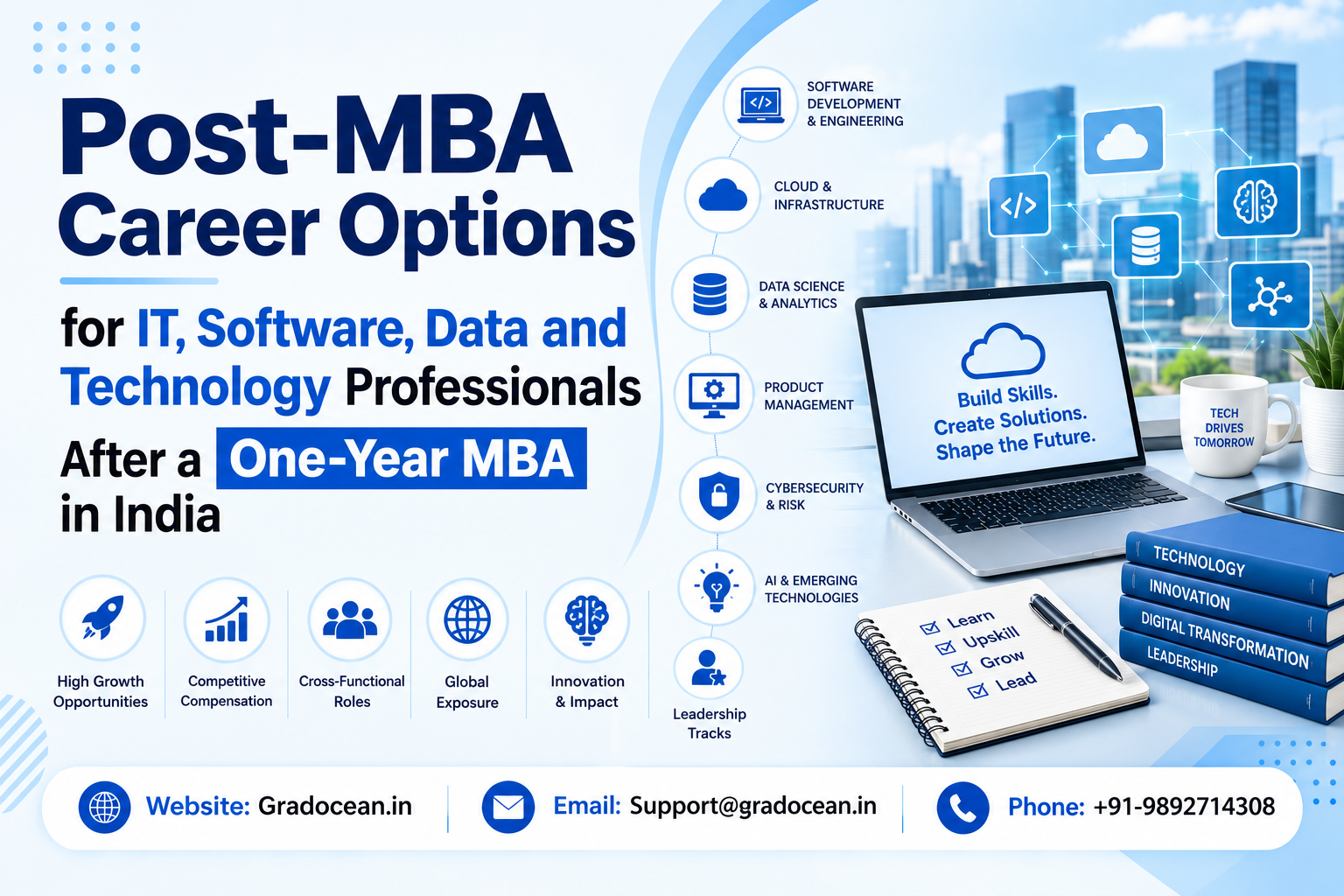
Professionals working in IT and technology often consider an MBA when they want to move beyond a specialised technical or delivery role into positions involving products, strategy, consulting, business leadership or commercial decision-making.
For someone working as a software engineer, data analyst, technology consultant, business analyst, project manager, data scientist or technical lead, a one-year MBA can provide several career options.
Programs such as the ISB PGP, IIM Ahmedabad PGPX, IIM Bangalore EPGP, IIM Calcutta MBAEx and IIM Lucknow IPMX attract professionals with significant technology experience. Technology is also an important recruiting sector across these programs.
However, an MBA does not make every career transition equally easy. A software engineer moving into technology product management has a very different starting point from the same engineer attempting to move into investment banking or FMCG brand management.
The most realistic post-MBA career options therefore depend heavily on what you were doing before the MBA.
Why Do Technology Professionals Pursue a One-Year MBA?
Technology careers can provide rapid progression during the first several years of work. A software engineer may progress from developer to senior engineer and technical lead, while someone in IT consulting may move from analyst to consultant or manager.
At some point, however, professionals may want greater involvement in decisions beyond technology implementation.
Typical questions include:
- Which products should we build?
- Which customer segments should we target?
- How should a technology product be monetised?
- Should the company build or buy a particular capability?
- How should AI be incorporated into the business?
- Which digital investments should be prioritised?
- How should a new product be taken to market?
- How can technology improve the company’s overall business model?
A one-year MBA can help bridge the gap between understanding technology and understanding the broader business decisions surrounding it.
For technology professionals, the MBA can generally facilitate three types of movement:
- Moving from a technical role into a broader technology-management role.
- Retaining technology as the industry while moving into a business function.
- Moving into a different industry and function altogether.
The first two transitions are usually easier to execute because the candidate continues to use a significant part of their previous experience.
1. Management Consulting
Management consulting is one of the most prominent post-MBA career options for technology professionals.
Consulting firms increasingly work on projects involving digital transformation, artificial intelligence, cloud adoption, technology strategy, operating-model transformation and data analytics in addition to traditional corporate strategy.
This can make professionals with technology experience relevant to consulting recruiters.
Potential employers include firms such as McKinsey, BCG, Bain, Accenture Strategy, Deloitte, EY-Parthenon, Kearney, PwC and other consulting organisations, although recruiter participation varies between schools and placement years.
Where a Technology Background Helps
Consider a technology consultant who has spent six years implementing enterprise systems for banking clients.
The candidate may already understand:
- Client management
- Business requirements
- Technology implementation
- Project management
- Process transformation
- Cross-functional coordination
- Senior stakeholder management
After an MBA, the candidate can potentially move further upstream from implementing technology solutions to advising clients on which transformations should be undertaken and how they should support broader business objectives.
Software engineers can also make the transition, particularly if they have demonstrated problem-solving, leadership and stakeholder-management experience.
How Difficult Is the Transition?
For IT consultants and business analysts, the transition difficulty is generally low to moderate.
For software developers without significant client or business exposure, it is usually moderate.
Candidates need to develop structured problem-solving, case-interview skills, financial understanding and executive communication during the MBA.
2. Product Management
Product management is one of the most natural post-MBA targets for many software and technology professionals.
A Product Manager typically sits between technology, customers and business objectives.
Depending on the company, responsibilities can include:
- Understanding customer problems
- Defining product requirements
- Prioritising features
- Working with engineering teams
- Analysing product metrics
- Developing product roadmaps
- Coordinating product launches
- Working on pricing and monetisation
- Developing go-to-market strategies
This makes prior technology experience valuable.
A software engineer already understands how products are built. The MBA can add knowledge of customers, markets, pricing, finance, strategy and marketing.
Who Has the Strongest Fit?
Candidates with backgrounds in the following areas can be particularly relevant:
- Software development
- Product engineering
- Business analysis
- Data analytics
- UX and technology
- SaaS
- Cloud products
- Fintech technology
- E-commerce
- AI and machine learning
- Technology consulting
A developer who has spent several years building customer-facing applications may therefore have a credible path into product management.
A software engineer who has worked exclusively on back-end infrastructure can also make the transition but may need to demonstrate greater customer and commercial understanding.
Potential Employers
Product roles can exist across:
- Big Tech
- SaaS
- E-commerce
- Fintech
- Consumer internet
- Enterprise technology
- AI companies
- Mobility
- Healthtech
- B2B technology companies
How Difficult Is the Transition?
For candidates with product-development or customer-facing technology experience, the transition difficulty is generally moderate.
For candidates with limited product exposure, the transition can be moderate to high.
The MBA should therefore be used to develop product strategy, customer discovery, analytics, pricing and go-to-market capabilities.
3. Corporate Strategy and Technology Strategy
Corporate strategy is another potential career option, particularly for technology professionals who have accumulated substantial experience.
Possible positions include:
- Strategy Manager
- Business Strategy Manager
- Technology Strategy Manager
- Digital Strategy Manager
- Corporate Development
- CEO’s Office
- Transformation Strategy
- Innovation Strategy
The role represents a movement from executing technology initiatives to participating in broader business decisions.
For example, a technical lead may previously have evaluated how a particular system should be designed.
After an MBA, the candidate might instead evaluate whether the company should invest in a new technology platform, enter a new digital business, develop an AI capability internally or acquire an external technology provider.
Where a Technology Background Helps
Technology knowledge is particularly useful when strategy decisions involve:
- Artificial intelligence
- Digital transformation
- Cloud
- Data
- Automation
- Cybersecurity
- Software platforms
- Technology investments
The challenge is demonstrating that you can think beyond the technical aspects of the problem.
How Difficult Is the Transition?
The transition difficulty is generally moderate.
Candidates with exposure to clients, business stakeholders, budgets and strategic decisions tend to have an advantage over those whose careers have been entirely technical.
4. Program Management and Digital Transformation
Program management is one of the more natural career options for experienced technology professionals.
Many software and IT professionals already coordinate:
- Engineering teams
- Product teams
- Clients
- Vendors
- Business stakeholders
- Technology infrastructure
- Delivery schedules
- Budgets
An MBA can help expand this experience into broader business program management.
Possible roles include:
- Program Manager
- Senior Program Manager
- Technical Program Manager
- Transformation Manager
- Digital Transformation Manager
- PMO Lead
- Program Director
These opportunities exist not only within technology companies but also in banks, retailers, manufacturers, healthcare organisations and other companies undergoing large digital transformations.
A technology professional can therefore change industries without completely changing functions.
How Difficult Is the Transition?
For experienced project managers and technology leads, the transition difficulty is relatively low.
For individual contributors without significant project ownership, it may be moderate.
5. Data, Analytics and AI Leadership
Data analysts, data scientists, business intelligence professionals and machine-learning engineers have another set of opportunities.
Instead of moving away from analytics, the MBA can help candidates move from producing analysis to deciding how analytics should be used within a business.
Potential roles include:
- Analytics Manager
- Data Strategy Manager
- AI Strategy Manager
- Analytics Consultant
- AI Product Manager
- Data Product Manager
- Business Analytics Lead
- Decision Science Manager
This distinction is important.
A data analyst might spend most of their time before the MBA building dashboards, analysing customer behaviour or developing forecasting models.
After the MBA, the role may involve deciding which business problems should be solved using data, managing analytics teams and communicating recommendations to senior management.
Potential Industries
These opportunities can exist in:
- Technology
- Consulting
- Banking
- Fintech
- Insurance
- E-commerce
- Retail
- Healthcare
- Telecom
- Consumer businesses
ISB, for example, currently identifies Analytics and Data Science as one of the areas for which organisations recruit from its PGP talent pool.
How Difficult Is the Transition?
For data analysts and data scientists moving into analytics management, the transition difficulty is relatively low.
Moving from analytics into product management or consulting is generally low to moderate.
Moving into unrelated functions such as traditional marketing or finance can be considerably more difficult.
6. General Management and Leadership
Professionals entering programs such as IIMA PGPX, IIMB EPGP, IIMC MBAEx and IIML IPMX can have substantially more work experience than the typical MBA candidate.
A technology professional entering an MBA after ten or twelve years may already have experience managing teams, clients, budgets and large programs.
The post-MBA objective may therefore not be an entry-level career switch.
Potential roles can include:
- Business Unit Manager
- General Manager
- Associate Director
- Director
- Technology Business Leader
- Digital Business Head
- Transformation Leader
- P&L roles
The candidate’s pre-MBA seniority becomes particularly important here.
A software engineer with four years of experience and an engineering manager with twelve years of experience may attend one-year MBA programs, but their post-MBA career objectives should look very different.
How Difficult Is the Transition?
For experienced managers with significant team and business responsibility, the transition difficulty is moderate.
For candidates with substantial experience but limited leadership exposure, directly targeting general-management positions can be more challenging.
7. Technology Sales and Business Development
Technology professionals with strong client-facing experience can also consider sales and business development.
This is particularly relevant for professionals from:
- Technology consulting
- Pre-sales
- Solutions engineering
- Enterprise software
- Account management
- Customer success
- Implementation consulting
Possible post-MBA positions include:
- Enterprise Sales Manager
- Business Development Manager
- Partnerships Manager
- Key Account Manager
- Go-to-Market Manager
- Solutions Sales Manager
- Commercial Strategy Manager
- Product Marketing Manager
Technical understanding can be an advantage in B2B technology sales because enterprise customers often require solutions to complex technology and business problems.
The MBA adds capabilities in pricing, negotiation, market segmentation, sales strategy and commercial decision-making.
How Difficult Is the Transition?
For professionals who already interact with clients, the transition difficulty is generally low to moderate.
For developers with little commercial or customer exposure, the transition can be more difficult.
8. Fintech and Digital Financial Services
Fintech can be particularly attractive for professionals combining technology and analytics backgrounds with an interest in financial services.
Banks and financial institutions are also increasingly technology-driven businesses.
Potential roles include:
- Fintech Product Manager
- Digital Transformation Manager
- Payments Product Manager
- Analytics Manager
- Digital Banking Strategy
- Technology Strategy
- Program Management
- Business Development
A software developer who has spent several years building payment systems for a banking client, for example, already possesses domain knowledge that can become valuable after an MBA.
Similarly, data professionals with experience in credit analytics, fraud detection, customer analytics or risk models can potentially move into broader fintech or financial-services management roles.
How Difficult Is the Transition?
For candidates with banking, payments or financial-technology exposure, the transition difficulty is generally low to moderate.
Moving from an unrelated software background into highly specialised finance roles such as investment banking or private equity is significantly more difficult.
Can You Completely Move Away From Technology?
Yes, but candidates need to understand the difference between a career transition and a double pivot.
Moving from software development into technology product management changes the function but continues to use technology knowledge. This is generally a moderate transition.
Moving from technology consulting into management consulting is also relatively logical because consulting skills, client exposure and problem-solving experience remain relevant.
Moving from data analytics into fintech analytics changes the industry while retaining much of the candidate’s functional expertise. This can be relatively straightforward.
Moving from software engineering into FMCG brand management changes both function and industry. The candidate is competing against people with more directly relevant marketing and consumer experience.
That does not make the transition impossible, but it makes it considerably more difficult.
The MBA provides access to recruiters. It does not make previous experience irrelevant.
Which One-Year MBA Programs Can Technology Professionals Consider?
ISB PGP
ISB can be particularly relevant for technology professionals with approximately four to seven years of experience who want to transition into consulting, product management, technology, strategy, analytics, fintech or general-management roles.
Technology and consulting consistently represent important recruiting areas at ISB.
The program can also support significant career transitions. Recent placement outcomes show that a substantial proportion of students change either their industry, function or both after the PGP.
IIM Ahmedabad PGPX
IIMA PGPX can be particularly relevant for more experienced technology professionals seeking consulting, product, strategy, general-management and leadership positions.
Candidates entering with substantial experience should think beyond simply changing job titles and evaluate whether the MBA can help them move from technical or delivery leadership into broader business responsibility.
IIM Bangalore EPGP
IIMB EPGP can be attractive for experienced technology professionals given the program’s exposure to consulting and technology recruiting.
Its Bengaluru location also places students within one of India’s largest technology, SaaS, startup and digital-business ecosystems.
IIM Calcutta MBAEx
IIMC MBAEx has historically seen significant recruiting from IT and consulting companies.
This can make it relevant for technology professionals targeting IT leadership, consulting, digital transformation, analytics and broader management positions.
IIM Lucknow IPMX
IIM Lucknow IPMX is another option for experienced technology professionals seeking mid-to-senior management transitions.
Candidates should evaluate the program based on recent recruiter participation and the types of roles available for their experience level rather than relying only on average placement numbers.
Choosing Your Post-MBA Career Based on Your Current Role
Your pre-MBA function is one of the strongest indicators of which transitions may be realistic.
| Pre-MBA Background | Strong Post-MBA Options |
|---|---|
| Software Developer/Engineer | Product Management, Consulting, Program Management, Technology Strategy |
| Data Analyst/Data Scientist | Analytics Leadership, AI/Data Product Management, Consulting, Fintech |
| IT/Technology Consultant | Management Consulting, Strategy, Digital Transformation, Product Management |
| Business Analyst | Product Management, Consulting, Strategy, Transformation |
| IT Project Manager | Program Management, Transformation, Consulting, Operations |
| Engineering/Technical Lead | Product, Program Management, General Management, Consulting |
| Pre-Sales/Solutions Consultant | Technology Sales, Business Development, Partnerships, Product Marketing |
| Product Engineer | Product Management, Program Management, Strategy |
| Cloud/Infrastructure Professional | Technology Strategy, Program Management, Digital Transformation |
| AI/ML Professional | AI Product Management, AI Strategy, Analytics Leadership, Consulting |
This framework also helps candidates create a more credible MBA career narrative.
A software engineer could use the MBA to move into product management and eventually product leadership.
A data analyst could move into analytics management before progressing into broader data strategy.
A technology consultant could transition into management consulting or digital strategy before eventually taking on corporate strategy or transformation leadership.
The MBA becomes a bridge between the candidate’s existing expertise and broader business responsibility rather than an attempt to erase the previous career.
How Technology Professionals Should Position Their Experience
One of the most common mistakes technology professionals make in MBA applications and recruitment is describing their achievements almost entirely through technical terminology.
Recruiters outside engineering may not care which programming language, framework or database was used unless it is directly relevant to the position.
They care about what changed because of your work.
Candidates should therefore focus on outcomes such as:
- Revenue generated
- Costs reduced
- Customers affected
- Processing time reduced
- Productivity improved
- System reliability improved
- Customer satisfaction increased
- Projects delivered
- Team size managed
- Client relationships handled
- Business processes transformed
Instead of focusing primarily on developing a particular software architecture, explain how the solution improved customer experience, reduced costs or enabled the company to launch a product faster.
Similarly, a data analyst should not focus only on the complexity of the model developed. The more important question is what business decision the analysis influenced.
This shift in communication becomes particularly important when targeting consulting, strategy, product and general-management roles.
Skills to Build During the MBA
Technology professionals generally enter an MBA with strong analytical and problem-solving capabilities. Their biggest development areas are often commercial rather than technical.
For consulting, candidates should develop case-interview skills, structured problem-solving, financial analysis and executive communication.
For product management, important capabilities include customer discovery, product metrics, pricing, product strategy and go-to-market planning.
For corporate and technology strategy, candidates should strengthen financial modelling, market analysis, competitive strategy and corporate finance.
For analytics and AI leadership, candidates need to become better at translating technical insights into commercial decisions rather than simply adding more technical skills.
For general management, finance, marketing, organisational behaviour, leadership and P&L understanding become particularly important.
Technology professionals should also use live projects, consulting engagements, competitions, alumni interactions and industry projects during the MBA to demonstrate their interest in the target function.
The MBA Should Build on Your Technology Experience
A professional who enters business school after five, eight or twelve years in software, data, analytics or technology consulting already possesses valuable expertise.
The objective of the MBA does not have to be leaving technology behind.
For one candidate, the right transition may be from software engineering into product management. For another, it may be technology consulting into management consulting. A data scientist may move into analytics leadership, while an experienced engineering manager may target general management or technology strategy.
All can represent meaningful MBA outcomes.
The strongest career strategy usually lies at the intersection of three factors: your existing experience, the new capabilities developed during the MBA, and realistic recruiter demand.
A one-year MBA can significantly broaden the career options available to technology professionals. However, the best outcomes usually come from identifying where your technical experience gives you an advantage and then using the MBA to add the business capabilities required for the next stage of your career.
Rather than asking only what jobs become available after an MBA, a more useful question is which roles allow you to combine your technology experience with broader business responsibility.
For many IT, software, data and technology professionals, that is where the strongest post-MBA opportunities lie.
Other Articles of Interest:
1. ISB vs International MBA: How to Choose the Right Path for Your Career
2. Indian MBA Programs Are Rising Fast in Global Rankings — Here’s Why It Matters
3. Top Executive MBA Programs in India
4.GMAT Waiver for MBA: A Complete Guide to Test-Optional Business Schools
5.Top Global One-Year MBA Programs for Experienced Professionals: A Comprehensive Guide
6.Best MBA Programs for Healthcare: Top Schools, Curriculum & Career Scope (2026 Guide)
7. Best MBA Programs for Sustainability & ESG: Top Schools, Curriculum & Career Scope (2026 Guide)
8. ISB vs IIM One-Year MBA (2026): Fees, Placements, Rankings, ROI & Which is Better?
9. MBA ROI vs Rankings: How to Choose the Right MBA Program in 2026
11. HEC Paris MBA Essays 2027 Intake: A Complete Guide to Writing Winning Essays
16.MBA University of Virginia Darden MBA Admissions Guide (2026–2027 Intake)
18. MBA Letters of Recommendation (LOR): Complete Guide for Applicants
19.2026 IIM Ahmedabad PGPX Extempore Topics: Latest Questions & Preparation Guide
20. 18 Key Insights About ISB PGP Admissions
21.ISB PGP R1: What to Focus on Before You Submit Your Application
22. IIM Indore EPGP 2027–28: Admissions, Eligibility, Placements, Fees, Programme & Application Guide
24. IIM Lucknow IPMX 2027–28: Admissions, Eligibility, Placements, Batch Profile & Application Guide
25. Post-MBA Career Options for Fashion Professionals After a One-Year MBA in India
26. Post-MBA Career Options for Lawyers After a One-Year MBA in India
28. Post-MBA Career Options for PSU Professionals After a One-Year MBA in India