

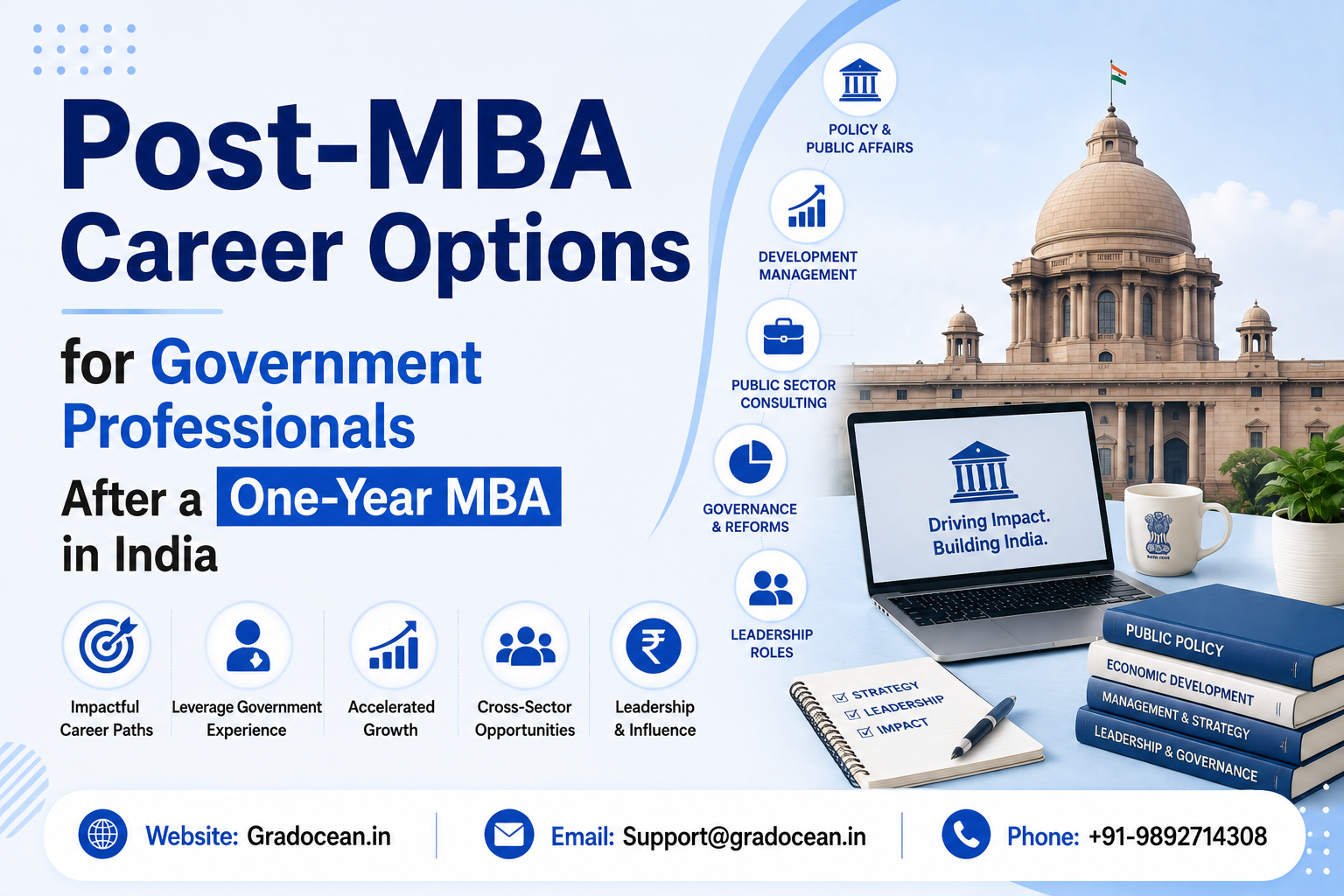
For someone working with the Government of India, a state government, DRDO, the Income Tax Department, GST, Railways or another public-sector organisation, pursuing an MBA can be a much bigger decision than it is for someone already working in the corporate world.
A government career offers stability, a defined progression path and, in many cases, significant responsibility. Walking away from that to spend a year on an MBA naturally raises an important question: what can I realistically do after the program?
The answer depends heavily on what you have done before the MBA.
Government professionals often bring experience that is more relevant to the corporate world than they initially realise. They may have managed large teams, worked on complex projects, handled taxation or financial investigations, dealt with regulations, managed vendors, implemented technology systems or coordinated across multiple government bodies.
What may be missing is exposure to areas such as corporate finance, business strategy, marketing, commercial decision-making and P&L management.
A one-year MBA from programs such as ISB PGP, IIMA PGPX, IIMB EPGP, IIM Calcutta MBAEx or IIM Lucknow IPMX can help fill these gaps and make a transition into the private sector more realistic.
The important part is choosing a career path that makes sensible use of your previous experience.
Why Do Government Professionals Consider an MBA?
The motivation is different for every candidate.
Some professionals want faster career progression or greater flexibility in choosing their roles. Others want to move from technical or administrative responsibilities into management. Some may want to move from regulation and policy into consulting or corporate strategy.
A DRDO scientist or engineer, for example, may have spent several years working on sophisticated technology programs but have limited exposure to their commercial side.
An Income Tax or GST professional may understand taxation, financial statements, investigations and regulation extremely well but may want to move closer to business strategy, financial advisory or consulting.
A government engineer or railway professional may already have experience managing large projects, contractors, procurement and operations but want to move into infrastructure, operations or general management.
An MBA can help add the commercial perspective that is often missing from these profiles.
The strongest career transitions usually build on previous experience rather than attempting to completely replace it.
1. Management and Strategy Consulting
Consulting can be one of the more attractive career options for government professionals looking to move into the corporate world.
Many government roles already involve solving complicated problems, coordinating multiple stakeholders and working within financial, regulatory or operational constraints. These skills can translate well into consulting.
Potential opportunities include management consulting, strategy consulting, public-sector consulting, government advisory, infrastructure consulting, risk consulting and business transformation.
Government professionals can be particularly relevant to consulting projects involving public infrastructure, taxation, regulation, defence, transportation, financial systems and government transformation.
Someone who has worked within government also understands how government organisations actually function. That can be useful when consulting firms advise ministries, public-sector enterprises, regulators and companies that work extensively with government.
However, consulting recruitment is competitive. Government experience alone will not be enough.
Candidates need to develop structured problem-solving, commercial thinking, financial analysis and case-interview skills during the MBA.
2. Corporate Strategy and General Management
Corporate strategy is another option worth exploring, particularly for experienced government professionals who have already managed projects, teams or large programs.
Potential roles include corporate strategy, strategic initiatives, business transformation, CEO or MD office positions, business operations and general management.
Government professionals sometimes underestimate how much management experience they already have because their responsibilities are described differently from those in the private sector.
Someone who has managed a large government program may already have experience dealing with budgets, teams, external agencies, vendors and senior stakeholders.
The MBA helps add another layer to this experience.
Candidates learn to think about revenue, profitability, competition, customers, market share and return on investment. These are areas that may not have been central to their previous government roles but become important when moving into corporate management.
The challenge is communicating previous experience in a way that recruiters can easily understand.
3. Public-Sector Consulting and Government Advisory
Not every government professional needs to make a complete break from the public sector after an MBA.
For some candidates, one of the most natural transitions lies between government and business.
Consulting firms, technology companies, infrastructure businesses and professional-services firms regularly work with central and state governments on projects involving digital transformation, taxation, infrastructure, healthcare, urban development, transportation and public administration.
A professional who has already spent several years inside government can bring valuable knowledge of how policies and programs actually get implemented.
Potential opportunities can include government advisory, public-sector consulting, regulatory strategy, infrastructure advisory, public policy and government technology.
This route can be particularly relevant for professionals who enjoy working on public-sector problems but want greater exposure to strategy, technology and commercial decision-making.
4. Risk, Tax, Regulatory and Financial Advisory
For professionals from the Income Tax Department, GST, government audit functions and other financial or regulatory organisations, this can be one of the more natural post-MBA pathways.
These professionals may already understand taxation, compliance, investigations, financial statements, regulatory frameworks and how businesses interact with government.
Potential roles can include tax advisory, risk consulting, regulatory advisory, forensic consulting, governance, compliance, enterprise risk and financial advisory.
The MBA can help candidates build a broader understanding of corporate finance, accounting, strategy and business operations.
Positioning is especially important here.
An Income Tax professional should not present their experience only in terms of assessments, enforcement or departmental responsibilities. They should also explain the financial analysis, business understanding, investigation, stakeholder management and decision-making involved in their work.
Similarly, a GST professional may have developed a strong understanding of indirect taxation, supply chains, compliance and business transactions.
These capabilities can have value outside government when presented correctly.
5. Operations, Infrastructure and Program Management
Professionals from Railways, defence, engineering services, infrastructure departments and large public-sector organisations can have strong experience in operations and project execution.
They may have managed vendors, contractors, procurement, large teams, engineering programs or projects spread across multiple locations.
Potential career options include operations management, program management, infrastructure consulting, project management, supply-chain strategy and business transformation.
For many such professionals, staying reasonably close to their previous industry can make the transition easier.
A railway professional, for example, may find it easier to build a case for infrastructure, transportation, logistics or operations roles than for an unrelated marketing position.
Similarly, someone who has managed large government infrastructure projects can potentially bring useful experience to infrastructure companies, consulting firms and project-management organisations.
The MBA can help shift the candidate from primarily executing projects to understanding the financial and strategic decisions behind them.
6. Defence, Aerospace and Technology Management
Professionals from DRDO and other technical government organisations have another set of possibilities.
Their technical experience does not necessarily need to be left behind after an MBA.
Instead, the MBA can help them move from technical execution towards technology strategy, management and commercialization.
Potential opportunities can include technology strategy, technical program management, product management, aerospace and defence strategy, operations, business development and technology consulting.
India’s expanding defence and aerospace ecosystem can also create opportunities with private manufacturers, technology companies, consulting firms and startups.
A professional who understands complex technology programs, government procurement and the defence ecosystem can bring knowledge that is difficult to acquire through an MBA alone.
The challenge is adding the commercial side: understanding customers, markets, costs, profitability and business strategy.
Professionals from sensitive organisations also need to remain mindful of confidentiality requirements and any post-employment restrictions associated with their previous roles.
7. Product Management and Digital Transformation
Product management is another possible pathway, particularly for government professionals who have worked closely with technology.
Government departments today operate large digital systems covering areas such as taxation, payments, infrastructure, public services and data management.
Professionals involved in implementing these platforms may already have experience gathering requirements, coordinating with technology teams, managing implementation and working with different stakeholders.
The job title may not say product manager, but some of the underlying experience can still be relevant.
The MBA can help add knowledge of customer needs, product economics, analytics, market strategy and commercialization.
This transition is likely to be easier for someone with meaningful technology or digital-project exposure before the MBA.
For someone coming from a purely administrative role without any technology exposure, moving directly into product management can be considerably more challenging.
Which Career Options Fit Different Government Backgrounds?
| Background | Potential Post-MBA Career Options |
|---|---|
| DRDO and Defence Technical Roles | Defence and aerospace, technology strategy, program management, operations, consulting, product management |
| Income Tax Department | Consulting, tax and financial advisory, risk, regulatory strategy, financial services, corporate strategy |
| GST and Indirect Tax Roles | Tax consulting, regulatory advisory, risk, supply-chain consulting, financial advisory |
| Railways and Infrastructure | Infrastructure consulting, operations, logistics, project management, corporate strategy |
| Government Audit and Finance | Risk consulting, financial advisory, governance, compliance, consulting, corporate finance |
| Ministries and Government Departments | Public-sector consulting, government advisory, strategy, program management, general management |
| Defence and Security Services | Operations, consulting, risk, program management, general management |
| Government Technical Organisations | Technology consulting, operations, product management, industrial strategy, program management |
These are not fixed career paths. The actual possibilities depend on the candidate’s experience, seniority, skills and the kind of work they have handled before the MBA.
Do Government Professionals Join Top One-Year MBA Programs?
Yes.
Government, defence and public-sector professionals have been represented across experienced-professional MBA programs in India.
IIMA PGPX cohorts, for example, have included professionals with backgrounds across central and state government organisations, government audit, Railways, policy organisations, defence services, security organisations and PSUs.
Previous cohorts have included professionals from organisations such as the Ministry of Home Affairs, NITI Aayog, Comptroller and Auditor General of India, Ministry of Railways, Indian Army, Indian Navy and CRPF.
The presence of these profiles is important because it shows that one-year MBA programs are not limited to candidates coming from consulting, technology, banking or other conventional corporate backgrounds.
Government professionals can bring a different kind of experience to the classroom.
They may have managed large public programs, worked in difficult operating environments, handled public funds, dealt with complex regulations or managed stakeholders across multiple institutions.
For admissions as well as recruitment, however, the designation itself matters less than what the person has actually accomplished.
The Biggest Challenge Is Translating Government Experience
This is one of the most important parts of the transition.
A corporate recruiter may not understand the significance of a particular government designation, grade or departmental hierarchy.
Simply listing your title and responsibilities therefore may not communicate the actual scale of your experience.
Government professionals need to translate their work into terms that corporate recruiters understand.
If you managed people, mention the size of the team.
If you handled a major program, explain its scale and budget where disclosure rules permit.
If you worked with contractors or vendors, explain the size and complexity of those relationships.
If you investigated financial irregularities, explain the scale of the financial exposure without disclosing confidential information.
If you implemented a technology platform or changed a process, explain how it improved efficiency, compliance or turnaround time.
This is especially important for candidates from defence and sensitive government organisations. Confidential information should never be disclosed, but leadership, scale, complexity and impact can still be communicated.
Can You Make a Complete Career Switch?
A one-year MBA can help government professionals make significant career changes, but not every transition will be equally easy.
The number of things you are trying to change matters.
An Income Tax professional moving into tax or risk consulting has a clear connection between previous experience and the target role.
A DRDO engineer moving into aerospace strategy or technical program management can also build on existing expertise.
A railway professional moving into infrastructure consulting or operations has a similarly understandable story.
Moving into a completely unrelated industry and function is harder.
For example, someone with a taxation background trying to move directly into consumer marketing would need to demonstrate why they are suited to the new function despite having little previous exposure to it.
The MBA can help, but employers will still look at what you did before the program.
For experienced professionals, previous experience can actually become more important because recruiters may be hiring for middle-management rather than entry-level positions.
How Can ISB PGP and the IIM One-Year MBAs Help?
Programs such as ISB PGP, IIMA PGPX, IIMB EPGP, IIM Calcutta MBAEx and IIM Lucknow IPMX can provide government professionals with the business knowledge, peer network and recruiting access needed to make a transition.
ISB PGP can be particularly relevant for candidates looking to make a substantial industry or functional change because of the breadth of industries and functions represented in its recruitment ecosystem.
IIMA PGPX, IIMB EPGP, IIM Calcutta MBAEx and IIM Lucknow IPMX cater to more experienced professionals and can be attractive for government candidates who already have significant leadership or specialist experience.
IIMA’s admissions framework also specifically recognises Central and State government employees among the categories eligible for certain entry scholarships, subject to the institute’s financial-aid criteria.
For experienced government professionals, the key advantage of these programs is that they do not necessarily have to enter the corporate world as fresh graduates.
Their previous experience can continue to influence the kind of roles and level of responsibility they target after the MBA.
At the same time, the school brand alone cannot guarantee a successful transition. The candidate still needs a realistic career target and a clear explanation of how previous government experience connects with that target.
What Should You Do During the MBA?
One-year MBA programs move quickly, so career planning ideally needs to begin before the program starts.
Government professionals should enter with one primary career target and perhaps one realistic alternative.
Someone from Income Tax might prioritise consulting or financial advisory. A DRDO professional might focus on technology strategy, defence, operations or program management.
The next priority should be closing the obvious skill gaps.
Government professionals may need to strengthen their understanding of corporate finance, accounting, profitability, marketing, competitive strategy and commercial decision-making.
They should also look for opportunities during the MBA to gain corporate exposure through live projects, case competitions, consulting assignments and industry projects.
This can be especially useful when the candidate is attempting a larger career change.
Finally, alumni can be valuable in understanding how similar professionals have made the transition. Speaking with people who have moved from government, defence or PSU careers into corporate roles can provide much more practical insight than relying only on placement statistics.
How Should You Explain Why MBA?
Government professionals should be careful about presenting the MBA simply as a way to leave a government job.
A stronger explanation focuses on what the candidate has learned from their existing career and what they now want to do with that experience.
A DRDO professional, for example, may have developed deep technical and project-management experience but now want to understand the strategic and commercial side of technology.
An Income Tax professional may have spent years understanding businesses from a regulatory and taxation perspective and now want to move closer to financial or business strategy.
A government infrastructure professional may have managed large projects but want to take on broader commercial and leadership responsibilities.
In each case, the MBA becomes the next stage of the career rather than an attempt to erase everything that came before it.
That distinction can also make the career story much more convincing to both admissions committees and recruiters.
Final Thoughts
For professionals from the Government of India, DRDO, Income Tax Department, GST, Railways, defence organisations and other government bodies, a one-year MBA can open up a much broader set of career possibilities.
But the strongest post-MBA opportunities will usually be the ones that make some use of the experience you already have.
Income Tax and GST professionals can potentially explore consulting, tax and financial advisory, risk, regulatory strategy and corporate roles.
DRDO and other technical professionals can consider defence, aerospace, technology strategy, program management, operations and product roles.
Railway and infrastructure professionals may find opportunities across infrastructure consulting, logistics, operations and corporate strategy.
Professionals from ministries and other government departments can explore public-sector consulting, government advisory, corporate strategy, program management and general management.
The biggest challenge is often not whether government experience has value in the corporate world. It is whether you can explain that value in a language that recruiters understand.
A one-year MBA can provide the business knowledge, network and recruiting platform required to make the transition.
But it works best when it builds on your previous experience rather than treating your government career as something that needs to be left behind.
For someone considering ISB PGP, IIMA PGPX, IIMB EPGP, IIM Calcutta MBAEx, IIM Lucknow IPMX or a similar one-year MBA, the key question should therefore be simple:
Which career path allows me to combine what I already know with what the MBA will help me learn?
Other Articles of Interest:
1. ISB vs International MBA: How to Choose the Right Path for Your Career
2. Indian MBA Programs Are Rising Fast in Global Rankings — Here’s Why It Matters
3. Top Executive MBA Programs in India
4.GMAT Waiver for MBA: A Complete Guide to Test-Optional Business Schools
5.Top Global One-Year MBA Programs for Experienced Professionals: A Comprehensive Guide
6.Best MBA Programs for Healthcare: Top Schools, Curriculum & Career Scope (2026 Guide)
7. Best MBA Programs for Sustainability & ESG: Top Schools, Curriculum & Career Scope (2026 Guide)
8. ISB vs IIM One-Year MBA (2026): Fees, Placements, Rankings, ROI & Which is Better?
9. MBA ROI vs Rankings: How to Choose the Right MBA Program in 2026
11. HEC Paris MBA Essays 2027 Intake: A Complete Guide to Writing Winning Essays
16.MBA University of Virginia Darden MBA Admissions Guide (2026–2027 Intake)
18. MBA Letters of Recommendation (LOR): Complete Guide for Applicants
19.2026 IIM Ahmedabad PGPX Extempore Topics: Latest Questions & Preparation Guide
20. 18 Key Insights About ISB PGP Admissions
21.ISB PGP R1: What to Focus on Before You Submit Your Application
22. IIM Indore EPGP 2027–28: Admissions, Eligibility, Placements, Fees, Programme & Application Guide
24. IIM Lucknow IPMX 2027–28: Admissions, Eligibility, Placements, Batch Profile & Application Guide
25. Post-MBA Career Options for Fashion Professionals After a One-Year MBA in India
26. Post-MBA Career Options for Lawyers After a One-Year MBA in India