


The Indian Institute of Management Ahmedabad (IIMA) has released the audited placement report for the 20th batch of its Post Graduate Programme in Management for Executives (PGPX). Widely regarded as one of India’s premier one-year MBA programs, the PGPX attracts experienced professionals seeking career acceleration, industry transitions, and leadership roles.
The 2026 placement report provides far more than salary figures—it offers valuable insights into recruiter preferences, hiring trends, career outcomes, and the evolving positioning of the program in India’s executive MBA landscape.
In this article, we analyze the audited placement report in detail, examine the major trends shaping placements, compare outcomes with the previous year, and discuss what these numbers mean for prospective applicants.
IIMA PGPX Placements 2026: Key Highlights
Before diving deeper into the data, here are the most important takeaways from this year’s placement report.
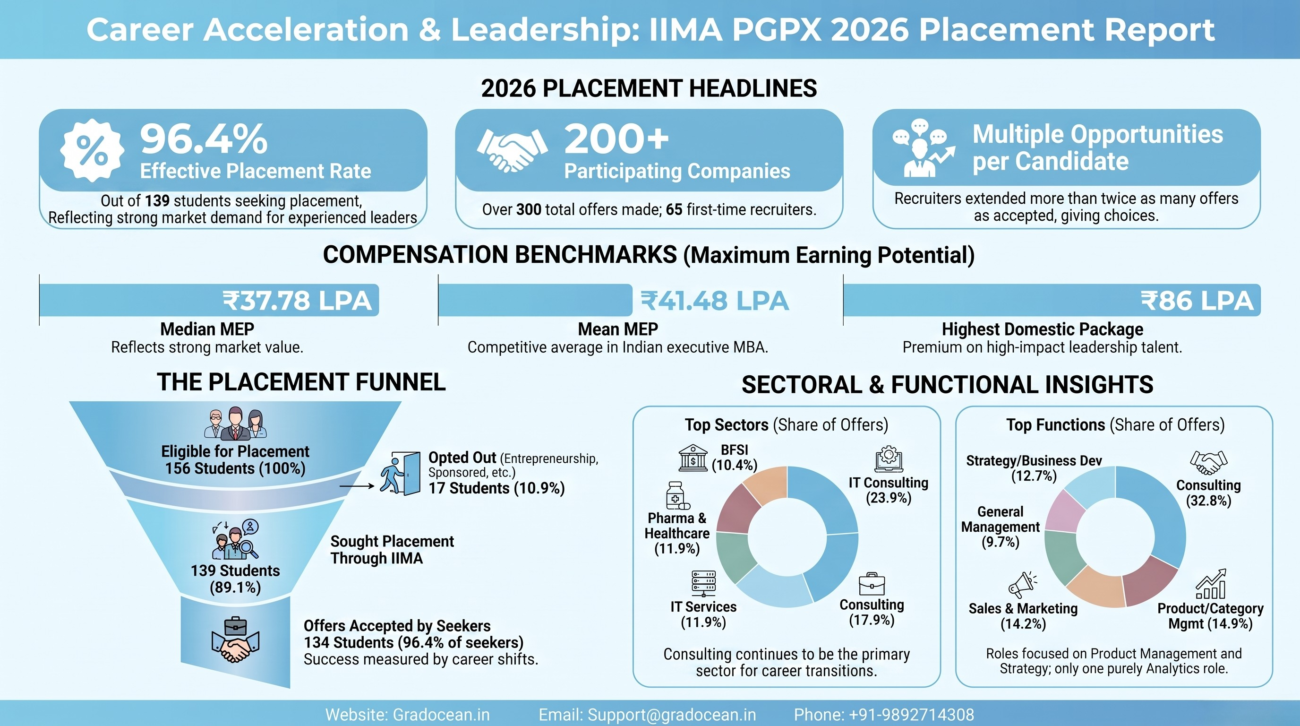
| Metric | 2026 |
|---|---|
| Batch Eligible for Placements | 156 |
| Students Participating in Placements | 139 |
| Offers Accepted | 134 |
| Effective Placement Rate | 96.4% |
| Companies Participated | 200+ |
| First-Time Recruiters | 65 |
| Total Offers Made | 300+ |
| Median Maximum Earning Potential (MEP) | ₹37.78 LPA |
| Mean Maximum Earning Potential | ₹41.48 LPA |
| Highest Domestic MEP | ₹86 LPA |
| International Offers | 2 |
The headline numbers indicate another successful placement season for IIMA PGPX. However, the real value lies beneath these statistics. The report highlights a clear shift toward consulting roles, improving compensation levels, and increasing recruiter participation despite a slightly lower placement rate compared to the previous year.
Understanding the Placement Numbers
Unlike two-year MBA programs where nearly every student participates in campus placements, executive MBA programs attract professionals with diverse career objectives.
Many participants already hold senior leadership positions, receive company sponsorships, manage family businesses, or pursue entrepreneurial ventures immediately after graduation. Consequently, evaluating the success of an executive MBA solely through the number of placement offers can be misleading.
The more relevant metric is the placement success among candidates who actively sought institute-supported placements.
IIMA PGPX 2026 Placement Funnel
| Stage | Number | Percentage |
| Eligible for Placement | 156 | 100% |
| Opted Out of Institute Placements | 17 | 10.9% |
| • Company Sponsored / Already Employed | 8 | 5.1% |
| • Entrepreneurship | 1 | 0.6% |
| • Family Business | 1 | 0.6% |
| • Self-Placed Outside Campus | 7 | 4.5% |
| Sought Placement Through IIMA | 139 | 89.1% |
| Offers Accepted | 134 | 85.9% of Eligible |
| Unplaced | 5 | 3.2% |
Among the 156 eligible participants, only 139 actively participated in the institute-led placement process. Out of these, 134 accepted offers, resulting in an effective placement rate of 96.4%.
This figure provides a much more meaningful assessment of placement outcomes than simply comparing offers accepted against the total batch size.
Why the Placement Rate Should Be Interpreted Differently
One of the most common misconceptions among MBA applicants is comparing executive MBA placement statistics with those of traditional two-year MBA programs.
That comparison is fundamentally flawed.
Participants in the IIMA PGPX typically possess between four and twenty-two years of work experience. Many already occupy managerial or leadership roles and often receive attractive opportunities through their professional networks.
Some candidates deliberately opt out of campus placements because they:
- Return to sponsoring organizations
- Join family businesses
- Launch entrepreneurial ventures
- Accept external offers independently
Therefore, the objective of the placement process is not necessarily to place every student but to provide career opportunities for those who actively seek them.
Viewed from this perspective, a 96.4% placement rate reflects a highly effective placement process.
Recruiter Participation Continues to Expand
One of the strongest indicators of the program’s market reputation is recruiter engagement.
The 2026 placement season witnessed:
- More than 200 participating companies
- 65 first-time recruiters
- Over 300 offers made to candidates
This is particularly significant because only 134 offers were ultimately accepted.
In other words, recruiters extended more than twice as many offers as were eventually accepted, suggesting that many candidates received multiple opportunities before making their final decision.
For experienced professionals, this is a positive signal.
Rather than accepting the first available role, many candidates were able to evaluate competing offers based on factors such as leadership responsibilities, industry preference, compensation, geography, and long-term career alignment.
This competitive recruiting environment reflects both strong employer confidence in the PGPX talent pool and increased bargaining power for candidates.
What the Placement Funnel Really Tells Applicants
Several important insights emerge from this year’s placement data.
First, recruiter demand remains exceptionally strong. More than 200 organizations participated despite ongoing uncertainty across several global industries.
Second, multiple offers continue to be common for experienced professionals, indicating healthy competition among recruiters.
Third, institute-led placements represent only one avenue through which PGPX participants achieve their career goals. A meaningful proportion of students successfully leverage their prior networks, employer sponsorships, or entrepreneurial ambitions.
Finally, applicants should evaluate the PGPX placement report through the lens of career transformation rather than merely employment statistics.
For most participants, success is measured by moving into higher-impact leadership roles, transitioning into consulting or strategy, or accelerating long-term career progression—not simply securing a job offer.
Initial Observations from the 2026 Placement Report
While salary figures often dominate discussions around MBA placements, the broader placement trends reveal a much more interesting story.
The 2026 report suggests three important developments:
- Consulting continues to strengthen its position as the dominant post-MBA career destination.
- Recruiter participation has expanded significantly, with more than 200 companies visiting campus.
- Compensation has improved across almost every major metric compared to the previous year.
The Indian Institute of Management Ahmedabad (IIMA) has released the audited placement report for the 20th batch of its Post Graduate Programme in Management for Executives (PGPX). Widely regarded as one of India’s premier one-year MBA programs, the PGPX attracts experienced professionals seeking career acceleration, industry transitions, and leadership roles.
The 2026 placement report provides far more than salary figures—it offers valuable insights into recruiter preferences, hiring trends, career outcomes, and the evolving positioning of the program in India’s executive MBA landscape.
In this article, we analyze the audited placement report in detail, examine the major trends shaping placements, compare outcomes with the previous year, and discuss what these numbers mean for prospective applicants.
Source: IIMA PGPX Placement Report 2026, independently audited by B2K Analytics Pvt. Ltd. under Indian Placement Reporting Standards (IPRS) Revision 2.2 (Report dated July 16, 2026).
IIMA PGPX Placements 2026: Key Highlights
Before diving deeper into the data, here are the most important takeaways from this year’s placement report.
| Metric | 2026 |
|---|---|
| Batch Eligible for Placements | 156 |
| Students Participating in Placements | 139 |
| Offers Accepted | 134 |
| Effective Placement Rate | 96.4% |
| Companies Participated | 200+ |
| First-Time Recruiters | 65 |
| Total Offers Made | 300+ |
| Median Maximum Earning Potential (MEP) | ₹37.78 LPA |
| Mean Maximum Earning Potential | ₹41.48 LPA |
| Highest Domestic MEP | ₹86 LPA |
| International Offers | 2 |
The headline numbers indicate another successful placement season for IIMA PGPX. However, the real value lies beneath these statistics. The report highlights a clear shift toward consulting roles, improving compensation levels, and increasing recruiter participation despite a slightly lower placement rate compared to the previous year.
Understanding the Placement Numbers
Unlike two-year MBA programs where nearly every student participates in campus placements, executive MBA programs attract professionals with diverse career objectives.
Many participants already hold senior leadership positions, receive company sponsorships, manage family businesses, or pursue entrepreneurial ventures immediately after graduation. Consequently, evaluating the success of an executive MBA solely through the number of placement offers can be misleading.
The more relevant metric is the placement success among candidates who actively sought institute-supported placements.
IIMA PGPX 2026 Placement Funnel
| Stage | Number | Percentage |
| Eligible for Placement | 156 | 100% |
| Opted Out of Institute Placements | 17 | 10.9% |
| • Company Sponsored / Already Employed | 8 | 5.1% |
| • Entrepreneurship | 1 | 0.6% |
| • Family Business | 1 | 0.6% |
| • Self-Placed Outside Campus | 7 | 4.5% |
| Sought Placement Through IIMA | 139 | 89.1% |
| Offers Accepted | 134 | 85.9% of Eligible |
| Unplaced | 5 | 3.2% |
Among the 156 eligible participants, only 139 actively participated in the institute-led placement process. Out of these, 134 accepted offers, resulting in an effective placement rate of 96.4%.
This figure provides a much more meaningful assessment of placement outcomes than simply comparing offers accepted against the total batch size.
Why the Placement Rate Should Be Interpreted Differently
One of the most common misconceptions among MBA applicants is comparing executive MBA placement statistics with those of traditional two-year MBA programs.
That comparison is fundamentally flawed.
Participants in the IIMA PGPX typically possess between four and twenty-two years of work experience. Many already occupy managerial or leadership roles and often receive attractive opportunities through their professional networks.
Some candidates deliberately opt out of campus placements because they:
- Return to sponsoring organizations
- Join family businesses
- Launch entrepreneurial ventures
- Accept external offers independently
Therefore, the objective of the placement process is not necessarily to place every student but to provide career opportunities for those who actively seek them.
Viewed from this perspective, a 96.4% placement rate reflects a highly effective placement process.
Recruiter Participation Continues to Expand
One of the strongest indicators of the program’s market reputation is recruiter engagement.
The 2026 placement season witnessed:
- More than 200 participating companies
- 65 first-time recruiters
- Over 300 offers made to candidates
This is particularly significant because only 134 offers were ultimately accepted.
In other words, recruiters extended more than twice as many offers as were eventually accepted, suggesting that many candidates received multiple opportunities before making their final decision.
For experienced professionals, this is a positive signal.
Rather than accepting the first available role, many candidates were able to evaluate competing offers based on factors such as leadership responsibilities, industry preference, compensation, geography, and long-term career alignment.
This competitive recruiting environment reflects both strong employer confidence in the PGPX talent pool and increased bargaining power for candidates.
What the Placement Funnel Really Tells Applicants
Several important insights emerge from this year’s placement data.
First, recruiter demand remains exceptionally strong. More than 200 organizations participated despite ongoing uncertainty across several global industries.
Second, multiple offers continue to be common for experienced professionals, indicating healthy competition among recruiters.
Third, institute-led placements represent only one avenue through which PGPX participants achieve their career goals. A meaningful proportion of students successfully leverage their prior networks, employer sponsorships, or entrepreneurial ambitions.
Finally, applicants should evaluate the PGPX placement report through the lens of career transformation rather than merely employment statistics.
For most participants, success is measured by moving into higher-impact leadership roles, transitioning into consulting or strategy, or accelerating long-term career progression—not simply securing a job offer.
Initial Observations from the 2026 Placement Report
While salary figures often dominate discussions around MBA placements, the broader placement trends reveal a much more interesting story.
The 2026 report suggests three important developments:
- Consulting continues to strengthen its position as the dominant post-MBA career destination.
- Recruiter participation has expanded significantly, with more than 200 companies visiting campus.
- Compensation has improved across almost every major metric compared to the previous year.
IIMA PGPX 2026 Sector-Wise Placement Analysis
One of the biggest takeaways from the 2026 placement report is the concentration of hiring across a handful of sectors. While more than 200 companies participated in placements, nearly three-fourths of all accepted offers came from just five industries.
For applicants, this data is particularly valuable because it provides a realistic picture of where IIMA PGPX graduates are most likely to build their post-MBA careers.
Sector-Wise Distribution of Offers
| Sector | Offers | Share |
|---|---|---|
| IT Consulting | 32 | 23.9% |
| Consulting | 24 | 17.9% |
| IT Services | 16 | 11.9% |
| Pharmaceutical & Healthcare | 16 | 11.9% |
| BFSI | 14 | 10.4% |
| Consumer Goods (FMCG) | 8 | 6.0% |
| Online Services | 7 | 5.2% |
| Conglomerates | 5 | 3.7% |
| Manufacturing | 4 | 3.0% |
| Automotive | 3 | 2.2% |
| Environment & Energy | 2 | 1.5% |
| Retail | 2 | 1.5% |
| Infrastructure | 1 | 0.7% |
Consulting Continues to Dominate
Perhaps the most significant trend in this year’s report is the continued dominance of consulting.
IT Consulting accounted for 32 offers, while Consulting firms made 24 offers, together contributing 56 offers, or 41.8% of the entire batch.
In practical terms, this means that nearly one in every two students who accepted an offer joined either a consulting firm or a consulting role within a technology organization.
This reinforces IIMA PGPX’s long-standing reputation as one of India’s strongest one-year MBA programs for experienced professionals seeking a transition into consulting.
Unlike traditional MBA programs that distribute placements relatively evenly across industries, IIMA PGPX has increasingly become a preferred destination for professionals targeting consulting careers.
Technology Continues to Remain a Strong Recruiter
Technology-related organizations also maintained a significant hiring presence.
When IT Consulting and IT Services are combined, technology companies accounted for 48 offers, representing nearly 36% of all accepted offers.
However, applicants should avoid assuming that these opportunities are purely technical roles.
A closer examination of the functional data reveals that most hires within technology organizations were for:
- Consulting
- Product Management
- Strategy
- General Management
- Program Management
Very few candidates were recruited into purely technical or analytics-focused positions.
This reflects the core objective of the PGPX program—to prepare experienced professionals for business leadership rather than technical specialization.
BFSI and Healthcare Continue to Offer Strong Opportunities
The Banking, Financial Services and Insurance (BFSI) sector accounted for 14 offers, while Pharmaceutical and Healthcare companies made 16 offers.
Together, these sectors represented more than one-fifth of the entire placement season.
Healthcare continues to remain a particularly attractive destination for professionals with backgrounds in pharmaceuticals, life sciences, medical devices, healthcare consulting, and biotechnology.
Similarly, BFSI continues to recruit experienced professionals into consulting, strategy, product, and leadership roles rather than traditional operational positions.
Consumer Goods Shows Encouraging Growth
Consumer Goods (FMCG) contributed 8 offers, representing approximately 6% of placements.
While this may appear modest compared to consulting or technology, it represents a meaningful improvement over previous years and indicates renewed hiring interest from consumer-facing organizations.
For candidates targeting brand management, sales leadership, category management, or commercial strategy roles, this is an encouraging development.
Limited Hiring Across Smaller Sectors
Several industries accounted for only a handful of placements:
- Manufacturing
- Automotive
- Retail
- Environment & Energy
- Infrastructure
These sectors collectively contributed less than 10% of all accepted offers.
This does not imply that opportunities are unavailable.
Rather, applicants from these industries should recognize that campus hiring options are comparatively limited and should supplement the placement process through networking and off-campus opportunities.
What Does This Mean for Applicants?
One of the most important observations from the placement report is that recruiter concentration is relatively high.
The top five sectors—
- IT Consulting
- Consulting
- IT Services
- Pharmaceutical & Healthcare
- BFSI
—accounted for approximately 76% of all accepted offers.
This concentration creates different implications for different applicant profiles.
Candidates from technology, consulting, pharmaceuticals, healthcare, and financial services enter industries with an established hiring ecosystem and multiple recruiters.
Candidates from niche sectors such as infrastructure, energy, manufacturing, or retail may still achieve successful career transitions, but they should proactively build industry connections, engage with alumni, and pursue off-campus opportunities alongside the institute’s placement process.
Understanding these dynamics allows applicants to set realistic expectations and prepare a more effective post-MBA job search strategy.
IIMA PGPX 2026 Function-Wise Placement Analysis
While sector analysis shows where graduates joined, functional analysis reveals what roles they actually performed after graduation.
This distinction is important because many applicants mistakenly equate technology-sector hiring with technical jobs or healthcare-sector hiring with scientific roles.
The placement data paints a very different picture.
Function-Wise Distribution of Offers
| Function | Offers | Share |
| Consulting | 44 | 32.8% |
| Product / Category Management | 20 | 14.9% |
| Sales & Marketing | 19 | 14.2% |
| General Management | 13 | 9.7% |
| Business Development | 9 | 6.7% |
| Strategy | 8 | 6.0% |
| Supply Chain & Operations | 8 | 6.0% |
| Program Management | 7 | 5.2% |
| Finance | 3 | 2.2% |
| Project Management | 2 | 1.5% |
| Analytics | 1 | 0.7% |
Consulting Is the Clear Career Destination
Consulting emerged as the single largest functional outcome for the second consecutive year.
With 44 offers, consulting represented nearly one-third of all accepted placements.
This confirms that the PGPX continues to be a preferred platform for experienced professionals seeking careers in management consulting, transformation consulting, technology consulting, and strategic advisory.
For applicants aspiring to transition from engineering, operations, manufacturing, healthcare, energy, or technology into consulting, the placement data provides strong evidence that IIMA PGPX continues to support these career objectives.
Product Management Remains a Strong Option
Product and Category Management accounted for 20 offers, making it the second-largest function.
Although product management hiring declined compared to the previous year, it remains one of the most attractive career paths for professionals from software, engineering, technology, and consumer businesses.
Many of these opportunities were offered by technology firms rather than traditional product companies, highlighting the growing convergence between technology and business leadership roles.
Commercial Leadership Roles Continue to Grow
Sales and Marketing contributed 19 offers, representing over 14% of placements.
These roles typically involve responsibilities such as:
- Commercial strategy
- Business growth
- Market expansion
- Customer acquisition
- Brand leadership
The growth in commercial functions suggests increasing recruiter demand for professionals capable of combining business strategy with execution.
General Management and Strategy Continue to Recruit
General Management accounted for 13 offers, while Strategy contributed 8 offers.
Although smaller than consulting, these functions remain attractive destinations for experienced professionals looking to assume broader leadership responsibilities across business units.
Such roles often provide accelerated exposure to cross-functional decision-making and enterprise leadership.
A Declining Focus on Technical Roles
Perhaps the most surprising insight from the report is the extremely limited number of analytics-focused placements.
Despite technology companies accounting for more than one-third of sectoral hiring, Analytics received only one offer.
This clearly demonstrates that the PGPX is not positioned as a technical upskilling program.
Instead, graduates are recruited into managerial and leadership positions where business understanding, stakeholder management, strategic thinking, and commercial decision-making matter more than technical execution.
Applicants seeking purely technical or analytics-focused careers should recognize that the program is designed primarily for leadership transitions rather than specialist technical roles.
Key Takeaways from the Functional Analysis
Several trends become immediately apparent.
First, consulting continues to dominate placement outcomes and remains the defining career pathway for PGPX graduates.
Second, leadership-oriented functions such as Product Management, General Management, Sales, Strategy, and Business Development collectively account for the majority of remaining placements.
Finally, technical functions have become increasingly rare, reinforcing the program’s positioning as a leadership-focused MBA rather than a technical management degree.
IIMA PGPX 2026 Sector-Wise Placement Analysis
One of the biggest takeaways from the 2026 placement report is the concentration of hiring across a handful of sectors. While more than 200 companies participated in placements, nearly three-fourths of all accepted offers came from just five industries.
For applicants, this data is particularly valuable because it provides a realistic picture of where IIMA PGPX graduates are most likely to build their post-MBA careers.
Sector-Wise Distribution of Offers
| Sector | Offers | Share |
|---|---|---|
| IT Consulting | 32 | 23.9% |
| Consulting | 24 | 17.9% |
| IT Services | 16 | 11.9% |
| Pharmaceutical & Healthcare | 16 | 11.9% |
| BFSI | 14 | 10.4% |
| Consumer Goods (FMCG) | 8 | 6.0% |
| Online Services | 7 | 5.2% |
| Conglomerates | 5 | 3.7% |
| Manufacturing | 4 | 3.0% |
| Automotive | 3 | 2.2% |
| Environment & Energy | 2 | 1.5% |
| Retail | 2 | 1.5% |
| Infrastructure | 1 | 0.7% |
Consulting Continues to Dominate
Perhaps the most significant trend in this year’s report is the continued dominance of consulting.
IT Consulting accounted for 32 offers, while Consulting firms made 24 offers, together contributing 56 offers, or 41.8% of the entire batch.
In practical terms, this means that nearly one in every two students who accepted an offer joined either a consulting firm or a consulting role within a technology organization.
This reinforces IIMA PGPX’s long-standing reputation as one of India’s strongest one-year MBA programs for experienced professionals seeking a transition into consulting.
Unlike traditional MBA programs that distribute placements relatively evenly across industries, IIMA PGPX has increasingly become a preferred destination for professionals targeting consulting careers.
Technology Continues to Remain a Strong Recruiter
Technology-related organizations also maintained a significant hiring presence.
When IT Consulting and IT Services are combined, technology companies accounted for 48 offers, representing nearly 36% of all accepted offers.
However, applicants should avoid assuming that these opportunities are purely technical roles.
A closer examination of the functional data reveals that most hires within technology organizations were for:
- Consulting
- Product Management
- Strategy
- General Management
- Program Management
Very few candidates were recruited into purely technical or analytics-focused positions.
This reflects the core objective of the PGPX program—to prepare experienced professionals for business leadership rather than technical specialization.
BFSI and Healthcare Continue to Offer Strong Opportunities
The Banking, Financial Services and Insurance (BFSI) sector accounted for 14 offers, while Pharmaceutical and Healthcare companies made 16 offers.
Together, these sectors represented more than one-fifth of the entire placement season.
Healthcare continues to remain a particularly attractive destination for professionals with backgrounds in pharmaceuticals, life sciences, medical devices, healthcare consulting, and biotechnology.
Similarly, BFSI continues to recruit experienced professionals into consulting, strategy, product, and leadership roles rather than traditional operational positions.
Consumer Goods Shows Encouraging Growth
Consumer Goods (FMCG) contributed 8 offers, representing approximately 6% of placements.
While this may appear modest compared to consulting or technology, it represents a meaningful improvement over previous years and indicates renewed hiring interest from consumer-facing organizations.
For candidates targeting brand management, sales leadership, category management, or commercial strategy roles, this is an encouraging development.
Limited Hiring Across Smaller Sectors
Several industries accounted for only a handful of placements:
- Manufacturing
- Automotive
- Retail
- Environment & Energy
- Infrastructure
These sectors collectively contributed less than 10% of all accepted offers.
This does not imply that opportunities are unavailable.
Rather, applicants from these industries should recognize that campus hiring options are comparatively limited and should supplement the placement process through networking and off-campus opportunities.
What Does This Mean for Applicants?
One of the most important observations from the placement report is that recruiter concentration is relatively high.
The top five sectors—
- IT Consulting
- Consulting
- IT Services
- Pharmaceutical & Healthcare
- BFSI
—accounted for approximately 76% of all accepted offers.
This concentration creates different implications for different applicant profiles.
Candidates from technology, consulting, pharmaceuticals, healthcare, and financial services enter industries with an established hiring ecosystem and multiple recruiters.
Candidates from niche sectors such as infrastructure, energy, manufacturing, or retail may still achieve successful career transitions, but they should proactively build industry connections, engage with alumni, and pursue off-campus opportunities alongside the institute’s placement process.
Understanding these dynamics allows applicants to set realistic expectations and prepare a more effective post-MBA job search strategy.
IIMA PGPX 2026 Function-Wise Placement Analysis
While sector analysis shows where graduates joined, functional analysis reveals what roles they actually performed after graduation.
This distinction is important because many applicants mistakenly equate technology-sector hiring with technical jobs or healthcare-sector hiring with scientific roles.
The placement data paints a very different picture.
Function-Wise Distribution of Offers
| Function | Offers | Share |
| Consulting | 44 | 32.8% |
| Product / Category Management | 20 | 14.9% |
| Sales & Marketing | 19 | 14.2% |
| General Management | 13 | 9.7% |
| Business Development | 9 | 6.7% |
| Strategy | 8 | 6.0% |
| Supply Chain & Operations | 8 | 6.0% |
| Program Management | 7 | 5.2% |
| Finance | 3 | 2.2% |
| Project Management | 2 | 1.5% |
| Analytics | 1 | 0.7% |
Consulting Is the Clear Career Destination
Consulting emerged as the single largest functional outcome for the second consecutive year.
With 44 offers, consulting represented nearly one-third of all accepted placements.
This confirms that the PGPX continues to be a preferred platform for experienced professionals seeking careers in management consulting, transformation consulting, technology consulting, and strategic advisory.
For applicants aspiring to transition from engineering, operations, manufacturing, healthcare, energy, or technology into consulting, the placement data provides strong evidence that IIMA PGPX continues to support these career objectives.
Product Management Remains a Strong Option
Product and Category Management accounted for 20 offers, making it the second-largest function.
Although product management hiring declined compared to the previous year, it remains one of the most attractive career paths for professionals from software, engineering, technology, and consumer businesses.
Many of these opportunities were offered by technology firms rather than traditional product companies, highlighting the growing convergence between technology and business leadership roles.
Commercial Leadership Roles Continue to Grow
Sales and Marketing contributed 19 offers, representing over 14% of placements.
These roles typically involve responsibilities such as:
- Commercial strategy
- Business growth
- Market expansion
- Customer acquisition
- Brand leadership
The growth in commercial functions suggests increasing recruiter demand for professionals capable of combining business strategy with execution.
General Management and Strategy Continue to Recruit
General Management accounted for 13 offers, while Strategy contributed 8 offers.
Although smaller than consulting, these functions remain attractive destinations for experienced professionals looking to assume broader leadership responsibilities across business units.
Such roles often provide accelerated exposure to cross-functional decision-making and enterprise leadership.
A Declining Focus on Technical Roles
Perhaps the most surprising insight from the report is the extremely limited number of analytics-focused placements.
Despite technology companies accounting for more than one-third of sectoral hiring, Analytics received only one offer.
This clearly demonstrates that the PGPX is not positioned as a technical upskilling program.
Instead, graduates are recruited into managerial and leadership positions where business understanding, stakeholder management, strategic thinking, and commercial decision-making matter more than technical execution.
Applicants seeking purely technical or analytics-focused careers should recognize that the program is designed primarily for leadership transitions rather than specialist technical roles.
Key Takeaways from the Functional Analysis
Several trends become immediately apparent.
First, consulting continues to dominate placement outcomes and remains the defining career pathway for PGPX graduates.
Second, leadership-oriented functions such as Product Management, General Management, Sales, Strategy, and Business Development collectively account for the majority of remaining placements.
Finally, technical functions have become increasingly rare, reinforcing the program’s positioning as a leadership-focused MBA rather than a technical management degree.