

Getting shortlisted for a one-year MBA programme at one of India’s leading business schools is an important milestone. However, the personal interview, Written Ability Test (WAT) and extempore rounds are equally important parts of the admission journey.
For experienced professionals, these interactions go beyond academic credentials and work experience. The admissions panel wants to understand your professional journey, leadership abilities, career aspirations, business awareness and readiness to take on managerial responsibilities.
Whether you are applying to IIM Ahmedabad PGPX, IIM Bangalore EPGP, IIM Calcutta MBAEx or IIM Lucknow IPMX, understanding the interview format and preparing for the questions you may encounter can make a significant difference.
In this guide, GradOcean discusses the interview formats, important preparation areas and current-affairs themes relevant to the 2026–27 admission cycle.
1. Understanding the IIM Interview Process
The interview formats differ across programmes, although all four institutions assess candidates on their professional experience, leadership potential, communication skills and clarity of career goals.
IIM Ahmedabad PGPX
The selection process typically includes an extempore exercise followed by a personal interview. Candidates are given a topic to discuss, often covering business, economics, politics, technology or current affairs. The panel may challenge their arguments and ask follow-up questions.
The personal interview focuses on professional achievements, career progression, leadership experiences, MBA motivation and future goals.
IIM Bangalore EPGP
The interview process includes a Written Ability Test (WAT) and a personal interview. The WAT evaluates analytical thinking, written communication and the ability to present a structured argument. The personal interview explores the candidate’s professional journey, career aspirations, leadership experiences and understanding of the business environment.
IIM Calcutta MBAEx
The selection process primarily focuses on the personal interview. Candidates should be prepared for detailed discussions around their professional responsibilities, industry knowledge, career objectives, managerial experience and reasons for choosing the programme.
IIM Lucknow IPMX
The selection process includes a Written Ability Test and a personal interview. The WAT can cover business ethics, social issues, governance and contemporary developments. The interview evaluates professional maturity, managerial potential, career direction and programme fit.
Interview formats and assessment criteria may change between admission cycles. Candidates should refer to the official admission communication for their respective application year.
2. What Questions Should You Expect?
Although interview questions vary depending on the candidate’s profile, most discussions revolve around a few common areas.
Personal Background and Professional Experience
Candidates should be prepared to discuss their educational background, career progression, professional responsibilities, achievements and significant challenges.
Career Goals and MBA Motivation
Expect questions about why you want to pursue an MBA at this stage, your short-term and long-term goals, and how the programme will help you achieve them.
Leadership and Decision-Making
The panel may ask about situations involving team management, stakeholder conflicts, difficult decisions, professional failures and organisational challenges.
Industry and Business Awareness
Experienced professionals are expected to understand their respective industries, competitors, business models and emerging challenges.
Programme Fit
You should be able to explain why you have chosen a particular programme and how its curriculum, peer group and learning environment align with your career aspirations.
One important recommendation is to prepare your application thoroughly. Anything mentioned in your essays, resume or professional achievements can potentially become a discussion point during the interview.
3. Important Current Affairs and Extempore Topics for 2026
Current affairs are an important part of preparation, particularly for programmes that include extempore discussions or WATs.
For the 2026–27 admission cycle, candidates should pay particular attention to the following broad themes:
- Artificial Intelligence and Technology: AI and employment, India’s AI ambitions, responsible AI, data privacy and the future of consulting and IT services.
- Indian Economy and Manufacturing: India’s growth prospects, China+1, manufacturing competitiveness, semiconductor ambitions and infrastructure development.
- Geopolitics and International Trade: US tariffs, India-US relations, globalisation, trade wars, supply-chain resilience and strategic autonomy.
- Governance and Public Policy: NEET controversy, examination reforms, institutional accountability, education and public-sector reforms.
- Startups and Entrepreneurship: Venture capital, deep-tech innovation, startup sustainability and India’s entrepreneurial ecosystem.
- Business Strategy and Leadership: Corporate governance, organisational transformation, decision-making and leadership in uncertain environments.
- Society and Sustainability: Gig economy regulations, employment, ESG, climate change and the relationship between economic development and social welfare.
Candidates should also prepare for unconventional topics involving business ethics, consumer behaviour, public spending, aviation, real estate and urban infrastructure.
The objective is not to memorise hundreds of current-affairs questions. Instead, develop an understanding of major developments, their implications and different perspectives surrounding them.
4. How to Prepare for WAT and Extempore Rounds
Extempore and WAT require different approaches.
For an extempore, candidates should practise organising their thoughts within 60–90 seconds. A useful structure is to introduce the issue, establish a clear position, present two or three arguments, acknowledge an opposing viewpoint and conclude with a balanced recommendation.
For WAT, the emphasis should be on written communication and structured analysis. Responses should include the context, key arguments, stakeholders, advantages and disadvantages, practical recommendations and a logical conclusion.
In both formats, avoid unsupported statistics, extreme opinions and arguments that simply repeat newspaper headlines.
A particularly useful preparation technique is to connect current-affairs topics with your own industry and professional experience. This demonstrates the ability to apply broader developments to real business situations.
5. Common Mistakes to Avoid During IIM Interviews
Even experienced professionals can make avoidable mistakes during their interviews.
Some common ones include:
- Memorising answers instead of understanding the reasoning behind them.
- Having unclear or unrealistic post-MBA career goals.
- Being unable to explain professional achievements in sufficient detail.
- Having limited understanding of one’s industry and competitors.
- Preparing current affairs but neglecting personal interview questions.
- Failing to research the specific MBA programme.
- Becoming defensive when interview panelists challenge an opinion.
Remember, the panel is not necessarily looking for perfect answers. It wants to understand how you think, communicate, evaluate situations and respond to challenging questions.
6. How GradOcean Can Help with IIM Interview Preparation
Preparing for one-year MBA interviews requires a structured approach that combines profile preparation, current-affairs awareness, business understanding and regular practice.
At GradOcean, we provide personalised interview preparation support for candidates applying to IIMA PGPX, IIMB EPGP, IIMC MBAEx, IIML IPMX and other leading management programmes.
Our preparation support includes profile-based interview preparation, career-goal discussions, institute-specific guidance, WAT and extempore practice, and personalised mock interviews with actionable feedback.
Our focus is on helping candidates communicate their professional journeys effectively, develop well-reasoned opinions and approach interviews with greater confidence.
Conclusion
An IIM interview is an opportunity to demonstrate that you are ready for the next stage of your professional career.
Whether you are appearing for IIMA PGPX, IIMB EPGP, IIMC MBAEx or IIML IPMX, preparation should extend beyond commonly asked interview questions. Understanding your professional journey, establishing clear career goals, developing business awareness and practising structured communication are equally important.
Start preparing early, stay updated on major developments and approach every discussion with an open and analytical mindset.
Looking for personalised IIM interview preparation?
Connect with GradOcean for interview preparation, WAT practice, extempore guidance and mock interviews.
Website: https://gradocean.in
Email: Support@gradocean.in
Phone: +91-9892714308
Other Articles of Interest:
1. ISB vs International MBA: How to Choose the Right Path for Your Career
2. Indian MBA Programs Are Rising Fast in Global Rankings — Here’s Why It Matters
3. Top Executive MBA Programs in India
4.GMAT Waiver for MBA: A Complete Guide to Test-Optional Business Schools
5.Top Global One-Year MBA Programs for Experienced Professionals: A Comprehensive Guide
6.Best MBA Programs for Healthcare: Top Schools, Curriculum & Career Scope (2026 Guide)
7. Best MBA Programs for Sustainability & ESG: Top Schools, Curriculum & Career Scope (2026 Guide)
8. ISB vs IIM One-Year MBA (2026): Fees, Placements, Rankings, ROI & Which is Better?
9. MBA ROI vs Rankings: How to Choose the Right MBA Program in 2026
11. HEC Paris MBA Essays 2027 Intake: A Complete Guide to Writing Winning Essays
16.MBA University of Virginia Darden MBA Admissions Guide (2026–2027 Intake)
18. MBA Letters of Recommendation (LOR): Complete Guide for Applicants
19.2026 IIM Ahmedabad PGPX Extempore Topics: Latest Questions & Preparation Guide
20. 18 Key Insights About ISB PGP Admissions
21.ISB PGP R1: What to Focus on Before You Submit Your Application
22. IIM Indore EPGP 2027–28: Admissions, Eligibility, Placements, Fees, Programme & Application Guide
24. IIM Lucknow IPMX 2027–28: Admissions, Eligibility, Placements, Batch Profile & Application Guide
25. Post-MBA Career Options for Fashion Professionals After a One-Year MBA in India
26. Post-MBA Career Options for Lawyers After a One-Year MBA in India
28. Post-MBA Career Options for PSU Professionals After a One-Year MBA in India
31. Post-MBA Career Options for Civil Engineering Professionals After a One-Year MBA in India
35. XLRI PGDM (GM) 2027: Eligibility, Admissions, Batch Profile, Placements and Career Opportunities
36. How to Prepare for MBA Applications While Working Full-Time
37. ISB Interview Excerpts 2026: Questions and Preparation Insights
38.One Month Left Before IIMA PGPX, IIMB EPGP and ISB PGP Applications: What to Start Doing Now
39. ISB PGP MFAB Admissions 2027–28: Deadlines, Programme Highlights and Application Guide
40. ISB and IIM One-Year MBA Interview Preparation: Common Questions, WAT and Extempore Tips
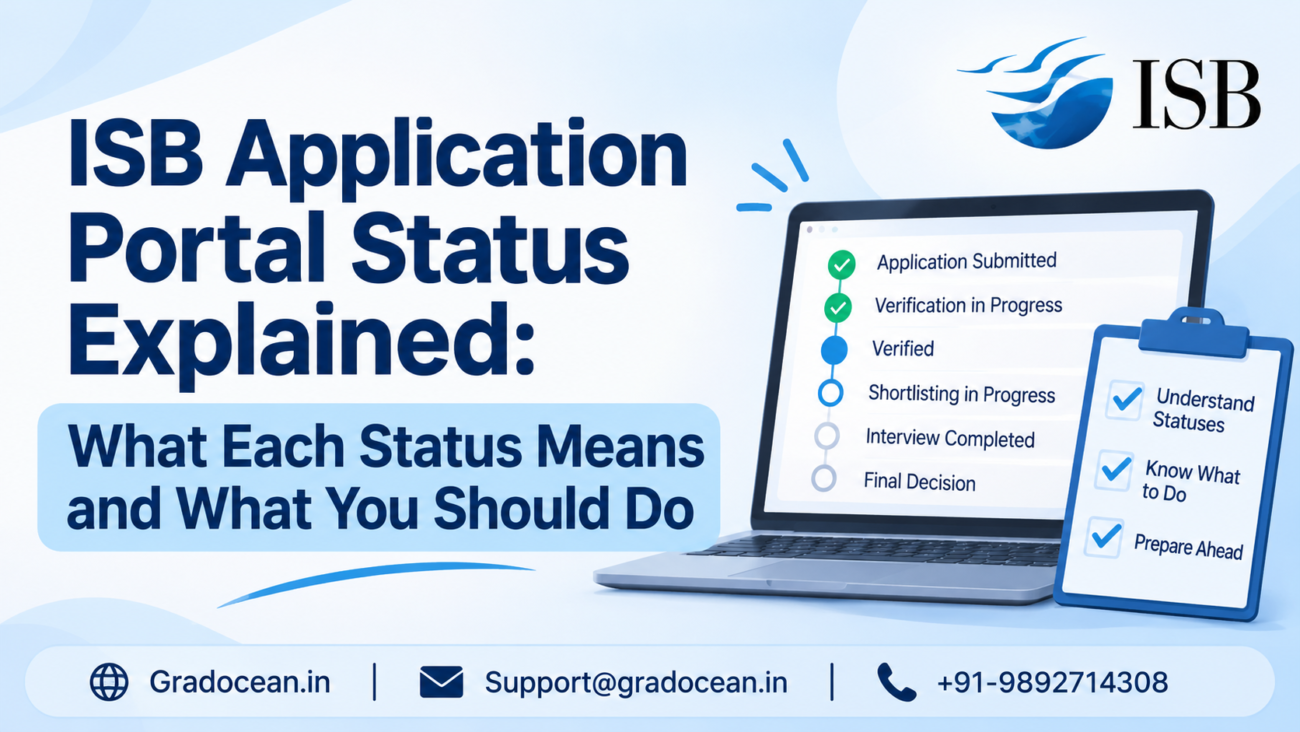
41. ISB Application Portal Status Explained: What Each Status Means and What You Should Do
42.ISB PGP Letter of Recommendation: How to Choose the Right Recommender and Get It Right