

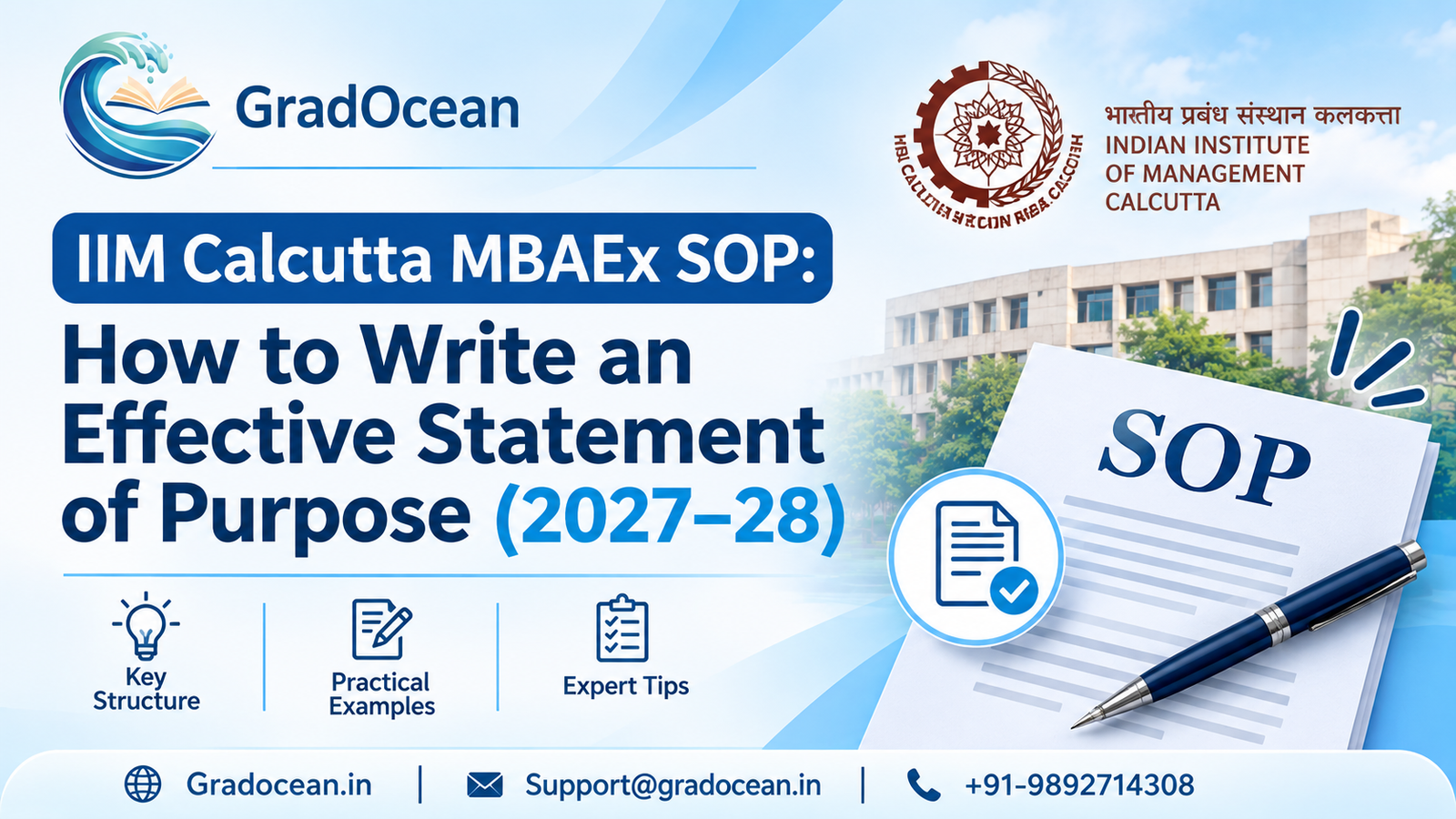
The Statement of Purpose (SOP) is an important part of the IIM Calcutta MBA for Executives (MBAEx) application. However, there is an interesting aspect of the admissions process that applicants should understand before beginning their essays.
IIM Calcutta does not publish a specific SOP question or assign a separate weight to the SOP in its published selection criteria. Instead, the institute evaluates applicants through a composite score comprising six parameters:
- Academic performance: 10%
- Diversity: 5%
- Work experience: 15%
- GMAT score: 25%
- Written Ability Test (WAT): 15%
- Personal Interview: 30%
Although the SOP does not feature as an independent component in this calculation, it remains an important document in your application. It provides the admissions panel with an understanding of your professional journey, career ambitions, reasons for pursuing an MBA and the value you could bring to the classroom.
More importantly, the interview carries the highest individual weight in the selection process. Your SOP can therefore influence the direction of the conversation and the questions you encounter during the interview.
In this guide, we explain how to approach the IIM Calcutta MBAEx SOP, what to include, how to structure your responses and how to ensure that your application is supported by credible examples.
1. Understand What IIM Calcutta Expects From Your SOP
Before drafting your SOP, it is important to distinguish between what IIM Calcutta officially publishes and what applicants can reasonably infer from its selection process.
The institute’s published admissions documents do not specify a dedicated SOP prompt, an independent SOP weight or a publicly stated word limit. Applicants should check the actual application form for the questions and prescribed limits applicable to their application cycle.
For the purpose of developing a draft, we recommend working with approximately 600 words. This can subsequently be shortened to 400 words or expanded to 800 words, depending on the application requirements.
Your SOP should ideally address six broad areas:
- A professional experience that illustrates your capabilities or interests.
- Your career progression and significant accomplishments.
- The skills or exposure you currently lack.
- Your short-term and long-term career objectives.
- Your reasons for choosing the MBAEx programme at IIM Calcutta.
- The experience, perspective and knowledge you will contribute to the cohort.
These are suggested writing areas rather than officially prescribed IIM Calcutta essay questions.
2. Why Your SOP Matters in the IIM Calcutta Selection Process
A common mistake applicants make is treating the SOP as a standalone document that needs to sound impressive.
That is not the right approach.
Your application, WAT and personal interview should communicate a consistent professional story. The admissions panel should be able to understand your career decisions, achievements and future plans without encountering contradictions between these different stages.
Consider an applicant who describes a strong interest in moving into corporate strategy but cannot explain during the interview why this transition makes sense given their previous experience.
Similarly, an applicant who highlights leading a major business initiative should be prepared to explain their individual contribution, the challenges involved and the measurable outcome.
The SOP should therefore be written with the interview in mind.
There are two other selection parameters worth considering:
Work experience (15%)
The number of years you have worked is only one part of your professional profile. Your responsibilities, career progression, decision-making exposure and accomplishments help establish the quality of your experience.
Diversity (5%)
Your professional background, industry exposure, academic discipline and experiences can contribute to the diversity of the MBAEx cohort. Explain what makes your perspective different rather than simply describing yourself as a diverse candidate.
3. Recommended Structure for Your MBAEx SOP
A well-organised SOP should move logically from your professional experience to your future ambitions.
Here is a suggested structure for a draft of approximately 600 words.
| Section | Suggested word count | Purpose |
|---|---|---|
| Professional introduction | 60–80 | Establish your professional context |
| Career progression and achievements | 180–220 | Demonstrate growth and impact |
| Career limitations and why an MBA now | 90–110 | Explain the need for further education |
| Career objectives | 80–100 | Establish a realistic direction |
| Why IIM Calcutta MBAEx | 80–100 | Explain programme fit |
| Contribution to the cohort | 50–70 | Highlight your distinctive perspective |
These allocations are flexible. The objective is to create a coherent narrative rather than mechanically fill each section.
Section 1: Begin With a Meaningful Professional Experience
Your opening should introduce the reader to an experience that reflects your professional capabilities, interests or the kind of challenges you want to address in the future.
Avoid generic introductions about leadership, ambition or the importance of business management.
For instance, an operations professional could begin by describing how a distribution bottleneck affected the company’s ability to fulfil customer orders across multiple regions.
A finance professional might discuss an instance where an analysis of working capital helped the organisation identify inefficiencies and improve cash flow.
The experience should establish a connection with your subsequent career objectives.
What to avoid:
“I have always been passionate about business and management. Over the years, I have developed excellent leadership and analytical skills, and I now wish to pursue an MBA to become a successful business leader.”
This introduction could apply to thousands of applicants. It provides no meaningful information about the individual.
A more effective approach:
“During my tenure in the consumer goods sector, I noticed that our regional distribution network was struggling to accommodate seasonal fluctuations in demand. I worked with the sales and supply chain teams to redesign inventory allocation across 18 distribution centres. Although the initiative improved product availability, it also exposed me to broader questions around pricing, demand forecasting and business planning that extended beyond my operational responsibilities.”
This introduction establishes the applicant’s professional context, individual involvement and an area of interest that can be explored further.
Section 2: Demonstrate Career Progression Through Achievements
This should be one of the most substantial sections of your SOP.
With at least five years of professional experience, the admissions committee will expect you to demonstrate how your responsibilities and capabilities have evolved.
Avoid reproducing your resume in paragraph form. Instead, select two or three experiences that best demonstrate your professional development.
For each accomplishment, consider including:
- Responsibility: What were you personally accountable for?
- Challenge: What problem were you trying to address?
- Action: What steps did you take?
- Outcome: What changed because of your contribution?
- Scope: What was the scale of the initiative in terms of people, customers, budgets or business operations?
Whenever possible, quantify the results.
Illustrative example:
“I joined the organisation as a business analyst and subsequently moved into a regional project management position. In my current role, I oversee process improvement initiatives across 14 manufacturing locations. One of my key assignments involved identifying inefficiencies in procurement cycles, where I worked with finance, operations and vendor management teams to reduce average processing time from 18 days to 11 days. The revised process also improved visibility into pending purchase orders and was subsequently adopted by two additional business units.”
This example demonstrates career progression, cross-functional collaboration, individual contribution and measurable impact.
The important distinction is between describing what your job involved and demonstrating what you accomplished.
Section 3: Explain Why You Need an MBA at This Stage
One of the most important questions your SOP must answer is:
Why do you need an MBA now?
An applicant with several years of professional experience should have a reasonably clear understanding of their strengths and limitations.
Identify the areas where your current experience has prepared you well and the capabilities you need to develop further.
For example, a technology professional may have extensive experience in product delivery but limited exposure to corporate finance, business strategy and commercial decision-making.
Similarly, a supply chain professional may understand operational planning but want to develop a broader perspective on organisational strategy and business leadership.
Explain why these gaps matter for your future career.
Also consider why a full-time MBA is more appropriate than continuing with your existing career trajectory or pursuing a part-time qualification.
If there are aspects of your academic or professional record that require clarification, such as a career break or a change in industry, address them briefly and factually where relevant.
Avoid lengthy justifications or defensive explanations.
Section 4: Clearly Articulate Your Career Goals
Your career objectives should emerge naturally from your professional experiences and the capabilities you want to develop.
A useful way to approach this section is to distinguish between short-term and long-term objectives.
Short-term goals
Be specific about:
- The function you want to enter.
- The industry you are interested in.
- The type of organisation you wish to work with.
- The role or level you realistically intend to pursue.
For example, an applicant with experience in technology consulting could aim to transition into a corporate strategy or business transformation role within a technology or financial services organisation.
Long-term goals
Your long-term ambitions can be broader, but they should remain connected to your previous experience and short-term plans.
For instance, the same applicant may aspire to lead enterprise-wide transformation initiatives or take up a senior business leadership position.
Avoid statements such as becoming a CEO or starting a multinational company without explaining the intermediate steps that could make these ambitions achievable.
Your goals should demonstrate ambition as well as an understanding of the professional journey required to reach them.
Section 5: Why IIM Calcutta MBAEx?
This section should explain why the MBAEx programme is relevant to your professional development.
Avoid relying entirely on the institute’s reputation, rankings, alumni network or legacy.
Instead, identify two or three programme-specific aspects that address your learning requirements.
You could explore:
- Relevant courses and academic areas.
- Faculty research and areas of expertise.
- Opportunities for peer learning.
- The experience and diversity of the MBAEx cohort.
- The programme’s structure and learning environment.
For example, an applicant looking to transition from a technical role into business leadership could explain how exposure to corporate finance, competitive strategy and organisational management would help bridge their existing knowledge gaps.
Be selective about the information you include. Anything you mention in your SOP could become a subject of discussion during the interview.
Do not include courses or faculty references simply because they appear impressive. Make sure you understand their relevance to your objectives.
Section 6: What Will You Bring to the MBAEx Cohort?
The final section should communicate what your professional and personal experiences will add to the classroom.
Think beyond your job title and years of experience.
You may have worked in an industry that is underrepresented in the cohort, managed teams across international markets, worked in a family-owned enterprise or gained experience in a specialised technical domain.
For example, an applicant with experience in the renewable energy sector could bring practical insights into infrastructure financing, regulatory challenges and the commercial considerations involved in energy transition projects.
Another applicant with experience in a family business could offer a different perspective on succession planning, entrepreneurship and managing growth in closely held organisations.
The objective is to explain what classmates could learn from your experiences and how you could contribute to discussions, projects and collaborative learning.
4. Examples of Effective and Ineffective SOP Writing
Understanding the difference between generic statements and evidence-based writing can significantly improve your draft.
The following examples are illustrative and do not represent actual IIM Calcutta applicants.
Example 1: Describing Leadership Experience
Weak approach:
“I have demonstrated excellent leadership skills throughout my career. I have successfully managed several projects and worked with different stakeholders to achieve organisational objectives.”
The problem is that the applicant makes several claims without providing any evidence.
Improved approach:
“While managing a customer onboarding initiative at a financial services firm, I noticed that applications were frequently delayed because the compliance and sales teams followed different verification processes. I brought both teams together to standardise documentation requirements and introduced a common tracking mechanism. Over the following six months, average onboarding time declined from nine days to five days, improving the customer experience and reducing the number of pending applications.”
The revised version demonstrates leadership through a specific situation, individual action and measurable outcome.
Example 2: Demonstrating Professional Growth
Weak approach:
“I have consistently performed well in my organisation and have received recognition for my contributions. My experience has helped me develop strong problem-solving and communication skills.”
Improved approach:
“I started my career in financial planning, where I was responsible for preparing monthly business reports. Over the next five years, I moved into a commercial finance role and began working directly with business heads on budgeting and investment decisions. One of my key contributions was developing a revised forecasting model for a business division with annual revenue of Rs. 120 crore. The model improved quarterly forecasting accuracy and helped management identify cost overruns earlier in the financial year.”
The improved version establishes a clear progression from an execution-oriented role to one involving greater business responsibility.
5. Questions Your SOP Could Trigger During the Personal Interview
Since the personal interview carries 30% of the composite score, applicants should approach SOP preparation and interview preparation as interconnected activities.
A useful exercise is to read every sentence in your SOP and ask yourself what the admissions panel might want to know next.
Below are some questions worth preparing for.
Questions about your professional introduction
- Why did you choose this particular experience to introduce your SOP?
- What was your individual contribution to the initiative?
- What were the biggest challenges you encountered?
- How did you measure the outcome?
- What would you approach differently if you handled the same assignment today?
- Why could you not address the underlying problem within your existing organisation?
Questions about your achievements
- Which accomplishments best demonstrate your professional capabilities?
- How much of the reported outcome was directly attributable to you?
- What was the baseline against which you measured improvement?
- How did you manage disagreements with other departments?
- What was the most difficult decision you made during the project?
- What feedback did your reporting manager give you?
Questions about your career progression
- Why did you move between organisations?
- How have your responsibilities changed over the years?
- What prompted your transition into your current function?
- Which professional experience has influenced you the most?
- What would your previous manager identify as an area for improvement?
Questions about pursuing an MBA
- What specific capabilities do you currently lack?
- Why is an MBA necessary to address these gaps?
- Why pursue a full-time programme instead of an executive or part-time qualification?
- Why is this the right time to leave your current position?
- How have you planned for the financial implications of taking a career break?
- What will you do if you are not selected this year?
Questions about career goals
- Why have you selected this particular industry?
- Which organisations would you target after graduation?
- What roles would you realistically qualify for immediately after the MBA?
- What if your preferred industry does not offer suitable opportunities?
- How does your previous experience support your career transition?
- Where do you see yourself five to ten years after graduation?
Questions about IIM Calcutta and cohort contribution
- Why have you selected IIM Calcutta over other executive MBA programmes?
- Which courses are particularly relevant to your learning objectives?
- How would your professional background contribute to classroom discussions?
- What would you like to learn from your classmates?
- How would you handle a disagreement with someone who has a very different professional perspective?
- What do you understand about the MBAEx programme structure?
This is not an exhaustive list of possible interview questions. It is a preparation framework to help you identify areas where your SOP may invite further discussion.
6. Seven Practical Tips for Writing Your IIM Calcutta MBAEx SOP
1. Prioritise evidence over adjectives.
Words such as strategic, innovative, collaborative and entrepreneurial are easy to include. Demonstrating these qualities through actual experiences is much more effective.
2. Quantify your accomplishments.
Whenever possible, provide measurable outcomes. Explain the scale of the project, the improvement achieved and your individual contribution.
3. Maintain consistency across your application.
Your resume, SOP, WAT and interview responses should communicate the same professional story. Ensure that dates, designations and achievements are accurate.
4. Demonstrate decision-making rather than listing responsibilities.
At this stage of your career, the admissions committee will want to understand how you have evolved professionally. Focus on decisions, ownership and outcomes.
5. Make your career goals realistic.
Your aspirations should be ambitious but achievable given your existing experience and the opportunities available after an MBA.
6. Research IIM Calcutta before writing the school-fit section.
Identify relevant courses, faculty interests and programme characteristics. Your reasons for choosing the institute should be based on actual research.
7. Write naturally.
Avoid unnecessarily complicated vocabulary, corporate jargon and generic statements. A well-written SOP should sound like a thoughtful professional explaining their career journey, not a marketing brochure.
7. Suggested Four-Week SOP Preparation Timeline
Applicants targeting the second round should avoid leaving the SOP and supporting documents until the final few days.
A structured preparation plan can help.
Week 1: Collect your professional evidence
Review your career history and identify three or four significant accomplishments. Collect relevant figures, project outcomes and examples of professional development.
Also review the eligibility requirements and arrange the necessary academic and employment documents.
Week 2: Develop the first draft
Establish your professional narrative and prepare the initial SOP.
Focus on career progression, the rationale for pursuing an MBA, future goals and programme fit.
Do not spend too much time polishing individual sentences at this stage. Establishing a logical structure is more important.
Week 3: Review and refine
Check whether every accomplishment is supported by evidence and whether your career objectives are realistic.
Compare the SOP against your resume and ensure that the information is consistent.
Ask someone familiar with MBA admissions to review the document and identify gaps in your reasoning.
Week 4: Finalise the application and begin interview preparation
Make the necessary revisions, check the application form requirements and submit the application before the deadline.
Once the SOP is finalised, begin preparing for the personal interview and Written Ability Test. Practise explaining the experiences and decisions discussed in your application.
8. Frequently Asked Questions About the IIM Calcutta MBAEx SOP
Q1. Does IIM Calcutta assign a separate weight to the MBAEx SOP?
No separate SOP weight appears in IIM Calcutta’s published composite selection criteria. However, the application requires an SOP, which provides the admissions panel with information about your professional background and aspirations.
Q2. What is the word limit for the IIM Calcutta MBAEx SOP?
The publicly available admissions documents referenced in this guide do not specify a word limit. Applicants should check the application form for the applicable instructions and follow the prescribed limit, if any.
Q3. Can I reuse my SOP from IIM Bangalore EPGP or another executive MBA application?
You can reuse relevant professional experiences, achievements and career goals, but avoid copying the entire document.
Different programmes have different selection criteria and expectations. Your reasons for choosing IIM Calcutta should be specific to MBAEx, and your application should address the relevant programme requirements.
Q4. Should I explain a low graduation score in my SOP?
If your academic performance meets the eligibility requirements but is relatively
Other Articles of Interest:
1. ISB vs International MBA: How to Choose the Right Path for Your Career
2. Indian MBA Programs Are Rising Fast in Global Rankings — Here’s Why It Matters
3. Top Executive MBA Programs in India
4.GMAT Waiver for MBA: A Complete Guide to Test-Optional Business Schools
5.Top Global One-Year MBA Programs for Experienced Professionals: A Comprehensive Guide
6.Best MBA Programs for Healthcare: Top Schools, Curriculum & Career Scope (2026 Guide)
7. Best MBA Programs for Sustainability & ESG: Top Schools, Curriculum & Career Scope (2026 Guide)
8. ISB vs IIM One-Year MBA (2026): Fees, Placements, Rankings, ROI & Which is Better?
9. MBA ROI vs Rankings: How to Choose the Right MBA Program in 2026
11. HEC Paris MBA Essays 2027 Intake: A Complete Guide to Writing Winning Essays
16.MBA University of Virginia Darden MBA Admissions Guide (2026–2027 Intake)
18. MBA Letters of Recommendation (LOR): Complete Guide for Applicants
19.2026 IIM Ahmedabad PGPX Extempore Topics: Latest Questions & Preparation Guide
20. 18 Key Insights About ISB PGP Admissions
21.ISB PGP R1: What to Focus on Before You Submit Your Application
22. IIM Indore EPGP 2027–28: Admissions, Eligibility, Placements, Fees, Programme & Application Guide
24. IIM Lucknow IPMX 2027–28: Admissions, Eligibility, Placements, Batch Profile & Application Guide
25. Post-MBA Career Options for Fashion Professionals After a One-Year MBA in India
26. Post-MBA Career Options for Lawyers After a One-Year MBA in India
28. Post-MBA Career Options for PSU Professionals After a One-Year MBA in India
31. Post-MBA Career Options for Civil Engineering Professionals After a One-Year MBA in India
35. XLRI PGDM (GM) 2027: Eligibility, Admissions, Batch Profile, Placements and Career Opportunities
36. How to Prepare for MBA Applications While Working Full-Time
37. ISB Interview Excerpts 2026: Questions and Preparation Insights
38.One Month Left Before IIMA PGPX, IIMB EPGP and ISB PGP Applications: What to Start Doing Now
39. ISB PGP MFAB Admissions 2027–28: Deadlines, Programme Highlights and Application Guide
40. ISB and IIM One-Year MBA Interview Preparation: Common Questions, WAT and Extempore Tips
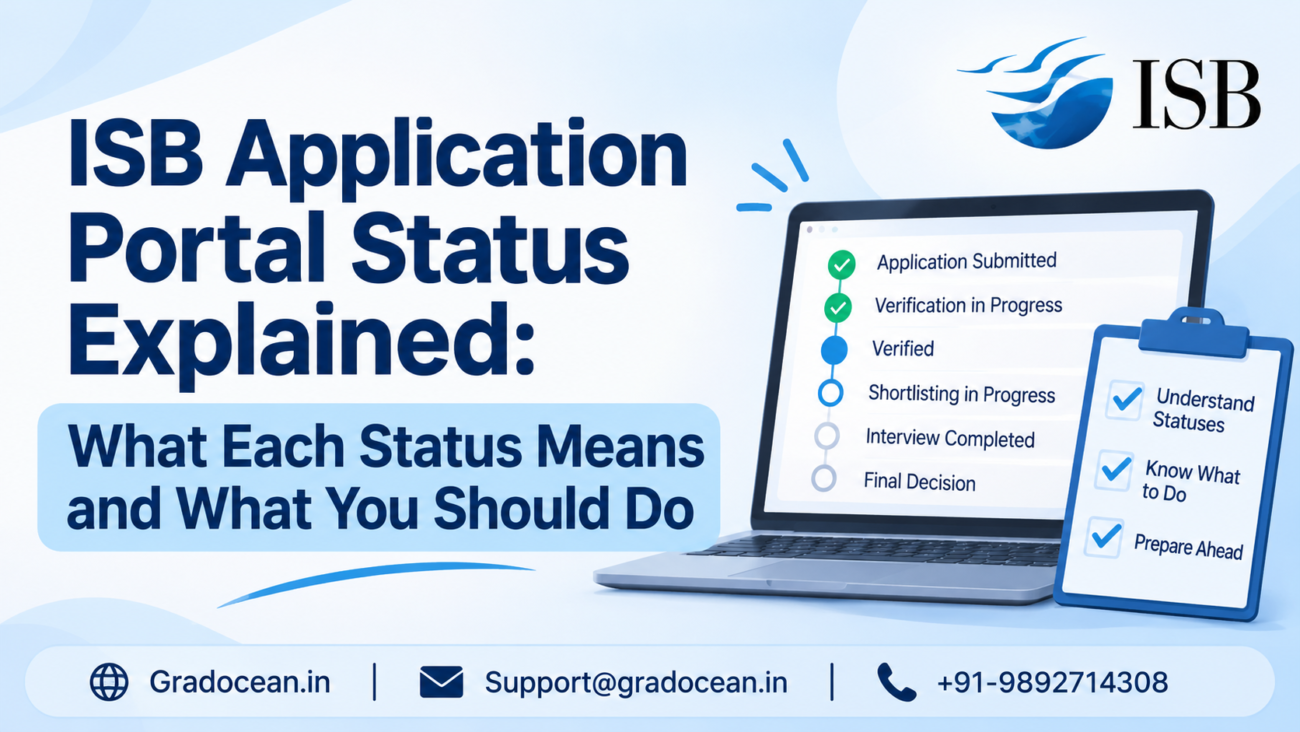
41. ISB Application Portal Status Explained: What Each Status Means and What You Should Do