

Professionals from chemical engineering and process industries often reach a point where they want to move beyond purely technical responsibilities.
A process engineer may want to move from plant operations into consulting or strategy. Someone working in a cement company may want broader operations or general-management responsibility. A professional from paints or specialty chemicals may want to move into product management, business development or commercial roles. An oil & gas professional may be interested in energy strategy, consulting or the energy transition.
A one-year MBA can provide a route to these transitions.
Programs such as the ISB PGP, IIM Ahmedabad PGPX, IIM Bangalore EPGP, IIM Calcutta MBAEx and IIM Lucknow IPMX attract experienced professionals from engineering, manufacturing, energy and other technical sectors. IIMA, for example, identifies energy and manufacturing among the sectors recruiting PGPX graduates, while its 2026–27 PGPX cohort includes professionals from Energy & Utilities and Manufacturing/Engineering backgrounds.
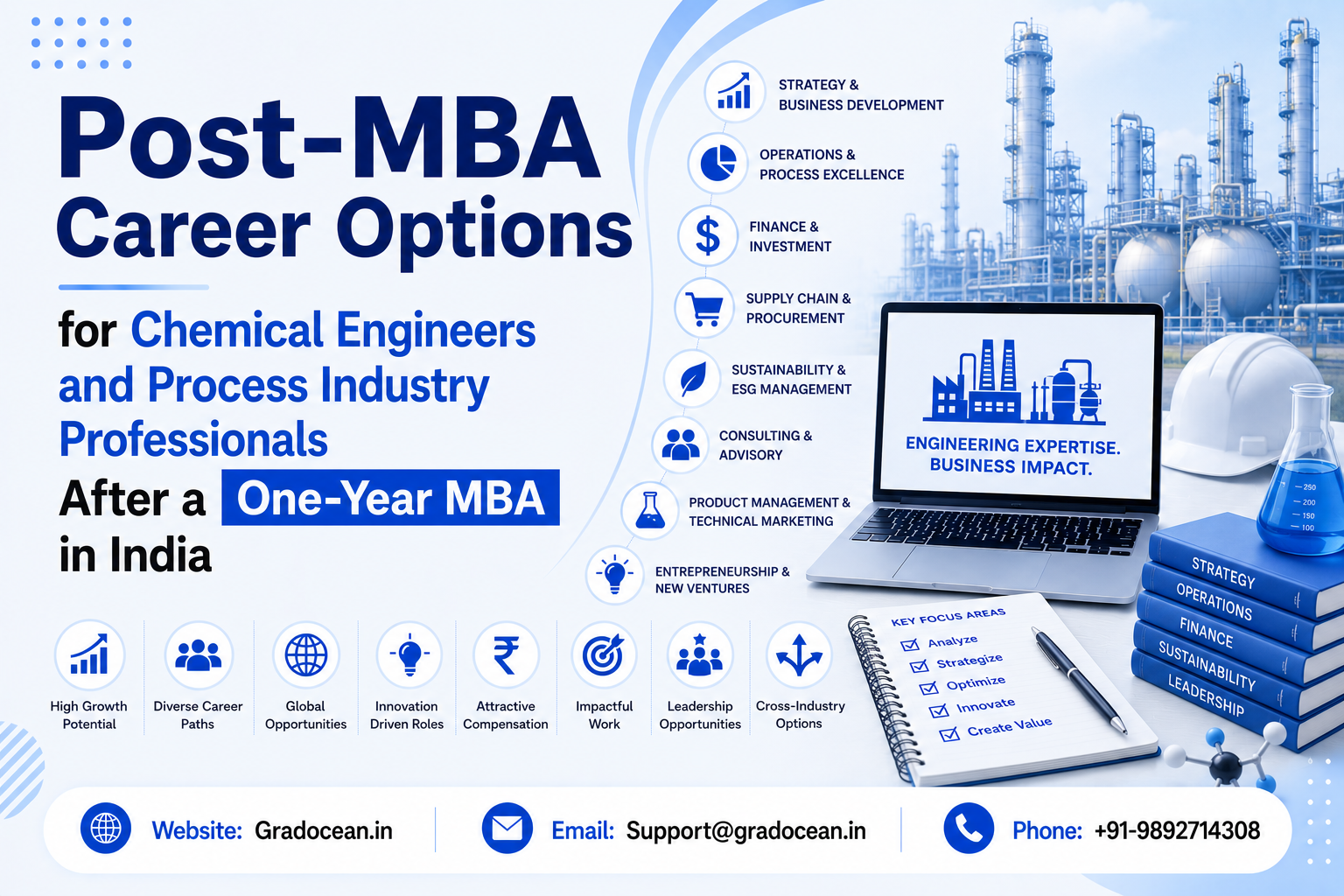
For professionals from chemical and process industries, potential post-MBA options include management consulting, operations and supply chain, corporate strategy, energy strategy, sustainability, general management, business development, industrial product management, project management and procurement.
However, the feasibility of each transition depends heavily on what the candidate was doing before the MBA.
An oil & gas professional with eight years of refinery experience targeting energy consulting has substantial transferable knowledge. The same professional targeting technology product management would be attempting a much larger transition.
The objective should therefore not necessarily be to move as far away from engineering as possible. It should be to identify where your technical and industry experience can be combined with the business capabilities developed during the MBA.
Why Chemical and Process Industry Professionals Pursue an MBA
Chemical and process-industry professionals can spend the early stages of their careers working in areas such as:
- Process engineering
- Production
- Plant operations
- Projects
- Maintenance
- Quality
- Procurement
- Technical sales
- Supply chain
- Process optimisation
- Health, safety and environment
These roles provide strong technical and operational foundations.
As professionals become more experienced, however, the questions they deal with can become increasingly commercial.
Should the company expand capacity?
Which products or markets should it enter?
Where should capital expenditure be prioritised?
How can operating costs be reduced?
How should the company respond to changes in energy or raw-material prices?
Which sustainability investments make commercial sense?
How should a new industrial product be taken to market?
An MBA adds knowledge of finance, strategy, marketing, economics, analytics and organisational management that can help engineers participate in these decisions.
Broadly, post-MBA transitions fall into three categories.
The first involves staying within the same broad industry while moving into a managerial or commercial role.
The second involves retaining a similar function while changing industries.
The third involves changing both industry and function.
The first two are generally easier because they continue to use the candidate’s previous experience.
1. Management Consulting
Management consulting is one of the most common career-switching options considered by engineers pursuing an MBA.
Chemical engineers can bring a useful combination of analytical ability, problem-solving experience and understanding of complex industrial businesses.
Potential areas include:
- Strategy consulting
- Operations consulting
- Supply chain consulting
- Energy consulting
- Manufacturing consulting
- Procurement consulting
- Cost transformation
- Sustainability consulting
A process engineer who has worked on refinery optimisation, for example, already understands capacity, yields, costs, bottlenecks and operational trade-offs.
A cement professional may understand manufacturing economics, logistics, energy consumption and distribution.
A paints or specialty-chemicals professional may understand raw-material costs, manufacturing processes, product portfolios and industrial customers.
This knowledge can be valuable when consulting firms work with industrial, manufacturing, chemicals and energy clients.
The MBA helps candidates add structured business problem-solving, financial analysis and commercial understanding to their technical knowledge.
Consulting is also a significant recruiting function across leading one-year MBA programs. IIMA’s recent PGPX placements, for example, have seen consulting emerge as one of the largest recruiting sectors.
Transition Difficulty
Process/operations engineer to operations consulting: Low to Moderate
Oil & gas professional to energy consulting: Low to Moderate
Manufacturing professional to management consulting: Moderate
Pure R&D professional to general strategy consulting: Moderate to High
Candidates with leadership, cost optimisation, project management or cross-functional experience generally have an easier story to build than someone whose career has remained entirely technical.
2. Operations and Supply Chain Management
Operations is one of the most natural post-MBA career options for process-industry professionals.
Many candidates already have experience in:
- Production planning
- Capacity utilisation
- Procurement
- Inventory
- Maintenance
- Quality
- Logistics
- Process improvement
- Vendor management
- Plant productivity
Potential post-MBA positions include:
- Operations Manager
- Manufacturing Strategy Manager
- Supply Chain Manager
- Operations Excellence Manager
- Strategic Sourcing Manager
- Procurement Manager
- Supply Chain Transformation Manager
The MBA helps candidates move from managing an individual process or production line towards understanding the economics of the complete business.
For example, a process engineer may previously have focused on increasing plant throughput.
A post-MBA operations professional may need to determine whether increasing production actually makes commercial sense after considering demand, inventory, logistics, working capital and profitability.
Transition Difficulty
Plant operations to corporate operations: Low
Production to manufacturing strategy: Low to Moderate
Procurement to strategic sourcing: Low
Operations to supply-chain consulting: Moderate
For chemical, cement and oil & gas professionals, this is often one of the strongest ways to obtain broader management responsibility while retaining the value of previous technical experience.
3. Corporate Strategy
Corporate strategy can be attractive to experienced professionals who want to move from executing projects or operating assets to making business-level decisions.
Potential roles include:
- Corporate Strategy Manager
- Business Strategy Manager
- Strategic Planning Manager
- Growth Strategy Manager
- CEO’s Office
- New Business Manager
- Business Transformation Manager
Within chemicals, cement, paints, manufacturing and energy companies, strategy teams can work on:
- Capacity expansion
- Market entry
- Product portfolio strategy
- Capital allocation
- Competitor analysis
- Mergers and acquisitions
- Geographic expansion
- New business opportunities
Previous industry knowledge can be particularly useful.
Someone who has spent seven years working in refining understands the operational realities and economics of the sector in a way that someone entering the industry for the first time may not.
Similarly, a cement professional may understand plant economics, distribution networks, capacity utilisation and regional demand.
The MBA adds finance, competitive strategy, market analysis and corporate decision-making to this experience.
Transition Difficulty
Chemical/oil & gas professional to strategy in the same sector: Low to Moderate
Manufacturing professional to industrial corporate strategy: Moderate
Chemical engineer to corporate strategy in an unrelated industry: Moderate to High
Staying reasonably close to the candidate’s existing sector can therefore make the initial transition into strategy easier.
4. Energy Strategy and Energy Transition
Oil & gas and petrochemical professionals have an additional set of post-MBA opportunities because of the scale and transformation taking place within the energy sector.
Professionals may already have experience in:
- Refining
- Petrochemicals
- Upstream operations
- Pipelines
- LNG
- Project development
- Process optimisation
- Asset management
Potential post-MBA directions include:
- Energy Strategy
- Energy Consulting
- Commercial Strategy
- Energy Business Development
- Corporate Planning
- New Energy Businesses
- Renewable Energy
- Energy Transition
The transition towards lower-carbon energy systems also creates opportunities involving areas such as:
- Green hydrogen
- Biofuels
- Carbon management
- Renewable energy
- Energy efficiency
- Sustainable manufacturing
- Decarbonisation strategy
Chemical engineers can have useful technical foundations for these areas.
A refinery professional understands energy-intensive industrial processes. A cement professional understands an industry where reducing emissions can require significant changes to technology, energy use and capital investment.
The MBA can add understanding of business models, investment decisions, finance and commercial strategy.
Energy continues to appear within the recruiting ecosystem of one-year MBA programs. IIMA explicitly identifies energy among sectors recruiting PGPX graduates.
Transition Difficulty
Oil & gas operations to energy strategy: Low to Moderate
Oil & gas to energy consulting: Low to Moderate
Oil & gas to renewable-energy strategy: Moderate
Process engineer to sustainability consulting: Moderate
Oil & gas to an unrelated corporate strategy role: Moderate to High
5. General Management
Experienced process-industry professionals can also consider general-management positions.
Potential roles include:
- Business Unit Manager
- General Manager
- Regional Business Manager
- Commercial Manager
- P&L Manager
- Operations Head
This pathway becomes more realistic as the candidate’s pre-MBA leadership responsibility increases.
Consider a production manager with ten years of experience in cement manufacturing who manages teams, production targets, costs, safety and plant performance.
The MBA can help that professional move from managing production towards eventually managing a business where responsibility includes finance, operations, customers, people and profitability.
This is particularly relevant to experienced candidates considering programs such as IIMA PGPX, IIMB EPGP, IIMC MBAEx and IIML IPMX.
IIMA, for example, states that its PGPX placement process is designed around the middle and senior-management roles pursued by its experienced participants.
Transition Difficulty
Senior operations professional to industrial general management: Low to Moderate
Technical manager to business-unit management in the same industry: Moderate
Engineer with limited leadership experience to general management: High
An MBA cannot substitute entirely for previous management experience. Team size, decision-making authority, budgets and scale of responsibility remain important.
6. Business Development and Technical Sales
Business development can be one of the strongest options for professionals working in paints, specialty chemicals, industrial products and other B2B sectors.
A technical-sales professional may already understand:
- Customer requirements
- Product specifications
- Pricing
- Competitor products
- Account management
- Distributor relationships
- Industrial applications
- Technical negotiations
The MBA adds capabilities in commercial strategy, finance, marketing, negotiation and market analysis.
Potential roles include:
- Business Development Manager
- Key Account Manager
- Commercial Manager
- Regional Sales Manager
- Strategic Accounts Manager
- Market Development Manager
- Commercial Strategy Manager
This is particularly relevant in industries such as:
- Paints and coatings
- Specialty chemicals
- Construction chemicals
- Industrial gases
- Petrochemicals
- Lubricants
- Building materials
- Industrial equipment
For someone already working in technical sales, the MBA may therefore represent career acceleration rather than a complete career change.
Transition Difficulty
Technical sales to business development: Low
Technical sales to commercial leadership: Low
Process engineering to industrial business development: Moderate
Chemical engineering to unrelated consumer sales: Moderate to High
7. Industrial Product and Category Management
Product management is not limited to technology companies.
Chemical, paints, coatings, industrial products and building-material companies also require professionals to manage products and portfolios.
Potential roles include:
- Product Manager
- Category Manager
- Product Portfolio Manager
- Product Marketing Manager
- Commercial Product Manager
- Market Development Manager
A paints professional, for example, may understand coatings, customer applications, dealers, contractors and competing products.
A specialty-chemicals professional may understand a chemical category, customer industries and product economics.
The post-MBA role can involve decisions around:
- Pricing
- Product launches
- Portfolio strategy
- Customer segmentation
- Market research
- Sales strategy
- Profitability
- Competitive positioning
Transition Difficulty
Technical sales to industrial product management: Low
Chemical commercial professional to category management: Low to Moderate
Process engineer to industrial product management: Moderate
Process engineer to technology product management: High
The distinction between industrial product management and technology product management is important. They require different experience and capabilities.
8. Project and Program Management
Chemicals, cement, oil & gas and other process industries are capital intensive.
Professionals may already have experience managing:
- Plant expansions
- Equipment installation
- Shutdowns
- Commissioning
- EPC contractors
- Capital projects
- Vendors
- Engineering teams
- Project budgets
This can provide a strong foundation for broader project and program-management positions after the MBA.
Potential roles include:
- Project Manager
- Program Manager
- Capital Projects Manager
- PMO Manager
- Transformation Program Manager
- Project Strategy Manager
The MBA helps candidates add financial evaluation, organisational management and strategy to their project-execution experience.
For example, instead of being responsible only for delivering a plant expansion, a post-MBA professional may participate in deciding whether the investment should happen, how it should be financed and how the project fits into the company’s overall strategy.
Transition Difficulty
Engineering projects to project management: Low
Project management to program management: Low
Technical projects to business transformation programs: Moderate
9. Procurement and Strategic Sourcing
Chemical and process industries purchase significant quantities of raw materials, equipment, energy and services.
Professionals with procurement, materials or vendor-management experience can consider roles such as:
- Strategic Sourcing Manager
- Procurement Manager
- Category Manager
- Supplier Relationship Manager
- Procurement Strategy Manager
- Supply Chain Manager
Technical knowledge can be an advantage because the professional understands the specifications and performance requirements behind what is being purchased.
The MBA adds negotiation, supplier strategy, financial analysis and broader commercial understanding.
Transition Difficulty
Procurement to strategic sourcing: Low
Technical procurement to category management: Low
Process engineering to procurement strategy: Moderate
10. What About Finance?
Chemical engineers sometimes assume that completing an MBA automatically opens careers in investment banking, private equity or venture capital.
These transitions should not be treated as default outcomes.
More realistic finance-related options for candidates with relevant experience can include:
- Project Finance
- Corporate Finance
- Business Finance
- Commercial Finance
- Infrastructure/Energy Finance
A professional who has worked on large capital projects, feasibility studies, CAPEX evaluation or budgeting may have some relevant foundation.
Project finance can be particularly interesting for professionals from oil & gas, energy and other capital-intensive sectors because technical understanding of the underlying assets can be useful.
Moving directly into investment banking or private equity without prior transaction or finance experience is considerably harder.
Transition Difficulty
Engineering/project experience to project finance: Moderate
Industry experience to corporate/business finance: Moderate to High
Chemical engineer to investment banking: High
Chemical engineer to private equity: Very High
Candidates interested in finance need to build strong capabilities in accounting, financial modelling, valuation and corporate finance during the MBA.
Choosing Your Post-MBA Career Based on Your Pre-MBA Role
| Pre-MBA Background | Strong Post-MBA Options |
|---|---|
| Process Engineer | Consulting, Operations, Manufacturing Strategy, Energy Strategy |
| Plant/Production Manager | Operations, General Management, Supply Chain, Strategy |
| Cement Professional | Operations, Supply Chain, Consulting, General Management, Sustainability |
| Paints/Coatings Professional | Product Management, Category Management, Sales, Business Development |
| Oil & Gas Process Engineer | Energy Consulting, Energy Strategy, Operations, Energy Transition |
| Oil & Gas Project Professional | Project/Program Management, Energy Strategy, Consulting |
| Technical Sales Professional | Business Development, Commercial Strategy, Product Management |
| Procurement Professional | Strategic Sourcing, Supply Chain, Category Management |
| Chemical R&D Professional | Product Strategy, Innovation, Operations, Consulting |
| Project Engineer | Project Management, Program Management, Consulting, Operations |
The strongest option generally lies reasonably close to the candidate’s previous experience.
For example, moving from refinery operations into energy consulting changes the function but retains industry knowledge.
Moving from technical sales in specialty chemicals into industrial product management changes the function while retaining customers and product knowledge.
Moving from cement manufacturing into operations consulting retains substantial functional knowledge.
By contrast, moving from refinery process engineering into consumer-tech product management changes both industry and function and is therefore significantly harder.
Which One-Year MBA Programs Can Chemical Professionals Consider?
ISB PGP
ISB can be particularly relevant for professionals seeking significant career transitions into consulting, strategy, operations, technology and broader management roles.
Its larger class and recruiter base can provide opportunities across multiple sectors. However, candidates specifically interested in remaining within chemicals or core manufacturing should examine recent recruiter participation rather than assuming that large numbers of chemical companies recruit every year.
For professionals with roughly four to eight years of experience, ISB can be particularly relevant for moving from technical execution towards consulting, strategy or commercial responsibility.
IIM Ahmedabad PGPX
IIMA PGPX can be particularly relevant for more experienced chemical, manufacturing and energy professionals.
The current 2026–27 PGPX class itself includes professionals from Energy & Utilities and Manufacturing/Engineering, and the batch has an average work experience of approximately 7.5 years.
IIMA also explicitly identifies energy, manufacturing, logistics and automotive alongside consulting, financial services and technology among the sectors recruiting PGPX graduates.
This can make the program relevant for experienced candidates targeting consulting, strategy, operations and middle-to-senior management positions.
IIM Bangalore EPGP
IIMB EPGP can be considered by experienced chemical, energy and manufacturing professionals targeting consulting, strategy, operations, product or general-management roles.
Candidates should assess how their experience level aligns with the seniority of positions typically available to EPGP graduates.
IIM Calcutta MBAEx
IIMC MBAEx can similarly be considered by experienced professionals from oil & gas, manufacturing, chemicals and industrial sectors.
For candidates targeting consulting, strategy or commercial roles, previous leadership and cross-functional exposure can become particularly important.
IIM Lucknow IPMX
IIML IPMX can be another option for experienced process-industry professionals seeking transitions into consulting, operations, general management, strategy and program-management roles.
Across all these programs, candidates should evaluate recent placement reports and alumni outcomes in their target function rather than selecting a school purely on overall rankings.
How Chemical Professionals Should Position Their Experience
One of the biggest challenges for engineers is explaining technical experience in language that MBA admissions committees and corporate recruiters can understand.
A resume filled with equipment names, chemical processes and engineering terminology may demonstrate technical competence but say very little about business impact.
Candidates should instead quantify areas such as:
- Production improvement
- Cost savings
- Capacity utilisation
- Energy reduction
- Downtime reduction
- Yield improvement
- CAPEX managed
- Revenue influenced
- Vendors managed
- Team size
- Projects delivered
- Safety improvement
For example, instead of simply stating that you optimised a refinery process, explain the scale of the operation and the resulting improvement in throughput, energy consumption or annual cost.
A technical-sales professional should quantify revenue, customer acquisition, account growth and market expansion.
A project professional should quantify project value, budgets, schedules, teams and commercial impact.
A plant manager should demonstrate the scale of production, people managed, costs controlled and operational improvements achieved.
The objective is not to hide the technical nature of your career.
It is to demonstrate the business consequences of your technical decisions.
Skills to Build During the MBA
The capabilities to develop depend on the intended transition.
For consulting, focus on structured problem-solving, case interviews, financial analysis and executive communication.
For operations and supply chain, develop stronger capabilities in operations strategy, analytics, procurement and supply-chain management.
For corporate strategy, focus on financial modelling, competitive analysis, market sizing and corporate finance.
For energy-transition roles, develop understanding of energy economics, sustainability, project economics and emerging energy business models.
For business development and product management, strengthen pricing, marketing, negotiation, customer segmentation and go-to-market strategy.
For general management, finance, leadership, organisational behaviour and P&L management become particularly important.
Your Chemical Engineering Background Can Remain an Advantage
Chemical and process-industry professionals sometimes assume that an MBA is valuable only if it allows them to leave engineering completely.
That is usually too narrow a way to look at the degree.
Several years spent operating a refinery, manufacturing cement, developing coatings, managing chemical production or delivering an energy project can create significant domain expertise.
The MBA can add the commercial perspective required to use that expertise differently.
A refinery engineer may move into energy consulting.
A cement production manager may move into operations or general management.
A paints professional may move into product or category management.
A specialty-chemicals technical-sales professional may move into commercial leadership.
An oil & gas project manager may move into energy strategy or program management.
All can represent meaningful post-MBA transitions.
The strongest career strategy usually lies at the intersection of three factors: your existing industry and functional experience, the capabilities developed during the MBA and realistic recruiter demand.
A one-year MBA can significantly broaden the options available to chemical and process-industry professionals. But the degree works best when it builds on the experience you already have rather than attempting to make that experience irrelevant.
The better question is therefore not simply what jobs are available after an MBA.
It is which post-MBA roles allow you to combine your technical and industry knowledge with broader commercial and managerial responsibility.
Other Articles of Interest:
1. ISB vs International MBA: How to Choose the Right Path for Your Career
2. Indian MBA Programs Are Rising Fast in Global Rankings — Here’s Why It Matters
3. Top Executive MBA Programs in India
4.GMAT Waiver for MBA: A Complete Guide to Test-Optional Business Schools
5.Top Global One-Year MBA Programs for Experienced Professionals: A Comprehensive Guide
6.Best MBA Programs for Healthcare: Top Schools, Curriculum & Career Scope (2026 Guide)
7. Best MBA Programs for Sustainability & ESG: Top Schools, Curriculum & Career Scope (2026 Guide)
8. ISB vs IIM One-Year MBA (2026): Fees, Placements, Rankings, ROI & Which is Better?
9. MBA ROI vs Rankings: How to Choose the Right MBA Program in 2026
11. HEC Paris MBA Essays 2027 Intake: A Complete Guide to Writing Winning Essays
16.MBA University of Virginia Darden MBA Admissions Guide (2026–2027 Intake)
18. MBA Letters of Recommendation (LOR): Complete Guide for Applicants
19.2026 IIM Ahmedabad PGPX Extempore Topics: Latest Questions & Preparation Guide
20. 18 Key Insights About ISB PGP Admissions
21.ISB PGP R1: What to Focus on Before You Submit Your Application
22. IIM Indore EPGP 2027–28: Admissions, Eligibility, Placements, Fees, Programme & Application Guide
24. IIM Lucknow IPMX 2027–28: Admissions, Eligibility, Placements, Batch Profile & Application Guide
25. Post-MBA Career Options for Fashion Professionals After a One-Year MBA in India
26. Post-MBA Career Options for Lawyers After a One-Year MBA in India
28. Post-MBA Career Options for PSU Professionals After a One-Year MBA in India
31. Post-MBA Career Options for Civil Engineering Professionals After a One-Year MBA in India