

Civil engineering careers can develop in very different directions. One professional may spend several years managing construction sites, another may work in cost management or project controls, while others build careers in real estate consulting, infrastructure, building materials, technical sales or government organisations.
Despite these differences, many civil engineering professionals eventually face a similar question: how do I move from being primarily a technical or project professional into a broader business role?
A one-year MBA can provide one route to make this transition.
Programs such as the ISB PGP, IIM Ahmedabad PGPX, IIM Bangalore EPGP, IIM Calcutta MBAEx and IIM Lucknow IPMX attract experienced professionals from engineering, project management, manufacturing, infrastructure, government and other sectors.
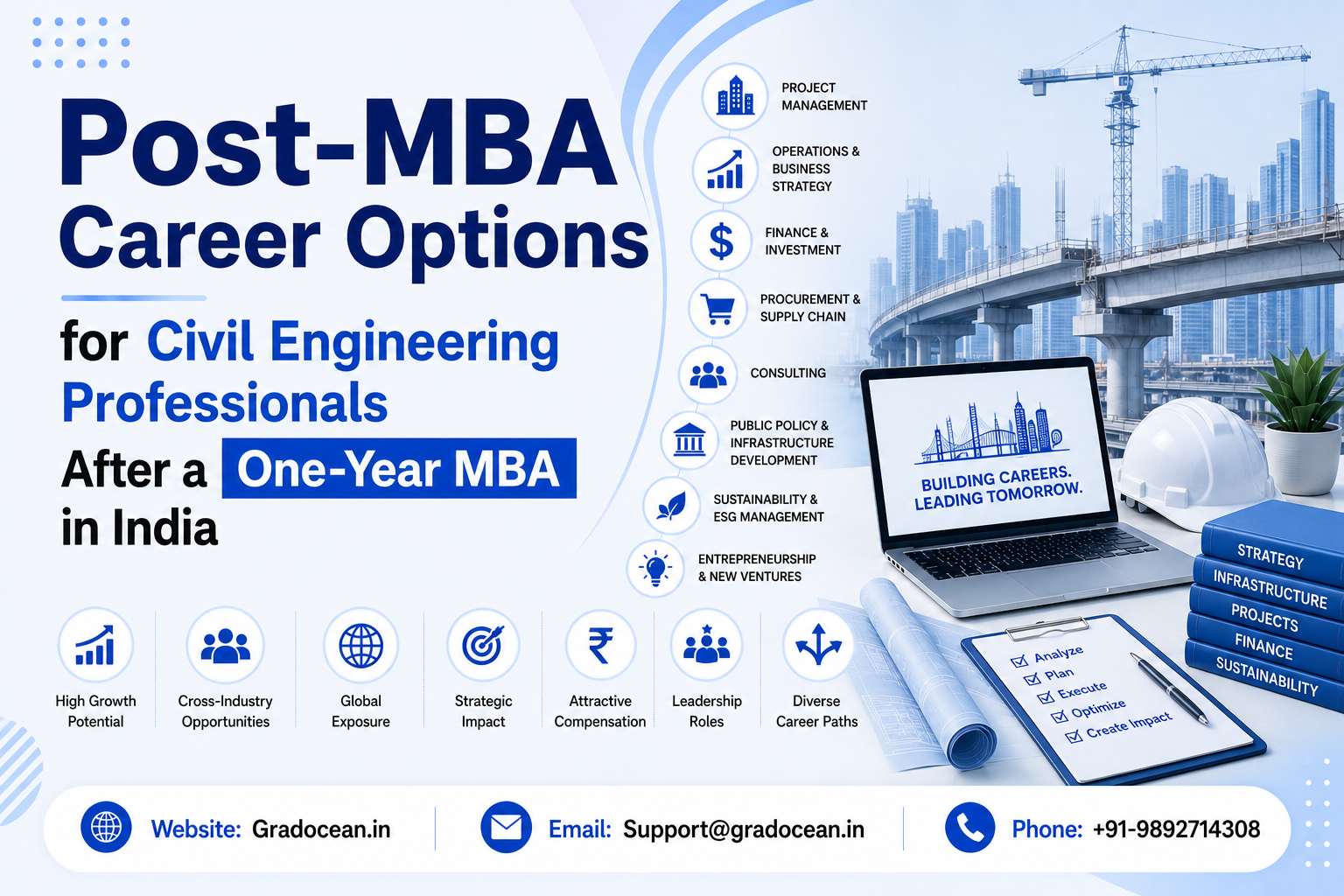
The post-MBA opportunities for civil engineers are also not restricted to construction and real estate. Depending on previous experience, candidates can consider management consulting, infrastructure advisory, corporate strategy, project and program management, operations, procurement and supply chain, real estate, business development, technical sales, general management and, in selected cases, infrastructure finance.
The important question is therefore not simply what jobs are available after an MBA. It is which transitions make sense given your experience before the MBA.
Why Civil Engineering Professionals Pursue a One-Year MBA
Civil engineers often begin their careers in highly execution-oriented positions.
A site or project engineer may be responsible for construction execution, subcontractors, schedules, quality and safety. A cost manager may handle budgets, procurement, contracts and commercial management. A project manager may coordinate clients, consultants, contractors and internal teams.
Similarly, someone working in real estate consulting may be involved in transactions, project advisory, valuations or development consulting, while a technical sales professional may work with architects, contractors, developers and distributors to sell construction materials or engineered products.
These roles can provide considerable responsibility. However, professionals interested in broader management positions eventually need exposure to areas such as finance, strategy, marketing, organisational behaviour and general management.
A one-year MBA can help bridge this gap.
For civil engineering professionals, the MBA can broadly enable three types of transitions:
- Moving into a broader management role while remaining within infrastructure, construction or real estate.
- Changing industries while retaining a similar function, such as moving from construction project management into program management elsewhere.
- Changing both industry and function, such as moving from site engineering into management consulting.
The first two are generally easier than changing both industry and function simultaneously.
1. Management Consulting
Management consulting is one of the most attractive post-MBA options for civil engineering professionals who want a significant career change.
Engineering experience can be relevant because consulting requires structured problem-solving, analytical ability, stakeholder management and the ability to work with complex problems.
Civil professionals can also bring practical knowledge of:
- Project economics
- Procurement
- Contracts
- Cost management
- Operations
- Supply chains
- Capital expenditure
- Regulatory approvals
- Project execution
- Vendor management
This can be particularly useful for consulting engagements involving infrastructure, real estate, manufacturing, energy, capital projects, supply chain and operations.
Consulting is also an important recruiting sector across several leading one-year MBA programs. For example, consulting was the largest recruiting sector for IIMA PGPX in its 2024 placements, accounting for 35% of the class.
Who Has the Strongest Fit?
Civil professionals with backgrounds such as the following can have a credible consulting story:
- Project management
- Cost and commercial management
- Real estate consulting
- Infrastructure advisory
- Project controls
- Procurement
- Client-side project management
- Large public infrastructure projects
Someone working as a project manager for a metro rail project, for example, already deals with budgets, contractors, schedules, government stakeholders and complex execution problems.
The MBA can help the candidate move from managing one project to advising organisations on broader operational, strategic and transformation problems.
How Difficult Is the Transition?
Transition difficulty: Moderate
The candidate needs to develop case-interview skills, structured problem-solving, financial analysis and executive communication.
Someone coming from a client-facing consulting or project-management environment may have a somewhat easier transition than a site engineer whose work has been almost entirely technical.
2. Infrastructure and Capital Projects Consulting
Civil engineers have access to another consulting path that is particularly relevant to their previous experience: infrastructure and capital-project advisory.
Consulting firms and professional-services organisations work with governments, developers, infrastructure companies and investors on major capital programs.
Potential areas include:
- Capital-project strategy
- Project and program management
- Infrastructure advisory
- Capital expenditure optimisation
- Project controls
- Procurement transformation
- Cost optimisation
- Project governance
- Digital transformation of capital projects
For a civil engineer, this can provide an opportunity to enter consulting without abandoning their domain expertise.
A cost manager, for example, may already understand construction economics, contracts, procurement and commercial risk. The MBA can add corporate finance, strategy and organisational knowledge.
Similarly, a project manager can combine execution experience with broader business and transformation capabilities.
How Difficult Is the Transition?
Transition difficulty: Low to Moderate
For candidates with strong infrastructure, project-management, cost-management or consulting experience, this can be one of the most natural MBA transitions.
3. Project and Program Management
Project and program management is another strong option because civil engineers already work in project-driven environments.
A construction project manager routinely coordinates:
- Design teams
- Contractors
- Consultants
- Procurement
- Finance
- Clients
- Government authorities
- Quality and safety teams
These skills are not exclusive to construction.
Technology companies, manufacturing businesses, logistics companies, energy firms and consulting organisations also need professionals who can manage large, complex programs.
Possible post-MBA roles include:
- Program Manager
- Senior Program Manager
- Transformation Manager
- Project Director
- PMO Lead
- Business Program Manager
- Capital Projects Manager
A civil engineer does not necessarily have to remain in construction to use their project-management experience.
For example, someone who has managed large construction programs could potentially move into capital-project management for a manufacturing or energy company.
The industry changes, but the underlying ability to manage budgets, timelines, stakeholders and risk remains relevant.
How Difficult Is the Transition?
Transition difficulty: Low to Moderate
For experienced project managers, this is generally one of the easier post-MBA transitions.
4. Corporate Strategy and General Management
Experienced civil professionals can also consider corporate strategy and broader management positions.
Possible roles include:
- Strategy Manager
- Business Strategy Manager
- Corporate Planning
- CEO’s Office
- Business Transformation
- General Management
- Business Unit Management
These opportunities are particularly relevant within industries where the candidate’s existing domain knowledge remains useful.
Examples include:
- Infrastructure
- Real estate
- Construction
- Building materials
- Energy
- Industrial products
- Engineering
- Manufacturing
Consider a professional who has spent eight years delivering infrastructure projects.
Before the MBA, the person’s responsibility may have been determining how a project should be executed.
After the MBA, a strategy role could involve evaluating which projects the company should pursue, which markets it should enter, how much capital should be allocated, or whether the organisation should expand into a new infrastructure segment.
The candidate moves from project-level decision-making towards business-level decision-making.
How Difficult Is the Transition?
Transition difficulty: Moderate
Candidates with commercial exposure, budget ownership and senior stakeholder interaction generally have a stronger case than those whose experience has been almost entirely technical.
5. Operations, Procurement and Supply Chain
Civil engineering projects involve substantial procurement and supply-chain activity.
Construction professionals regularly deal with:
- Contractors
- Equipment
- Cement
- Steel
- MEP systems
- Logistics
- Procurement schedules
- Vendor negotiations
- Inventory
- Commercial contracts
For professionals who already have substantial exposure to these areas, an MBA can facilitate a move into broader operations and supply-chain positions.
Potential roles include:
- Operations Manager
- Procurement Manager
- Strategic Sourcing Manager
- Supply Chain Manager
- Category Manager
- Operations Excellence Manager
- Procurement Transformation Consultant
These opportunities can exist within construction and infrastructure but also in manufacturing, industrial products, logistics, e-commerce and other sectors.
How Difficult Is the Transition?
Remaining within infrastructure or construction is generally a low-difficulty transition.
Moving into supply chain or procurement in another industry is generally low to moderate.
Moving into operations or supply-chain consulting is generally moderate.
6. Real Estate and Real Estate Strategy
Civil engineers with real estate exposure can use an MBA to move towards the commercial side of the industry.
This is particularly relevant for professionals coming from:
- Real estate consulting
- Project management consulting
- Developers
- Cost consulting
- Property advisory
- Construction management
Potential post-MBA roles can include:
- Development Strategy
- Real Estate Strategy
- Investment Analysis
- Asset Management
- Development Management
- Corporate Real Estate
- Business Development
- Real Estate Consulting
The MBA can help candidates understand the financial and commercial side of property development, including valuation, investment returns, financing, market analysis and portfolio strategy.
For example, a project manager working for a developer may understand how a residential development is constructed.
After an MBA, the same professional could potentially become involved in deciding where the company should invest, which projects should be developed, what product should be launched and how the investment should be structured.
How Difficult Is the Transition?
For candidates already working in real estate:
Transition difficulty: Low to Moderate
For civil engineers without previous commercial or real estate exposure:
Transition difficulty: Moderate to High
7. Building Materials, Technical Sales and Business Development
Civil engineers working in building materials or technical sales already operate at the intersection of engineering and business.
Examples include professionals working with:
- Cement
- Steel
- Construction chemicals
- HVAC
- Elevators
- Electrical products
- Plumbing systems
- Heavy equipment
- Building technologies
- Industrial products
These professionals often interact directly with contractors, architects, consultants, developers and distributors.
An MBA can help them move from technical selling into broader commercial leadership.
Possible roles include:
- Regional Sales Manager
- Business Development Manager
- Key Account Manager
- Product Manager
- Category Manager
- Commercial Strategy Manager
- Go-to-Market Manager
- Sales Head
For someone already working in technical sales, this can be one of the most straightforward MBA transitions because the candidate already understands both the product and the customer.
How Difficult Is the Transition?
Transition difficulty: Low to Moderate
Moving into commercial leadership within the same or a related industry is generally easier than moving into an unrelated consumer-marketing role.
8. Infrastructure and Project Finance
Finance is possible for civil engineers, but this career option needs to be approached carefully.
A civil engineer who understands how infrastructure or real estate projects are developed may be able to combine that knowledge with financial skills developed during the MBA.
Potential areas include:
- Infrastructure finance
- Project finance
- Real estate investment
- Infrastructure advisory
- Investment analysis
- Development finance
Cost managers and real estate consultants may have a particularly relevant starting point because they already work with project costs and commercial feasibility.
However, there is a major difference between moving into infrastructure finance and attempting to move directly into mainstream investment banking or private equity.
The first can build on previous industry knowledge. The second represents a much larger career pivot.
How Difficult Is the Transition?
Infrastructure or project finance with relevant prior experience:
Transition difficulty: Moderate
Real estate investment roles with relevant real estate experience:
Transition difficulty: Moderate
Mainstream investment banking or private equity from a purely technical civil background:
Transition difficulty: High
The MBA alone does not remove the experience requirements associated with specialised finance positions.
9. Opportunities for Government and PSU Professionals
Civil engineers working in government organisations, PSUs, railways, public works, transportation, energy or other public-sector organisations have a somewhat different profile.
Their experience may include:
- Large-scale infrastructure
- Public procurement
- Government contracts
- Regulatory processes
- Project implementation
- Vendor management
- Public stakeholders
- Large budgets
This experience can be valuable, but candidates need to translate it into language private-sector recruiters understand.
Potential transitions can include:
- Infrastructure consulting
- Public-sector advisory
- Program management
- Operations
- Infrastructure strategy
- Government consulting
- Project advisory
- General management
Professionals with substantial experience managing major public infrastructure programs can be particularly relevant to consulting organisations that advise governments and public-sector clients.
However, a move from a highly specialised government engineering role into an unrelated private-sector function can be more difficult.
How Difficult Is the Transition?
Into infrastructure/public-sector consulting:
Moderate
Into project or program management:
Low to Moderate
Into an unrelated corporate function:
Moderate to High
The quality of the candidate’s leadership, commercial exposure and stakeholder-management experience becomes especially important.
Can You Completely Leave the Civil Engineering Industry?
Yes.
But the difficulty depends on how many things you are attempting to change simultaneously.
Consider a construction project manager who moves into infrastructure program management. The function and industry remain closely related, making this a relatively straightforward transition.
A project manager moving into program management at an industrial or technology company changes industries but retains many of the same underlying capabilities. This is also reasonably achievable.
Moving from construction project management into management consulting represents a larger functional change, but consulting firms regularly hire experienced engineers. This is generally a moderate transition.
Moving from site engineering into investment banking, however, changes both industry and function while providing limited overlap with the candidate’s previous experience. This is considerably more difficult.
The MBA creates access to opportunities, but it does not make every transition equally realistic.
Choosing Your Post-MBA Career Based on Your Pre-MBA Role
| Pre-MBA Background | Strong Post-MBA Options |
|---|---|
| Site Engineer | Project/Program Management, Operations, Consulting |
| Project Engineer | Program Management, Consulting, Operations, Strategy |
| Project Manager | Program Management, Consulting, General Management, Transformation |
| Cost Manager/Quantity Surveyor | Consulting, Procurement, Commercial Strategy, Project Finance |
| Project Controls/Planning | Program Management, Operations, Consulting, Transformation |
| Procurement/Contracts | Supply Chain, Strategic Sourcing, Consulting, Category Management |
| Real Estate Consultant | Real Estate Strategy, Development, Consulting, Investment Analysis |
| Building Materials Sales | Sales Leadership, Business Development, Product/Category Management |
| Technical Sales Engineer | Business Development, B2B Sales, Product Management, Commercial Strategy |
| Government/PSU Civil Engineer | Infrastructure Advisory, Consulting, Program Management, Strategy |
This framework helps candidates build career plans that demonstrate progression rather than trying to manufacture a completely unrelated post-MBA goal.
A site engineer could progress into project management, use the MBA to move into program management or consulting, and eventually take on broader business leadership.
A cost manager could use experience in project economics and contracts to move into consulting, procurement strategy or infrastructure finance.
A technical sales professional could move into business development or commercial leadership.
The MBA becomes the bridge between existing experience and broader responsibility.
Which One-Year MBA Programs Can Civil Engineers Consider?
ISB PGP
ISB can be particularly relevant for civil professionals with roughly four to eight years of experience seeking consulting, strategy, technology, operations or general-management transitions.
Candidates should recognise, however, that core construction and real estate represent a much smaller part of MBA recruiting than consulting, technology and financial services.
This means that candidates seeking an industry switch should prepare accordingly rather than expecting a large number of traditional civil-engineering employers on campus.
IIM Ahmedabad PGPX
IIMA PGPX can be particularly relevant for experienced professionals targeting consulting, strategy, operations and middle-to-senior management positions.
Its placement process specifically targets experienced professionals for middle and senior-management positions, and recent recruiting has included consulting, general management, program management, operations and strategic/growth roles.
For experienced project managers, consultants and infrastructure professionals, these can align well with the skills developed before the MBA.
IIM Bangalore EPGP
IIMB EPGP can be relevant for experienced civil professionals seeking consulting, technology, operations or general-management transitions.
Candidates interested in areas such as proptech, construction technology, infrastructure technology or broader technology-enabled businesses may also benefit from exposure to Bengaluru’s business ecosystem.
IIM Calcutta MBAEx
IIMC MBAEx can be considered by experienced candidates targeting consulting, general management, operations and broader corporate positions.
For civil engineers, the key consideration should again be whether the candidate wants to remain within infrastructure or use the MBA for a wider industry transition.
IIM Lucknow IPMX
IIM Lucknow IPMX attracts experienced professionals from engineering and project-management backgrounds. The IPMX Class of 2024, for example, included candidates from real estate and government backgrounds, while project management represented 17% of the incoming class and operations and supply chain 29%.
Its corporate ecosystem also includes organisations across consulting, technology, manufacturing, automotive and infrastructure-related sectors.
For candidates with eight or more years of experience, it can therefore be evaluated for consulting, program management, operations and general-management transitions.
How Civil Engineers Should Position Their Experience
One of the biggest mistakes civil engineers make in MBA applications and interviews is describing their careers almost entirely through technical terminology.
A recruiter does not necessarily need to understand the reinforcement design, concrete grade, BIM software or technical specifications of a project.
They need to understand the scale and business impact of your work.
Candidates should therefore quantify:
- Project value
- Budget managed
- Cost savings
- Revenue generated
- Schedule improvement
- Team size
- Number of contractors or vendors managed
- Procurement savings
- Productivity improvement
- Claims avoided or resolved
- Clients managed
- Geographic scale
- Safety or quality improvements
Instead of saying that you were responsible for quantity surveying for a commercial development, explain the commercial impact of your work.
For example, you might describe how you managed cost planning and procurement for a large commercial project, identified savings through value engineering and vendor negotiations, and helped maintain the project within its approved budget.
Similarly, instead of describing yourself simply as a site engineer, explain the scale of the project, team, contractors, budget and decisions you were responsible for.
The underlying experience has not changed. The framing has.
Skills to Build During the MBA
Civil engineers generally enter business school with strong project execution and analytical skills.
The MBA should be used to develop areas where their previous careers provided less exposure.
For consulting, candidates should focus on structured problem-solving, case interviews, financial analysis and executive communication.
For corporate strategy and general management, financial modelling, corporate finance, competitive strategy, marketing and P&L understanding become important.
For real estate and infrastructure finance, candidates should develop valuation, project finance, financial modelling and investment-analysis capabilities.
For operations and supply chain, procurement strategy, process improvement, analytics and operations strategy can complement existing project experience.
For technical sales and business development, candidates should strengthen pricing, customer segmentation, negotiation, marketing and go-to-market capabilities.
Candidates should also use live projects, competitions, consulting assignments, alumni interactions and networking to demonstrate interest in their target careers.
This is particularly important in a one-year MBA because the recruiting cycle begins quickly and candidates have less time to experiment with completely different career options.
The MBA Should Build on Your Civil Engineering Experience
A professional entering business school after six, eight or twelve years in construction, infrastructure, real estate or project management already possesses substantial professional experience.
That experience should not automatically be treated as something to leave behind.
For one candidate, the right transition may be from construction project management into consulting.
For another, it may be from cost management into procurement strategy.
A real estate consultant may move towards development strategy, while someone from building-materials sales may progress into broader commercial leadership.
An experienced government engineer may use the MBA to enter infrastructure advisory or program management.
All can represent meaningful post-MBA outcomes.
The strongest career strategy usually lies at the intersection of three factors: your existing experience, the business capabilities developed during the MBA, and realistic recruiter demand.
A one-year MBA can significantly broaden the career options available to civil engineering professionals. However, the best outcomes generally come from identifying which parts of your existing experience have value beyond traditional civil engineering and then building the commercial and managerial capabilities required for the next stage of your career.
Rather than asking only what jobs become available after an MBA, a more useful question is which roles allow you to combine your experience in projects, costs, clients, contracts, infrastructure or sales with broader business responsibility.
For many civil engineering professionals, that is where the strongest post-MBA opportunities lie.
Other Articles of Interest:
1. ISB vs International MBA: How to Choose the Right Path for Your Career
2. Indian MBA Programs Are Rising Fast in Global Rankings — Here’s Why It Matters
3. Top Executive MBA Programs in India
4.GMAT Waiver for MBA: A Complete Guide to Test-Optional Business Schools
5.Top Global One-Year MBA Programs for Experienced Professionals: A Comprehensive Guide
6.Best MBA Programs for Healthcare: Top Schools, Curriculum & Career Scope (2026 Guide)
7. Best MBA Programs for Sustainability & ESG: Top Schools, Curriculum & Career Scope (2026 Guide)
8. ISB vs IIM One-Year MBA (2026): Fees, Placements, Rankings, ROI & Which is Better?
9. MBA ROI vs Rankings: How to Choose the Right MBA Program in 2026
11. HEC Paris MBA Essays 2027 Intake: A Complete Guide to Writing Winning Essays
16.MBA University of Virginia Darden MBA Admissions Guide (2026–2027 Intake)
18. MBA Letters of Recommendation (LOR): Complete Guide for Applicants
19.2026 IIM Ahmedabad PGPX Extempore Topics: Latest Questions & Preparation Guide
20. 18 Key Insights About ISB PGP Admissions
21.ISB PGP R1: What to Focus on Before You Submit Your Application
22. IIM Indore EPGP 2027–28: Admissions, Eligibility, Placements, Fees, Programme & Application Guide
24. IIM Lucknow IPMX 2027–28: Admissions, Eligibility, Placements, Batch Profile & Application Guide
25. Post-MBA Career Options for Fashion Professionals After a One-Year MBA in India
26. Post-MBA Career Options for Lawyers After a One-Year MBA in India
28. Post-MBA Career Options for PSU Professionals After a One-Year MBA in India