

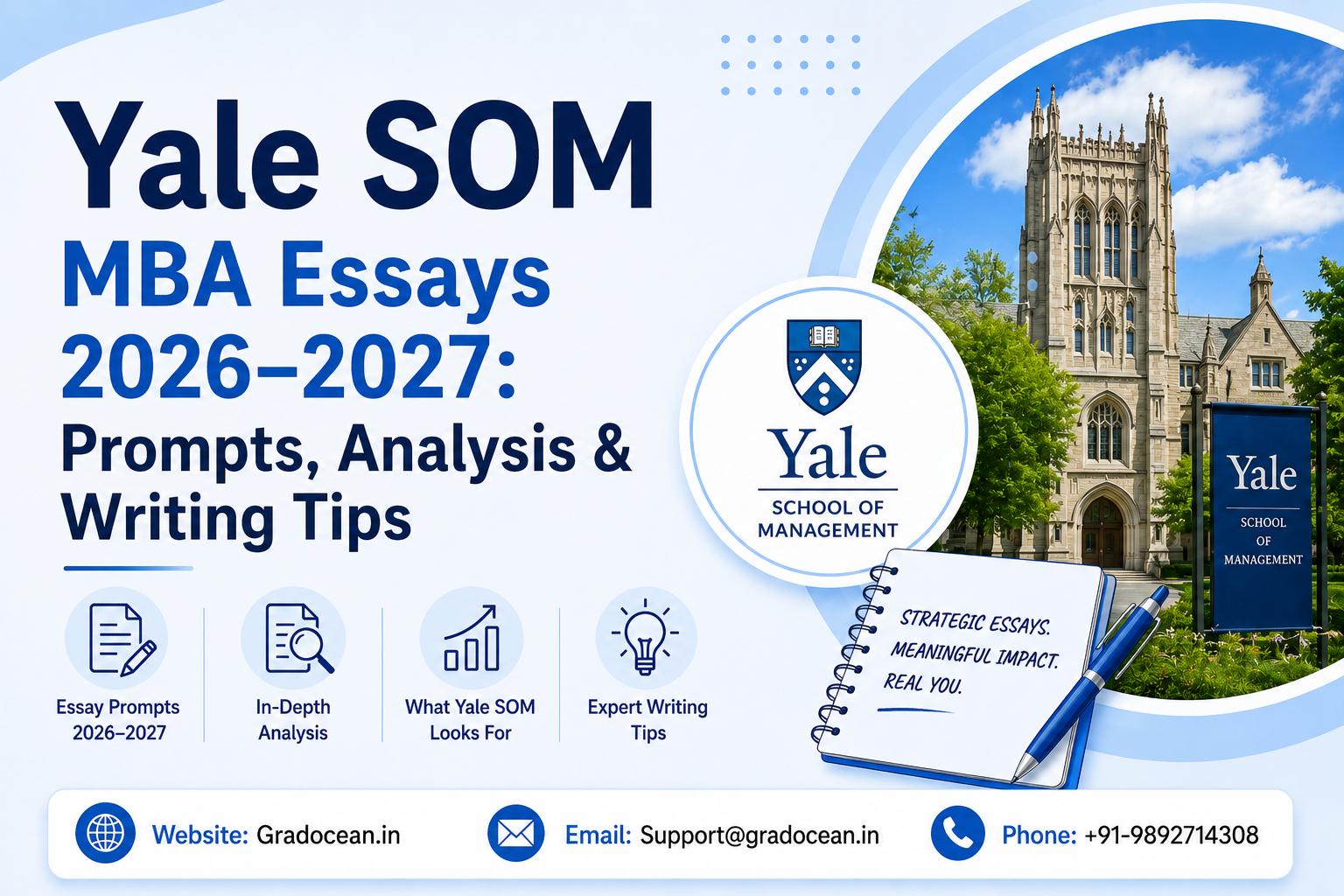
Yale School of Management (Yale SOM) has taken a slightly different approach to its MBA essays for the 2026–2027 application cycle. Instead of asking every applicant to answer multiple questions, Yale gives candidates three essay options and asks them to choose one.
The prompts focus on three areas that can reveal a great deal about an applicant: commitment, community, and personal challenges.
This gives applicants considerable flexibility. You can choose the question that allows you to tell the most meaningful story about yourself rather than trying to fit your experiences into a predetermined format.
For the 2026–2027 cycle, the required Yale SOM MBA essay has a 500-word limit. Reapplicants are also required to submit an additional essay of up to 200 words.
In this guide, we break down all three Yale SOM MBA essay prompts, explain what each question is really asking, and share practical approaches for deciding which prompt is right for you.
Yale SOM MBA Essay Prompts 2026–2027
Yale SOM asks applicants to select one of the following three prompts:
Option 1: Biggest Commitment
Describe the biggest commitment you have ever made. Why is this commitment meaningful to you and what actions have you taken to support it?
Word limit: 500 words
Option 2: Most Meaningful Community
Describe the community that has been most meaningful to you. What is the most valuable thing you have gained from being a part of this community and what is the most important thing you have contributed to this community?
Word limit: 500 words
Option 3: Most Significant Challenge
Describe the most significant challenge you have faced. How have you confronted this challenge and how has it shaped you as a person?
Word limit: 500 words
There is no inherently better prompt. The strongest choice is the one that gives you the clearest opportunity to reveal something important about who you are, how you think, and how you have developed.
Yale SOM Essay Option 1: Biggest Commitment
Prompt
Describe the biggest commitment you have ever made. Why is this commitment meaningful to you and what actions have you taken to support it?
This prompt is not simply asking you to describe an achievement or an ambitious professional goal.
The key word is commitment.
Yale SOM wants to understand what you have cared about deeply enough to sustain over time—and, more importantly, what you have actually done because of that commitment.
What should you write about?
Your commitment could come from almost any part of your life.
It might involve:
- A professional responsibility you took seriously
- A family responsibility
- A social or community initiative
- Mentoring or supporting others
- A personal goal that required sustained effort
- An entrepreneurial pursuit
- A cause or issue you genuinely care about
- A long-term involvement outside work
The subject itself does not need to sound impressive.
In fact, choosing a story simply because it sounds impressive can make the essay feel generic. What matters is why this commitment matters to you and how you have demonstrated it through your actions.
A useful structure
- Introduce the commitment
Start by giving the reader enough context to understand what you committed yourself to and how that commitment developed.
Avoid spending too many words setting up the story. With only 500 words, you need to get to the heart of the experience quickly.
- Explain why it matters
This is where the essay becomes personal.
Ask yourself:
- Why did I care about this?
- Where did this sense of responsibility come from?
- What did this commitment mean to me personally?
- Why did I continue when it became difficult?
The answer should go beyond “I wanted to make an impact.”
- Show what you actually did
This should be the core of the essay.
Rather than saying that you were committed, demonstrate it through specific actions.
What did you change? Who did you involve? What obstacles did you face? What decisions did you make?
- Reflect on what the commitment changed in you
End by showing what you learned about yourself.
Perhaps the experience changed your understanding of responsibility, leadership, persistence, or the way you work with others.
The reflection should feel like a natural conclusion to the story rather than a generic statement about becoming a better leader.
Common mistake
Don’t turn this into a resume story.
Yale already has access to your professional accomplishments. The essay should help the admissions committee understand the person behind those accomplishments.
Yale SOM Essay Option 2: Most Meaningful Community
Prompt
Describe the community that has been most meaningful to you. What is the most valuable thing you have gained from being a part of this community and what is the most important thing you have contributed to this community?
This prompt is particularly interesting because Yale asks you to discuss both sides of the relationship.
What did the community give you?
And what did you give back?
That distinction is important.
What counts as a community?
Don’t limit yourself to formal organizations.
A community could be:
- Your workplace or professional team
- A student organization
- A sports team
- A volunteer organization
- A cultural or creative group
- An entrepreneurial community
- A group formed around a shared interest
- A local community
- A family or close-knit personal community
The strongest community is usually one in which you have had a meaningful and sustained relationship, rather than something you joined briefly for your application profile.
What Yale is looking for
The admissions committee is interested in how you function as part of a group.
For example:
- How do you build relationships?
- What have you learned from people different from you?
- How have others influenced your thinking?
- What role do you naturally play in a group?
- How have you helped others?
- What responsibility have you taken?
- How has the community changed you?
A useful structure
- Establish the community
Give the reader a clear picture of the community and your relationship with it.
Don’t spend 200 words describing the organization itself. Yale is interested in your experience within it.
- Explain what you gained
Think beyond obvious answers such as “friendships” or “networking.”
Perhaps the community taught you to listen before acting, gave you confidence to take risks, exposed you to perspectives you had never considered, or changed how you understand leadership.
- Explain what you contributed
This part deserves equal attention.
What did you personally do that made the community stronger?
Your contribution doesn’t have to involve a formal leadership position. Mentoring someone, creating a process, bringing people together, solving a recurring problem, or simply becoming a dependable member can all be meaningful.
- Bring the two sides together
The most compelling essays often show that the relationship was reciprocal.
You weren’t simply taking from the community, and you weren’t simply helping others.
You grew because of the community, and your contribution helped shape it in return.
Common mistake
Don’t turn this into a “leadership essay” simply because you want to demonstrate leadership.
If the community story is fundamentally about belonging, learning, relationships, and contribution, let it remain that way.
Authenticity is more valuable than trying to tick an admissions checkbox.
Yale SOM Essay Option 3: Most Significant Challenge
Prompt
Describe the most significant challenge you have faced. How have you confronted this challenge and how has it shaped you as a person?
This prompt gives you an opportunity to discuss an experience that tested you and changed your perspective.
But there is an important distinction:
The essay is not really about the challenge. It is about your response to the challenge and what happened to you because of it.
Choosing the right challenge
A strong challenge does not necessarily have to be the most dramatic event in your life.
Instead, look for an experience that genuinely forced you to reconsider something, adapt, make difficult decisions, or grow.
It could be:
- A significant professional setback
- A difficult career decision
- Failure in an important endeavor
- A major responsibility you weren’t prepared for
- A situation involving conflict or uncertainty
- A personal obstacle
- A difficult transition
- An experience that challenged a deeply held belief
The important thing is that the experience should have real stakes and lasting consequences.
How to approach the essay
- Establish what made the challenge difficult
The reader needs to understand what was at stake.
Why was this situation particularly difficult for you?
What made it different from an ordinary problem?
- Focus on your response
This should be the heart of the essay.
Explain what you did.
But don’t just provide a chronological list of actions. Show the thinking behind those actions.
What options did you consider? What did you get wrong? What did you change? Who did you turn to for help?
- Acknowledge uncertainty or mistakes
A challenge essay does not require you to present yourself as someone who handled everything perfectly.
In fact, acknowledging mistakes can make the essay more credible.
The goal isn’t to prove that you are flawless. It is to demonstrate self-awareness and growth.
- Explain how the experience shaped you
This is perhaps the most important part of the prompt.
How did the experience change:
- Your values?
- Your perspective?
- Your approach to leadership?
- Your relationship with others?
- Your decision-making?
- Your understanding of yourself?
Avoid ending with a generic lesson such as “I learned that challenges make us stronger.”
Show specifically how this experience changed you.
Which Yale SOM Essay Prompt Should You Choose?
Don’t choose the prompt based on what you think Yale “wants to hear.”
Instead, compare your potential stories.
| Prompt | Best suited if you have… |
|---|---|
| Commitment | A long-term responsibility, cause, goal, or pursuit that says something meaningful about you |
| Community | A community that has significantly shaped you and where you have made a genuine contribution |
| Challenge | A difficult experience that changed your perspective or way of operating |
A simple test can help.
For each potential story, ask:
“Can I tell this story in 500 words while revealing something about myself that Yale cannot learn from the rest of my application?”
If the answer is yes, you may have found your essay topic.
How to Make Your Yale SOM Essay Stand Out
1. Don’t write what you think Yale wants to hear
Yale SOM’s prompts are deliberately broad.
Use that flexibility.
You don’t need to manufacture a social-impact story, invent a dramatic challenge, or turn an ordinary experience into a leadership case study.
Write about something that genuinely matters to you.
2. Prioritize specific stories over broad claims
Instead of writing:
“I have always believed in helping others.”
Show the reader a moment when that belief influenced what you actually did.
Specific details make an essay believable.
3. Spend less time describing and more time reflecting
A 500-word essay is extremely short.
You cannot afford to spend most of the essay explaining what happened.
A useful approach is:
Story → Action → Reflection
The story gives context. Your actions reveal who you are. Your reflection explains why the experience matters.
4. Don’t repeat your resume
If your career achievements already appear elsewhere in the application, don’t simply reproduce them in essay form.
Use the essay to explain the motivation, values, relationships, or personal experiences behind those achievements.
5. Be comfortable being personal
These prompts are designed to reveal something beyond your job title and career progression.
Don’t be afraid to discuss uncertainty, mistakes, vulnerability, relationships, or experiences that changed you.
The strongest personal essays often reveal something the applicant couldn’t communicate through a resume alone.
6. Keep the Yale connection subtle
You do not necessarily need a final paragraph saying:
“This is why I will be a great fit for Yale SOM.”
The essay is primarily about you.
If your story naturally demonstrates qualities that fit Yale SOM’s community, the admissions committee will make that connection.
Yale SOM Video Assessment
After submitting the application, Yale SOM applicants complete a video assessment designed to give the admissions committee another perspective on the applicant.
Applicants respond to two questions, with 60 seconds available for each response.
The questions are intended to be answered spontaneously, so applicants should focus on becoming comfortable with the format rather than preparing memorized responses.
Use the practice functionality in the application portal to get familiar with the one-minute limit.
A few practical tips:
- Practice answering questions within 60 seconds.
- Choose a quiet location.
- Check your camera, microphone, and internet connection.
- Speak naturally rather than memorizing a script.
- Keep your answers focused.
- Don’t try to sound overly rehearsed.
The purpose of the video assessment is to give Yale a sense of how you communicate and present yourself beyond the written application.
Yale SOM MBA Application Deadlines 2026–2027
For the Class of 2029, Yale SOM’s MBA application deadlines are:
| Round | Application Deadline | Decision Date |
|---|---|---|
| Round 1 | September 15, 2026 | December 3, 2026 |
| Round 2 | January 6, 2027 | March 18, 2027 |
| Round 3 | April 7, 2027 | May 13, 2027 |
If Yale SOM is one of several schools on your MBA list, it is worth planning your essays well ahead of the deadline. The 500-word limit may look manageable, but choosing the right story and developing a meaningful reflection often takes considerably more time than expected.
Final Thoughts: How to Approach Yale SOM Essays
The biggest opportunity in Yale SOM’s 2026–2027 essay is also its biggest challenge: you have a lot of freedom.
You can write about a commitment, a community, or a challenge. The right choice depends entirely on your personal experiences.
Rather than asking, “Which prompt will impress Yale?”, ask:
“Which experience best explains something important about who I am?”
Once you identify that experience, focus on the details that reveal your values, decisions, relationships, growth, and perspective.
A strong Yale SOM essay should leave the reader with a clearer understanding of the person behind the application—not simply another list of accomplishments.
Frequently Asked Questions About Yale SOM MBA Essays
1. How many Yale SOM MBA essays are required for the 2026–2027 application cycle?
Applicants are required to choose one of three essay prompts and submit a response of up to 500 words. Reapplicants have an additional 200-word essay requirement.
2. What are the Yale SOM MBA essay prompts for 2026–2027?
Applicants can choose from three topics: their biggest commitment, the community that has been most meaningful to them, or the most significant challenge they have faced.
3. Which Yale SOM essay prompt should I choose?
There is no universally best prompt. Choose the one that gives you the strongest opportunity to share a meaningful experience and demonstrate self-awareness, personal growth, and your values.
4. Can I write about a personal experience in the Yale SOM essay?
Yes. The prompts are intentionally broad, so your essay can focus on a professional, personal, academic, family, community, or other meaningful experience.
5. Should my Yale SOM essay be about my career?
Not necessarily. Your professional experience can certainly be the basis for your essay, but avoid simply repeating your resume. The strongest essay will reveal something about your motivations, values, decisions, or personal growth.
6. Can I write about a family experience for the commitment essay?
Yes. A family responsibility or long-term commitment can be an excellent topic if it genuinely represents a significant commitment in your life and you can clearly explain why it matters to you and what actions you took to honor it.
7. What makes a strong Yale SOM community essay?
A strong community essay demonstrates both what you gained and what you contributed. Focus on a community that has had a meaningful influence on you and where your involvement has been genuine and sustained.
8. Does my community have to be related to work or academics?
No. Yale SOM does not require your community to be professional or academic. A meaningful community can come from your personal life, hobbies, volunteering, sports, cultural activities, or other areas of your life.
9. What kind of challenge should I use for the Yale SOM challenge essay?
Choose a challenge that genuinely tested you and resulted in meaningful growth. The challenge does not need to be dramatic, but it should have real stakes and allow you to demonstrate how you responded, adapted, and changed.
10. Should I discuss my failures in the challenge essay?
You can. Discussing mistakes or failures can make the essay more compelling when you can demonstrate what you learned and how the experience changed your approach. Avoid presenting yourself as either completely responsible for everything or as a victim of circumstances.
11. How personal should my Yale SOM essay be?
The essay should be personal enough to reveal something that the rest of your application cannot. Don’t force vulnerability, but don’t be afraid to discuss meaningful experiences, uncertainty, mistakes, relationships, or changes in perspective when they are relevant to your story.
12. Should I mention Yale SOM in my essay?
You don’t have to. The Yale SOM essay prompt is primarily designed to understand you. A forced paragraph explaining why you belong at Yale can take valuable space away from your story.
13. What is the Yale SOM video assessment?
The Yale SOM video assessment gives applicants an opportunity to demonstrate their communication style and personality beyond the written application. Applicants answer two questions and have 60 seconds for each response.
14. Can I prepare for the Yale SOM video questions?
You should practice the format, but avoid memorizing scripted answers. Use the practice tool provided through the application portal to become comfortable answering questions within the 60-second limit.
15. What are the Yale SOM MBA application deadlines for 2026–2027?
The Round 1 deadline is September 15, 2026, Round 2 is January 6, 2027, and Round 3 is April 7, 2027.
16. How important are the Yale SOM essays in the overall application?
The essays are an important part of the application because they provide context that cannot be captured through test scores, grades, or a resume alone. They give the admissions committee an opportunity to understand your values, motivations, experiences, and personal growth.
17. How can I make my Yale SOM essay more authentic?
Start with your actual experiences rather than trying to reverse-engineer what you think the admissions committee wants. Use specific moments, decisions, conversations, and reflections from your life. Avoid excessive buzzwords and generic statements about leadership or impact.
18. Can I use the same story for another MBA school’s essay?
You can potentially use the same underlying experience, but the essay should be tailored to the specific question. Yale SOM’s prompts are asking for personal reflection, so simply recycling an essay written for another school may result in a response that does not fully address the question.
19. How should I approach the 500-word limit?
Treat the 500 words as a constraint that forces you to prioritize. Focus on one central story rather than trying to cover your entire career or personality. Every paragraph should either advance the story or help the reader understand what the experience means to you.
20. What is the biggest mistake applicants make in Yale SOM essays?
One of the most common mistakes is trying too hard to impress the admissions committee. Applicants sometimes turn personal stories into achievement lists or force themes such as leadership and social impact into experiences where they don’t naturally belong. A focused, specific, and genuinely personal story is usually much more effective.
Other Article of Interest:
1. NYU Stern MBA Essays 2026–27: Prompts, Guidelines & How to Approach Them
2. INSEAD MBA Essays 2026–27: Prompts, Guidelines & How to Approach Them
3.HEC Paris MBA Essays 2026–2027: Analysis, Tips, Frameworks & Samples
4.Darden MBA Essays 2026–2027: Prompts, Analysis, Guidelines & How to Approach Them
5.Michigan Ross MBA Essays 2026–2027: Analysis, Tips, Frameworks & Strategies
6.Duke Fuqua MBA Essays 2026–27: Prompts, Analysis & Application Tips
7.Berkeley Haas MBA Essays 2026–27: Prompts, Analysis & Writing Tips
8. Dartmouth Tuck MBA Essays 2027: Prompts, Analysis & Writing Tips