

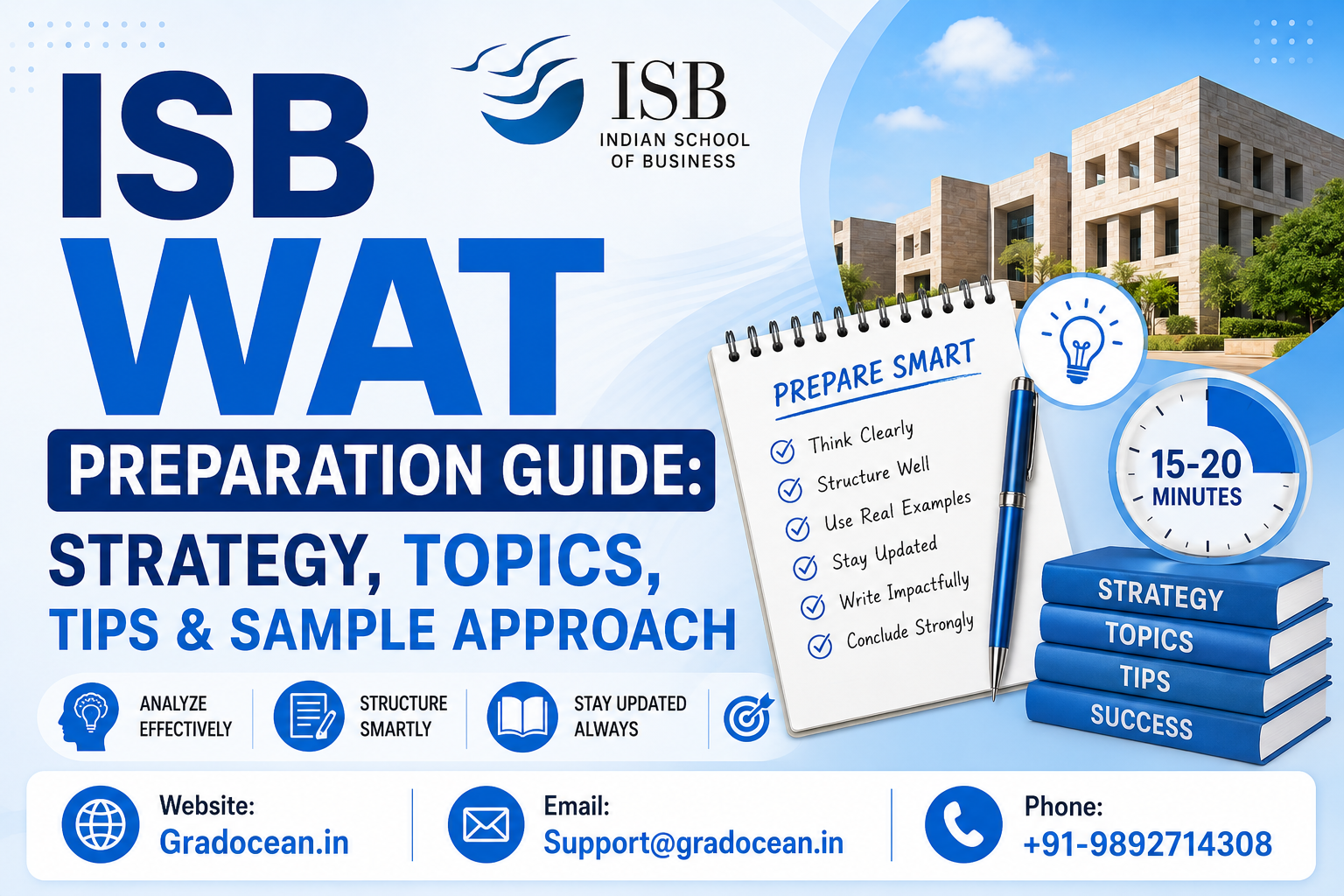
The Written Ability Test (WAT) is an important component of the ISB admission process. It evaluates a candidate’s ability to analyze a topic, build logical arguments, and communicate ideas clearly within a limited timeframe.
While the WAT may appear to be a simple writing exercise, it is actually a test of your thought process, awareness, communication skills, and ability to present a balanced perspective.
This ISB WAT preparation guide covers the format, importance, preparation strategy, writing framework, common mistakes, and practical tips to help you perform better in the assessment.
What is the ISB Written Ability Test (WAT)?
The ISB Written Ability Test is a timed written assessment designed to understand how effectively a candidate can think, structure ideas, and express viewpoints.
Unlike a traditional essay where you have unlimited time to research and edit, the ISB WAT requires you to organize your thoughts quickly and present a meaningful response under pressure.
Typical Format:
Duration: 15–20 minutes
Number of Questions: Usually 2 topics
Word Limit: No fixed word limit
Mode: Generally conducted during the interview process (offline or online depending on the admission cycle)
The objective is not to write the most complex essay but to demonstrate clarity, maturity, and structured thinking.
Why is ISB WAT Important?
The ISB admissions committee uses the WAT as a window into your thinking ability.
It helps evaluate:
Clarity of Thought
Can you understand the topic quickly and develop a logical viewpoint?
A strong response shows that you can identify the core issue and approach it systematically.
Structured Communication
Can you organize your thoughts into a clear beginning, middle, and conclusion?
The ability to communicate complex ideas simply is an important leadership skill.
Awareness of Current Affairs
Many WAT topics are based on:
- Business trends
- Economic developments
- Social issues
- Technology
- Global events
Being aware of the world helps you build stronger arguments.
Analytical and Critical Thinking
The evaluator looks for your ability to:
- Consider multiple perspectives
- Identify challenges
- Present balanced arguments
- Reach logical conclusions
A strong WAT performance can strengthen your overall application and create a positive impression before the interview.
How to Prepare for ISB WAT?
1. Understand the Topic Before Writing
Before you start writing, spend the first few moments analyzing the topic.
Ask yourself:
- What exactly is the topic asking?
- Is it asking for an opinion, analysis, or solution?
- What are the possible perspectives?
Many weak responses fail because candidates start writing without understanding the issue properly.
2. Follow a Clear Essay Structure
A simple structure works best:
Introduction
Introduce the topic and establish your viewpoint.
Avoid generic openings. Try to directly address the core issue.
Body
Develop your argument using:
- Logical reasoning
- Examples
- Data points
- Real-world situations
Try to cover multiple dimensions rather than presenting only one side.
Conclusion
Summarize your main points and provide a balanced closing thought.
A strong conclusion leaves the evaluator with a clear understanding of your perspective.
3. Keep Your Writing Clear and Concise
The objective is effective communication.
Avoid:
- Unnecessary jargon
- Complicated sentences
- Repeating the same ideas
Focus on making your arguments easy to understand.
4. Practice Under Time Pressure
WAT requires speed along with quality.
Practice regularly by:
- Selecting random topics
- Spending 2–3 minutes planning
- Writing within 15–20 minutes
- Reviewing your structure and arguments
The more you practice, the easier it becomes to organize thoughts quickly.
5. Stay Updated with Current Affairs
A strong awareness of current events helps you add depth to your responses.
Follow:
- Business news
- Economic policies
- Global developments
- Technology trends
- Social issues
Do not just memorize facts.
Understand the impact and different viewpoints around each issue.
6. Improve Grammar and Expression
Even strong ideas can lose impact if they are poorly expressed.
Focus on:
- Sentence clarity
- Grammar
- Logical transitions
- Professional tone
Use simple language that communicates your thoughts effectively.
7. Develop Your Own Perspective
ISB is not looking for a textbook answer.
A good essay reflects:
- Independent thinking
- Professional experiences
- Practical insights
- Balanced judgment
Your personal and professional experiences can help make your response unique.
5-Step Framework to Write a Winning ISB WAT Essay
Step 1: Identify the Core Issue
Break down the topic.
Understand:
- The main argument
- Hidden assumptions
- Key stakeholders involved
This helps you avoid going off-topic.
Step 2: Consider Counter Arguments
Strong essays acknowledge different perspectives.
Instead of presenting only one side, discuss:
- Advantages
- Challenges
- Trade-offs
This demonstrates maturity and analytical thinking.
Step 3: Add Relevant Examples
Examples make your arguments stronger.
You can use:
- Current events
- Industry examples
- Historical examples
- Professional experiences
Choose examples that directly support your point.
Step 4: Suggest a Way Forward
For policy or problem-based topics, include practical solutions.
Discuss:
- Possible actions
- Implementation challenges
- Long-term impact
This demonstrates solution-oriented thinking.
Step 5: End with a Strong Conclusion
Your conclusion should:
- Summarize your key argument
- Reinforce your perspective
- Provide a broader insight
Avoid ending abruptly.
Common Mistakes to Avoid in ISB WAT
Lack of Structure
A response without a clear flow becomes difficult to evaluate.
Always organize your thoughts before writing.
Overgeneralization
Avoid statements without reasoning or examples.
Instead of making absolute claims, explain your logic.
Going Off Topic
Many candidates introduce unrelated points.
Stay focused on the central theme.
Weak Conclusions
A weak ending can reduce the overall impact.
Always close with a clear final thought.
Trying to Sound Too Complex
Simple and logical writing is more effective than complicated language.
Sample ISB WAT Topics
Some common themes for ISB WAT preparation include:
Business and Economy
- Is economic growth possible without increasing inequality?
- Are startups overvalued in today’s market?
- Should companies prioritize shareholders or stakeholders?
- Is globalization helping developing countries?
Technology
- Will AI create more jobs than it eliminates?
- Should governments regulate artificial intelligence?
- Is technology reducing human interaction?
Society and Governance
- Should social media platforms be regulated?
- Is privacy more important than security?
- Can economic development happen without environmental damage?
Leadership and Ethics
- Should leaders prioritize results or processes?
- Is failure necessary for professional growth?
- How should organizations handle ethical conflicts?
Final Thoughts
The ISB WAT is not just a test of writing ability. It is an assessment of how you think, analyze problems, and communicate your perspective.
A successful WAT response requires:
- Structured thinking
- Awareness of current affairs
- Balanced arguments
- Clear communication
The goal is not to write a perfect essay.
The goal is to demonstrate the mindset of a future business leader.
With consistent practice and the right approach, you can significantly improve your performance in the ISB WAT and strengthen your overall application.
Other Articles of Interest:
1. ISB vs International MBA: How to Choose the Right Path for Your Career
2. Indian MBA Programs Are Rising Fast in Global Rankings — Here’s Why It Matters
3. Top Executive MBA Programs in India
4.GMAT Waiver for MBA: A Complete Guide to Test-Optional Business Schools
5.Top Global One-Year MBA Programs for Experienced Professionals: A Comprehensive Guide
6.Best MBA Programs for Healthcare: Top Schools, Curriculum & Career Scope (2026 Guide)
7. Best MBA Programs for Sustainability & ESG: Top Schools, Curriculum & Career Scope (2026 Guide)
8. ISB vs IIM One-Year MBA (2026): Fees, Placements, Rankings, ROI & Which is Better?
9. MBA ROI vs Rankings: How to Choose the Right MBA Program in 2026
10. ISB PGP Curriculum Breakdown: What You Actually Learn (And Why It Matters)
11. The Real Role of Extracurriculars in MBA Admissions (ISB, IIMA PGPX, IIMB EPGP)
12. What Should a Strong Letter of Recommendation Include? (ISB, IIMA PGPX, IIMB EPGP Guide)
13.Career Pathways for Chartered Accountants After a One-Year MBA (ISB, IIMA PGPX, IIMB EPGP)
15. ISB PGP Essay Analysis 2026–27: How to Write Winning ISB Essays (With Expert Tips)
16. IIM Mumbai One-Year MBA (PGPEx): Everything You Need to Know
17.IIM Calcutta PGPEX-VLM Program: A Comprehensive Guide
21. IIM Ahmedabad PGPX Extempore Preparation Guide: Topics, Strategy & Tips
22. IIM Bangalore EPGP WAT Preparation Guide: Topics, Strategy & Sample Questions