

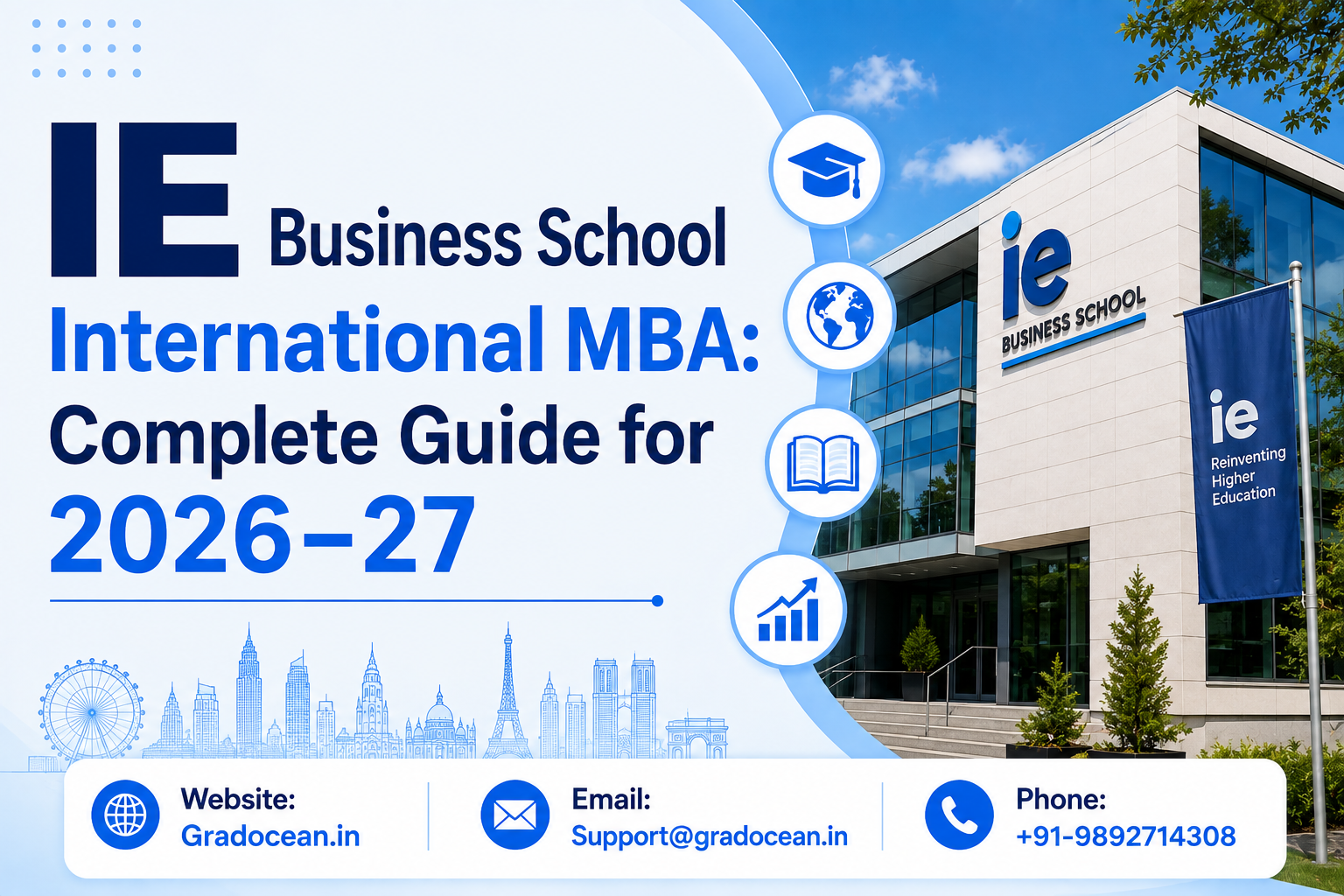
The IE Business School International MBA is one of Europe’s most distinctive MBA programmes, particularly for candidates interested in entrepreneurship, technology, innovation and international careers.
Located in Madrid, IE Business School has built its MBA around flexibility, diversity and personal transformation. Unlike traditional MBA programmes that follow a largely fixed structure, the International MBA allows students to customise the length and content of their experience based on their career goals.
With students representing more than 70 nationalities and international students making up more than 90% of the cohort, the programme offers a genuinely global classroom.
In this guide, we cover the IE International MBA structure, curriculum, duration options, career opportunities, admissions process, scholarships and how it compares with other leading European MBA programmes.
IE Business School International MBA at a Glance
- Location: Madrid, Spain
- Format: Full-time, in-person
- Language: English
- Intakes: September and January
- Duration: 11, 15 or 19 months
- Tuition: €89,900, plus a €1,200 IE Foundation contribution
- Average age: 29–30 years
- Average work experience: Approximately 6 years
- International students: 90%+
- Nationalities represented: 70+
- Accreditation: AACSB, EQUIS and AMBA
What Makes IE Business School Different?
IE Business School was founded in 1973 by entrepreneurs with the objective of approaching management education differently.
Today, that entrepreneurial DNA remains central to the school’s identity.
The International MBA is built around four key ideas: a pioneer mindset, Liquid Learning, global diversity and individual transformation.
1. Pioneer Mindset
IE places considerable emphasis on innovation, entrepreneurship and challenging traditional approaches to business education.
The programme is particularly relevant for candidates who are comfortable with uncertainty and want to explore new business models, technologies and ways of working.
2. Liquid Learning
One of IE’s most distinctive concepts is Liquid Learning.
The approach combines physical and digital learning experiences to create a more flexible educational environment.
Rather than treating online and classroom learning as completely separate formats, IE integrates both into the overall learning experience.
3. Global Diversity
Diversity is one of the strongest characteristics of the IE MBA.
With more than 70 nationalities represented and over 90% international students, students interact with classmates from a wide range of professional, cultural and geographic backgrounds.
For candidates targeting international careers, this can be particularly valuable.
4. Individual Transformation
IE places significant emphasis on personal development and career transformation.
The programme is designed to help students understand their professional goals, identify their strengths and develop a career path aligned with their ambitions.
IE International MBA Programme Structure
The IE International MBA is designed as a full-time programme delivered in English in Madrid.
One of its biggest advantages is the flexibility around programme duration.
Students can choose between three different tracks:
11-Month MBA
The 11-month option is designed for candidates who want an accelerated MBA experience.
It can be particularly suitable for professionals who already have strong business fundamentals and a relatively clear career direction.
15-Month MBA
The 15-month option provides additional time for electives, career development and international exposure.
Students also receive an extended Global Immersion Month and more opportunities to participate in career-focused labs.
19-Month MBA
The 19-month option offers the greatest level of flexibility.
It allows students to explore a broader range of electives, spend more time developing specialised skills and undertake a more extensive career transition.
For candidates looking for significant professional reinvention, the longer format can be particularly attractive.
The Four Stages of the IE MBA Experience
The programme can broadly be understood through four stages.
Core Period
Students begin by developing fundamental knowledge in areas such as management, leadership and digital innovation.
This provides the foundation required for the more personalised parts of the programme.
Personalised Journey
Students then have greater flexibility to shape their MBA experience.
This can include electives, career-focused labs and international exchange opportunities based on individual career goals.
Global Immersion
The programme also places significant emphasis on international exposure.
Students participate in multicultural teamwork, company visits and initiatives focused on social impact and European markets.
Next Best You
IE also places considerable emphasis on behavioural development.
The Next Best You component focuses on mindset, personal development, professional identity and purpose.
The objective is not simply to develop technical business skills but also to help students become more effective leaders.
How Does IE Compare With Other European MBA Programmes?
IE competes with several leading European business schools, but its positioning is somewhat different.
IE Business School – Madrid
11–19 months
Key strengths: Diversity, entrepreneurship and Liquid Learning
London Business School – London
15–21 months
Key strengths: Finance, consulting and global alumni network
INSEAD – France/Singapore
Approximately 10 months
Key strengths: Global alumni network and international mobility
HEC Paris – France
Approximately 16 months
Key strengths: Finance, strategy and strong European recruiting
IESE Business School – Barcelona
Approximately 19 months
Key strengths: Case-method learning, leadership and general management
ESADE Business School – Barcelona
Approximately 12 months
Key strengths: Entrepreneurship, innovation and international careers
Rotterdam School of Management – Rotterdam
Approximately 12 months
Key strengths: European multinational connections and international business
Frankfurt School of Finance & Management – Frankfurt
Approximately 12 months
Key strengths: Finance, fintech and the German business ecosystem
IE’s strongest differentiators are its international diversity, entrepreneurial ecosystem and flexibility around programme duration.
Who Is the IE International MBA Best Suited For?
The programme does not target candidates from one specific professional background.
Instead, it is particularly relevant for professionals looking to make a meaningful career transition or expand their international exposure.
Career Switchers
Professionals looking to move into a new industry, function or geography can benefit from IE’s flexible curriculum and career resources.
International Professionals
Candidates who have already worked across multiple countries or want to build an international career can benefit from the programme’s highly diverse classroom.
Entrepreneurs
IE is particularly attractive for candidates who want to start, scale or internationalise a business.
Experienced Professionals
The programme can also suit professionals who want to move from technical or functional roles into broader management and leadership positions.
IE MBA Career Outcomes
Technology and consulting are among the major career destinations for IE MBA graduates.
The employment distribution in the referenced data is:
- Technology: 28%
- Consulting: 21%
- Consumer Goods: 18%
- Financial Services: 13%
- Other sectors: 20%
Major employers associated with IE graduates include Amazon, Salesforce, BCG, McKinsey, Deloitte, Barclays, GSK and AB InBev.
The breadth of employers reflects the programme’s sector diversity and international orientation.
However, candidates should always review the latest IE employment report before making decisions, as recruiting outcomes can vary across graduating classes.
Entrepreneurship at IE Business School
Entrepreneurship is one of IE’s strongest differentiators.
Around 25% of IE alumni go on to start their own businesses, highlighting the importance the school places on entrepreneurship.
Students also have access to several entrepreneurship initiatives.
Area 31
Area 31 is IE’s entrepreneurship and innovation space, hosting more than 100 events each year and providing a platform for entrepreneurs, investors and students.
Venture Lab
The Venture Lab supports hundreds of startups each year and provides entrepreneurs with mentorship, resources and opportunities to pitch their businesses.
The programme culminates in Venture Day Madrid.
EnlightED
IE is also involved in EnlightED, an edtech accelerator whose participating startups have collectively raised around $60 million.
South Summit
IE is closely connected with South Summit, one of Europe’s major entrepreneurship events.
The event attracts thousands of entrepreneurs, CEOs, investors and executives.
For candidates who want entrepreneurship to be a significant part of their MBA experience, this ecosystem is a major advantage.
IE MBA Admissions Process
IE follows a rolling admissions model rather than relying exclusively on fixed application deadlines.
This means candidates can apply throughout the year, although applying early is generally advisable because places are offered on a rolling basis.
The admissions process typically consists of four stages.
1. Online Application
Candidates submit their application along with documents such as:
- CV
- Academic transcripts
- Recommendations
- Personal statement
- English-language proficiency documentation, where applicable
2. Admissions Test
Applicants can submit a GMAT or GRE score or take the IE-specific ieGAT.
The choice of test can depend on the candidate’s profile and preferred application strategy.
3. Kira Assessment
Shortlisted candidates complete a Kira assessment.
The assessment generally includes video and written responses and is designed to give the admissions team a better understanding of the candidate’s personality, communication style and motivations.
4. Personal Interview
Candidates who progress further are invited for a personal interview.
The interview typically lasts around 45–60 minutes and focuses on the candidate’s professional background, career goals, motivations and overall fit with IE.
A final decision is generally communicated within a few weeks of the interview.
International applicants should also account for visa processing timelines when planning their application.
IE MBA Scholarships and Financial Aid
IE offers a broad range of scholarships, with awards ranging from partial tuition assistance to full tuition coverage.
Some of the key options include:
IE High Potential Award
A merit-based scholarship for strong candidates. Applicants are automatically considered as part of the admissions process.
Dean’s Award
A highly competitive scholarship covering up to 70% of tuition.
The award is limited to a small number of candidates and is intended for exceptionally strong applicants.
Application-Based Scholarships
IE offers several scholarships providing approximately 10–40% tuition coverage for candidates from specific backgrounds.
These can include opportunities related to:
- Asia Pacific
- High achievers
- Technology and innovation
- Women in business
Angelini Academy Gateway
Candidates from areas such as life sciences and robotics may be eligible for the Angelini Academy Gateway.
This opportunity can provide full funding covering tuition and living expenses, along with an internship opportunity with Angelini Industries.
Is IE Business School a Good Choice?
IE Business School is particularly attractive for candidates who value entrepreneurship, international exposure and flexibility.
It may be a strong fit if you are:
- Looking to transition into a new industry or function
- Interested in technology or entrepreneurship
- Planning an international career
- Interested in launching a business
- Looking for a highly diverse MBA cohort
- Interested in a flexible MBA duration
- Comfortable with a less traditional approach to management education
However, candidates primarily targeting traditional finance careers may want to compare IE carefully with schools such as LBS, HEC Paris or other programmes with particularly strong finance ecosystems.
Similarly, candidates focused heavily on consulting should compare IE’s consulting outcomes with schools that have particularly strong consulting pipelines.
Final Takeaway
The IE International MBA is not simply another European MBA programme.
Its strongest differentiators are its entrepreneurial DNA, highly international student body, flexible programme structure and emphasis on personal transformation.
The choice between the 11, 15 and 19-month formats also allows candidates to tailor the programme to their career objectives.
For someone looking for an international career, entrepreneurship, technology exposure or a significant career transition, IE can be a compelling option.
But as with any MBA, the right question is not simply whether IE is a good business school.
The more important question is whether IE’s ecosystem, location, curriculum, career opportunities and cost align with your specific post-MBA goals.
For candidates considering the IE International MBA, understanding that fit should be the starting point of the application strategy.
Frequently Asked Questions About the IE Business School International MBA
1. Is IE Business School good for an MBA?
Yes. IE Business School is one of Europe’s leading business schools and is particularly well known for entrepreneurship, technology, innovation, international exposure and career flexibility. It can be especially attractive for candidates looking to switch industries, functions or geographies.
2. Where is the IE International MBA located?
The IE International MBA is based in Madrid, Spain. The programme is delivered in English and is designed as a full-time, in-person MBA.
3. How long is the IE International MBA?
IE offers three duration options: 11 months, 15 months and 19 months. The shorter format is suitable for candidates seeking an accelerated MBA, while the longer options provide more opportunities for electives, international exposure and career exploration.
4. How much does the IE International MBA cost?
The tuition fee is €89,900, along with an additional €1,200 IE Foundation contribution. Candidates should also budget separately for accommodation, living expenses, travel, insurance and other personal costs.
5. What is the average age of IE MBA students?
The average age of students is around 29–30 years, with approximately six years of professional experience. However, the class includes candidates from a broad range of professional and personal backgrounds.
6. How diverse is the IE International MBA class?
IE has a highly international student body, with more than 70 nationalities represented and over 90% of students coming from outside Spain. This makes the programme particularly attractive for candidates seeking a global classroom experience.
7. What are the main career sectors after an IE MBA?
Technology and consulting are among the largest employment sectors, followed by consumer goods and financial services. IE graduates also move into sectors such as healthcare, telecommunications, energy, industrials and entrepreneurship.
8. Is IE Business School good for consulting?
Yes. Consulting is one of the major career destinations for IE MBA graduates, with companies such as BCG, McKinsey and Deloitte among the prominent employers associated with the school. However, candidates should evaluate consulting outcomes based on their target geography, firm and role.
9. Is IE Business School good for technology careers?
IE can be a strong choice for candidates targeting technology, digital transformation, product management, innovation and technology strategy. Its location in Madrid and broader European network provide access to a growing technology ecosystem.
10. Is IE Business School good for entrepreneurship?
Entrepreneurship is one of IE’s biggest strengths. The school provides access to initiatives such as Area 31, Venture Lab and South Summit, giving students opportunities to connect with entrepreneurs, investors and startups.
11. Does IE offer scholarships?
Yes. IE offers a range of scholarships covering partial to, in some cases, full tuition. Options include the IE High Potential Award, Dean’s Award and several application-based scholarships for candidates from specific backgrounds.
12. Does IE require GMAT or GRE?
Candidates can generally apply using the GMAT or GRE, while IE also offers its own admissions test, the ieGAT. The appropriate option depends on the applicant’s profile and application strategy.
13. What is the IE MBA admissions process?
The process generally involves submitting an online application, completing an admissions test, participating in a Kira assessment and attending a personal interview. IE follows a rolling admissions process, so candidates should consider applying early.
14. What is the Kira assessment at IE?
The Kira assessment is designed to give the admissions team an early understanding of the candidate beyond their CV and academic profile. It typically includes video and written responses covering areas such as motivation, personality and communication.
15. Is IE Business School better than INSEAD?
Neither is universally better. INSEAD has an exceptionally strong global alumni network and a highly accelerated MBA format, while IE is particularly differentiated by its entrepreneurship ecosystem, diversity, flexibility and Madrid location. The better choice depends on your career goals.
16. Is IE better than ESADE or IESE?
IE, ESADE and IESE are all strong European MBA options but have different strengths. IE is particularly strong in entrepreneurship, innovation and international diversity, while IESE is known for its case-based approach and general management focus, and ESADE has strong positioning in entrepreneurship, innovation and international business.
17. Can I work in Europe after an IE MBA?
An IE MBA can provide access to European employers, but employment opportunities depend on factors such as nationality, visa eligibility, language skills, previous experience and the target country. Candidates should research work authorization requirements for their preferred destination before applying.
18. Is IE Business School worth it for Indian students?
IE can be a good option for Indian students looking for an international MBA and considering careers in Europe, technology, consulting, entrepreneurship or multinational companies. However, applicants should carefully compare the total cost, post-MBA salary potential, visa considerations and career opportunities against alternatives such as ISB, IIMs and other European MBA programmes.
19. Which IE MBA duration should I choose?
The right duration depends on your career goals. The 11-month format can work well for candidates with a clear career direction, while the 15-month and 19-month options provide more time for electives, international experiences, internships and career exploration.
20. Who should consider the IE International MBA?
The IE MBA can be particularly suitable for professionals looking for an international career, industry or functional transition, entrepreneurship opportunities, technology exposure or a highly diverse MBA experience. Candidates should ultimately evaluate the programme based on their post-MBA goals rather than rankings alone.