

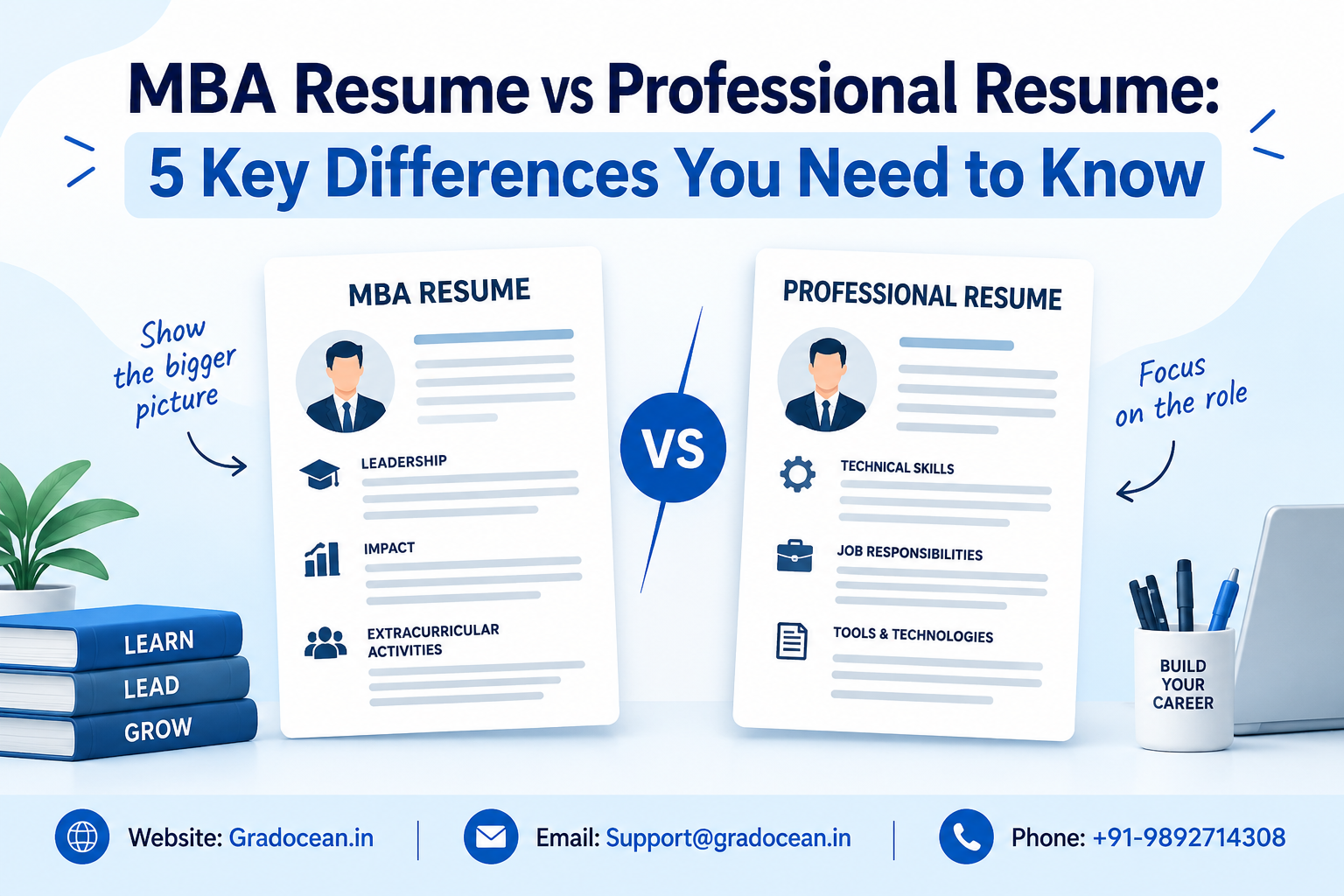
Your resume is an important part of your MBA application, but an MBA resume is not the same as the resume you would use while applying for a job.
A professional resume is typically written for recruiters and hiring managers who understand your industry and want to determine whether your experience matches a particular role. An MBA admissions committee evaluates your resume from a different perspective.
Admissions officers are interested in understanding your career progression, leadership potential, impact, achievements, and experiences outside work. Your MBA resume therefore needs to be written specifically for the admissions process rather than simply being a copy of your professional resume.
Here are five important differences to keep in mind while preparing your MBA resume.
1. Avoid Excessive Industry Jargon
Your professional resume may contain technical terminology, acronyms, product names, tools, and industry-specific language. This can make sense when the person reading your resume works in the same industry.
An MBA admissions officer, however, may have little familiarity with your particular function or sector.
For example, if you work in technology, consulting, engineering, healthcare, financial services, or manufacturing, do not assume that the admissions committee will understand every technical term you use.
Your objective should be to make your experience understandable to someone who does not work in your industry.
Instead of focusing heavily on technical details, explain the business problem you addressed, what you were responsible for, and what changed because of your contribution.
A simple test can help: if someone from a completely different industry cannot understand a bullet point, consider simplifying it.
2. Highlight Leadership and Transferable Skills
A professional resume often emphasizes the technical skills required for a particular job. An MBA resume should provide a broader picture of your capabilities.
Admissions committees are interested in evidence of leadership, initiative, problem-solving, collaboration and decision-making.
Think about experiences where you:
- Led a team or project
- Took ownership beyond your formal responsibilities
- Influenced senior stakeholders
- Introduced a new idea or process
- Managed an important client or relationship
- Solved a significant business problem
- Worked across multiple functions
- Mentored or developed colleagues
- Made decisions in difficult or uncertain situations
Leadership also does not necessarily mean managing a large team. You can demonstrate leadership by influencing people, taking initiative or assuming responsibility for an important outcome.
Your resume should help the admissions committee understand not just what technical skills you possess, but also how you operate within an organization.
3. Focus on Achievements Rather Than Job Responsibilities
One of the most common MBA resume mistakes is turning the professional experience section into a description of the applicant’s job.
For example:
“Responsible for managing relationships with key clients and coordinating with internal teams.”
This explains what the position involves, but tells the reader very little about how well you performed.
A stronger MBA resume focuses on what you actually accomplished.
Ask yourself:
What did I improve?
What problem did I solve?
What initiative did I lead?
What responsibility did I take beyond my regular role?
Did I receive a promotion or recognition?
Did my work generate revenue, reduce costs, improve efficiency or increase customer satisfaction?
Did I influence an important organizational decision?
Two people with the same job title can have very different levels of impact. Your MBA resume should make that distinction visible.
4. Quantify Your Impact Wherever Possible
Numbers provide context and make accomplishments easier to understand.
Instead of writing:
“Managed an important product launch.”
You could write:
“Led the launch of a new product across 12 cities, coordinating a 15-member cross-functional team and contributing ₹8 crore in first-year revenue.”
Depending on your role, useful metrics could include:
- Revenue generated
- Costs reduced
- Percentage improvement
- Number of customers served
- Size of teams managed
- Project or portfolio value
- Number of markets or locations covered
- Increase in sales or adoption
- Reduction in processing time
- Number of stakeholders or clients managed
Not every bullet needs a number, and you should never force metrics where they do not naturally exist. However, wherever reliable numbers are available, they can make your impact much more tangible.
5. Show Who You Are Beyond Your Job
Your professional experience will naturally occupy a significant part of your MBA resume, but admissions committees are evaluating more than your career.
Extracurricular activities, volunteering, sports, entrepreneurship, community involvement, leadership positions and meaningful personal interests can add another dimension to your profile.
This becomes particularly valuable when these experiences demonstrate qualities that may not be visible through your professional experience.
For example, you may have:
- Led a college or alumni organization
- Built a side business
- Volunteered consistently with an NGO
- Mentored students or young professionals
- Competed seriously in a sport
- Organized community initiatives
- Pursued a meaningful creative interest over several years
The key is to prioritize substance over quantity.
Adding numerous superficial activities simply to make the resume appear more impressive can create unnecessary clutter. Include experiences that genuinely tell the admissions committee something meaningful about you.
What Should an MBA Resume Ultimately Communicate?
An effective MBA resume should allow an admissions officer to quickly understand three things: where you have been, what impact you have created, and how you have progressed.
Your resume should demonstrate a clear trajectory across your professional and personal experiences.
Rather than simply listing everything you have done, prioritize experiences that demonstrate increasing responsibility, leadership, initiative and measurable impact.
This also means that you do not necessarily need to include every responsibility from every job. An MBA resume is a selective representation of your experiences, not an exhaustive record of your employment history.
Final Thoughts
Your MBA resume may contain much of the same factual information as your professional resume, but the way that information is presented should be different.
A professional resume is primarily designed to demonstrate your suitability for a particular job. An MBA resume should help an admissions committee understand your overall trajectory, achievements, leadership potential and the experiences you could bring to the classroom.
Keep the language accessible, minimize unnecessary technical jargon, emphasize accomplishments over responsibilities, quantify your impact where possible, and include meaningful experiences outside work.
Most importantly, every bullet should earn its place on the page.
Other Articles of Interest:
1. ISB vs International MBA: How to Choose the Right Path for Your Career
2. Indian MBA Programs Are Rising Fast in Global Rankings — Here’s Why It Matters
3. Top Executive MBA Programs in India
4.GMAT Waiver for MBA: A Complete Guide to Test-Optional Business Schools
5.Top Global One-Year MBA Programs for Experienced Professionals: A Comprehensive Guide
6.Best MBA Programs for Healthcare: Top Schools, Curriculum & Career Scope (2026 Guide)
7. Best MBA Programs for Sustainability & ESG: Top Schools, Curriculum & Career Scope (2026 Guide)
8. ISB vs IIM One-Year MBA (2026): Fees, Placements, Rankings, ROI & Which is Better?
9. MBA ROI vs Rankings: How to Choose the Right MBA Program in 2026
11. HEC Paris MBA Essays 2027 Intake: A Complete Guide to Writing Winning Essays
16.MBA University of Virginia Darden MBA Admissions Guide (2026–2027 Intake)
18. MBA Letters of Recommendation (LOR): Complete Guide for Applicants
19.2026 IIM Ahmedabad PGPX Extempore Topics: Latest Questions & Preparation Guide
20. 18 Key Insights About ISB PGP Admissions
21.ISB PGP R1: What to Focus on Before You Submit Your Application
22. IIM Indore EPGP 2027–28: Admissions, Eligibility, Placements, Fees, Programme & Application Guide
24. IIM Lucknow IPMX 2027–28: Admissions, Eligibility, Placements, Batch Profile & Application Guide
25. Post-MBA Career Options for Fashion Professionals After a One-Year MBA in India
26. Post-MBA Career Options for Lawyers After a One-Year MBA in India
28. Post-MBA Career Options for PSU Professionals After a One-Year MBA in India
31. Post-MBA Career Options for Civil Engineering Professionals After a One-Year MBA in India