

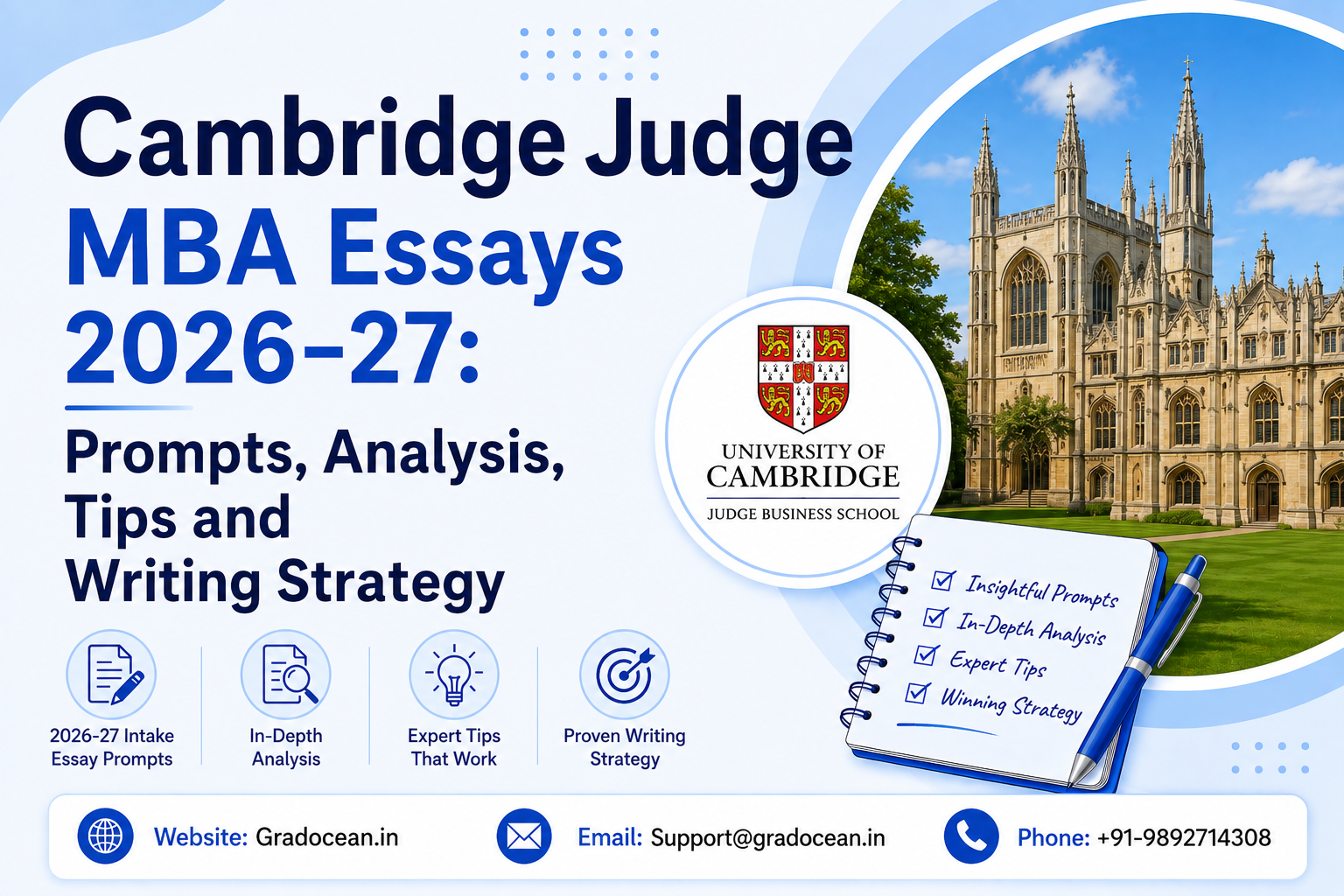
The Cambridge Judge MBA application for the 2026-27 admissions cycle gives applicants several opportunities to demonstrate their career ambitions, professional maturity, teamwork skills, and personal values. The written application includes a 500-word Career Objectives statement and three additional essays of up to 200 words each.
The three shorter essays focus on a professional mistake, a successful team experience, and an individual who has positively influenced your life. Together, these questions allow the admissions committee to understand not only what you have achieved, but also how you respond to setbacks, collaborate with others, and learn from the people around you.
Cambridge Judge has five application rounds for the 2026-27 cycle, with Round 1 closing on 24 August 2026 and the final round closing in May 2027.
In this guide, we break down each Cambridge Judge MBA essay prompt, explain what the admissions committee is likely looking for, and share practical strategies for developing thoughtful and convincing responses.
Cambridge Judge MBA Career Objectives
Prompt:
Please provide details of your post-MBA career plans. The statement should not exceed 500 words and address the following:
- What are your short- and long-term career objectives? How will the Cambridge MBA equip you to achieve these?
- Looking at your short-term career goal, describe the research you have done to understand how this industry, role, and location recruits MBA talent and what they are looking for in a candidate.
- How confident do you feel about meeting your short-term career goal? What skills and characteristics do you already have that will help you achieve it, and what preparation are you doing now?
What Cambridge Judge wants to understand
The Career Objectives statement is one of the most important parts of the Cambridge Judge application because it brings together your professional experience, future ambitions, and reasons for pursuing an MBA.
The admissions committee wants to see that you have a clear understanding of where you want to go and why an MBA is necessary at this stage of your career.
Your goals should be ambitious but credible. The committee will also look at whether you understand the realities of your intended career transition, including how recruitment works, what employers look for, and where you may need to strengthen your profile.
The essay is also an opportunity to demonstrate self-awareness. Rather than presenting yourself as someone who already has every skill required for your target role, identify the capabilities you have developed and the areas where you still need to grow.
How to structure the Career Objectives statement
Begin with your immediate post-MBA goal. Clearly explain the role, industry, and geography you are targeting. Avoid broad statements such as “I want to work in consulting” or “I want to move into technology.” Explain what type of role you want and why it is the logical next step for you.
Next, discuss your longer-term objective. Your long-term goal should build naturally on your short-term plan rather than appearing as an unrelated ambition.
The next section should explain why Cambridge Judge is important to achieving these objectives. Rather than listing courses, clubs, or resources, focus on the specific gaps you need the MBA to address. This could include industry knowledge, leadership capabilities, international exposure, technical skills, or access to a particular professional network.
The recruitment research component is particularly important. Demonstrate that you have looked beyond general industry information and understand how MBA recruitment actually works in your target market.
You could discuss conversations with alumni or professionals, recruitment events, company research, industry reports, or your understanding of the skills employers seek. The objective is to demonstrate that your career plan is based on research rather than assumptions.
Finally, assess your readiness for the transition. Identify the strengths you already possess and explain how they will help you compete for your target role. At the same time, acknowledge the gaps you need to address and describe the steps you are already taking.
Tips for the Career Objectives essay
- Be specific about your career direction. Clearly define your target role, industry, and location.
- Create a logical career story. Your post-MBA objective should make sense in light of your previous experience.
- Explain why Cambridge Judge is necessary. Focus on the specific capabilities, experiences, and networks you need from the MBA.
- Demonstrate recruitment awareness. Show that you understand how employers in your target market hire MBA graduates.
- Include evidence of preparation. Networking, relevant projects, certifications, industry research, or other preparation can strengthen your credibility.
- Be realistic about challenges. Acknowledging genuine gaps demonstrates maturity and self-awareness.
- Avoid turning the essay into a list of Cambridge resources. Every program feature you mention should have a clear connection to your career objectives.
Cambridge Judge MBA Essay Prompts 2026-2027
The three additional Cambridge Judge MBA essays for the 2026-27 application cycle are:
- Tell us about a time when you made a professional mistake. How could it have ended differently? Maximum 200 words.
- Tell us about the best team you worked with. What made the team successful? Maximum 200 words.
- Provide an example of when someone else positively impacted your life. What did you learn from this experience? Maximum 200 words.
With only 200 words for each response, applicants need to be selective. The goal is not to provide every detail of the story, but to choose the details that reveal something meaningful about your character and approach to work.
Cambridge Judge MBA Essay 1: Professional Mistake
Prompt:
Tell us about a time when you made a professional mistake. How could it have ended differently? Maximum 200 words.
What Cambridge Judge is looking for
This question is designed to test your self-awareness and ability to learn from failure.
Everyone makes mistakes. The important distinction is how you respond to them. Cambridge Judge wants to see whether you can acknowledge your role, understand what went wrong, and use the experience to change your future behavior.
A strong response should demonstrate accountability rather than blame others or present a mistake that was barely a mistake at all.
How to approach the essay
Start by establishing the situation quickly. Explain the project, decision, or professional circumstance and identify the mistake you made.
Do not spend most of your 200 words describing the background. The admissions committee is more interested in your reflection than in the mechanics of the incident.
Explain what happened as a result of your decision. Then discuss what you would have done differently.
Perhaps you should have communicated earlier, involved another stakeholder, challenged an assumption, gathered more information, delegated differently, or sought feedback before acting.
The most important part is demonstrating how the experience changed your behavior.
For example, if you previously tended to make decisions independently, you could explain how the experience taught you to involve stakeholders earlier. The lesson should be specific enough that the reader can see how you have applied it since.
Tips for the mistake essay
Choose a genuine professional mistake with meaningful consequences.
Take responsibility for your role.
Do not blame colleagues, managers, clients, or external circumstances.
Avoid examples that make you look careless or unethical.
Do not disguise a success as a failure.
Spend more time on the lesson and subsequent change than on describing the mistake.
Show that the experience influenced how you operate today.
Cambridge Judge MBA Essay 2: Best Team Experience
Prompt:
Tell us about the best team you worked with. What made the team successful? Maximum 200 words.
What Cambridge Judge is looking for
Cambridge Judge places considerable importance on collaboration, and this essay provides an opportunity to demonstrate how you function within a team.
The committee wants to understand what you believe makes a team effective and how you personally contributed to that success.
The strongest responses will go beyond statements such as “we communicated well” or “everyone respected each other.” Instead, explain what the team actually did differently and how those behaviors contributed to the outcome.
How to structure the essay
Begin with a brief description of the team and its objective. Give the reader enough context to understand what was at stake.
Then identify two or three factors that made the team successful.
These could include complementary skills, trust, effective leadership, constructive disagreement, shared ownership, clear communication, diversity of perspectives, or a strong sense of accountability.
Your own role should be clear, but avoid turning the essay into another leadership story if your contribution was actually as a team member.
Cambridge Judge is interested in whether you understand that effective teamwork is not necessarily about being the person in charge.
End by reflecting on what the experience taught you about collaboration and how it has influenced the way you work with teams today.
Tips for the team essay
Choose a specific team rather than describing your general approach to teamwork.
Explain what made this particular team successful.
Be honest about your contribution.
Highlight the team’s dynamics rather than focusing exclusively on your own achievements.
Show that you value different perspectives.
Include the outcome where relevant, but do not let the result overshadow the lesson.
Cambridge Judge MBA Essay 3: Someone Who Positively Impacted Your Life
Prompt:
Provide an example of when someone else positively impacted your life. What did you learn from this experience? Maximum 200 words.
What Cambridge Judge is looking for
This question moves away from traditional achievement-focused MBA essays and asks you to reflect on the influence of another person.
The admissions committee is interested in your ability to recognize the contributions of others, learn from them, and incorporate those lessons into your own life.
The person could be a manager, mentor, colleague, teacher, friend, family member, or another individual who had a meaningful influence on you.
The identity of the person is less important than the nature of their impact.
How to approach the essay
Introduce the person and provide just enough context to explain your relationship with them.
Then describe a specific interaction, decision, piece of advice, or example that affected you.
Avoid simply saying that someone inspired you. Explain what they did and why it changed your thinking.
The second half of the essay should focus on what you learned.
Perhaps the person taught you to approach problems differently, encouraged you to take risks, showed you the importance of empathy, changed your leadership style, or helped you reconsider an assumption.
The strongest responses also demonstrate that the lesson has continued to influence your actions.
Tips for the essay
Choose someone who genuinely had an impact on you.
Focus on a specific interaction or experience.
Show rather than simply state the person’s influence.
Explain what you learned and how it changed you.
Demonstrate that you have carried the lesson forward.
Avoid turning the response into a biography of the person.
Cambridge Judge MBA Deadlines 2026-2027
Cambridge Judge has five application rounds for the 2026-27 admissions cycle.
Round 1: Application deadline 24 August 2026. Interview window: 28 September to 9 October 2026.
Round 2: Application deadline 5 October 2026. Interview window: 9 to 20 November 2026.
Round 3: Application deadline 4 January 2027. Interview window: 15 February to 12 March 2027.
Round 4: Application deadline 22 March 2027. Interview window: 19 to 30 April 2027.
Round 5: Application deadline 4 May 2027. Interview window: 1 to 11 June 2027.
Applicants should consider applying as early as practical, particularly if they are interested in scholarships or want to maximize the time available for the admissions process.
How to Make the Four Cambridge Judge Essays Work Together
Although each essay addresses a different question, your application should still feel like a coherent representation of you.
The Career Objectives statement establishes where you want to go and why Cambridge Judge is important to that journey.
The professional mistake essay can demonstrate your ability to reflect and grow.
The team essay shows how you collaborate and contribute to groups.
The final essay provides insight into the people and experiences that have shaped your values.
Taken together, these essays should present a candidate who is ambitious but self-aware, collaborative rather than purely individualistic, and willing to learn from both personal experiences and other people.
Avoid repeating the same achievement across multiple essays. If your Career Objectives statement already discusses a major professional project, consider using a different experience for the team or mistake essay.
The admissions committee should finish reading the four responses with a broader understanding of your personality and potential than they had from your CV alone.
Final Thoughts
The Cambridge Judge MBA essays for the 2026-27 application cycle give applicants the opportunity to demonstrate much more than career ambition.
The Career Objectives statement requires a clear and well-researched explanation of your short- and long-term plans, your understanding of MBA recruitment, and the reasons Cambridge Judge is the right bridge to your next career stage.
The three 200-word essays require a different kind of reflection. They ask you to demonstrate how you respond to mistakes, what you have learned from working in effective teams, and how other people have influenced your development.
Because the word limits are tight, strong essays depend on careful selection. Choose specific experiences, remove unnecessary background, and spend your words on the insights that reveal something distinctive about you.
Most importantly, avoid trying to manufacture the “perfect” MBA applicant. Cambridge Judge is looking for candidates who can reflect on their experiences, learn from others, work effectively with diverse teams, and bring a clear sense of purpose to the MBA.
Your objective should be to make the admissions committee understand not only what you have accomplished, but also how you think, how you learn, and what you hope to contribute to the Cambridge Judge community.
Frequently Asked Questions
How many essays does Cambridge Judge require for the 2026-27 MBA application?
Cambridge Judge requires one 500-word Career Objectives statement and three additional essays of up to 200 words each.
What is the Cambridge Judge Career Objectives essay?
The Career Objectives statement asks applicants to explain their short- and long-term career goals, how the Cambridge MBA will help them achieve those goals, how they have researched MBA recruitment in their target industry and location, and how prepared they currently are for their desired career path.
What is the word limit for the Cambridge Judge MBA essays?
The Career Objectives statement has a maximum of 500 words. Each of the three additional essays has a maximum of 200 words.
What does Cambridge Judge ask about professional mistakes?
The first short essay asks applicants to describe a professional mistake and explain how the situation could have ended differently. The maximum response length is 200 words.
What should I write about for the Cambridge Judge team essay?
Choose a specific team experience that demonstrates what makes collaboration effective. Explain the team’s objective, the factors that contributed to its success, your role, and what you learned about teamwork.
Who should I write about in the “someone who positively impacted your life” essay?
You can write about anyone who has had a meaningful influence on you, including a mentor, manager, colleague, teacher, friend, or family member. Focus on the specific impact they had and what you learned from the experience.
When should I apply to Cambridge Judge?
Cambridge Judge has five application rounds for the 2026-27 cycle, beginning on 24 August 2026 and ending on 4 May 2027. Applying earlier can be beneficial for candidates who want to maximize their opportunities for scholarships and admission.
Other Article of Interest:
1. NYU Stern MBA Essays 2026–27: Prompts, Guidelines & How to Approach Them
2. INSEAD MBA Essays 2026–27: Prompts, Guidelines & How to Approach Them
3.HEC Paris MBA Essays 2026–2027: Analysis, Tips, Frameworks & Samples
4.Darden MBA Essays 2026–2027: Prompts, Analysis, Guidelines & How to Approach Them
5.Michigan Ross MBA Essays 2026–2027: Analysis, Tips, Frameworks & Strategies
6.Duke Fuqua MBA Essays 2026–27: Prompts, Analysis & Application Tips
7.Berkeley Haas MBA Essays 2026–27: Prompts, Analysis & Writing Tips
8. Dartmouth Tuck MBA Essays 2027: Prompts, Analysis & Writing Tips
9. Yale SOM MBA Essays 2026–2027: Prompts, Analysis & Writing Tips
10. Cornell Johnson MBA Essays 2026–2027: Prompts, Analysis, Tips & Deadlines
11. London Business School MBA Essays 2026–2027: Prompts, Analysis, Tips & Deadlines