

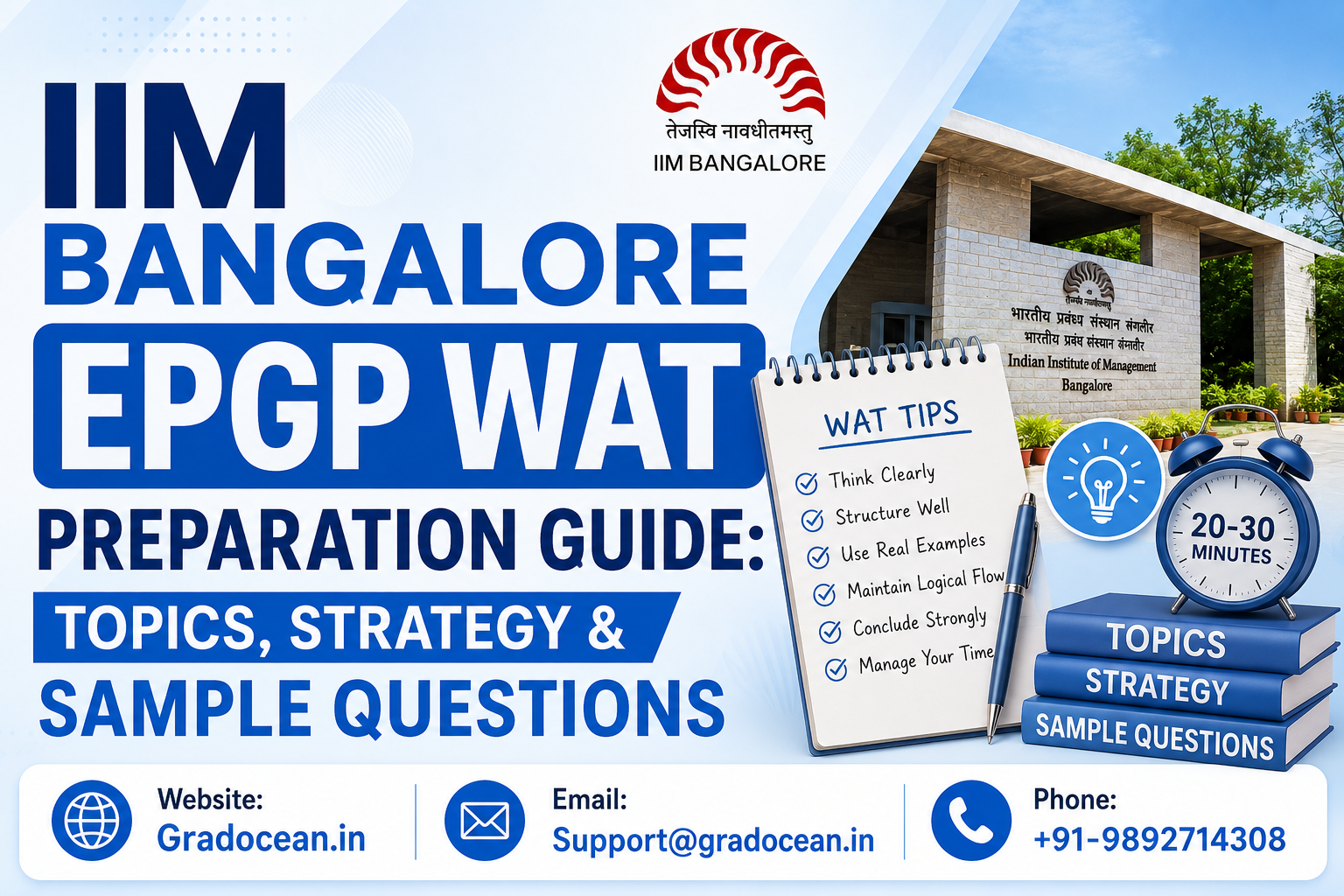
The IIM Bangalore EPGP Written Ability Test (WAT) is an important stage of the admission process for the one-year MBA programme. It evaluates a candidate’s ability to analyze a topic, structure arguments, think critically, and communicate ideas clearly within a limited time.
Unlike a conventional essay-writing test, the WAT is not about writing a fact-heavy answer. The objective is to understand how you think, how you approach complex issues, and how effectively you can present your perspective.
This guide covers the IIM Bangalore EPGP WAT format, evaluation criteria, preparation strategy, topic categories, and sample questions to help you prepare effectively.
What is IIM Bangalore EPGP WAT?
The Written Ability Test (WAT) is conducted as part of the IIM Bangalore EPGP selection process.
Candidates are provided with a topic and are required to write a structured response within a limited timeframe.
The topics generally cover:
- Current affairs
- Business and economics
- Technology
- Social issues
- Ethics
- Leadership situations
- Abstract themes
The panel uses the WAT to evaluate your clarity of thought, communication ability, maturity, and decision-making approach.
IIM Bangalore EPGP WAT Format
The typical WAT process includes:
- A topic is given to the candidate
- Candidates get limited time to analyze the topic
- A short essay is written, usually around 250–300 words
- The response may be discussed during the personal interview
The topics can be:
- Opinion-based
- Analytical
- Case-based
- Situational
The interview panel may use your written response to understand your reasoning and leadership mindset.
What Does IIM Bangalore Evaluate Through WAT?
1. Clarity of Thought
The evaluator wants to understand whether you can quickly interpret a topic and form a logical viewpoint.
You do not need to know every detail about the topic. Your ability to structure your thoughts matters more.
2. Logical Flow and Structure
A strong WAT response usually follows:
Introduction:
Provide context and define the issue.
Body:
Explain your arguments with examples.
Counter Perspective:
Acknowledge another viewpoint.
Conclusion:
Summarize your position.
3. Depth and Originality
Avoid generic statements.
A good answer demonstrates:
- Independent thinking
- Practical examples
- Balanced analysis
- Ability to evaluate multiple perspectives
4. Writing Ability
The panel also evaluates:
- Grammar
- Sentence construction
- Coherence
- Ability to communicate complex ideas simply
How to Prepare for IIM Bangalore EPGP WAT?
Stay Updated with Current Affairs
WAT topics often come from areas like:
- Business
- Economy
- Public policy
- Technology
- Global affairs
Develop a habit of reading news and editorials regularly.
Focus on understanding:
- Why something happened
- Its impact
- Different perspectives
Practice Structured Writing
A simple framework:
Introduction:
Explain the topic.
Main Body:
Present 2–3 arguments.
Conclusion:
Provide a balanced closing.
This helps avoid random thoughts and improves readability.
Practice Previous Year WAT Topics
Practice helps build speed and confidence.
A useful routine:
- Select a random topic
- Spend 3–5 minutes planning
- Write within 20–30 minutes
- Review your structure
Read Editorials and Opinion Pieces
Reading opinion articles improves your ability to:
- Build arguments
- Identify counterpoints
- Write balanced responses
Types of IIM Bangalore EPGP WAT Topics
Current Affairs and Social Issues
These topics test awareness of real-world issues.
Examples:
- AI and governance
- Climate change
- Digital transformation
- Social equality
- Education reforms
- Governance challenges
Business and Economics Topics
These evaluate your understanding of organizations and markets.
Common themes:
- Startup ecosystem
- Future of work
- Globalization
- Innovation
- Sustainability
- Corporate responsibility
Abstract Topics
These test creativity and interpretation.
Examples:
- Success vs happiness
- Freedom vs responsibility
- Change is the only constant
- Knowledge vs wisdom
Situational and Leadership-Based WAT Topics
Some WAT questions are designed around real-life management situations.
These evaluate:
- Leadership ability
- Ethical decision-making
- Team management
- Conflict resolution
Examples:
Team Conflict Situation
During a group presentation project, one team member strongly disagrees with the strategy and starts expressing disagreement aggressively.
How would you handle the situation and rebuild team alignment?
Managing Priorities
A new case competition opportunity comes up, but participating may affect the progress of an ongoing project.
As a leader, how would you balance both?
Quality vs Deadline
Your team has a strict deadline. Members suggest shortcut solutions that may create problems later.
How would you handle this situation?
IIM Bangalore EPGP WAT Sample Questions
Below are sample practice questions based on common WAT themes.
Technology, AI and Future of Work
- How will automation, artificial intelligence, and emerging technologies impact jobs in the future?
- Can Artificial Intelligence improve governance without compromising accountability?
- Will AI create more jobs than it eliminates?
- Is technological progress increasing inequality?
- Should governments regulate AI to balance innovation and risks?
- Can machines be taught ethical decision-making?
Business and Economy
- Startup valuations are driven more by hype than performance. Discuss.
- Are startups the real drivers of inclusive economic growth?
- Should organizations focus on shareholder wealth or stakeholder value?
- Can economic development and environmental protection coexist?
- Is globalization empowering nations or weakening local economies?
- Should India focus more on self-reliance?
Society and Governance
- Is freedom of press in India sufficient?
- Should governments regulate social media platforms?
- Is digital surveillance necessary for national security?
- Is caste enumeration a step towards social justice or political mobilization?
- Should dissent be considered a responsibility in democracy?
- Is gender equality still a distant goal?
Environment and Sustainability
- Is climate change the biggest challenge facing humanity?
- Can India achieve economic growth while reducing emissions?
- Is coal still necessary for India’s development?
- Should environmental regulations be relaxed for faster growth?
- Are climate commitments realistic or political promises?
Leadership and Ethical Situations
- During a group project, you make a mistake that affects the team. Would you disclose it?
- A team member is not contributing to a project. How would you handle the situation?
- A high-performing teammate is stressed and unable to attend meetings. What would you do?
- A colleague suggests showing inflated project results to improve grades. How would you respond?
- A manager offers you an expensive gift after assigning a project. How would you handle it?
- A supplier delays deliveries repeatedly, impacting operations. How would you resolve it?
Conflict Management Questions
- A team member strongly disagrees with the presentation strategy and becomes aggressive. How would you handle the situation?
- Your team wants to participate in a competition by compromising an existing project deadline. What would you do?
- A key team member makes an error that impacts project quality. The professor asks you to replace them. How would you respond?
- A teammate proposes a shortcut solution that may create future problems. How would you manage the situation?
Common Mistakes to Avoid in WAT
Avoid:
- Writing without structure
- Taking extreme positions without justification
- Using complicated language unnecessarily
- Repeating the same argument
- Ignoring alternate viewpoints
- Exceeding the word limit
The goal is not to impress through complexity.
The goal is to demonstrate clear thinking.
Final Tips for IIM Bangalore EPGP WAT
A strong WAT response reflects:
- Awareness
- Analytical thinking
- Leadership maturity
- Structured communication
You do not need to know everything.
You need to demonstrate that you can understand a problem, analyze different viewpoints, and communicate effectively.
The WAT is not just a writing test.
It is a reflection of how you think.
Other Articles of Interest:
1. ISB vs International MBA: How to Choose the Right Path for Your Career
2. Indian MBA Programs Are Rising Fast in Global Rankings — Here’s Why It Matters
3. Top Executive MBA Programs in India
4.GMAT Waiver for MBA: A Complete Guide to Test-Optional Business Schools
5.Top Global One-Year MBA Programs for Experienced Professionals: A Comprehensive Guide
6.Best MBA Programs for Healthcare: Top Schools, Curriculum & Career Scope (2026 Guide)
7. Best MBA Programs for Sustainability & ESG: Top Schools, Curriculum & Career Scope (2026 Guide)
8. ISB vs IIM One-Year MBA (2026): Fees, Placements, Rankings, ROI & Which is Better?
9. MBA ROI vs Rankings: How to Choose the Right MBA Program in 2026
10. ISB PGP Curriculum Breakdown: What You Actually Learn (And Why It Matters)
11. The Real Role of Extracurriculars in MBA Admissions (ISB, IIMA PGPX, IIMB EPGP)
12. What Should a Strong Letter of Recommendation Include? (ISB, IIMA PGPX, IIMB EPGP Guide)
13.Career Pathways for Chartered Accountants After a One-Year MBA (ISB, IIMA PGPX, IIMB EPGP)
15. ISB PGP Essay Analysis 2026–27: How to Write Winning ISB Essays (With Expert Tips)
16. IIM Mumbai One-Year MBA (PGPEx): Everything You Need to Know
17.IIM Calcutta PGPEX-VLM Program: A Comprehensive Guide
21. IIM Ahmedabad PGPX Extempore Preparation Guide: Topics, Strategy & Tips