



The Graduate Management Admission Council (GMAC) has introduced one of the most significant changes to the GMAT in recent years—the GMAT Superscore.
For years, MBA applicants had to rely on a single GMAT attempt to showcase their academic potential. While candidates could retake the exam, business schools evaluated each score independently, often placing greater emphasis on the highest overall score rather than the strongest performance across multiple attempts.
With the introduction of the GMAT Superscore, this approach changes significantly.
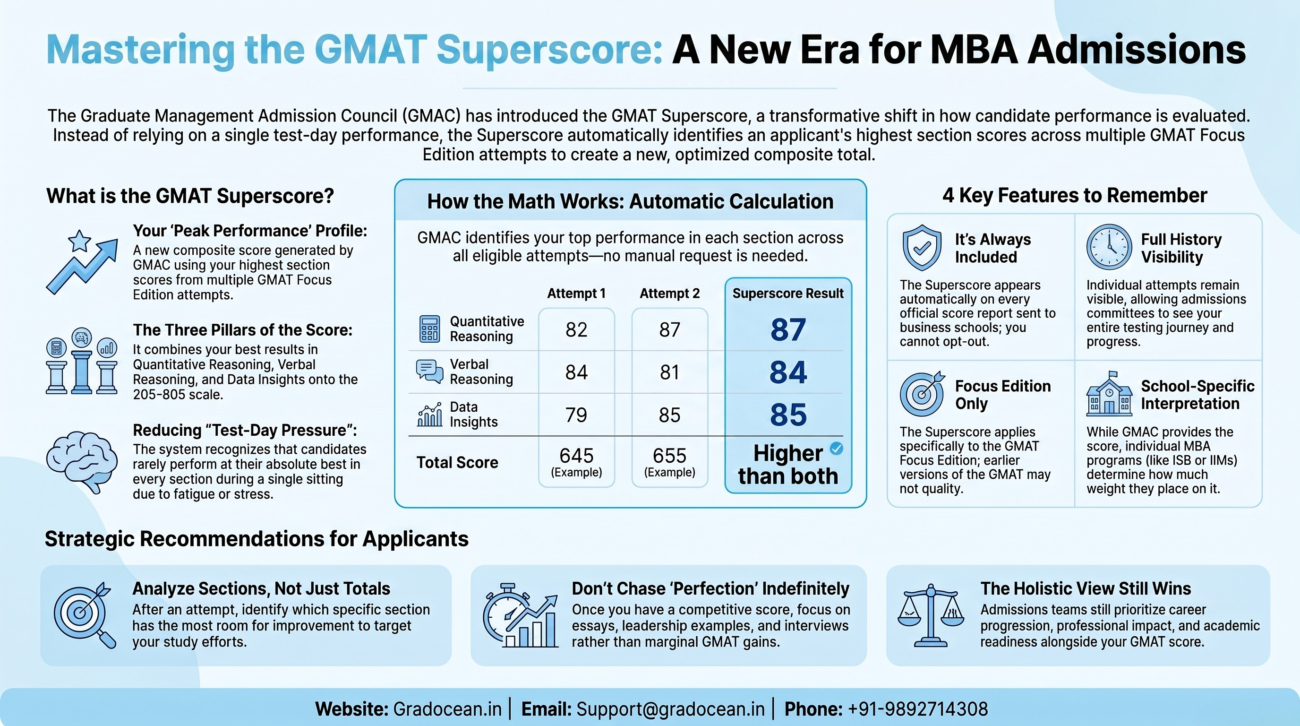
Instead of judging candidates solely on one test day, GMAC will now calculate a combined score using the highest section scores from multiple GMAT Focus Edition attempts. This allows applicants to present a score that better reflects their peak performance across Quantitative Reasoning, Verbal Reasoning, and Data Insights.
For many MBA aspirants, particularly those targeting highly competitive programs such as ISB PGP, IIM Ahmedabad MBA-PGPX, IIM Bangalore EPGP, IIM Calcutta MBAEx, and other leading one-year MBA programs, this change could influence both test-taking strategy and application planning.
In this guide, we’ll explain what the GMAT Superscore is, how it works, why GMAC introduced it, and what it means for future MBA applicants.
What Is the GMAT Superscore?
The GMAT Superscore is a new composite score generated by GMAC using your highest section scores from multiple GMAT Focus Edition attempts.
Instead of calculating your score based on a single exam sitting, GMAC identifies your best performance in each of the three sections:
- Quantitative Reasoning
- Verbal Reasoning
- Data Insights
These highest section scores are then combined to generate a new Total Score on the familiar 205–805 scale.
The Superscore does not replace your previous GMAT attempts. Rather, it appears as an additional score alongside your existing score history whenever you send your official score report to a business school.
This approach recognizes an important reality of standardized testing: candidates rarely perform at their absolute best in every section on the same day.
For example, a candidate may achieve an outstanding Quantitative score during one attempt but perform below expectations in Verbal due to fatigue or exam-day pressure. On a subsequent attempt, the opposite may happen.
Under the previous system, applicants had to choose between these scores. Under the new system, GMAC combines the strongest section performances into a single score that more accurately reflects overall ability
How Does the GMAT Superscore Work?
The calculation is straightforward.
Imagine the following performance across two GMAT Focus Edition attempts:
| Section | Attempt 1 | Attempt 2 |
|---|---|---|
| Quantitative Reasoning | 82 | 87 |
| Verbal Reasoning | 84 | 81 |
| Data Insights | 79 | 85 |
Instead of evaluating each attempt independently, GMAC selects:
- Quantitative Reasoning: 87
- Verbal Reasoning: 84
- Data Insights: 85
These section scores are then used to calculate your official GMAT Superscore.
As a result, your Superscore may be higher than the total score achieved on either individual attempt.
For applicants whose strengths vary across multiple test dates, this provides a more representative measure of their capabilities.
Key Features of the GMAT Superscore
Understanding how the new system functions is essential before planning your testing strategy.
1. It is calculated automatically
Applicants do not need to request a Superscore.
If you have multiple eligible GMAT Focus Edition attempts, GMAC automatically calculates the highest possible score using your best section performances.
2. Every official score report includes it
Whenever you send your GMAT score to a business school, the Superscore will appear alongside your individual attempts.
Unlike some other standardized tests where students can choose which scores to submit, applicants cannot opt out of including the Superscore in their official report.
3. Individual attempts remain visible
The introduction of the Superscore does not erase your testing history.
Admissions committees will still see your previous attempts, allowing them to understand your overall testing journey while also considering your strongest combined performance.
4. It applies only to the GMAT Focus Edition
The Superscore has been introduced specifically for the GMAT Focus Edition.
Candidates who took earlier versions of the GMAT should carefully review GMAC’s eligibility guidelines to understand whether previous attempts qualify.
Why Did GMAC Introduce the GMAT Superscore?
Like many changes in standardized testing, the introduction of the Superscore reflects evolving applicant behaviour and admissions trends.
One of the biggest challenges MBA applicants face is exam-day pressure.
Many candidates spend months preparing, only to underperform in one section due to stress, fatigue, or simple variance in performance.
A single difficult section can significantly reduce the overall score, even when the candidate demonstrates stronger ability across multiple attempts.
GMAC has acknowledged that this creates unnecessary anxiety for applicants.
The Superscore aims to reduce this pressure by rewarding consistent improvement across different attempts instead of treating every exam sitting as an isolated event.
It also encourages candidates to continue improving rather than abandoning applications because of one disappointing performance.
Instead of asking:
“Can I achieve my target score in one perfect sitting?”
Applicants can now think more strategically:
“How can I maximize my strongest performance across all three sections?”
What Does This Mean for MBA Applicants?
The introduction of the GMAT Superscore changes the conversation around GMAT preparation.
Previously, candidates often delayed applications while trying to achieve a perfect overall score in one sitting.
Now, applicants have greater flexibility.
Rather than expecting perfection on test day, they can focus on continuous improvement across individual sections.
This does not mean that unlimited retakes are advisable.
Business schools will continue to see your complete testing history, and applicants should still approach each attempt with adequate preparation.
However, the pressure associated with a single disappointing section performance is likely to reduce significantly.
For many candidates, this creates a more balanced and confidence-driven testing strategy.
Does the GMAT Superscore Change MBA Admissions?
While the scoring methodology has changed, the fundamentals of MBA admissions remain the same.
A competitive GMAT score is only one component of a successful application.
Leading business schools evaluate applicants holistically by considering:
- Professional achievements
- Leadership experience
- Career progression
- Academic background
- Essays
- Letters of recommendation
- Interview performance
- Career goals
The Superscore simply gives admissions committees another data point that may better represent an applicant’s academic potential.
It should be viewed as an opportunity to strengthen an already competitive application—not as a substitute for building a compelling overall profile.
What Does the GMAT Superscore Mean for MBA Applicants?
The introduction of the GMAT Superscore is undoubtedly one of the biggest changes to the exam in recent years.
However, one important question remains unanswered:
How will business schools actually evaluate it?
The answer, at least for now, is that we don’t know.
GMAC has confirmed how the Superscore will be calculated and reported. What has not yet been clarified is how individual MBA programs will incorporate it into their admissions process.
For applicants, this distinction is important.
Understanding how the Superscore works is only one part of the equation. Understanding how admissions committees choose to interpret it is equally critical.
What Has Been Confirmed?
At the time of writing, a few aspects of the GMAT Superscore are clear.
- GMAC will automatically calculate a Superscore for eligible candidates.
- The Superscore will appear on official score reports.
- Individual GMAT attempts and section scores will continue to be available as part of the score report.
Everything beyond this depends on how individual business schools choose to use the information.
As of now, many MBA programs around the world—including leading one-year MBA programs in India—have not publicly announced detailed admissions policies explaining how the GMAT Superscore will be evaluated.
Applicants should therefore avoid assuming that the Superscore will automatically replace the importance of individual GMAT attempts.
Why Applicants Shouldn’t Jump to Conclusions
Whenever a standardized test introduces a major policy change, it takes time for institutions to adapt.
Admissions committees typically evaluate several factors before updating their internal processes, including:
- Consistency with previous admissions cycles
- Academic benchmarking
- Class profile reporting
- Institutional admissions philosophy
- Internal evaluation frameworks
It is therefore entirely possible that different schools may adopt different approaches.
Some institutions may place greater emphasis on the Superscore.
Others may continue evaluating the highest single-attempt score alongside the Superscore.
Some may review both as complementary pieces of information within a holistic application review.
Until official policies are published, there is simply no way to know.
What Does This Mean for Applicants Targeting One-Year MBA Programs?
Applicants considering leading one-year MBA programs in India—including ISB PGP, IIM Ahmedabad MBA-PGPX, IIM Bangalore EPGP, IIM Calcutta MBAEx, IIM Lucknow IPMX, XLRI GMP, and other schools that accept GMAT scores—should closely monitor official admissions announcements over the coming months.
Rather than relying on speculation, applicants should base their testing strategy on information released directly by each business school.
Admissions policies evolve, and individual institutions may clarify their position as the GMAT Superscore becomes more widely adopted.
Should You Change Your GMAT Strategy?
Not dramatically.
The core objective remains exactly the same:
Achieve the strongest GMAT performance you reasonably can.
The Superscore should not become an excuse to approach the exam casually or assume that future attempts will compensate for a weaker first performance.
Instead, applicants should continue to:
- Prepare thoroughly before every attempt.
- Analyse section-level performance after each exam.
- Retake the GMAT only when there is a realistic opportunity for meaningful improvement.
- Focus on building a strong overall MBA application rather than pursuing marginal score gains indefinitely.
In many cases, strengthening essays, recommendations, leadership examples, and interview preparation will have a greater impact on admission outcomes than improving a GMAT score by a small margin.
A Holistic MBA Application Still Matters Most
One misconception applicants often have is that a higher GMAT score automatically translates into better admission chances.
In reality, leading MBA programs evaluate candidates across multiple dimensions.
Admissions committees are looking for professionals who demonstrate:
- Strong career progression
- Leadership potential
- Clear post-MBA goals
- Professional impact
- Communication skills
- Academic readiness
The GMAT helps establish one part of that profile.
The rest of the application explains who you are as a professional and why you are likely to contribute to the MBA classroom and succeed after graduation.
Whether schools ultimately place significant emphasis on the Superscore or treat it as an additional reference point, that broader evaluation process is unlikely to change.
The Practical Takeaway
The introduction of the GMAT Superscore is a positive development because it gives applicants another opportunity to showcase their strongest academic performance.
What it does not do—at least based on currently available information—is guarantee a different admissions outcome or fundamentally alter how MBA applications are evaluated.
Until business schools publish official guidance, the most effective strategy is to prepare for the GMAT as seriously as ever, stay informed about school-specific policies, and invest equal attention in the non-test components of your application.
For most applicants, a compelling career story, meaningful professional achievements, and well-crafted application materials will continue to be just as important as the GMAT score itself.
How Should MBA Applicants Prepare for the GMAT Superscore Era?
The introduction of the GMAT Superscore offers applicants greater flexibility, but it does not fundamentally change what makes a strong MBA application.
Instead of viewing the Superscore as a shortcut to admission, applicants should use it as an opportunity to plan their GMAT strategy more effectively.
Here are a few practical recommendations.
1. Prepare Seriously for Your First Attempt
Although the Superscore allows candidates to combine their best section scores across multiple attempts, your first GMAT attempt remains important.
A strong initial score gives you flexibility. If you’re already within the competitive range for your target schools, you can decide whether a retake is worthwhile based on your section-level performance rather than feeling compelled to improve your overall score.
2. Analyse Section Scores, Not Just the Total Score
One of the biggest advantages of the Superscore is that it encourages applicants to think beyond the composite score.
After every attempt, evaluate:
- Which section was your strongest?
- Which section has the greatest scope for improvement?
- Is another attempt likely to result in a meaningful increase?
This approach enables more focused preparation instead of repeating the same study plan.
3. Don’t Delay Your MBA Applications Chasing a Perfect Score
A common mistake among MBA applicants is postponing applications in pursuit of incremental GMAT improvements.
Once you’ve achieved a competitive score for your target schools, your time may be better spent strengthening:
- MBA essays
- Resume
- Letters of recommendation
- Interview preparation
- Career goals
- Leadership examples
Admissions decisions are based on the overall quality of your application—not just your GMAT score.
4. Stay Updated on School-Specific Policies
As the GMAT Superscore becomes more widely adopted, business schools are likely to release additional guidance on how they intend to evaluate it.
Before making decisions about retaking the exam, applicants should review the latest admissions information published by their target schools.
Official admissions policies should always take precedence over speculation.
Frequently Asked Questions About the GMAT Superscore
What is the GMAT Superscore?
The GMAT Superscore is a composite score calculated by GMAC using your highest Quantitative Reasoning, Verbal Reasoning, and Data Insights scores from eligible GMAT Focus Edition attempts.
Does the GMAT Superscore replace my previous GMAT scores?
No.
Your individual GMAT attempts remain part of your official score report. The Superscore is displayed as an additional score.
Can I choose whether to send my GMAT Superscore?
According to GMAC, the Superscore is included in official score reports for eligible candidates. Applicants should review GMAC’s latest policies for complete details.
Should I retake the GMAT because of the Superscore?
Not necessarily.
A retake should be based on realistic opportunities for improvement rather than the existence of the Superscore itself.
If your score already aligns with your target schools, strengthening the rest of your application may provide a better return on investment.
Will ISB, IIM Ahmedabad, IIM Bangalore and other MBA programs consider the GMAT Superscore?
At the time of writing, many business schools have not publicly clarified how the GMAT Superscore will be incorporated into their admissions process.
Applicants should monitor official admissions announcements from individual schools instead of relying on assumptions.\
Does the Superscore guarantee a higher chance of admission?
No.
A stronger GMAT score may strengthen your academic profile, but admissions decisions continue to depend on multiple factors, including work experience, leadership, career progression, essays, recommendations, and interviews.
Can the GMAT Superscore improve my overall score?
Yes.
If your strongest section performances occur across different GMAT attempts, your Superscore may be higher than the total score from any individual sitting.
Key Takeaways
The introduction of the GMAT Superscore represents an important change in how GMAT performance can be reported.
However, applicants should remember a few important points:
- The Superscore provides an additional way to present your strongest academic performance.
- Individual GMAT attempts remain visible on official score reports.
- Business schools have not yet universally clarified how they will evaluate the Superscore.
- A strong GMAT score remains only one part of a competitive MBA application.
- Leadership, career progression, essays, recommendations, and interviews continue to play a critical role in admissions decisions.
Ultimately, the GMAT Superscore should be viewed as a useful enhancement to your testing strategy—not as a replacement for building a strong overall profile.
Final Thoughts
The GMAT Superscore reflects a broader shift toward recognizing consistent performance across multiple test attempts rather than judging applicants on a single exam day.
For MBA aspirants, this creates additional flexibility and may reduce some of the pressure associated with standardized testing.
At the same time, applicants should avoid overestimating its impact.
Until business schools publish detailed admissions policies, the most effective strategy remains unchanged: prepare thoroughly, perform to the best of your ability, and build an application that demonstrates leadership, impact, and a clear sense of purpose.
For most successful applicants, the GMAT opens the door—but the overall application is what ultimately earns an admission offer.
Other articles of interest:
1. GMAT Waiver for MBA: A Complete Guide to Test-Optional Business Schools
2. How to Overcome a Low GPA for MBA Admissions (GMAT, Essays & Tips)
3. GMAT vs GRE for MBA Admissions 2026
4. GMAT Exam 2026: Pattern, Scores, Syllabus & MBA Admission Strategy
5. Executive Assessment (EA) vs GMAT vs GRE: Which Test Should Experienced MBA Applicants Choose?