



A low GPA can feel like a long shadow — especially when you’re aiming for top MBA programs.
But here’s the reality:
Admissions committees don’t evaluate your GPA in isolation. They look at context, trajectory, and proof of growth.
We’ve seen many applicants with below-average GPAs still make it — when they position their story right.
Here’s how you can approach it:
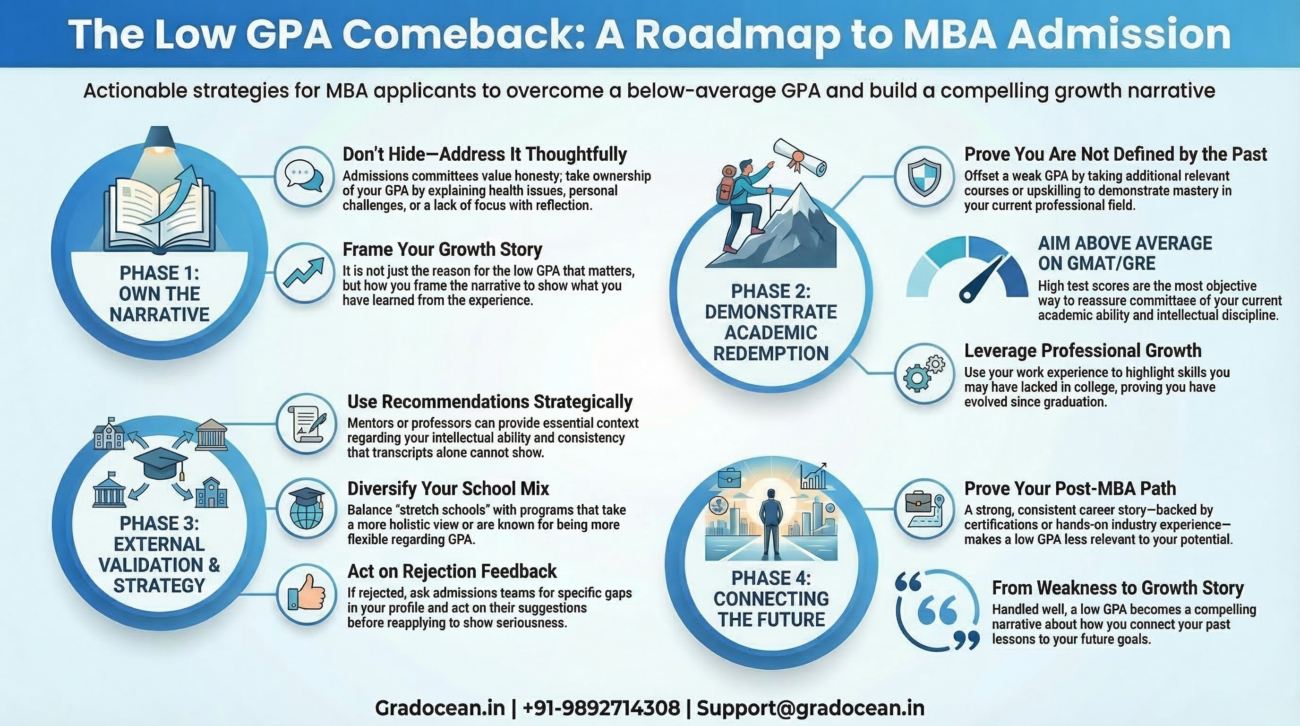
1. Don’t ignore it — address it thoughtfully
Trying to “hide” a low GPA rarely works.
Instead, take ownership:
-
Explain what went wrong (health, personal challenges, lack of focus, etc.)
-
Be honest, but also reflective
-
Show what you’ve learned from it
If there’s a genuine reason, support it with context or documentation where possible. What matters most is how you frame the narrative, not just the reason itself.
2. Show academic redemption
One of the strongest ways to offset a weak GPA is to prove that it no longer defines you.
This could look like:
-
Taking additional courses
-
Upskilling in relevant areas
-
Demonstrating mastery in your field
Example:
If you struggled academically in engineering but later built a strong career as a software engineer through continuous learning, that’s a powerful signal of growth.
Even with limited experience, highlight how your work has helped you build skills you may have lacked during college.
3. Use your GMAT/GRE strategically
A strong test score can significantly balance a low GPA.
-
Start early and prepare seriously
-
Aim above the average of your target schools
-
Treat it as proof of your current academic ability
This is one of the most objective ways to reassure admissions committees.
4. Leverage the right recommendations
Strong recommendations can provide context that your transcripts cannot.
-
For MiM/MSc: academic recommenders can explain inconsistencies
-
For MBA: managers, mentors, or even past professors can highlight your intellectual ability and discipline
Real scenario:
An applicant with a weak semester GPA secured admission to a top program after a professor validated her consistency and academic effort in a recommendation.
5. Be realistic with your school mix
Ambition is great — but strategy matters.
Along with stretch schools, include programs that:
-
Are more flexible on GPA
-
Take a more holistic view of applicants
This ensures you’re not overexposed to risk.
6. Learn from rejections (if any)
If you’ve faced rejections, don’t move on blindly.
Reach out to admissions teams:
-
Ask for feedback
-
Understand gaps in your profile
-
Act on their suggestions (courses, test scores, etc.)
This not only improves your application but also shows seriousness if you reapply.
7. Prove your interest in your post-MBA path
A low GPA matters less when your career story is strong and consistent.
Show that you’ve already taken steps toward your goals:
-
Relevant work experience
-
Certifications or courses
-
Hands-on exposure in your target industry
For example, if you’re targeting finance, demonstrate how you’ve built financial skills despite your academic record.
Final thought
A low GPA is a weakness — but it’s rarely a deal-breaker.
What matters more is:
-
How you explain it
-
What you’ve done since
-
And how clearly you connect your past to your future
Handled well, it can even become part of a compelling growth story.
Need Personalized Guidance for MBA Applications?