



Career Breaks in MBA Applications: How to Explain Them Without Hurting Your Chances
Career breaks are more common than most applicants think.
In fact, while working with MBA candidates, I’ve seen a wide range of reasons — from exam prep to burnout, health issues, and layoffs. Yet, the moment applicants start preparing for MBA applications, this becomes one of their biggest anxieties.
“Will this hurt my chances?”
“How do I explain it?”
The good news:
Admissions committees don’t reject you because of a break. They evaluate how you used that time and how you explain it.
Let’s break down the most common scenarios and how to handle each of them.
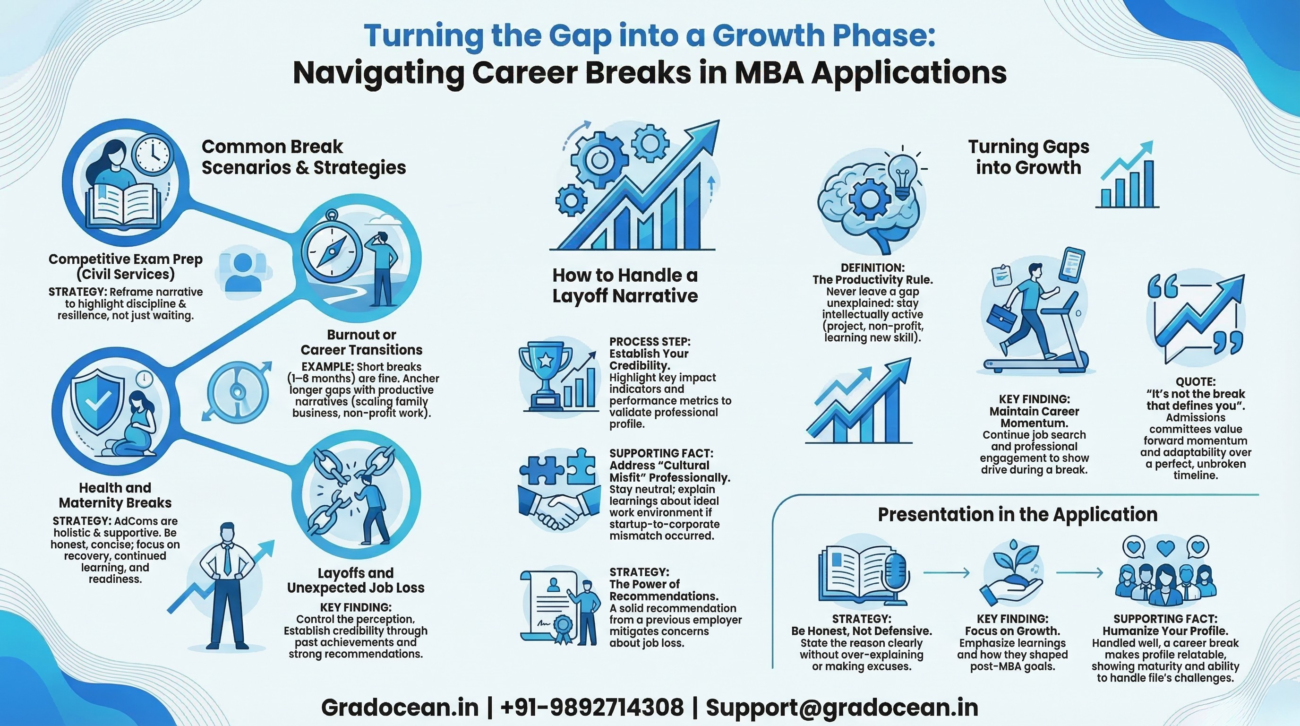
1. Career break for competitive exam preparation
This is especially common among Indian applicants preparing for civil services or similar exams with extremely low success rates.
Many candidates take 2–3 years off purely for preparation.
While the intent is understandable, this kind of break can be tricky — particularly for international B-schools.
Why?
Because MBA programs value action, impact, and progression, not waiting for a single outcome.
Applicants often justify this by highlighting their intent to contribute to society. While that’s admirable, it doesn’t always align with what business schools are looking for.
If you fall into this category:
-
You need to carefully reframe the narrative
-
Highlight discipline, resilience, and learning
-
Show how this period shaped your perspective
This is one scenario where strong storytelling becomes critical.
2. Burnout or transition breaks
Short breaks (1–6 months), especially in high-pressure roles like consulting or startups, are generally not a concern.
In fact, they can work in your favor if positioned well:
-
Personal growth
-
Learning new skills
-
Resetting your career direction
The challenge arises when the break extends beyond a year.
In such cases, the key is: don’t let it look like idle time.
Strong examples I’ve seen:
-
A candidate who became a certified yoga and mindfulness instructor and worked with a non-profit during a year-long break
-
Another who spent 18 months helping scale her family’s medical business before returning to her corporate role
The takeaway:
If your break is long, anchor it with a clear, productive narrative.
3. Health or maternity breaks
This is one area where schools tend to be more understanding.
Admissions committees evaluate applicants holistically and take personal challenges into account.
For health-related breaks:
-
Be honest but concise
-
Focus on recovery and readiness to return
For maternity breaks:
-
Many candidates use an MBA as a pathway back into the workforce
-
Schools are supportive, but they expect clarity and intent
What matters most:
-
Demonstrating resilience
-
Showing continued learning or engagement (even if informal)
-
Reinforcing your commitment to your career
4. Layoffs and unexpected job loss
This is becoming increasingly common, especially in startups and certain industries.
The challenge here is perception.
Admissions teams may wonder:
“Was this performance-related?”
So your job is to control that narrative.
a) Establish your credibility
Highlight:
-
Key achievements
-
Impact you created
-
Strong performance indicators
A solid recommendation (even from your previous employer) can go a long way in validating your profile.
b) Address cultural misfit carefully
Sometimes layoffs happen due to misalignment, not incompetence.
Examples:
-
Startup to corporate transitions
-
Corporate to startup environments
If this applies to you:
-
Avoid blaming the organization
-
Stay neutral and professional
-
Focus on what you learned about your preferred work environment
Then connect this insight to your post-MBA goals.
5. Turn the gap into a growth phase
Regardless of the reason behind your break, one principle applies to everyone:
An unexplained gap is a problem.
A well-used gap is an asset.
If you’re currently in a break or anticipate one:
-
Take up a project (professional or personal)
-
Work with a non-profit
-
Learn something new
-
Stay intellectually and professionally active
At the same time:
-
Continue job searching if applicable
-
Maintain momentum in your career
How to present it in your application
When addressing a career break:
-
Be honest about the reason
-
Avoid over-explaining or sounding defensive
-
Focus on what you learned and how you grew
Admissions committees are not looking for perfection.
They’re looking for self-awareness, resilience, and forward momentum.
Final thought
Career breaks often feel like a weakness — but they don’t have to be.
Handled well, they can:
-
Add depth to your story
-
Show maturity and adaptability
-
Make your profile more human and relatable
The difference lies in how you frame it.
Because at the end of the day,
it’s not the break that defines your application —
it’s what you did with it.
Need Personalized Guidance for MBA Applications?
At GradOcean, we help students:
- Shortlist the right universities
- Maximize scholarships
- Build strong applications with expert mentorship
Email us at support@gradocean.in, call us at +91-9892714308, or connect with us directly through our contact page:
https://gradocean.in/contact-us/
Start your academic journey with clarity and confidence