


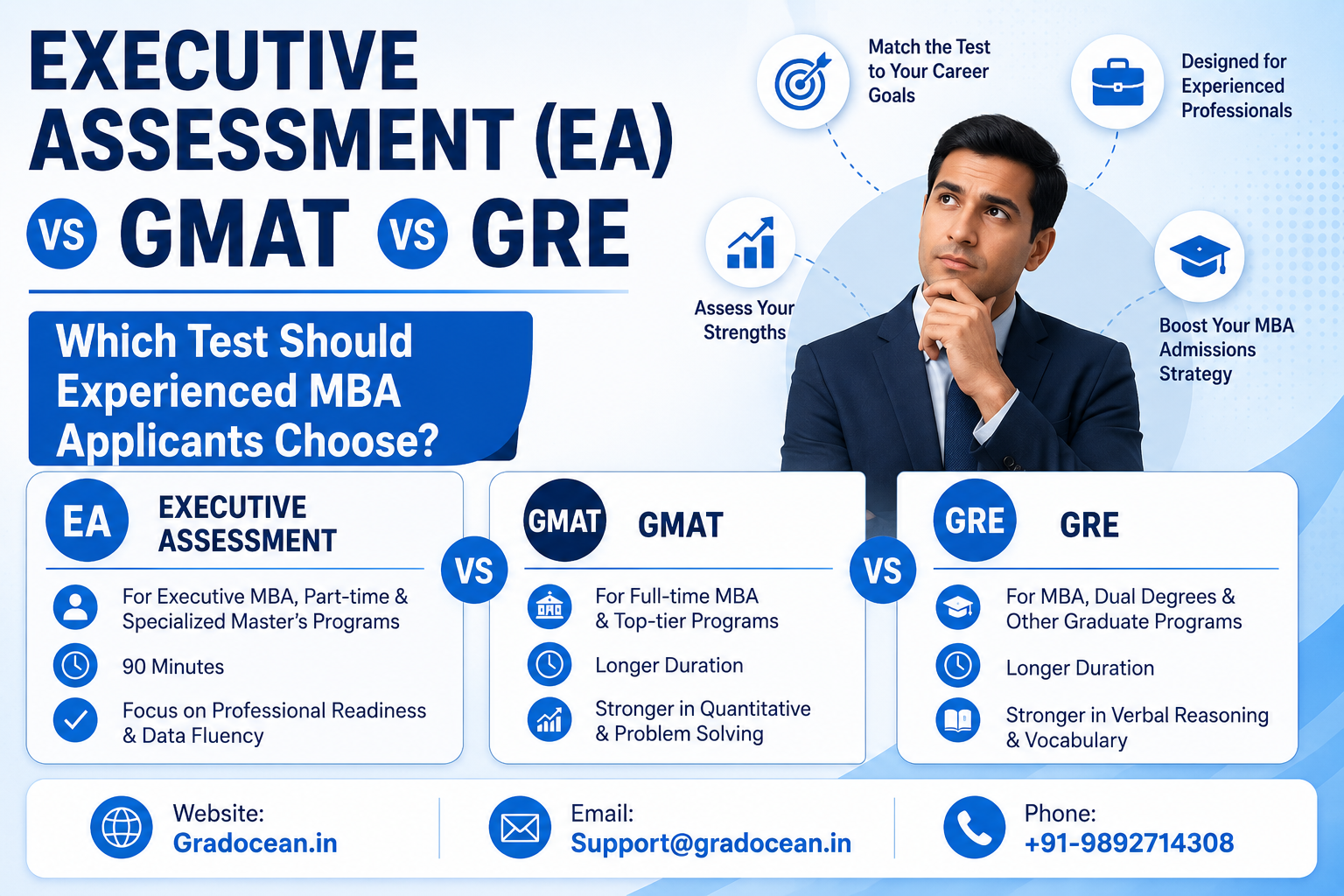
For many experienced professionals planning their next career move through an MBA or executive education program, choosing the right standardized test can be confusing.
While the GMAT and GRE have traditionally been the most recognized MBA admissions exams, the Executive Assessment (EA) has emerged as a specialized alternative designed specifically for working professionals.
Unlike the GMAT or GRE, which are often used as competitive ranking tools, the EA focuses on one key question:
Is the candidate academically prepared to handle the rigor of a business program?
In this article, we break down the Executive Assessment vs GMAT vs GRE and help you understand which test aligns best with your career goals.
What is the Executive Assessment (EA)?
The Executive Assessment (EA) is a standardized test created by the Graduate Management Admission Council (GMAC) for experienced professionals.
It is designed as a shorter, more practical assessment of business school readiness, making it particularly relevant for candidates applying to:
- Executive MBA (EMBA) programs
- Part-time MBA programs
- Modular MBA programs
- Specialized business master’s programs
- Flexible and online management programs
The EA is built around the idea that experienced professionals already bring significant workplace knowledge. Therefore, it evaluates whether candidates have the analytical and reasoning skills required for graduate-level business education.
Who Should Consider Taking the EA?
The EA is generally best suited for:
- Mid-to-senior level professionals
- Candidates with significant work experience (often 8+ years)
- Applicants targeting executive-format programs
- Professionals who want a shorter preparation timeline
For someone with extensive professional experience, the EA can be a more efficient alternative compared to preparing for a longer and more competitive exam.
EA vs GMAT vs GRE: Key Differences
| Factor | Executive Assessment | GMAT | GRE |
|---|---|---|---|
| Primary Audience | EMBA, Executive Programs, Specialized Masters | Full-time MBA | MBA + Other Graduate Programs |
| Test Duration | 90 minutes | Longer exam duration | Longer exam duration |
| Preparation Time | 3–6 weeks typically | More intensive | More intensive |
| Main Focus | Professional readiness | Competitive MBA admissions | General graduate admissions |
| Strength Area | Data interpretation & reasoning | Quantitative ability | Verbal reasoning & vocabulary |
| Essay Section | No | No (current GMAT Focus) | Yes |
| Score Validity | 5 years | 5 years | 5 years |
Understanding the EA Exam Structure
The Executive Assessment consists of three sections:
1. Integrated Reasoning (30 minutes)
This section measures your ability to analyze and interpret business data.
It tests skills such as:
- Understanding graphs and tables
- Evaluating multiple sources of information
- Making data-driven decisions
For experienced professionals, this section often connects closely with workplace decision-making.
2. Verbal Reasoning (30 minutes)
The verbal section evaluates:
- Reading comprehension
- Logical reasoning
- Critical analysis
The focus is not on advanced vocabulary but on understanding arguments and evaluating information.
3. Quantitative Reasoning (30 minutes)
The quantitative section tests mathematical thinking through practical applications.
Compared to the GMAT, the EA avoids extremely complex mathematical concepts and focuses more on:
- Problem solving
- Data interpretation
- Business-oriented reasoning
How Do MBA Programs Interpret EA Scores?
One of the biggest differences between EA and GMAT/GRE is how schools use the score.
The GMAT and GRE are often used to compare applicants against each other.
The EA works differently.
Schools typically use it as a readiness benchmark to confirm:
“Can this candidate successfully handle the academic workload?”
A balanced EA score across all sections is generally preferred over an unusually high score in only one area.
A commonly targeted range is around 145–155, although expectations vary by program.
Global Acceptance of the Executive Assessment
The EA is accepted by more than 200 business programs globally.
Some notable schools accepting EA scores include:
United States
- The Wharton School
- MIT Sloan School of Management
- Chicago Booth School of Business
- Stanford Graduate School of Business
Europe
- INSEAD
- London Business School
- HEC Paris
Asia-Pacific
- Indian School of Business
- National University of Singapore
Acceptance varies by program, so candidates should always verify requirements for their target schools.
EA Preparation Strategy
The biggest advantage of the EA is its shorter preparation timeline.
Most candidates can prepare effectively within:
3–6 weeks
A strong preparation plan should focus on:
1. Understanding the Exam Format
The EA rewards familiarity with the test structure and timing.
2. Building Data Interpretation Skills
Integrated Reasoning is a key differentiator.
3. Practicing Time Management
The exam is only 90 minutes, so pacing is critical.
4. Using Official Resources
Official GMAC practice material is the best starting point.
Cost and Test Logistics
The Executive Assessment offers flexibility for working professionals.
Key details:
- Test fee: $350
- Available online and at test centers
- Rescheduling allowed up to 24 hours before the exam
- Scores typically available within 24 hours
- Score validity: 5 years
EA vs GMAT vs GRE: Final Takeaway
There is no universally “best” test.
The right choice depends on:
- Your career stage
- Target MBA program
- Work experience
- Preparation bandwidth
- Strengths in quantitative and verbal areas
For experienced professionals targeting executive-format programs, the EA can be a strategic choice that saves time while still demonstrating academic readiness.
For candidates targeting competitive full-time MBA programs, GMAT or GRE may continue to offer broader flexibility.
The key is choosing the exam that aligns with your MBA goals.
Other articles of interest:
1. GMAT Waiver for MBA: A Complete Guide to Test-Optional Business Schools
2. How to Overcome a Low GPA for MBA Admissions (GMAT, Essays & Tips)
3. GMAT vs GRE for MBA Admissions 2026
4. GMAT Exam 2026: Pattern, Scores, Syllabus & MBA Admission Strategy