

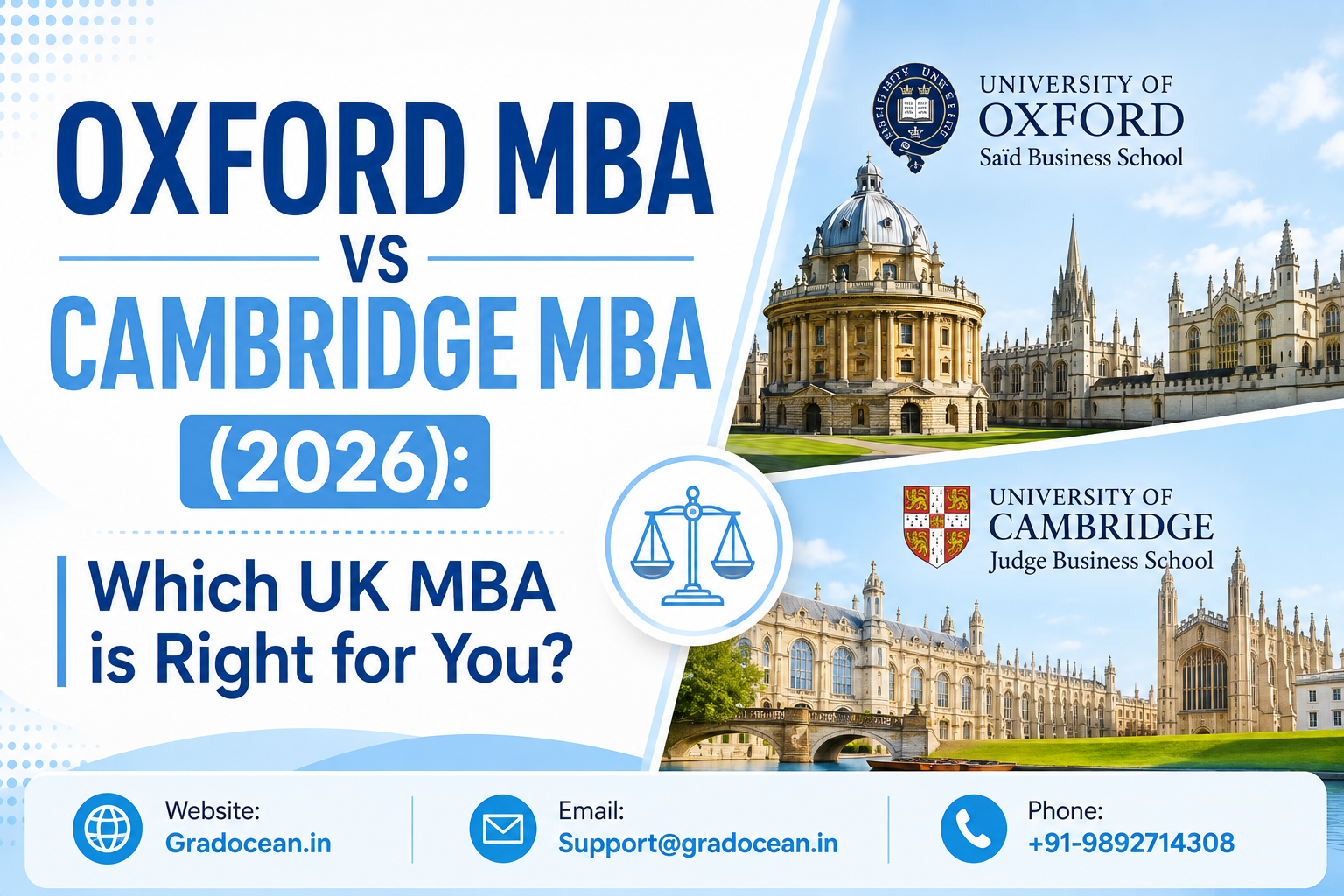
Choosing between the Oxford MBA at Saïd Business School and the Cambridge MBA at Cambridge Judge Business School isn’t simply about picking between two world-famous universities. Both offer exceptional one-year MBA programs, but they differ in their academic philosophy, career strengths, classroom culture, and the type of leaders they aim to develop. Oxford is known for its focus on purpose-driven leadership, global policy, sustainability, and social impact, while Cambridge has built its reputation around innovation, technology, entrepreneurship, and venture capital, thanks to its location within Europe’s leading technology cluster, Silicon Fen. If you’re considering applying to either (or both) for the 2026 intake, this guide compares every major aspect—from class profile and curriculum to career outcomes and admissions.
Oxford MBA vs Cambridge MBA: Quick Comparison (2026)
| Feature | Oxford Saïd MBA | Cambridge Judge MBA |
|---|---|---|
| University | University of Oxford | University of Cambridge |
| Duration | 12 Months | 12 Months |
| Tuition (2026) | £88,800 | £80,000 |
| Class Size | Larger, highly international cohort (63 nationalities) | 217 students (43 nationalities) |
| Average Age | 29 | 29 |
| Average Work Experience | 6 years | 6 years |
| Average GMAT | 680 (Median) | 700 (Mean) |
| Average Salary | £74,143 | £76,138 (Average package: £93,085) |
| Strongest Career Sector | Financial Services | Finance & Technology |
Oxford Saïd MBA: Business with Purpose
Oxford Saïd believes that business should solve some of the world’s biggest challenges rather than simply maximize profits. Sustainability, responsible leadership, global governance, and systems thinking are woven throughout the curriculum. The program attracts students from more than 60 countries, creating one of the most internationally diverse MBA classrooms in Europe. Discussions often extend beyond business strategy to include climate change, public policy, healthcare, and social innovation. Students also benefit from access to the wider University of Oxford ecosystem, collaborating with researchers, policymakers, and academics from disciplines outside business. Oxford may be a better fit if you enjoy thinking about the intersection of business, government, economics, and society.
Cambridge Judge MBA: Innovation at the Heart of Silicon Fen
Cambridge Judge offers a very different experience. Located within Silicon Fen, one of Europe’s largest technology and life sciences ecosystems, the program is deeply connected with startups, venture capital firms, technology companies, and research institutions. The class is intentionally smaller than Oxford’s, allowing for closer interaction with faculty and stronger collaboration among students. Rather than focusing primarily on global systems and policy, Cambridge emphasizes practical problem-solving, innovation, entrepreneurship, and technology commercialization. If your long-term goal is to work in technology, startups, product management, or venture capital, Cambridge offers a particularly compelling environment.
Curriculum Comparison
Oxford MBA Curriculum
Oxford combines traditional management education with experiential learning and global problem-solving. The curriculum includes core courses in finance, strategy, marketing, operations, and business & society, alongside signature experiences such as GOTO (Global Opportunities & Threats: Oxford), where students tackle complex global challenges using systems thinking. Students also complete a year-long Entrepreneurship Project involving real companies across sectors like fintech, healthcare, and energy, followed by a seven-week Summer Consulting Project with corporations, governments, or non-profit organizations. The curriculum encourages students to think beyond functional business problems and consider broader economic and societal implications.
Cambridge MBA Curriculum
Cambridge places greater emphasis on hands-on learning throughout the year. Students begin with Management Praxis, focusing on negotiation, leadership, communication, and teamwork. They then participate in the Global Consulting Project (GCP), where teams advise organizations such as the United Nations, BlackRock, WHO, and the London Stock Exchange. During the Easter Term, students choose industry-specific concentrations before completing either an internship or an independent consulting project during the summer. Compared to Oxford, Cambridge offers a more applied, project-based MBA experience with a stronger emphasis on execution.
Career Outcomes
Oxford MBA Careers
Oxford has become a strong destination for professionals looking to make significant career changes. According to the latest employment report, 82% of graduates changed at least one major career dimension (industry, function, or geography), while 25% completed a “triple jump” by changing all three. Financial Services account for approximately 34% of placements, followed by Technology (23%), Global Industries (19%), and Consulting (19%). Many graduates build careers in London, particularly in investment banking, asset management, consulting, and multinational corporations.
Cambridge MBA Careers
Cambridge performs particularly well for candidates targeting technology and innovation-led careers. Recent employment data shows that 91% of graduates changed at least one career dimension, 75% switched industries entirely, and 85% secured employment within four months of graduation. Finance represents around 26% of placements, followed by Technology at 23%. Recruiters regularly include Google, TikTok, PwC, venture-backed startups, and other high-growth technology firms.
Student Experience Beyond the Classroom
One of the biggest advantages of studying at either university is becoming part of their centuries-old collegiate system. Rather than belonging only to the business school, MBA students also join one of the university’s colleges, where they interact with PhD researchers, scientists, lawyers, doctors, and students from dozens of disciplines. At Oxford, students typically become members of colleges such as Green Templeton or St Cross. The city offers access to historic libraries like the Bodleian, frequent guest lectures from global leaders, and excellent access to London, which is only about an hour away by train. This proximity makes networking with consulting firms, banks, and multinational companies particularly convenient. At Cambridge, students commonly join colleges such as Hughes Hall or St Edmund’s. The city offers a highly walkable, bicycle-friendly environment with close interaction with startup founders, the Accelerate Cambridge entrepreneurship programme, and a thriving network of investors and venture capital firms. For aspiring entrepreneurs, the surrounding innovation ecosystem becomes an extension of the MBA experience.
Admissions Requirements (2026 Entry)
Although both schools evaluate applicants holistically, the admissions process follows a similar structure. Applicants typically need a bachelor’s degree equivalent to a UK 2:1, at least two years of full-time work experience (with the average admitted student having around six years), a valid GMAT or GRE score, strong essays, compelling letters of recommendation, and demonstrated leadership potential. Oxford additionally requires applicants to complete a Kira Talent online assessment, while Cambridge invites shortlisted candidates to a virtual interview day that includes faculty interviews and interactive sessions.
Cost of Attendance
| Expense | Oxford MBA | Cambridge MBA |
|---|---|---|
| Tuition | £88,800 | £80,000 |
| Application Fee | £75 | £165 |
| Deposit | £9,800 | £7,950 |
| Estimated Living Expenses | £15,000–20,000+ | £19,860 |
| Estimated Total Cost | £103,000–110,000+ | Approximately £100,000 |
Both schools offer merit-based scholarships. Oxford recommends applying by the January deadline to maximize scholarship consideration, while Cambridge awards scholarships on a rolling basis throughout the admissions cycle.
Oxford MBA vs Cambridge MBA: Which Should You Choose?
There isn’t a universally “better” program—only the one that aligns more closely with your career goals. Oxford Saïd is likely to be a better fit if you want to build a career in investment banking or financial services, transition into management consulting, work in sustainability, public policy, or social impact, join a larger and more internationally diverse MBA cohort, and develop a broad global leadership perspective. Cambridge Judge, on the other hand, may be the better choice if your ambitions lie in technology, product management, startups, venture capital, or growth investing, and if you prefer a smaller, collaborative classroom with a highly practical, project-based curriculum.
Final Thoughts
Both Oxford and Cambridge consistently rank among the world’s leading MBA programs, offering access to exceptional faculty, powerful alumni networks, and globally recognised university brands. The decision ultimately comes down to your career ambitions. If you see yourself leading organisations that tackle complex global challenges across finance, consulting, or public policy, Oxford Saïd provides an outstanding platform. If your aspirations lie in technology, entrepreneurship, innovation, or venture capital, Cambridge Judge offers one of the strongest ecosystems anywhere in Europe. Rather than asking which MBA is more prestigious, ask which environment will best help you achieve your long-term goals. That answer is usually the right one.