

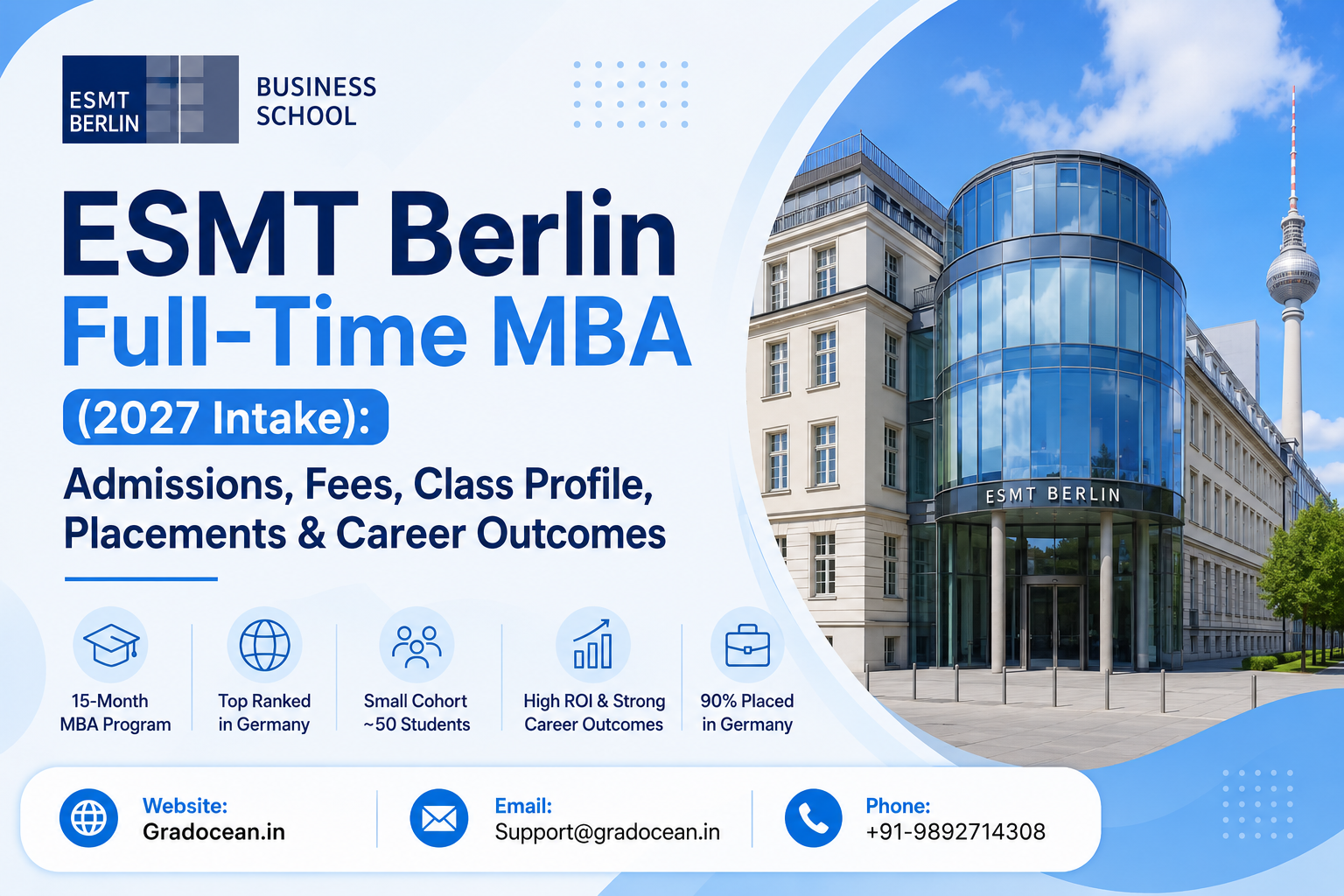
ESMT Berlin is widely regarded as Germany’s leading business school and has built a strong reputation for preparing professionals for leadership careers across Germany and Europe. Established by 25 of Germany’s largest multinational corporations, ESMT offers a unique blend of academic excellence, close corporate partnerships, and exceptional career opportunities.
If your goal is to build a career in Germany, transition across industries, or pivot into consulting, technology, or strategy, the ESMT Full-Time MBA deserves serious consideration.
This comprehensive guide covers everything you need to know about the ESMT Berlin MBA for the 2027 intake, including the curriculum, admissions process, career outcomes, fees, ROI, and application strategy.
About ESMT Berlin
Founded by 25 leading German corporations, ESMT Berlin is a triple-accredited business school consistently ranked among the top MBA programs in Europe.
Some of its founding corporate partners include:
- Allianz
- BCG
- Bosch
- DHL
- Lufthansa
- McKinsey & Company
- SAP
- Siemens
- Deutsche Telekom
These close industry partnerships provide students with exceptional networking opportunities, corporate projects, internships, and recruitment access throughout the MBA.
One of ESMT’s biggest strengths is its deep integration with Germany’s corporate ecosystem, making it particularly attractive for professionals looking to build long-term careers in Europe.
ESMT Berlin MBA Program Overview
| Feature | Details |
|---|---|
| Program Length | 15 Months |
| Language | English |
| Intake | January |
| Class Size | Approximately 50 Students |
| Location | Berlin, Germany |
The relatively small cohort creates a highly personalized learning experience with greater faculty interaction and individualized career coaching.
Curriculum
The MBA runs over 15 months and is divided into four phases.
Module 1: Core Business Foundations (January – June)
Students build a strong foundation across major management disciplines, including:
- Strategy
- Finance
- Marketing
- Operations
- Organizational Behaviour
- Analytics and Artificial Intelligence
The curriculum emphasizes practical decision-making through case discussions, simulations, and real-world business challenges.
Module 2: Practical Learning (June – August)
Students choose one of three experiential learning pathways:
- Corporate Internship
- Sustainability in Practice (SIP) Consulting Project
- Intensive German Language Program
This flexibility allows students to tailor the MBA according to their career objectives.
Module 3: Electives & Specializations (September – December)
Students customize their MBA by selecting one of the following tracks:
- Innovation & Entrepreneurship
- Managerial Analytics
Exchange opportunities are also available with leading international business schools, including:
- HEC Paris
- Yale School of Management
- Other global partner institutions
The Innovation & Entrepreneurship track is supported through Vali Berlin, which has helped launch more than 230 startups that have collectively raised over €250 million.
Module 4: Capstone Project (January – April)
The program concludes with a consulting-style capstone project where students work in teams to solve real business problems for corporate clients.
Previous clients have included organizations such as Merck Group.
Career Outcomes
One of ESMT Berlin’s strongest differentiators is its ability to facilitate significant career transitions.
According to the Class of 2024 Employment Report:
- 70% changed their role, industry, and country simultaneously.
- 76% changed industries.
- 90% accepted jobs in Germany.
- 90% changed countries after graduation.
- 15% launched entrepreneurial ventures.
These figures highlight ESMT’s strength in helping professionals make transformational career moves.
Salary Statistics
Graduates continue to secure competitive compensation packages across Europe.
| Salary Metric | Amount |
|---|---|
| Average Starting Salary (Including Bonus) | €98,500 |
| Median Base Salary | €77,500 |
| Highest Reported Salary | €160,000 |
Given the relatively lower tuition and living costs in Germany, the MBA offers an attractive return on investment.
Top Recruiting Industries
Graduates secured opportunities across multiple sectors.
The largest hiring industries include:
- Consulting (20%)
- Technology (20%)
- E-commerce
- Energy
- Manufacturing
- Media
- Retail
Top Recruiters
Some of the leading recruiters include:
- Amazon
- Allianz
- BCG
- Infosys
- Siemens Energy
- Wayfair
- Wipro
- Zalando
Fees and Return on Investment
| Expense | Approximate Cost |
|---|---|
| Tuition Fees | €50,000 |
| Total Cost (Including Living Expenses) | €62,000–€68,000 |
Compared to MBA programs in London, Paris, or Singapore, ESMT offers significantly lower living expenses while maintaining excellent employment outcomes.
With an average starting salary approaching €100,000, many graduates recover their investment within approximately two years.
Comparison with Other European MBA Programs
| School | Duration | Tuition | Average Salary | Class Size |
|---|---|---|---|---|
| ESMT Berlin | 15 Months | €50,000 | €98,500 | ~50 |
| HEC Paris | 16 Months | €68,000 | €105,000 | ~300 |
| IE Business School | 11 Months | €78,000 | €100,000 | ~300 |
| INSEAD | 10 Months | €105,000+ | €150,000+ | ~500 |
| London Business School | 15–21 Months | £100,000+ | £120,000+ | ~400 |
Why Germany is Attractive for MBA Graduates
One of the biggest advantages of studying in Germany is its immigration policy.
After graduation, international students are eligible for an 18-month job-seeker visa, allowing ample time to secure employment without requiring immediate employer sponsorship.
This significantly reduces career pressure compared to several other international destinations.
ESMT Berlin MBA Admissions
Admissions operate on a rolling basis across eight application rounds.
Key deadlines include:
- Round 1: March 1
- Round 4: June 30 (includes a €1,500 Early Application Award)
- Round 8: December 8 (Final Deadline)
International applicants requiring visas are strongly encouraged to apply by July 31.
Applicants from India and China should also account for APS certificate processing, which may take several months.
Eligibility Requirements
Applicants should typically have:
- A Bachelor’s degree (minimum 180 ECTS equivalent)
- At least three years of full-time professional work experience
- Strong English language proficiency
Accepted entrance examinations include:
- GMAT
- GRE
- Executive Assessment
- ESMT Business Admissions Test (BAT)
English proficiency requirements include:
- TOEFL: 95+
- IELTS: 7.0+
- PTE: 64+
Application Fee: €100
MBA Essays
Applicants must complete three essays (250–500 words each).
Essay 1: Career Goals & Why ESMT
Candidates should explain:
- Career goals
- Why Germany
- Why Berlin
- Why ESMT specifically
Generic responses are unlikely to be competitive.
Essay 2: Setback and Growth
Applicants should discuss a meaningful setback, the lessons learned, and how the experience shaped their leadership and professional development.
Authenticity is valued more than perfection.
Essay 3: Dinner Guest
Candidates are asked to identify someone they would like to have dinner with and explain why.
Admissions looks for originality, intellectual curiosity, and self-awareness rather than famous or predictable choices.
Student Life
The campus is located in Berlin Mitte within a historic building that previously served as the State Council of East Germany.
Students can participate in numerous clubs and leadership opportunities, including:
- Consulting Club
- Investment & FinTech Club
- Women in Leadership
- TEDxESMT Berlin
The school also maintains a global alumni network of over 9,000 professionals across more than 40 countries.
Students benefit from structured mentoring through the MentorMap initiative.
Responsible Leaders Fellowship
Graduates also have the opportunity to participate in the Responsible Leaders Fellowship, where they spend up to six months providing pro bono consulting support to organizations in developing countries.
Travel expenses and living stipends are covered by the program.
Who Should Consider ESMT Berlin?
ESMT is an excellent fit for professionals who:
- Want to build a long-term career in Germany or Europe.
- Are looking for significant career transitions across role, industry, or geography.
- Prefer a smaller, highly personalized MBA experience.
- Want strong ROI with relatively lower tuition and living costs.
- Are interested in consulting, technology, industrials, or entrepreneurship.
Who May Want to Consider Other Schools?
Another MBA program may be more suitable if your primary goal is:
- Investment Banking or Finance in London or New York.
- Luxury, Fashion, or Consumer Goods in France.
- Returning immediately to India after graduation.
- Maximizing global brand recognition over Germany-specific opportunities.
Final Thoughts
The ESMT Berlin Full-Time MBA offers one of the strongest value propositions among European MBA programs. Its combination of a small cohort, close corporate partnerships, strong placement outcomes, and affordable tuition makes it an attractive option for professionals seeking careers in Germany and Europe.
For candidates looking to transition across industries, functions, or geographies, ESMT consistently demonstrates impressive career outcomes. If Germany is part of your long-term career strategy, ESMT deserves serious consideration alongside programs such as INSEAD, HEC Paris, IESE, and London Business School.
Frequently Asked Questions (FAQs)
Is ESMT Berlin a good MBA for international students?
Yes. ESMT has a highly international student body and strong placement outcomes, with around 90% of graduates accepting jobs in Germany after graduation.
What GMAT score is recommended for ESMT Berlin?
There is no minimum GMAT requirement. A score of 645–675 on the GMAT Focus Edition is generally competitive, although the admissions process is holistic.
Does ESMT accept the Executive Assessment?
Yes. Applicants can submit the GMAT, GRE, Executive Assessment, or ESMT’s own Business Admissions Test (BAT).
How much work experience is required?
Applicants should typically have at least three years of full-time professional experience.
Is learning German mandatory?
No. The MBA is taught entirely in English. However, learning German can significantly improve employment opportunities after graduation.
What are the strongest recruiting sectors at ESMT?
Consulting, technology, manufacturing, energy, e-commerce, and retail are among the largest hiring industries.
Does ESMT offer internships?
Yes. Students can choose a corporate internship during the summer module as part of the MBA.
Is ESMT worth the investment?
For professionals targeting Germany or Europe, ESMT offers one of the strongest ROIs among European MBA programs due to its relatively low tuition, affordable living costs, and excellent employment outcomes.
Other Articles of Interest:
1. ISB vs International MBA: How to Choose the Right Path for Your Career
2. Indian MBA Programs Are Rising Fast in Global Rankings — Here’s Why It Matters
3. Top Executive MBA Programs in India
4.GMAT Waiver for MBA: A Complete Guide to Test-Optional Business Schools
5.Top Global One-Year MBA Programs for Experienced Professionals: A Comprehensive Guide
6.Best MBA Programs for Healthcare: Top Schools, Curriculum & Career Scope (2026 Guide)
7. Best MBA Programs for Sustainability & ESG: Top Schools, Curriculum & Career Scope (2026 Guide)
8. ISB vs IIM One-Year MBA (2026): Fees, Placements, Rankings, ROI & Which is Better?
9. MBA ROI vs Rankings: How to Choose the Right MBA Program in 2026
11. HEC Paris MBA Essays 2027 Intake: A Complete Guide to Writing Winning Essays
16.MBA University of Virginia Darden MBA Admissions Guide (2026–2027 Intake)