

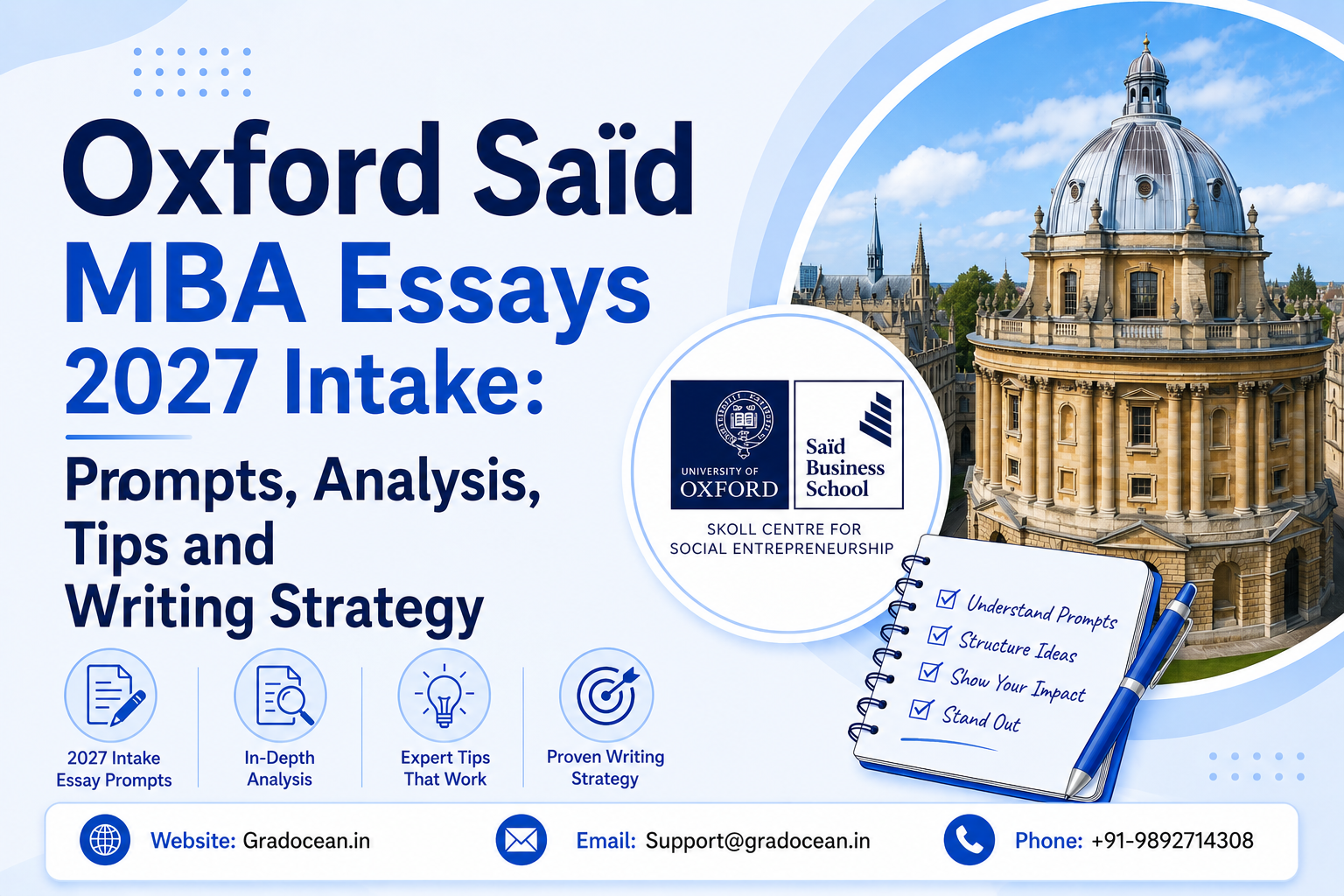
Applying to the Oxford Saïd MBA is a competitive process, and the essays play an important role in helping the admissions committee understand your goals, personality, experiences, and motivation beyond the numbers on your application.
For the 2027-28 intake, applicants need to answer a required personal essay, provide detailed information about their post-MBA career plans, and, if they are reapplying, submit an additional essay explaining how their candidacy has evolved since their previous application.
Oxford Saïd has five application stages for the 2027-28 intake, beginning in September 2026 and continuing through March 2027. Applicants seeking scholarship consideration should pay particular attention to the January deadline.
In this guide, we break down the Oxford Saïd MBA essay prompts, explain what the admissions committee is likely looking for, and provide practical strategies for developing strong and authentic responses.
Oxford Saïd MBA Essay Prompts for 2027 Intake
The Oxford Saïd MBA application includes the following written components:
Required Essay: Tell us something about you that would be impossible to know from the rest of your application. Maximum 500 words.
Reapplicant Essay: What improvements have you made in your candidacy since you last applied to the Oxford MBA? Maximum 250 words.
In addition, applicants are required to answer four short questions related to their post-MBA career plans. Each response has a 500-character limit.
The short-answer questions are:
- What is your plan within one year of completing the MBA?
- What obstacles currently stand in your way to achieving this goal?
- Why do you believe you are a strong candidate for this role?
- What is your alternative plan (Plan B)?
The key challenge is not simply answering each question individually. Your responses should work together to tell a consistent story about your career direction, capabilities, motivations, and the value you hope to create after Oxford.
Oxford Saïd Required MBA Essay
Prompt: Tell us something about you that would be impossible to know from the rest of your application. Maximum 500 words.
What is Oxford Saïd looking for?
This prompt gives you an opportunity to introduce a side of yourself that may not emerge from your CV, academic record, career history, recommendations, or other application components.
Unlike a conventional career-focused MBA essay, this question is deliberately open-ended. The admissions committee wants to understand the person behind the professional profile: your values, personality, motivations, interests, experiences, or perspectives.
The fact that this essay is required is important. You should not treat it as an optional space for adding random information or repeating achievements that are already visible elsewhere in the application.
Instead, use it to reveal something genuinely meaningful that helps the admissions committee understand what makes you distinctive.
How to approach the essay
Start by reviewing the rest of your application. Ask yourself:
What will the admissions committee already know about me?
Which parts of my personality or background are missing?
What experience has shaped the way I think or behave today?
What do I care deeply about outside my professional achievements?
What perspective would I bring to my MBA classmates?
Once you identify a potential theme, build the essay around a specific story rather than making a list of personal qualities.
For example, instead of saying that you are resilient, describe an experience that demonstrates resilience and explain how it changed the way you approach difficult situations.
Similarly, if you have an unusual hobby, family experience, community involvement, cultural background, or personal challenge, do not simply describe it. Explain why it matters and what it reveals about you.
Should you discuss a weakness or gap?
Potential weaknesses such as an employment gap, lower GPA, career transition, or other unusual element in your profile may sometimes need explanation. However, this essay should not automatically become a defensive explanation of every weakness in your application.
If there is an important issue that the admissions committee genuinely needs context for, you can address it briefly. But the primary objective should remain personal insight.
The strongest responses usually leave the reader with a clearer understanding of who the applicant is rather than simply explaining why something went wrong.
Consider your international and cross-cultural experiences
Oxford attracts a highly international student body, so experiences that have shaped your understanding of different cultures, communities, or perspectives can be valuable.
However, international exposure should not be included simply because it sounds impressive. Focus on what you learned from the experience and how it influenced your worldview.
A semester abroad, international assignment, relocation, cross-cultural team, volunteer experience, or interaction with people from very different backgrounds can all become strong material if they reveal something meaningful about you.
Connect your story to the Oxford community
You do not necessarily need to spend a large portion of this essay explaining why Oxford. The rest of the application already provides opportunities to discuss your career goals and program fit.
However, your essay should ideally make it possible for the reader to see how the quality or perspective you describe could enrich the Oxford community.
Think about what you would bring to conversations, student clubs, classroom discussions, social activities, or the broader Oxford network.
Tips for the required essay
- Be authentic. Choose a story that genuinely represents you rather than something you think an admissions committee wants to hear.
- Avoid repeating your CV. If an accomplishment is already obvious from another part of the application, use this space to reveal something new.
- Focus on one strong theme. A single well-developed story is generally more effective than five disconnected anecdotes.
- Use specific details. Concrete moments, decisions, challenges, and reflections make a personal essay more memorable.
- Show reflection. The important question is not only what happened, but why the experience mattered and how it influenced you.
- Keep the tone positive. Even when discussing a difficult experience, focus on what you learned and how it shaped you.
- Make every word count. With a 500-word limit, avoid long introductions and generic statements.
Oxford Saïd Reapplicant Essay
Prompt: What improvements have you made in your candidacy since you last applied to the Oxford MBA? Maximum 250 words.
If you are reapplying to Oxford Saïd, the admissions committee wants to understand what has changed since your previous application.
The goal is not simply to demonstrate that another year has passed. You need to show that you have actively strengthened your candidacy and addressed areas that may have previously held you back.
What should reapplicants discuss?
Potential areas of improvement include:
Professional advancement: Have you received a promotion, taken on additional responsibilities, managed a larger team, led an important project, or delivered measurable business results?
Academic improvement: Have you improved your GMAT or GRE score, completed additional coursework, or taken steps to demonstrate stronger academic readiness?
Skill development: Have you developed new technical, analytical, leadership, communication, or industry-specific skills?
Career development: Have you gained experience that makes your post-MBA goals more credible or better defined?
Extracurricular involvement: Have you taken on greater responsibility in a community initiative, nonprofit, professional association, or other activity?
Oxford engagement: Have you interacted with students or alumni, attended Oxford events, visited the school, or otherwise developed a deeper understanding of the program?
The most compelling reapplicant essays demonstrate meaningful progress rather than simply listing activities.
A practical structure for the reapplicant essay
Start by briefly establishing that your interest in Oxford remains strong.
Then focus on the most important improvements since your previous application. Prioritize developments that directly address weaknesses or gaps in your earlier candidacy.
For each improvement, explain what changed and, where possible, provide evidence.
For example, rather than writing that you have “developed stronger leadership skills,” explain the new responsibility you took on, the situation you managed, and the resulting impact.
Finally, explain how these developments have made you better prepared for the Oxford MBA and your future career.
Tips for reapplicants
Be specific. Use concrete achievements rather than generic claims.
Show measurable progress. Numbers, promotions, expanded responsibilities, test-score improvements, and business outcomes can make your progress easier to assess.
Demonstrate self-awareness. If you received feedback after your previous application, show how you acted on it.
Focus on what changed. Do not spend too much space repeating your previous application.
Maintain a forward-looking tone. The essay should demonstrate that you are stronger today and have a clear reason for pursuing Oxford now.
Oxford Saïd Post-MBA Goals
The four career-related questions provide Oxford with a concise view of your immediate post-MBA plans and the thinking behind them.
Because each answer is limited to 500 characters, clarity and precision are particularly important.
Your four responses should also complement one another. The career goal in Question 1 should connect logically to the obstacles in Question 2, the strengths in Question 3, and the alternative pathway in Question 4.
Question 1: What is your plan within one year of completing the MBA?
Maximum 500 characters.
What is Oxford looking for?
Oxford wants to see that you have a realistic and well-researched plan for the first year after graduation.
Your answer should ideally communicate three things:
Your target role
Your target industry or function
Your preferred geography or market
For example, saying that you want to “work in consulting” is too broad. A stronger response would identify the type of consulting role you are targeting and the market in which you intend to pursue it.
How to structure your response
Begin with your immediate post-MBA objective.
Then briefly explain how you intend to achieve it. Depending on your situation, this could involve targeting specific companies, leveraging relevant prior experience, networking with recruiters and alumni, or using Oxford’s career resources.
Your answer should demonstrate that you understand the recruitment environment rather than presenting an aspirational goal without a practical pathway.
You should also ensure that your short-term objective makes sense in the context of your longer-term career plans.
Key tips
Be specific about the role and industry.
Demonstrate awareness of your target market.
Make your plan realistic given your background.
Avoid naming companies simply to make the answer sound impressive.
Show how your existing experience and Oxford MBA will help you make the transition.
Question 2: What obstacles currently stand in your way to achieving this goal?
Maximum 500 characters.
This question tests your self-awareness.
The admissions committee wants to know whether you understand what currently separates you from your target role.
What should you discuss?
Identify one or two meaningful gaps rather than listing every weakness.
These could include:
Limited experience in your target industry
Lack of exposure to a particular function
A geographic or professional network gap
Limited experience managing certain types of stakeholders
A need for stronger strategic, financial, technical, or leadership capabilities
If your desired career requires a significant industry or functional transition, acknowledge the challenge directly.
The important point is to present these obstacles as manageable gaps rather than reasons why your goal is unrealistic.
Position the MBA as the bridge
Once you identify the gap, briefly show how the Oxford MBA can help you address it.
This could involve coursework, experiential learning, student clubs, career resources, alumni connections, or exposure to a new market.
Avoid turning this answer into a generic “Why Oxford?” response. The focus should remain on the obstacles and how you plan to overcome them.
Question 3: Why do you believe you are a strong candidate for this role?
Maximum 500 characters.
This question asks you to make the case for why your target employers should take you seriously.
Your answer should connect your previous experience with your post-MBA objective.
How to approach it
Identify two or three strengths that directly transfer to the role.
Then support those strengths with evidence.
For example, if you are targeting a product management role, you might highlight your experience working across engineering, business, and customer teams, supported by a specific product launch or measurable business outcome.
If you are moving into consulting, you could emphasize problem-solving, stakeholder management, analytical ability, and experience working across complex business problems.
The goal is to establish a logical bridge:
Past experience → transferable skills → MBA → target role.
Tips
Avoid simply listing personality traits such as “hardworking,” “passionate,” or “strategic.”
Use achievements to demonstrate your strengths.
Quantify results whenever possible.
Focus on skills that matter specifically for your target role.
Make your career transition feel logical rather than abrupt.
Question 4: What is your alternative plan (Plan B)?
Maximum 500 characters.
A strong Plan B demonstrates flexibility without making your primary career goal appear uncertain.
The mistake many applicants make is treating Plan B as an unrelated second career.
Instead, your alternative should remain connected to your broader professional direction.
How to develop a strong Plan B
Start by identifying an alternative role, industry, geography, or pathway that uses many of the same skills as your primary goal.
For example, if your primary goal is to move into strategy consulting, a Plan B could involve a strategy or corporate development role within an industry where you already have experience.
If your primary objective involves entering a new industry, your alternative could leverage your existing domain expertise while moving you toward the same long-term destination.
The admissions committee is not looking for a perfect backup plan. They want to see that you have thought realistically about your options and can adapt if circumstances change.
Tips for the Plan B answer
Make the alternative achievable.
Keep it connected to your long-term objective.
Leverage your existing experience and strengths.
Demonstrate flexibility without sounding indecisive.
Avoid presenting an entirely unrelated career simply because it sounds attractive.
How the Four Oxford Career Answers Should Work Together
Although each question is short, applicants should think of the four responses as one connected career narrative.
A useful way to think about them is:
Question 1: Where are you going?
Question 2: What is currently preventing you from getting there?
Question 3: Why can you realistically get there?
Question 4: What will you do if your first route does not work?
This creates a coherent story of ambition, self-awareness, credibility, and adaptability.
For example, your target role should create the gaps described in Question 2. Your experience and strengths in Question 3 should explain why the target role is nevertheless achievable. Your Plan B should remain connected to the same long-term direction.
Oxford Saïd MBA Deadlines for the 2027-28 Intake
Oxford Saïd has five application stages for the 2027-28 intake:
Stage 1: 2 September 2026 — Decision: 16 October 2026
Stage 2: 5 October 2026 — Decision: 20 November 2026
Stage 3: 4 November 2026 — Decision: 11 December 2026
Stage 4: 6 January 2027 — Decision: 5 March 2027
Stage 5: 15 March 2027 — Decision: 23 April 2027
All deadlines are at 23:59 UK time.
If you are seeking an Oxford scholarship, Stage 4 is particularly important because the January deadline is the scholarship consideration deadline. Applicants applying in later stages are not eligible for Oxford scholarships.
The application fee is £75, and admitted candidates are required to pay a £9,800 deposit to secure their place.
Final Thoughts
The Oxford Saïd MBA application gives candidates several opportunities to demonstrate who they are, where they want to go, and why they are prepared to make that journey.
The 500-word personal essay should reveal something meaningful that cannot be understood from the rest of your application. It should add depth to your profile rather than repeat your professional achievements.
For reapplicants, the 250-word essay should focus on tangible progress and demonstrate how you have strengthened your candidacy since your previous application.
The four post-MBA questions require a different approach. Because of the tight 500-character limit, every sentence should serve a clear purpose. Your responses should demonstrate career clarity, self-awareness, credibility, and adaptability.
Most importantly, avoid trying to write what you think Oxford wants to hear. The strongest applications present a clear and authentic connection between the applicant’s past experiences, future ambitions, and reasons for pursuing an Oxford MBA.
Start by identifying the story you want the admissions committee to remember. Then make every part of the application reinforce that story.
Frequently Asked Questions
What is the Oxford Saïd MBA essay for the 2027 intake?
The required essay asks: “Tell us something about you that would be impossible to know from the rest of your application.” The maximum length is 500 words.
Does Oxford Saïd have a reapplicant essay?
Yes. Reapplicants must answer: “What improvements have you made in your candidacy since you last applied to the Oxford MBA?” The maximum length is 250 words.
How many post-MBA questions does Oxford Saïd ask?
Applicants must answer four short questions covering their immediate career plan, obstacles, suitability for the target role, and alternative plan. Each response has a 500-character limit.
Which Oxford Saïd application deadline should scholarship applicants target?
Applicants seeking scholarship consideration should apply by Stage 4, which closes on 6 January 2027.
How can I make my Oxford Saïd MBA essays stronger?
Focus on specificity, authenticity, reflection, and consistency across the application. Avoid repeating your CV and use concrete experiences to demonstrate your qualities, career goals, and potential contribution to the Oxford community.