

The hype around product management goals began innocently enough.
After the pandemic, as markets reopened and business sentiment surged, technology companies experienced rapid growth. Venture capital was abundant, technology hiring accelerated, and Product Managers were often portrayed as the new rock stars of the corporate world. They did not necessarily code, sell, or design, yet they were frequently described as the “CEOs of their products.”
It was an attractive career proposition.
But as global uncertainty increased, interest rates rose, venture funding slowed, and the technology industry went through a wave of layoffs, the perception of product management began to change.
Roles that had once been described as “owning product vision” could involve far more execution, prioritization, stakeholder management, bug fixes, dashboard reviews, and constant changes to the roadmap. Many professionals began to realize that product management was not simply about having a great idea. It was about persuading different stakeholders, making difficult trade-offs, and continuously answering a much harder question: what problem is actually worth solving?
And then AI arrived.
How AI Is Changing Product Management
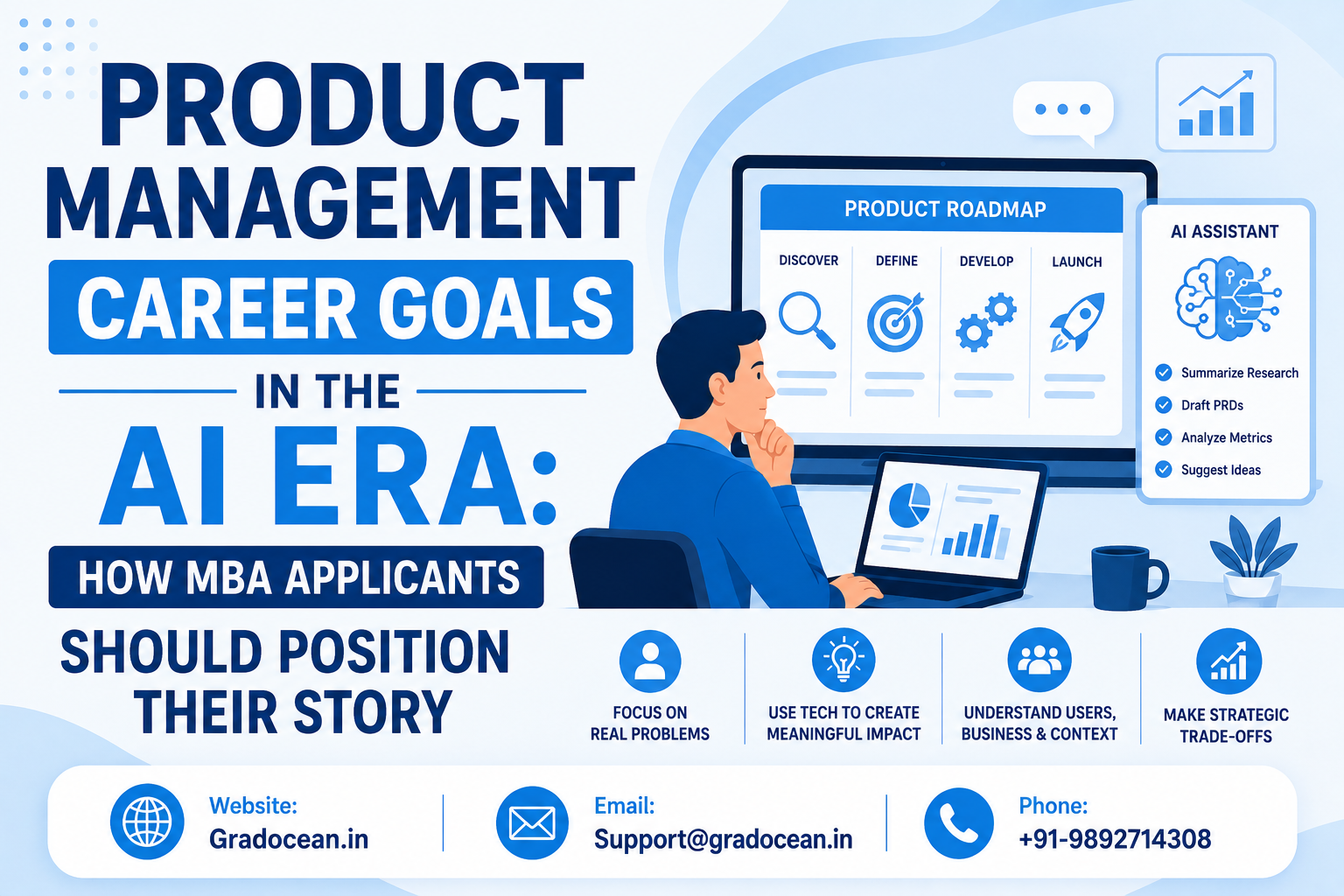
Generative AI can now summarize user research, draft PRDs, analyze data, generate product ideas, prepare documentation, and accelerate several other tasks that previously required significant amounts of a Product Manager’s time.
This is changing the nature of the role.
The competitive advantage of a Product Manager is increasingly less about execution and more about judgment.
AI can generate potential solutions. It can analyze large amounts of information. It can identify patterns and even suggest priorities.
But the more difficult question remains:
Which problem should the company actually solve?
That requires understanding customers, business economics, organizational constraints, competitive dynamics, technology limitations, and long-term strategy. It also requires making trade-offs when there is no obviously correct answer.
For MBA applicants, this distinction is particularly important.
Simply saying that you want to become a Product Manager because you enjoy technology is no longer enough. Your goals need to demonstrate a deeper understanding of what product management actually involves and why you want to pursue it.
Why Admissions Committees Often See Weak Product Management Goals
Product management is one of the most common post-MBA career goals, particularly among applicants coming from technology, consulting, engineering, analytics, and strategy backgrounds.
That makes generic product management goals particularly easy for admissions committees to identify.
A typical weak goal might look something like this:
“I have worked on technology projects and collaborated with product teams. After my MBA, I want to become a Product Manager and build innovative products that solve customer problems.”
There is nothing technically wrong with this statement.
The problem is that it says very little about the applicant.
What problem do you want to solve?
Why does that problem matter to you?
Why is technology the right way to address it?
Why do you need an MBA to make that transition?
What specific industry or customer segment do you want to work with?
What do you ultimately want to build or change?
These are the questions your career goals should answer.
Product Management Is More Than Technology
Another common mistake is assuming that Product Managers independently create products and strategies.
In reality, Product Managers typically operate at the intersection of multiple functions. Depending on the organization and the stage of the company, they may work closely with strategy, finance, operations, engineering, sales, marketing, customer success, and business teams.
Consider healthcare technology as an example.
A significant amount of industry expertise may sit with physicians, healthcare professionals, operations teams, strategists, or other domain experts. The Product Manager may not necessarily be the person defining the entire business strategy.
Instead, the Product Manager’s role can be to translate those business and customer requirements into systems and products that enable the organization to scale more effectively.
This distinction matters when developing an MBA application.
You should demonstrate that you understand the role rather than simply idealizing it.
What Should Strong Product Management Goals Look Like?
Strong product management goals usually begin with a problem rather than a job title.
Instead of starting with:
“I want to become a Product Manager at a technology company.”
Start by asking:
What problem have I observed that I genuinely want to solve?
Perhaps you have seen inefficiencies in healthcare delivery, financial inclusion, agriculture, education, logistics, manufacturing, or another sector.
Perhaps you have repeatedly encountered a customer problem in your current role that existing technology does not adequately solve.
Perhaps you have worked closely with users and realized that an industry is still operating with outdated systems, fragmented information, or poor access to insights.
That problem can become the foundation of your career story.
Your post-MBA goal then becomes a logical progression:
Problem → Why it matters → Technology-enabled opportunity → Role you need to play → Why MBA → Long-term impact
This creates a much stronger narrative than simply stating that you want to become a Product Manager.
Example 1: Using Technology to Bridge Critical Gaps
One powerful way to think about product management is through the potential of technology to address large-scale problems.
India’s successful polio eradication effort is an example of how complex systems, data, coordination, tracking mechanisms, and technology-enabled execution can come together to solve a large societal challenge.
The broader lesson for an MBA applicant is not that they need to replicate such a project.
Rather, it is that technology becomes meaningful when it addresses a clearly defined problem and enables people, organizations, or systems to operate more effectively.
That is the kind of thinking that can strengthen a product management career narrative.
Example 2: Using Technology to Empower Farmers
Consider the challenges faced by smallholder farmers.
Farmers can lose a significant portion of their potential income because of fragmented supply chains, information asymmetry, unpredictable demand, and dependence on intermediaries.
An applicant interested in product management could build a long-term career narrative around developing technology-enabled solutions that improve market access and decision-making.
For example, a digital platform could potentially combine supply-chain visibility with predictive insights on crop selection, pricing, demand, costs, and seasonality.
The important part of the story is not the sophistication of the technology.
It is the problem being solved.
The applicant is demonstrating that they understand the intersection of customer needs, business realities, technology, and product design.
Your Product Management Goals Should Be About Impact, Not Jargon
One of the biggest mistakes applicants make is filling their goals essays with product terminology.
Words such as:
- Product roadmap
- Agile
- User stories
- PRDs
- Growth metrics
- Product-market fit
- AI
- GenAI
- Machine learning
can certainly be relevant.
But simply knowing the terminology does not demonstrate that you understand product management.
Admissions committees are more interested in the thinking behind the goal.
What inefficiency have you identified?
What customer problem do you want to solve?
Why has the problem remained unresolved?
What could technology change?
What trade-offs would you need to make?
What kind of organization would you want to build or work in?
And ultimately, what impact would solving the problem create?
Why AI Should Be Part of the Conversation
For applicants targeting product management roles after an MBA, understanding AI is increasingly important.
But that does not mean every applicant needs to claim that they want to become an “AI Product Manager.”
That can sound just as generic as saying you want to become a Product Manager.
Instead, think about how AI changes the problem you want to solve.
For example:
Could AI make healthcare diagnostics more accessible?
Could predictive analytics improve agricultural decisions?
Could AI reduce inefficiencies in supply chains?
Could intelligent systems improve financial access?
Could AI make enterprise software more effective?
The strongest applications connect AI to a meaningful business or customer problem rather than mentioning AI simply because it is currently popular.
What Admissions Committees Want to See
When you present product management goals in an MBA application, the goal should be to demonstrate:
Clear understanding of the role.
A credible connection between your past experience and future ambitions.
A specific problem or opportunity that genuinely interests you.
An understanding of the industry and customer you want to serve.
Awareness of how technology can contribute to solving the problem.
A realistic short-term career goal.
A meaningful long-term vision.
Most importantly, your goals should feel personal.
The admissions committee should understand why you care about the problem—not simply why you want the job title.
How to Build Your Product Management Career Story
Before writing your goals essay, spend time answering a few fundamental questions.
What experiences have shaped your interest in product management?
What problems have you repeatedly encountered in your professional journey?
Which customer or industry challenge genuinely bothers you?
Why do you believe technology can help solve it?
What skills do you currently lack?
How will an MBA help you acquire those skills?
What role do you want immediately after the MBA?
What do you ultimately want to achieve?
Your answers should connect naturally.
The best MBA career goals do not feel manufactured for an application. They feel like the logical next chapter of the candidate’s career.
Frequently Asked Questions
What is the role of a Product Manager in the AI era?
In the AI era, the Product Manager’s role is increasingly focused on problem definition, prioritization, decision-making, customer understanding, and strategic trade-offs. AI can accelerate many execution-oriented activities, allowing Product Managers to focus more on judgment and higher-value decisions.
How is AI impacting product management?
AI can automate or accelerate activities such as research summarization, PRD drafting, data analysis, documentation, and idea generation. As these activities become faster, Product Managers increasingly need to demonstrate strategic thinking, customer understanding, prioritization, and sound judgment.
What are good product management career goals for an MBA application?
Strong product management goals should focus on a specific problem or industry opportunity rather than simply stating an intention to become a Product Manager. The goal should explain the target industry, customers, problem, technology opportunity, short-term role, and long-term impact.
Should I mention AI in my MBA career goals?
AI can be relevant, particularly when it is genuinely connected to the problem you want to solve. However, mentioning AI simply because it is a current trend can make your goals sound generic. The focus should remain on the problem and the impact you want to create.
What do schools such as INSEAD look for in career goals essays?
Applicants should demonstrate clarity, realism, and depth in their career goals. Your goals should make sense in the context of your previous experience and explain why the MBA is necessary to make the transition. The more clearly you can connect your past, MBA plans, short-term goal, and long-term vision, the stronger the story becomes.
Is Product Management still a good career in the AI era?
Yes, but the nature of the role is evolving. As AI reduces the amount of time required for many execution-oriented tasks, Product Managers may increasingly be differentiated by their ability to identify valuable problems, understand customers, make trade-offs, and make high-quality strategic decisions.
Final Thoughts
Product Management remains an attractive post-MBA career, but applicants need to move beyond the traditional narrative of becoming the “CEO of a product.”
In the AI era, the strongest Product Managers are likely to be those who can combine business understanding, customer insight, technology awareness, and sound judgment.
The same principle applies to MBA applications.
Do not build your career goals around a job title.
Build them around a problem you genuinely want to solve.
Once the problem is clear, the role, industry, MBA, and long-term vision should follow naturally.
Other Articles of Interest:
1. ISB vs International MBA: How to Choose the Right Path for Your Career
2. Indian MBA Programs Are Rising Fast in Global Rankings — Here’s Why It Matters
3. Top Executive MBA Programs in India
4.GMAT Waiver for MBA: A Complete Guide to Test-Optional Business Schools
5.Top Global One-Year MBA Programs for Experienced Professionals: A Comprehensive Guide
6.Best MBA Programs for Healthcare: Top Schools, Curriculum & Career Scope (2026 Guide)
7. Best MBA Programs for Sustainability & ESG: Top Schools, Curriculum & Career Scope (2026 Guide)
8. ISB vs IIM One-Year MBA (2026): Fees, Placements, Rankings, ROI & Which is Better?
9. MBA ROI vs Rankings: How to Choose the Right MBA Program in 2026
11. HEC Paris MBA Essays 2027 Intake: A Complete Guide to Writing Winning Essays
16.MBA University of Virginia Darden MBA Admissions Guide (2026–2027 Intake)
18. MBA Letters of Recommendation (LOR): Complete Guide for Applicants
19.2026 IIM Ahmedabad PGPX Extempore Topics: Latest Questions & Preparation Guide