



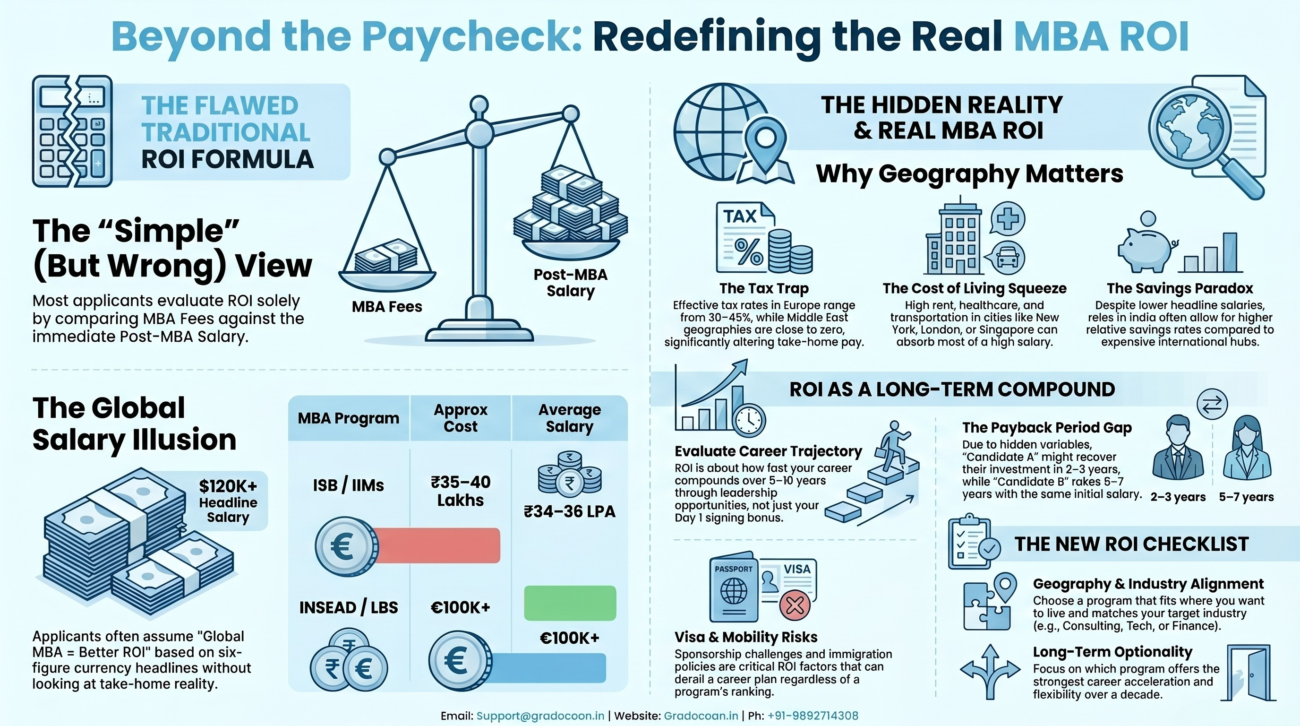
Most MBA applicants evaluate ROI in the simplest way possible:
MBA Fees vs Post-MBA Salary
At first glance, that sounds logical.
If one MBA program costs ₹40 lakhs and another leads to a ₹35–40 LPA salary, the decision seems straightforward.
Similarly, if a global MBA reports average salaries of $120K or €100K+, many applicants automatically assume:
“Global MBA = Better ROI.”
But this is where most applicants get the analysis completely wrong.
Because MBA ROI is not just about:
- placement reports,
- average salaries,
- or compensation headlines.
Real MBA ROI depends on:
- geography,
- taxes,
- savings potential,
- career trajectory,
- visa realities,
- industry growth,
- and long-term optionality.
And once you factor these variables in, the ROI equation changes dramatically.
The Biggest Mistake MBA Applicants Make
Most applicants compare programs like this:
| MBA Program | Approx Cost | Average Salary |
|---|---|---|
| ISB | ₹38–40L | ₹34–36 LPA |
| IIMA PGPX / IIMB EPGP | ₹35–40L | Strong Indian market outcomes |
| INSEAD / LBS | €100K+ | €100K+ compensation |
On paper, the international MBA appears to offer better ROI.
But salaries across geographies are not directly comparable.
A €100K salary in Europe and a ₹35–40 LPA salary in India can create very different real-world financial outcomes once:
- taxes,
- cost of living,
- rent,
- healthcare,
- and savings rates
are factored in.
Why Geography Changes MBA ROI Completely
1. Cost of Living Matters More Than Applicants Realize
One of the biggest hidden variables in MBA ROI is post-MBA living expenses.
In many international locations:
- rent is extremely high,
- healthcare costs are significant,
- transportation is expensive,
- and day-to-day expenses compound quickly.
For example:
- London,
- Paris,
- New York,
- Singapore
can absorb a substantial portion of post-MBA compensation.
Meanwhile, Indian post-MBA salaries—especially in consulting, product management, or leadership roles—can often allow relatively stronger savings rates despite lower headline compensation.
This is why:
Higher salary does not automatically mean higher savings.
2. Tax Structures Dramatically Impact ROI
Another factor applicants rarely evaluate properly:
post-tax income.
Different geographies create completely different take-home outcomes.
For example:
- Many European countries have effective tax rates between 30–45%
- Certain Middle East geographies have close to zero income tax
- India and Singapore fall somewhere in between depending on compensation structures
This alone can materially change:
- savings potential,
- investment capacity,
- and MBA payback timelines.
Two graduates with identical salaries can end up with drastically different disposable incomes purely because of geography.
3. MBA ROI Is About Career Trajectory, Not Day 1 Salary
Many applicants focus excessively on:
- average salary,
- median salary,
- signing bonuses,
- or first-year compensation.
But long-term ROI depends far more on:
- career acceleration,
- industry growth,
- leadership opportunities,
- and future earning trajectory.
For example:
- Consulting careers may scale rapidly over 5–7 years
- Product Management in high-growth tech ecosystems can compound significantly
- Certain geographies may offer slower salary growth despite high initial compensation
The important question is not:
“What will I earn immediately after MBA?”
The more important question is:
“How fast can my career compound over the next 5–10 years?”
4. Visa & Mobility Risks Are a Real ROI Factor
This is one of the most ignored aspects of global MBA ROI.
Many applicants focus heavily on:
- rankings,
- salaries,
- and international brand names
without evaluating:
- visa dependency,
- sponsorship challenges,
- immigration pathways,
- or long-term work authorization stability.
Global MBA outcomes are heavily influenced by:
- economic cycles,
- immigration policies,
- and hiring trends.
A program may have outstanding placement reports historically, but your personal ROI can still vary significantly depending on your:
- citizenship,
- target geography,
- and long-term mobility options.
Why Two MBA Graduates Can Have Completely Different ROI Outcomes
Consider two candidates:
Both graduate with:
- similar MBA costs,
- similar salaries,
- and similar job titles.
Yet:
Candidate A recovers MBA investment within:
✅ 2–3 years
Candidate B takes:
❌ 5–7 years
Why?
Because the real ROI drivers were different:
- geography,
- taxes,
- savings rate,
- industry growth,
- and long-term career acceleration.
MBA ROI is not a static number.
It is a combination of decisions.
So What Should Applicants Actually Evaluate?
Instead of asking:
“Which MBA has the highest average salary?”
Applicants should evaluate:
1. Geography Fit
Where do you realistically want to build your career?
2. Industry Alignment
Which MBA program aligns best with your target industry:
- consulting,
- product,
- finance,
- operations,
- entrepreneurship,
- sustainability,
- healthcare,
- etc.
3. Long-Term Mobility
Which program gives stronger optionality over time?
4. Savings Potential
What will your actual post-tax savings look like?
5. Career Acceleration
Which MBA best accelerates your long-term trajectory?
ISB vs IIMs vs Global MBAs: There Is No Universal “Best ROI”
This is where many applicants make another mistake.
They search for:
“Best MBA ROI.”
But ROI is highly profile-dependent.
For some applicants:
- ISB,
- IIMA PGPX,
- IIMB EPGP,
- or IIMC MBAEx
may create stronger long-term outcomes because:
- the Indian market is growing rapidly,
- consulting opportunities are strong,
- and savings rates can remain attractive.
For others:
- INSEAD,
- LBS,
- NUS,
- or US MBA programs
may align better because of:
- international mobility,
- global consulting opportunities,
- or specific industry ecosystems.
The correct answer depends on:
- your profile,
- your goals,
- your geography preferences,
- and your long-term career strategy.
Final Thoughts
MBA ROI is not a spreadsheet calculation.
It is a long-term career strategy decision.
The applicants who make the best MBA decisions are usually not the ones chasing:
- rankings,
- social media placement reports,
- or headline salaries.
They are the ones asking:
- Where can my career grow fastest?
- Which geography suits my goals?
- What will my actual financial trajectory look like?
- Which program creates the strongest long-term optionality?
Because ultimately:
The best MBA is not the one with the highest salary.
It is the one that creates the strongest long-term compounding effect for your career and life.