


Executive Summary
The Executive MBA (EMBA) landscape in India has evolved into a highly diverse ecosystem, catering to professionals across different career stages. Leading institutions such as ISB and the IIMs now offer a variety of formats—including weekend, modular, and blended programs—designed to help professionals upskill without leaving their jobs.
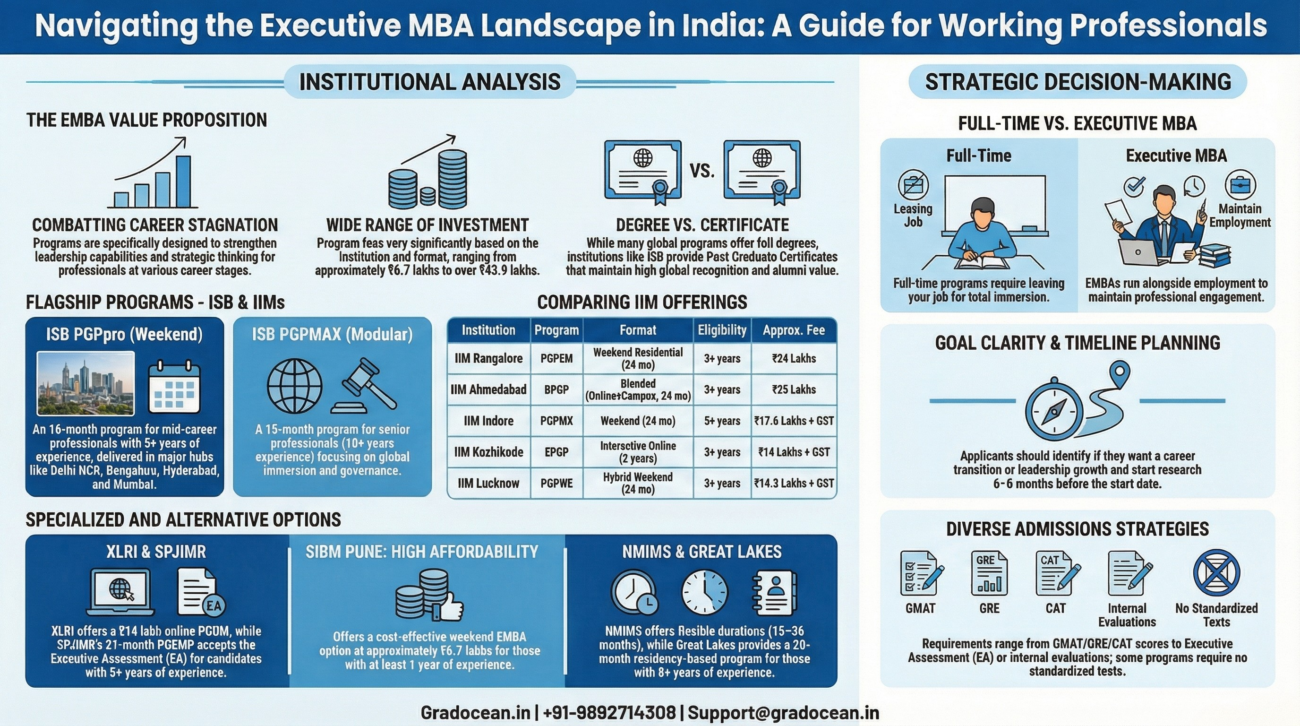
These programs primarily target mid-career stagnation by strengthening leadership capabilities, strategic thinking, and managerial effectiveness. The investment varies widely, ranging from approximately ₹6.7 lakhs to over ₹43.9 lakhs, with eligibility spanning from as little as 1 year to more than 10 years of experience.
While many global programs offer full MBA or MSc degrees, institutions like ISB provide Post Graduate Certificates that still hold strong global recognition, rankings, and alumni value.
Institutional Program Analysis: ISB and IIMs
Indian School of Business (ISB)
ISB offers two flagship executive programs tailored to different experience levels. Notably, its senior leadership program has consistently been ranked among the top globally (Financial Times EMBA rankings).
- ISB PGPpro: An 18-month weekend-based program designed for mid-career professionals with a minimum of 5 years of experience. The curriculum focuses on leadership and strategy, with specialization options such as Finance and Marketing. It is delivered across major cities like Delhi NCR, Bengaluru, Hyderabad, and Mumbai.
- ISB PGPMAX: A 15-month modular program aimed at senior professionals with at least 10 years of experience (average ~16 years). It emphasizes strategic leadership, innovation, and governance, along with global immersion modules.
Indian Institutes of Management (IIMs)
The IIM ecosystem offers both one-year full-time programs and a wide range of part-time executive formats. The latter is especially diverse and flexible for working professionals.
Key Programs Overview:
| Institution | Program | Format | Eligibility | Approx. Fee |
|---|---|---|---|---|
| IIM Bangalore | PGPEM | Weekend Residential (24 months) | 3+ years | ₹24 Lakhs |
| IIM Ahmedabad | BPGP | Blended (Online + Campus, 24 months) | 3+ years | ₹25 Lakhs |
| IIM Indore (Mumbai) | PGPMX | Weekend (24 months) | 5+ years | ₹17.6 Lakhs + GST |
| IIM Kozhikode | EPGP | Interactive Online (2 years) | 3+ years | ₹14 Lakhs + GST |
| IIM Lucknow (Noida) | PGPWE | Hybrid Weekend (24 months) | 3+ years | ₹14.3 Lakhs + GST |
Specialized and Alternative Executive Programs
Beyond ISB and the IIMs, several other institutions offer credible executive education options:
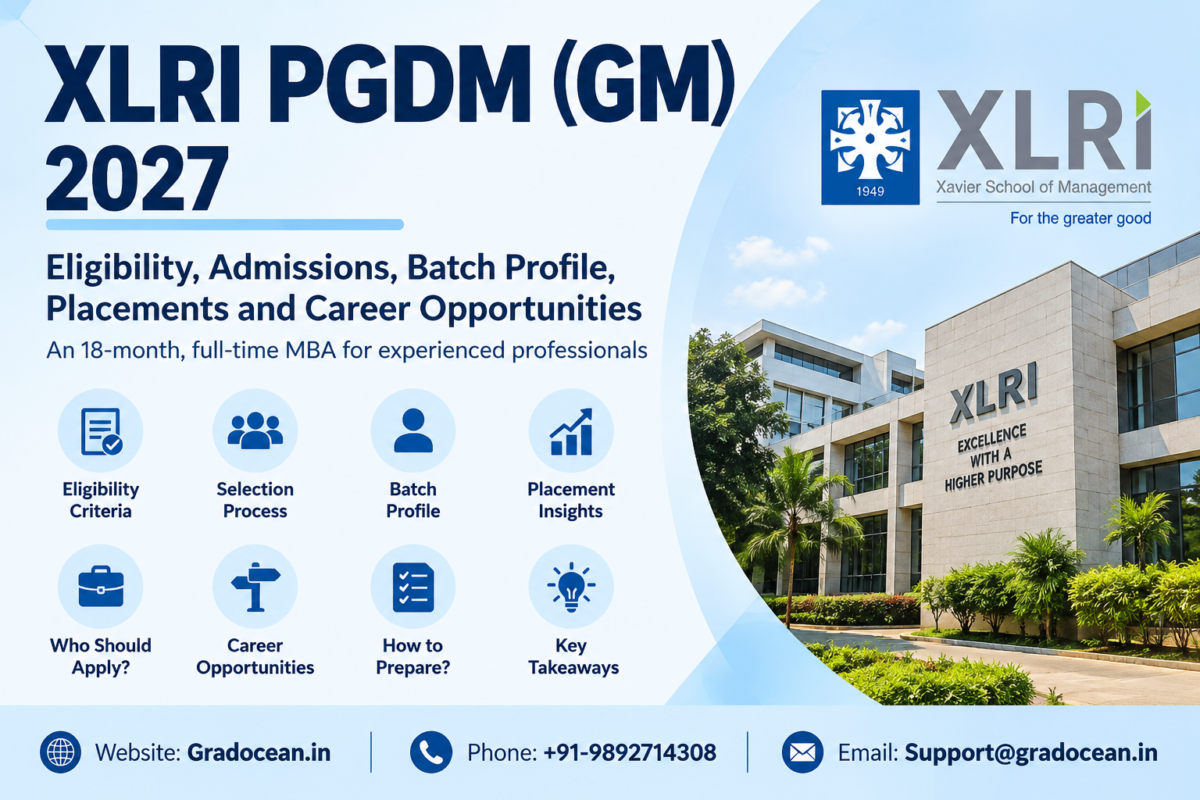
- XLRI (Xavier School of Management): Offers a two-year online PGDM in Business Management, priced around ₹14 lakhs.
- SPJIMR Mumbai: The PGEMP is a 21-month modular program for candidates with 5+ years of experience and accepts the Executive Assessment (EA).
- MDI Gurgaon: Provides an 18-month PGDM (Business Management) for professionals with at least 5 years of experience.
- Great Lakes Institute of Management: The PGXPM is a 20-month program with periodic residencies, requiring a minimum of 8 years of experience.
- NMIMS Mumbai: Offers flexible program durations (15–36 months) for professionals with 5+ years of experience.
- SIBM Pune: A cost-effective weekend EMBA option (~₹6.7 lakhs) with a minimum requirement of 1 year of experience.
- IMI: Provides 12- and 15-month residential formats with placement support for candidates with 5+ years of experience.
- IIFT (Delhi/Kolkata): Offers a 3-year weekend MBA in International Business for professionals with 3+ years of experience.
Strategic Decision-Making and Application Guidelines
Full-Time MBA vs Executive MBA
The fundamental difference lies in professional engagement. A full-time MBA requires complete immersion and typically involves leaving your job. In contrast, Executive MBA programs are designed to run alongside full-time employment, although they may limit campus interaction and networking time.
Critical Success Factors for Applicants
1. Clarity of Goals
Applicants must clearly define whether they are targeting career transition, leadership growth, or functional specialization.
2. Financial Planning
Apart from tuition, additional costs such as travel and accommodation (especially for modular formats) must be considered.
3. Timeline Planning
Ideally, candidates should begin research and preparation at least 6–8 months before the program start date.
4. Admissions Strategy
Requirements vary across programs. While some accept GMAT/GRE/CAT scores, others consider the Executive Assessment (EA) or conduct internal evaluations. There are also programs that do not require standardized tests.
Conclusion on Market Value
Executive MBA programs in India are designed to provide a strong competitive advantage to working professionals. They serve as a structured pathway for continuous learning and skill enhancement, especially for those experiencing career stagnation.
More importantly, these programs prepare professionals to take on larger, more complex leadership roles by equipping them with modern management frameworks and strategic thinking capabilities.
Other Articles of Interest:
- ISB vs IIM One-Year MBA (2026): Fees, Placements, Rankings, ROI & Which is Better?
- Is a One-Year MBA the Right Choice for You?
- One Year MBA Programs in India