



For students targeting Fall 2026 MS or PhD admissions, the GRE debate is back. With universities reinstating GRE requirements and preparation costing ₹30,000–35,000 plus two months of effort, the question is simple:
Is the GRE still relevant in 2026?
Here are four data-driven insights from the recent application cycle.
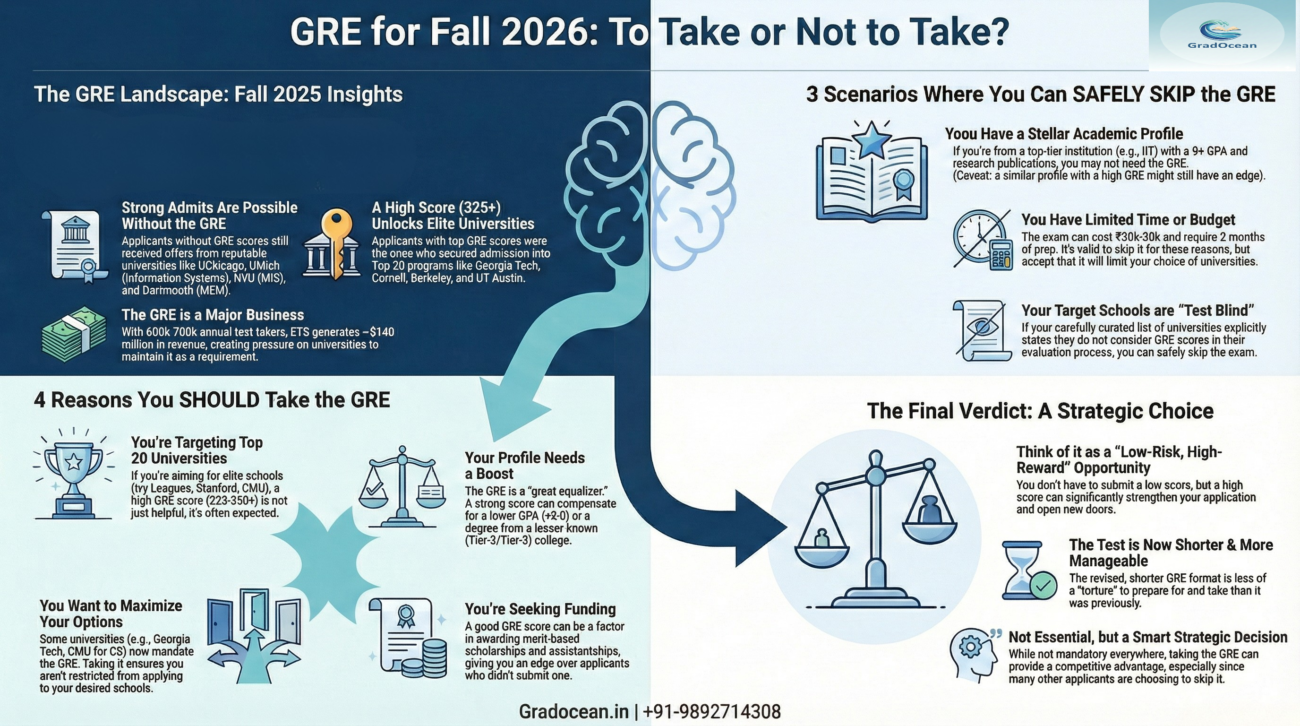
1. You Can Get Into Great Schools Without the GRE — But Not the Very Top
In the last admission cycle, many applicants did not submit a GRE score. Many still secured admits from strong universities like:
-
University of Michigan
-
NYU
-
Dartmouth
-
NCSU
-
Virginia Tech
-
University of Washington
This proves the GRE is not mandatory for many good programs.
However, there’s a clear pattern:
Applicants who got into top-20 programs (Georgia Tech, Cornell, Berkeley, UT Austin, etc.) consistently had high GRE scores (325+).
If you’re targeting elite programs, a strong GRE score is a major differentiator.
2. The GRE Is a Powerful Profile “Equalizer”
The GRE does more than keep options open — it strengthens weak areas.
It is especially useful if:
-
Your GPA is below 8.0
-
You’re from a Tier-2 or Tier-3 college
-
You’re applying to competitive programs like Computer Science
Many top universities (e.g., Georgia Tech, CMU, Duke, NCSU for CS) still require the GRE.
A strong score reassures admissions committees about your academic ability and gives them a standardized benchmark to evaluate your profile.
3. The Hidden Advantage: Scholarships & Funding
Many students overlook this:
A strong GRE score can significantly improve your chances of receiving merit-based scholarships and assistantships.
When two profiles are similar, the candidate with the better GRE score often gets the funding.
Skipping the GRE could mean missing out on substantial financial support.
4. Think of the GRE as a Low-Risk, High-Reward Bet
Strategically, the GRE has limited downside:
-
Worst case: You don’t get a great score — don’t submit it.
-
Best case: A strong score boosts your profile and unlocks top schools and funding.
With fewer applicants taking the test now, even a 315+ score can create a competitive edge.
Final Verdict: Should You Take the GRE for Fall 2026?
The GRE is no longer universally mandatory — but it remains a powerful strategic tool.
Take it if:
-
You’re targeting top-tier programs
-
You need to strengthen your academic profile
-
You want better scholarship chances
Skip it only if:
-
Your target schools don’t require it
-
Your overall profile is already extremely strong
The real question isn’t “Is the GRE required?”
It’s: Can a strong GRE score meaningfully improve your application?
For many Fall 2026/2027 applicants, the answer is still yes.
Need Personalized Guidance for Studying Abroad?
At GradOcean, we help students:
- Shortlist the right universities
- Maximize scholarships
- Plan education loans smartly
- Build strong applications with expert mentorship
Email us at support@gradocean.in, call us at +91-9892714308, or connect with us directly through our contact page:
https://gradocean.in/contact-us/
Start your academic journey with clarity and confidence.