


For decades, the global career roadmap was simple: secure an H-1B visa, move to the United States, and eventually obtain a Green Card. But in 2026, that pathway has become increasingly uncertain—especially for Indian professionals facing employment-based Green Card backlogs that can stretch for decades.
As global immigration policies evolve, skilled professionals are shifting from an “employer-sponsored” model to a merit-based, talent-driven immigration strategy. The American Dream hasn’t disappeared—it has diversified. Countries like Australia, Japan, the UAE, Singapore, and the UK are actively competing for global talent with faster, more predictable permanent residency pathways.
If you’re a skilled professional in tech, AI, engineering, biotech, or research, 2026 may be the most strategic year to rethink your global mobility plan.
Japan’s Talent Push: Stability in a High-Tech Economy
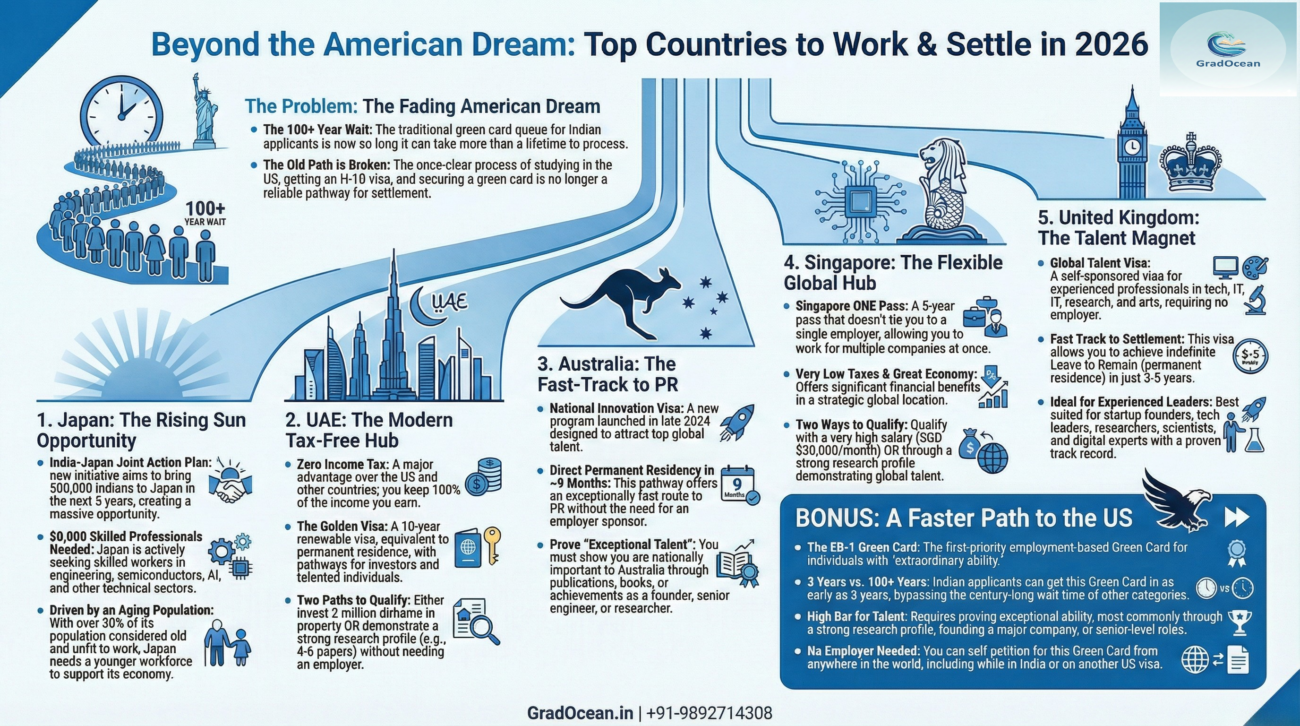
Japan is facing a demographic transformation, with more than 30% of its population over 65. To sustain its economy, the country is actively welcoming international professionals—particularly in AI, semiconductors, robotics, and advanced engineering.
Through new bilateral initiatives and skilled migration pathways, Japan is creating fast-track integration routes for high-demand professionals. For mid-career engineers and researchers, Japan offers:
-
Long-term job stability
-
Structured residency pathways
-
A reduced reliance on employer-driven visa uncertainty
For those seeking predictable immigration policy in a technology-driven economy, Japan is emerging as a serious contender.
UAE Golden Visa: 10-Year Residency Without Employer Sponsorship
The UAE has transformed from a tax-free business hub into a global talent magnet. While its 0% income tax is attractive, the real strategic advantage lies in the 10-year Golden Visa.
Unlike traditional work visas, the Golden Visa offers:
-
Self-managed residency
-
Freedom to change employers
-
Ability to sponsor family
-
Long-term security without corporate dependency
Beyond the standard investment route, professionals with strong research profiles and recognized achievements may qualify under specialized talent categories. For researchers, innovators, and high-performing executives, the UAE offers autonomy rarely found in employer-tied systems.
Australia’s Fast-Track Permanent Residency Options
Australia has positioned itself aggressively in the global talent race. Through innovation-focused visa programs, the country provides direct or accelerated pathways to Permanent Residency (PR) for professionals in sectors such as:
-
Software engineering
-
Biotechnology
-
Advanced manufacturing
-
Cybersecurity
-
Clean energy
Australia’s approach prioritizes national importance and economic contribution over employer sponsorship. For founders, senior engineers, and researchers, this can significantly reduce immigration timelines compared to traditional systems in the US or UK.
Singapore ONE Pass: Multi-Employer Flexibility
Singapore’s ONE Pass (Overseas Networks & Expertise Pass) is designed for top-tier global professionals. It provides five years of residency with unmatched flexibility.
Key advantages include:
-
Ability to work for multiple employers
-
Freedom to switch jobs without new visa applications
-
Strong ecosystem for finance, tech, and research
Eligibility is based on either high income benchmarks or exceptional professional achievement. For senior leaders, global executives, and research-driven professionals, Singapore offers both prestige and mobility in Asia’s leading innovation hub.
UK Global Talent Visa: A Self-Sponsorship Route
While general UK immigration pathways have tightened, the Global Talent Visa remains a powerful alternative. Designed for digital technology experts, researchers, and innovators, it allows:
-
Self-sponsorship (no job offer required)
-
Faster routes to settlement
-
Full work rights for dependents
For professionals with strong research portfolios, startup leadership, or recognized industry contributions, this visa provides a strategic entry point into the European market.
The U.S. EB-1: The Merit-Based Green Card Strategy
For those still committed to the United States, the H-1B lottery may not be the most strategic route. Instead, high-achieving professionals are increasingly targeting the EB-1 (First Priority) Green Card category.
The EB-1 is designed for individuals with extraordinary ability, outstanding researchers, or multinational executives. Typical qualification factors include:
-
Peer-reviewed publications
-
Original research contributions
-
Patents or nationally recognized awards
-
Senior leadership roles
While the standards are high, the EB-1 pathway offers significantly shorter processing timelines compared to standard employment-based categories—making it the most predictable U.S. option for high-impact professionals.
Why Research and Publications Matter More Than Ever
Across nearly every competitive immigration pathway in 2026, one theme stands out: documented expertise is the new currency.
Research publications, patents, industry recognition, and thought leadership create a portable professional profile. Unlike employer sponsorship, this type of profile travels with you—making you valuable to multiple countries simultaneously.
This marks a fundamental shift in global immigration strategy:
-
From luck-based lotteries to merit-based systems
-
From employer dependency to professional autonomy
-
From waiting in line to qualifying strategically
Final Thoughts: Build a Globally Valuable Profile
The global mobility landscape has changed. Countries are no longer simply filling roles—they are competing for intellectual capital.
If you are a software engineer, AI specialist, biotech researcher, founder, or senior executive, 2026 may be the year to:
-
Diversify beyond the H-1B pathway
-
Explore permanent residency options in Australia, UAE, Japan, Singapore, or the UK
-
Strengthen your research and leadership portfolio
-
Build a merit-based immigration strategy
The real question is no longer, “Will a country sponsor me?”
It’s: Which country is ready to compete for my talent?
Frequently Asked Questions (FAQs)
1. Why are skilled professionals reconsidering the U.S. Green Card pathway in 2026?
In 2026, long employment-based Green Card backlogs—especially for Indian nationals—have made the traditional H-1B to Green Card pathway highly uncertain. Many professionals are shifting toward merit-based immigration systems in countries like Australia, the UAE, Japan, and Singapore that offer faster and more predictable permanent residency options.
2. What is the fastest alternative to the H-1B visa in 2026?
Several countries now offer faster alternatives to the H-1B pathway. Australia provides innovation-focused PR routes, the UAE offers a 10-year Golden Visa, and Singapore’s ONE Pass allows multi-employer flexibility. For those committed to the U.S., the EB-1 Green Card remains the fastest merit-based option compared to traditional employment categories.
3. How does the UAE Golden Visa benefit skilled professionals?
The UAE Golden Visa offers 10-year residency without employer sponsorship. It allows professionals to switch jobs freely, sponsor family members, and maintain residency without corporate dependency. Highly skilled professionals, researchers, and innovators may qualify through specialized talent categories beyond investment-based routes.
4. Is Australia offering faster Permanent Residency (PR) for tech professionals?
Yes. Australia has introduced innovation-focused immigration pathways that prioritize national economic contribution over employer sponsorship. Professionals in technology, biotech, cybersecurity, and advanced engineering may qualify for accelerated Permanent Residency, often faster than traditional U.S. or UK immigration timelines.
5. What is the Singapore ONE Pass and who qualifies?
The Singapore ONE Pass (Overseas Networks & Expertise Pass) is a five-year visa designed for top global talent. It allows professionals to work for multiple employers and change roles without reapplying for a visa. Eligibility is based on high income thresholds or exceptional professional achievements in fields like tech, finance, and research.
6. How does the UK Global Talent Visa differ from other UK work visas?
The UK Global Talent Visa allows self-sponsorship, meaning no job offer is required. It provides faster settlement options compared to standard UK work visas and offers full work rights for dependents. It is ideal for digital tech experts, researchers, and innovation leaders with strong professional portfolios.
7. What makes the U.S. EB-1 Green Card a better option than the H-1B in 2026?
The EB-1 Green Card is a merit-based immigration category for individuals with extraordinary ability, outstanding research credentials, or multinational executive experience. Unlike the H-1B lottery system, the EB-1 pathway offers a more predictable timeline for qualified professionals and significantly reduces waiting periods compared to other employment-based categories.
Need Personalized Guidance for Masters Abroad Applications?
At GradOcean, we help students:
- Shortlist the right universities
- Maximize scholarships
- Plan education loans smartly
- Build strong applications with expert mentorship
Email us at support@gradocean.in, call us at +91-9892714308, or connect with us directly through our contact page:
https://gradocean.in/contact-us/
Start your academic journey with clarity and confidence.