



The global business landscape has changed. Leadership today is no longer defined by intuition alone—it is powered by analytics, technology, and data-driven decision-making. In response, business schools across the United States have redesigned their MBA programs to reflect this shift.
One of the most significant developments is the rise of the STEM-designated MBA.
For international applicants—especially Indian students targeting long-term U.S. careers—the STEM MBA is more than an academic trend. It is a strategic career accelerator that combines advanced quantitative training with extended U.S. work authorization benefits.
This guide breaks down what a STEM MBA really means, how the OPT extension works, which schools offer it, and how to evaluate whether it aligns with your goals.
What Exactly Is a STEM MBA?
A STEM MBA is a Master of Business Administration program that incorporates substantial coursework in science, technology, engineering, and mathematics.
These programs are officially recognized as STEM-designated by the U.S. Department of Homeland Security (DHS). As a result, international students graduating from such programs may qualify for an extended Optional Practical Training (OPT) period.
Academically, STEM MBAs combine traditional management education—finance, marketing, operations, strategy—with advanced quantitative areas such as:
-
Business Analytics
-
Data Science
-
Financial Engineering
-
Quantitative Modeling
-
Supply Chain Analytics
-
Technology Strategy
The outcome is a hybrid leader: someone who understands both boardroom strategy and technical execution.
The 36-Month OPT Advantage: Why It Matters
For international students on an F-1 visa, the biggest structural advantage of a STEM MBA is the extended work authorization period.
Standard OPT:
12 months of post-completion work authorization.
STEM OPT Extension:
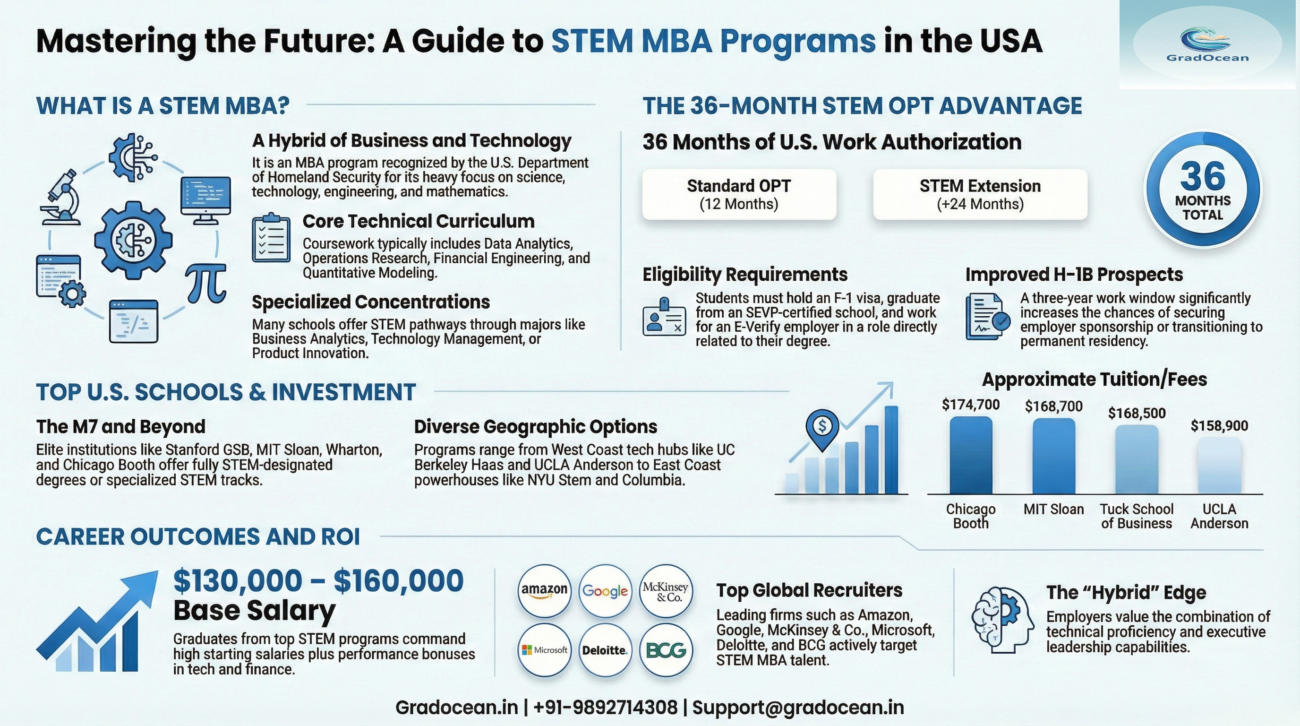
An additional 24 months, bringing the total to 36 months.
This extension significantly improves long-term U.S. career prospects.
Eligibility Requirements
To qualify for the STEM OPT extension, students must:
-
Hold a valid F-1 visa
-
Graduate from a STEM-designated degree program at an SEVP-certified institution
-
Work for an employer enrolled in E-Verify
-
Secure a role directly related to the STEM degree
-
Complete an employer-approved Form I-983 Training Plan
-
Submit six-month validation reports to their Designated School Official (DSO)
-
Stay within the 150-day unemployment limit across the 36-month period
Why This Is Strategically Powerful
-
Up to three H-1B lottery attempts instead of one
-
Greater stability for employers considering sponsorship
-
Increased flexibility to explore roles in tech, analytics, consulting, or operations
For Indian students pursuing a STEM MBA in the USA, this extended window often becomes the decisive factor in choosing programs.
Why the Demand for STEM MBAs Is Growing
The modern employer increasingly looks for leaders who can interpret data, evaluate risk quantitatively, and manage technology-enabled transformation.
A STEM MBA delivers:
1. Extended Work Authorization
Up to three years of legal work experience in the U.S. post-graduation.
2. Higher Return on Investment
Graduates from leading STEM MBA programs frequently secure starting salaries between $130,000 and $160,000, often with signing bonuses.
3. A Hybrid Skill Profile
Companies value professionals who combine analytics expertise with leadership capability.
4. Long-Term Immigration Advantage
More time in the U.S. improves chances of H-1B sponsorship and long-term residency pathways.
Top recruiters hiring STEM MBA graduates include:
-
Amazon
-
Google
-
McKinsey & Company
-
Microsoft
-
Boston Consulting Group
-
Deloitte
How STEM MBA Programs Are Structured
Most STEM MBAs follow a two-year full-time format, though some schools offer accelerated one-year options.
Core coursework typically includes:
-
Accounting
-
Corporate Finance
-
Marketing Strategy
-
Operations Management
-
Organizational Behavior
STEM components are integrated through:
-
Data analytics electives
-
Operations research
-
Financial modeling
-
AI and machine learning applications
-
Technology innovation labs
Some institutions offer full-program STEM designation, while others provide STEM status only through specific majors such as Business Analytics or Management Science.
Understanding this distinction is critical for maintaining OPT eligibility.
Leading STEM MBA Programs in the United States
Many top-tier U.S. business schools now offer STEM-designated MBA options.
Notable institutions include:
-
Stanford Graduate School of Business
-
University of Chicago Booth School of Business
-
MIT Sloan School of Management
-
Columbia Business School
-
Wharton School
-
UC Berkeley Haas School of Business
-
UCLA Anderson School of Management
-
Yale School of Management
-
NYU Stern School of Business
-
Kellogg School of Management
-
University of Michigan Ross School of Business
-
Duke University Fuqua School of Business
-
Carnegie Mellon Tepper School of Business
-
Cornell Johnson Graduate School of Management
Each school structures its STEM components differently, so applicants must review program details carefully.
Global MBA Programs with Strong Quantitative Focus
While STEM OPT benefits are specific to the United States, global institutions are also strengthening analytics-driven curricula.
Prominent international programs include:
-
INSEAD
-
London Business School
-
HEC Paris
-
Cambridge Judge Business School
-
IMD Business School
-
ESMT Berlin
-
National University of Singapore
-
IESE Business School
These schools incorporate advanced analytics and digital strategy modules to maintain global competitiveness.
Who Should Consider a STEM MBA?
A STEM MBA is particularly suitable if:
-
You have a technical background and want to move into leadership roles
-
You aim to pivot into product management, fintech, AI, or consulting
-
You want extended U.S. work authorization
-
You are comfortable with quantitative rigor
-
You plan to launch or scale a tech-driven business
For candidates transitioning from engineering, computer science, mathematics, healthcare analytics, or data science into executive roles, this degree can serve as a powerful bridge.
Cost Considerations
Tuition varies significantly across institutions. Examples include:
-
UCLA Anderson School of Management – Approx. $158,900
-
University of Chicago Booth School of Business – Approx. $174,700
-
MIT Sloan School of Management – Approx. $168,700
These figures exclude living expenses and additional costs. Applicants seeking strong ROI may also evaluate mid-tier institutions offering STEM designation at lower tuition levels.
How to Choose the Right STEM MBA
Before applying, evaluate:
-
STEM Designation Type – Is the entire program STEM-certified or only certain tracks?
-
OPT Eligibility – Does it fully qualify for the 24-month extension?
-
Curriculum Depth – How integrated are analytics and quantitative modules?
-
Career Placement Data – Which industries dominate employment reports?
-
Total Cost and ROI – Tuition, living expenses, and expected salary outcomes.
For international students, ensuring full STEM OPT eligibility should be a priority.
Final Thoughts
A STEM MBA is not simply a specialized business degree. It is a strategic response to a data-driven global economy.
It offers:
-
A hybrid technical-management skillset
-
Extended U.S. work authorization
-
Strong placement outcomes
-
Enhanced immigration flexibility
For ambitious professionals—particularly international candidates seeking U.S. career mobility—the STEM MBA is rapidly becoming one of the most powerful academic investments available.
The real question is not whether STEM MBAs are growing.
It is whether your long-term career strategy requires the structural advantages they provide.
Frequently Asked Questions (FAQs)
1. What makes a STEM MBA different from a traditional MBA?
A STEM MBA combines core business education (finance, marketing, strategy, operations) with quantitative and technical coursework such as data analytics, statistics, operations research, and technology management. It is officially designated as STEM by the U.S. Department of Homeland Security, allowing eligible international students to qualify for extended work authorization.
2. What is the STEM OPT extension and how long can students work in the U.S.?
International students on an F-1 visa typically receive 12 months of Optional Practical Training (OPT) after graduation. With a STEM-designated MBA, students may qualify for an additional 24-month extension, allowing up to 36 months of total work authorization in the United States.
3. Who is eligible for the 24-month STEM OPT extension?
To qualify, students must:
-
Hold a valid F-1 visa
-
Graduate from an SEVP-certified U.S. institution with a STEM-designated degree
-
Work for an employer enrolled in E-Verify
-
Be employed in a role directly related to their STEM degree
-
Comply with reporting requirements and the Form I-983 Training Plan
4. What career opportunities are common after a STEM MBA?
Graduates typically enter roles in consulting, technology, finance, product management, and operations. Common recruiters include firms like Amazon, Google, McKinsey, Microsoft, Deloitte, and BCG. Starting salaries at top schools often range between $130,000–$160,000 plus bonuses, especially in tech and consulting roles.
5. Which are some top U.S. business schools offering STEM MBA programs?
Several leading institutions now offer STEM-designated MBA pathways, including Stanford GSB, Chicago Booth, MIT Sloan, Wharton, Columbia, Berkeley Haas, NYU Stern, Duke Fuqua, Michigan Ross, and Carnegie Mellon Tepper, among others.
6. Is a STEM MBA only suitable for students with an engineering or technical background?
No. While candidates with STEM backgrounds often find it a natural fit, professionals from consulting, finance, operations, or even non-technical fields can pursue a STEM MBA if they want to build analytical expertise and move into data-driven leadership roles.
7. How should international students choose the right STEM MBA program?
Students should evaluate:
-
Whether the program qualifies for the full 24-month STEM OPT extension
-
Curriculum depth in analytics, technology, or quantitative fields
-
Total tuition and living costs
-
Employment outcomes and industry alignment
-
Geographic location and recruiting strength
Choosing strategically ensures strong ROI and better long-term visa and career prospects.
Need Personalized Guidance for STEM MBA Applications?
At GradOcean, we help students:
- Shortlist the right universities
- Maximize scholarships
- Build strong applications with expert mentorship
Email us at support@gradocean.in, call us at +91-9892714308, or connect with us directly through our contact page:
https://gradocean.in/contact-us/
Start your academic journey with clarity and confidence