



Executive Summary
This briefing document provides a synthesized analysis of the premier MBA programs in the United Kingdom, including London Business School (LBS), University of Cambridge (Judge), University of Oxford (Saïd), Imperial College Business School, Alliance Manchester Business School (AMBS), Cranfield School of Management, Warwick Business School (WBS), Bayes Business School, and Durham University Business School.
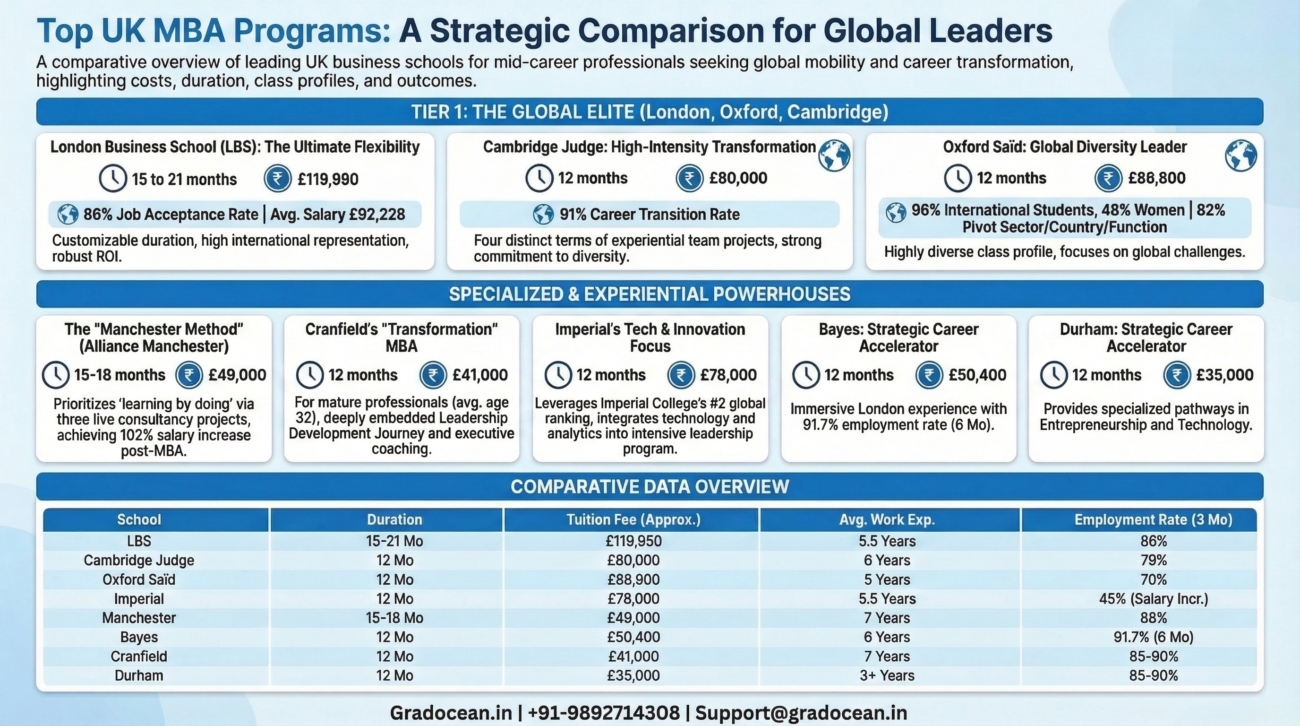
The UK MBA landscape is characterized by high intensity, significant international diversity, and a profound capacity for career transformation. While program durations vary from the accelerated 12-month models (Oxford, Cambridge, Imperial, Cranfield, Warwick, Bayes, Durham) to flexible 15–21 month tracks (LBS, Manchester), the overarching value proposition remains consistent: high return on investment (ROI) through rapid career pivoting. Key findings include:
- Career Transformation: Programs report exceptional career mobility, with transition rates (industry, function, or geography) often exceeding 80–90%.
- Internationalism: Cohorts are highly globalized; for instance, Oxford reports 96% international students, while Alliance Manchester reports 94%.
- Gender Diversity: Significant progress toward gender parity is evident, with several schools reporting female representation between 45% and 48% (Oxford, Cambridge, LBS, Manchester).
- Experiential Learning: A shift toward “live” consultancy projects and simulations (the “Manchester Method,” Cranfield’s Leadership Development Journey, and Bayes’ International Consultancy Week) defines the modern UK MBA curriculum.
- Financial Investment: Tuition fees range from approximately £35,000 (Durham) to £119,950 (LBS), supported by extensive scholarship portfolios focusing on diversity and merit.
1. Program Profiles and Strategic Durations
The UK offers a spectrum of MBA architectures designed to meet various professional needs, from rapid re-entry into the workforce to extended global internships.
12-Month Intensive Programs
Most UK institutions favor a one-year model to minimize opportunity costs for professionals.
- Cambridge Judge: A high-intensity four-term structure focusing on team building and organizational complexity.
- Oxford Saïd: A one-year immersive experience featuring a “Launch” residential and strategic consulting projects.
- Imperial: Leverages its parent institution’s strength in science and technology to focus on innovation and analytics.
- Cranfield: Marketed as a “Transformation MBA” for mid-career professionals (average age 32).
- Warwick: A standard 12-month format with a strong emphasis on “CareerPlus” services and global immersion weeks.
- Bayes: A rigorous 12-month format in London’s financial district, utilizing a four-block core curriculum.
- Durham: Offers a 12-month full-time track and a 24-month Executive MBA dual-award with EBS Universität.
Flexible Duration Programs
- London Business School (LBS): Offers customizable exit points at 15, 18, or 21 months, catering to career switchers who require longer internships.
- Alliance Manchester: Provides a dual-format structure of 15 or 18 months, centered on the “Manchester Method.”
2. Admissions Standards and Class Demographics
Admission to these programs is highly selective, prioritizing professional progression, academic readiness, and international perspective.
Academic and Professional Requirements
| Institution | Avg. Work Experience | Standardized Testing | Key Selection Criteria |
| LBS | 5.5 Years | GMAT / GRE / GMAT Focus | Professional aspirations; academic readiness. |
| Cambridge | 6 Years | GMAT (690-700) / GRE | Interpersonal resilience; learning mindset. |
| Oxford | 5 Years | Median GMAT: 690 | Cross-cultural fluency; leadership potential. |
| Imperial | 5–6 Years | GMAT / GRE | Leadership potential; innovation mindset. |
| Manchester | 7 Years | GMAT (Avg. 639) / MAT | Emotional intelligence; international exposure. |
| Cranfield | 7 Years | GMAT (600+ recommended) | Transformative intent; professional maturity. |
| Warwick | 3+ Years | GMAT (650+ competitive) | Transformative leadership development. |
| Bayes | 6 Years | GMAT (600+) / GRE | Personal transformation; adaptability. |
| Durham | 3+ Years | GMAT (Avg. 650) | Leadership potential; strategic mindset. |
Global Diversity and Gender Representation
The programs maintain a strong commitment to diversity, with international representation typically exceeding 60% and reaching as high as 96% at Oxford.
- Gender Parity: Oxford (48%), Cambridge (47%), Manchester (46%), and LBS (45%) are leading in female enrollment.
- Nationalities: Cohorts typically represent between 20 and 65 nationalities, providing a dynamic cross-cultural learning environment.
3. Career Outcomes and Employment Success
Graduates of UK MBA programs demonstrate high marketability, particularly in Consulting, Finance, and Technology.
Employment Rates and Compensation
| Institution | Employed at 3 Months | Average Salary (Approx.) | Career Transformation Rate |
| LBS | 86% | £92,228 ($116,465) | 52% switched sectors |
| Cambridge | 79% | £93,085 (Total Package) | 91% career transition |
| Oxford | 70% | £74,143 (Mean Base) | 82% switched sector/country/role |
| Imperial | N/A | $119,230 (PPP) | 64% changed sectors |
| Manchester | 88% | $140,238 (Weighted) | 102% salary increase |
| Cranfield | 85–90% | £70,000 – £90,000+ | 70% changed industry/function |
| Bayes | 91.7% (at 6 months) | £70,000 – £90,000 | 57% changed industries |
| Durham | 85–90% | £60,000 – £90,000+ | 60%+ changed industry/function |
Top Hiring Sectors
- Consulting: Remains the dominant recruiter across most schools. LBS reports 34% of its class entering consulting, with major hires from McKinsey, BCG, and Bain.
- Finance: A primary destination for LBS (21%), Cambridge (26%), and Oxford (34.2%) graduates.
- Technology: Increasingly significant at Imperial (20%), Cambridge (23%), and Oxford (22.6%). Oxford specifically notes that 83% of students without prior tech experience successfully pivoted into the sector.
4. Curricular Innovation and Experiential Learning
UK MBA programs emphasize “applied” learning, moving beyond traditional case studies to live consultancy and leadership coaching.
Experiential “Live” Projects
- The Manchester Method: Centered on three live consultancy projects, including a 150-hour Social Impact Project.
- Cambridge Projects: Includes the Cambridge Venture Project (CVP) and Global Consulting Project (GCP).
- Bayes Experiential Framework: Includes a Strategy Project for UK firms, an International Consultancy Week (e.g., Iceland or Poland), and a Business Integration Project.
- Durham’s Boardroom Exercise: A high-stakes simulation where students justify strategic decisions to a panel of faculty and practitioners.
Leadership and Personal Evolution
- Cranfield’s Leadership Development Journey (LDJ): Features mandatory executive coaching and self-awareness tools like MBTI and 360° feedback.
- LBS Tailored Core: Allows students to customize their foundation with options like Business Analytics or Digital Strategy in Terms 2 and 3.
- Warwick’s Leadership Development Program (LDP): Focuses on psychometric assessments and negotiation workshops.
5. Financial Investment and Scholarship Support
The total cost of attendance varies significantly by location and program duration, with London-based programs commanding the highest premiums.
Tuition and Estimated Expenses
| School | Tuition Fee | Estimated Living Costs (Annual) |
| LBS | £119,950 | Variable (Not specified) |
| Cambridge | £80,000 | £19,860 |
| Oxford | £88,800 | £16,860 – £25,260 |
| Imperial | £78,000 – £79,500 | £14,000 – £20,000 |
| Manchester | £49,000 | £15,000 – £20,000 |
| Bayes | £50,400 | Variable (London rates) |
| Warwick | £45,000 | Variable |
| Cranfield | £41,000 | £12,000 – £15,000 |
| Durham | £35,000 – £40,000 | £12,000 – £16,000 |
Funding and Scholarships
Institutions provide robust financial aid, often focusing on diversity and social impact.
- Women in Leadership: Forté Foundation Fellowships are offered across LBS, Oxford, Cambridge, Imperial, Manchester, Cranfield, and Warwick, often covering up to 50% of tuition.
- LGBTQ+ Support: Reaching Out MBA (ROMBA) Fellowships are available at LBS, Oxford, Cambridge, and Imperial.
- Social/Global Impact: Specific awards like the Skoll Scholarship (Oxford), Dean’s Impact Scholarship (Imperial), and Social Impact Scholarship (Bayes) target candidates from non-traditional or NGO backgrounds.
- Regional Awards: Schools like Durham and Bayes offer specific bursaries for talent from Africa, Asia, and Latin America.
6. Strategic Conclusions
The analyzed UK MBA programs offer distinct pathways for professional growth:
- For Career Switchers: LBS and Alliance Manchester provide the flexibility of longer durations and internships required for significant sectoral pivots.
- For Fast-Track Acceleration: The 12-month programs (Oxford, Cambridge, Warwick, Bayes) offer high ROI by minimizing time out of the market while maintaining prestige.
- For Tech/Innovation Focus: Imperial and Durham (Technology pathway) are specifically aligned with digital transformation and analytics.
- For Leadership Transformation: Cranfield and Warwick emphasize the psychological and interpersonal evolution of the leader through intensive coaching and self-reflection.
Frequently Asked Questions (FAQs)
1. What are the top MBA programs in the UK?
Some of the most recognized MBA programs in the UK include:
-
London Business School
-
University of Cambridge Judge Business School
-
Oxford Saïd Business School
-
Imperial College Business School
-
Alliance Manchester Business School
-
Warwick Business School
-
Cranfield School of Management
-
Bayes Business School
-
Durham University Business School
These schools are known for strong global rankings, diverse cohorts, and excellent post-MBA career outcomes.
2. How long does an MBA in the UK typically take?
Most UK MBA programs follow a 12-month intensive format, allowing students to return to the workforce quickly. Schools like Oxford, Cambridge, Imperial, Warwick, Bayes, Cranfield, and Durham follow this model.
Some programs offer longer options. For example, London Business School and Alliance Manchester Business School offer 15–21 month flexible programs that allow students to pursue internships.
3. What GMAT score is required for top UK MBA programs?
Most leading UK business schools prefer GMAT scores between 650 and 700+. For example:
-
University of Cambridge Judge Business School and Oxford Saïd Business School typically report median GMAT scores around 690.
-
Other schools such as Warwick Business School and Durham University Business School may consider scores around 650+ competitive.
However, admissions decisions also depend heavily on work experience, leadership, and career goals.
4. What is the average work experience required for a UK MBA?
Most UK MBA programs require 3–7 years of professional experience.
Schools such as Alliance Manchester Business School and Cranfield School of Management often admit candidates with 6–7 years of experience, while programs like Warwick Business School and Durham University Business School accept applicants with 3–5 years of experience.
5. What career opportunities do UK MBA graduates typically pursue?
The most common post-MBA industries include:
-
Consulting (firms such as McKinsey & Company, Boston Consulting Group, and Bain & Company)
-
Finance and banking
-
Technology companies
-
Strategy and leadership roles
Consulting remains the largest recruiter at many schools, especially at London Business School and University of Cambridge Judge Business School.
6. How much does an MBA in the UK cost?
Tuition fees vary depending on the institution:
-
London Business School – about £119,950
-
Oxford Saïd Business School – about £88,800
-
University of Cambridge Judge Business School – about £80,000
-
Warwick Business School – about £45,000
-
Durham University Business School – about £35,000–£40,000
Living expenses can range from £12,000 to £25,000 per year, depending on the city.
7. Is a UK MBA worth it for career switching?
Yes. One of the biggest advantages of a UK MBA is its ability to enable major career transitions.
Programs report career change rates of 80–90%, meaning graduates often switch industries, functions, or locations after completing their degree. The one-year format combined with strong global networks also helps deliver a high return on investment.
Need Personalized Guidance for UK MBA Applications?
At GradOcean, we help students:
- Shortlist the right universities
- Maximize scholarships
- Build strong applications with expert mentorship
Email us at support@gradocean.in, call us at +91-9892714308, or connect with us directly through our contact page:
https://gradocean.in/contact-us/
Start your academic journey with clarity and confidence