


Executive Summary
The 2026 outlook for Australian MBA programs highlights a sector that is globally competitive, defined by high standards in employability, return on investment (ROI), and student diversity. According to the 2026 QS Global MBA Rankings, 14 Australian programs are recognized internationally.
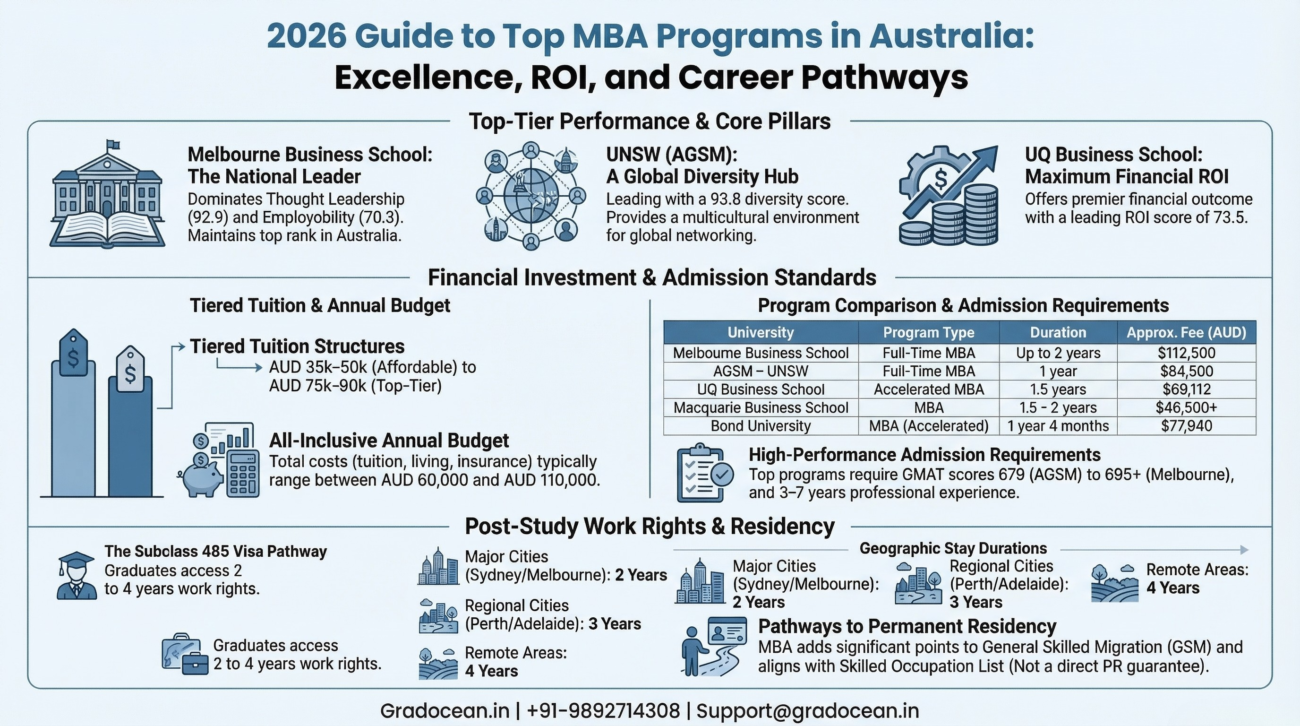
Melbourne Business School remains the national leader, particularly in employability and thought leadership. UNSW (AGSM) distinguishes itself through superior global diversity, while UQ Business School is identified as providing the premier financial outcome regarding ROI. Australia continues to be a top-tier destination for international candidates due to strategic advantages, including extended post-study work rights, comparative affordability to US and UK programs, and viable, albeit indirect, pathways to permanent residency.
Core Pillars of the Australian MBA Experience
The performance of Australian institutions is measured against four critical pillars that drive candidate selection and institutional prestige.
1. Employability and Career Impact
Employability remains the primary motivation for MBA candidates. Institutions are ranked based on their ability to facilitate career transitions and salary growth.
- Melbourne Business School: National leader with a score of 70.3.
- UNSW (AGSM): Follows with a score of 65.2.
- University of Sydney: Ranks third in this category at 62.3.
2. Financial Return on Investment (ROI)
The ROI metric evaluates post-MBA salary increases against the cost of tuition.
- UQ Business School: Reported as offering the highest ROI score in the country at 73.5.
- Melbourne Business School & UNSW (AGSM): Both provide significant financial returns, with scores of 79.3 and 77.8, respectively.
3. Thought Leadership and Academic Influence
This pillar assesses the impact of institutional research and the depth of industry engagement.
- Melbourne Business School: Dominates this category with a score of 92.9.
- High Performers: UNSW (AGSM) and the University of Sydney also maintain strong academic influence with scores of 86 and 85, respectively.
4. Global Diversity
Diversity scores reflect a multicultural learning environment, which is vital for building international business networks.
- National Leaders: UNSW (AGSM) and the University of Sydney share the top position with scores of 93.8.
- UQ Business School: Maintains a strong diversity presence with a score of 72.2.
Strategic Advantages for International Students
Australia’s value proposition is bolstered by several systemic advantages that make it an attractive alternative to other global education hubs.
- Post-Study Work Rights: Through the Subclass 485 visa, graduates can access 2 to 4 years of work rights, depending on the location of their studies.
- Comparative Affordability: Tuition and living expenses in Australia are generally lower than those found in the United States or the United Kingdom.
- Accelerated Formats: Many institutions offer 1-year MBA tracks, allowing experienced professionals to return to the workforce more quickly.
- Residency Pathways: While an MBA does not guarantee Permanent Residency (PR), it enhances a candidate’s points-based migration profile and provides the local work experience necessary for various skilled visas.
Financial and Admission Requirements
Program Costs (2026 Estimates)
Tuition is structured across three tiers based on institutional reputation and ranking:
| Tier | Institutions | Tuition Range (AUD) |
| Top-tier | Melbourne, UNSW, Monash, Macquarie | $75,000 – $90,000 |
| Mid-range | Deakin, RMIT, UQ, Curtin | $50,000 – $70,000 |
| Affordable | USQ, Charles Darwin, Federation | $35,000 – $50,000 |
Total Inclusive Costs: When accounting for tuition, living expenses (AUD 20,000–27,000/year), and health insurance, international students should budget between AUD 60,000 and AUD 110,000.
Admissions Standards
- Work Experience: Most programs require 3 to 7 years of professional experience.
- GMAT Scores: Requirements vary by institution. Melbourne Business School typically requires 695+, while AGSM (UNSW) prefers scores around 679.
- Waivers: Many schools offer GMAT waivers for candidates who possess more than 5 years of professional experience.
Institutional Comparisons: Formats and Duration
The following table summarizes the duration and estimated fees for prominent programs:
| University | Program Type | Duration | Approx. Fee (AUD) |
| Melbourne Business School | Full-Time MBA | Up to 2 years | $112,500 |
| AGSM – UNSW | Full-Time MBA | 1 year | $84,500 |
| UQ Business School | Accelerated MBA | 1.5 years | $69,112 |
| Macquarie Business School | MBA | 1.5 – 2 years | $46,500+ |
| Bond University | MBA (Accelerated) | 1 year 4 months | $77,840 |
Post-Graduation and Immigration Pathways
Temporary Graduate Visa (Subclass 485)
The duration of the post-study work visa is determined by the geographical location of the institution:
- Major Cities (Sydney, Melbourne, Brisbane): 2 years.
- Regional Cities (Perth, Adelaide, Canberra, Gold Coast): 3 years.
- Regional Centres and Remote Areas: 4 years.
Permanent Residency (PR) Outlook
An MBA graduate is not automatically eligible for PR as the degree itself is not on the Skilled Occupation List (SOL). However, it supports residency through:
- Points-Based System: The degree contributes points to General Skilled Migration (GSM) applications.
- Occupation Alignment: Roles such as Management Consultant or Finance Manager are on the SOL; an MBA strengthens applications for these roles.
- Visa Categories: The 485 visa provides the time required to gain local experience for the Skilled Independent (189), Skilled Nominated (190), or Employer Sponsored (186) visas.