


1. The Global Pivot
For today’s mid-career professional, the biggest hesitation around an MBA isn’t ambition — it’s opportunity cost. Stepping away from a fast-moving career for two full years can feel like a high-stakes gamble.
In 2025, that calculus is changing.
More professionals are moving away from the traditional two-year North American model and toward Europe’s accelerated, high-impact MBA formats. This shift isn’t just geographic — it reflects a broader rethink of how careers are built in a volatile, global economy.
European business schools combine historic academic legacy with modern, agile program design. The result? A faster, more efficient route to leadership that aligns with a workforce that values speed, adaptability, and rapid re-entry into the market.
2. The ROI Equation: The 10–18 Month Advantage
The defining edge of Europe’s top MBA programs is duration.
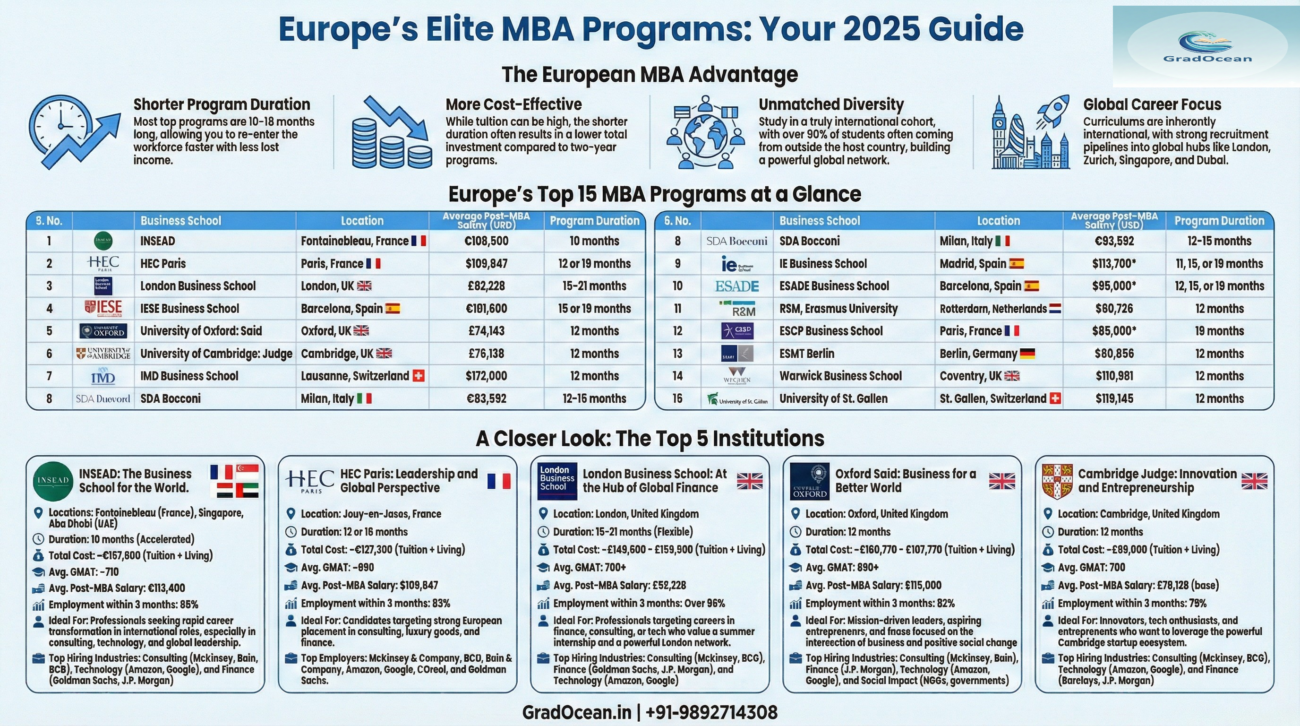
While many U.S. programs run for 24 months, leading European schools offer intensive 10–18 month formats. For example, the 10-month MBA at INSEAD enables candidates to return to the workforce significantly faster.
This isn’t just convenience — it’s financial strategy.
By choosing a 10-month program instead of a two-year option, candidates regain over a year of post-MBA earning potential. With average salaries ranging from $115,000 to $170,000+ at top institutions, that shortened absence can translate into a six-figure swing in earned income, in addition to lower tuition and living costs.
In an economy defined by disruption, minimizing time away from the market is no longer optional — it’s strategic.
3. Diversity by Design: The 90% International Cohort
One of the most powerful differentiators of European MBA programs is global diversity.
At leading schools, international representation often exceeds 85–90% of the cohort. Every classroom discussion mirrors a multinational boardroom. Students collaborate with peers from dozens of countries, industries, and functional backgrounds.
This environment doesn’t just broaden perspective — it builds cultural intelligence.
In a world of distributed teams, cross-border supply chains, and global leadership pipelines, the ability to navigate cultural nuance is a core executive competency. European MBAs make that fluency the default setting.
4. High-Velocity Career Pivots: The HEC Paris Example
The financial outcomes validate the model.
At HEC Paris, graduates report average post-MBA compensation of approximately $109,000, with many candidates experiencing salary increases of 90–100% or more compared to pre-MBA earnings.
In addition, sign-on bonuses remain strong — especially in consulting, finance, luxury, and strategy roles — signaling sustained recruiter confidence in the European MBA talent pool.
The takeaway? The accelerated format does not dilute career impact. If anything, it amplifies it.
5. A Truly Global Structure: INSEAD’s Multi-Campus Model
Often referred to as the “Business School for the World,” INSEAD offers more than speed. Its campuses in Fontainebleau, Singapore, and Abu Dhabi create a physically immersive global experience.
Students don’t just study international business — they live it.
Graduates enter hiring pipelines at top global firms including:
-
McKinsey & Company
-
Bain & Company
-
Boston Consulting Group
-
Amazon
-
Google
The multi-campus exposure prepares leaders for careers that span geographies, regulatory systems, and cultural contexts.
6. Flexibility in the Global Financial Capital: London Business School
Not every transformation follows a straight line. For professionals seeking deeper exploration or a summer internship, London Business School offers a flexible 15–21 month format.
Located in London — one of the world’s foremost financial and technology hubs — LBS provides unparalleled access to employers across consulting, finance, private equity, and tech.
For candidates making a significant industry pivot, this flexibility can serve as a strategic bridge.
7. The Ecosystem Edge: Oxford and Cambridge
Some European programs offer something even more distinctive — immersion within centuries-old intellectual ecosystems.
At University of Oxford (Saïd Business School), the 12-month MBA integrates themes of responsible leadership and allows cross-disciplinary engagement with departments such as AI, public policy, and social sciences.
Similarly, University of Cambridge (Judge Business School) emphasizes innovation and entrepreneurship, leveraging the broader Cambridge ecosystem to foster startup-ready and tech-forward leaders.
These programs go beyond management training. They offer exposure to interdisciplinary thinking — critical in an era where business intersects with technology, ethics, and public systems.
8. The Numbers at a Glance
Europe’s top MBA programs consistently combine elite compensation with efficient formats. Institutions such as:
-
IMD Business School
-
University of St. Gallen
-
London Business School
-
University of Oxford
-
INSEAD
report strong post-MBA salary outcomes, reinforcing the high-ROI nature of the one-year model.
9. Conclusion: The Future Belongs to the Agile
The European MBA has fundamentally reshaped the global business education landscape.
By combining:
-
Accelerated timelines
-
Deep international diversity
-
Strong compensation outcomes
-
Direct access to global employers
these programs have created a compelling alternative to the traditional two-year model.
In a world that rewards agility over endurance and global fluency over regional familiarity, the question is no longer whether a European MBA is credible.
The real question is strategic:
Can you afford to spend an additional year out of the market — or is it time to choose the high-impact sprint?