


For the modern MBA applicant, the journey to a top business school doesn’t begin with essays.
It begins with a high-stakes strategic decision:
GMAT or GRE?
For decades, the Graduate Management Admission Test (GMAT) was the undisputed gold standard for MBA admissions — the benchmark of quantitative rigor.
But today, the Graduate Record Examinations (GRE) is widely accepted at virtually every elite MBA program. As business schools aggressively diversify their cohorts — recruiting talent from consulting, arts, technology, healthcare, public policy, and social impact — the testing landscape has evolved.
Yet a paradox remains:
While schools publicly claim total parity between the GMAT and GRE, the GMAT remains the “native language” of business education.
So how should you decide?
To answer that, you must look beyond marketing statements and understand how Admissions Committees (AdComs) actually evaluate scores.
The “Ranking Loophole” and Strategic Flexibility
Historically, some business schools reported GMAT scores to ranking agencies more prominently than GRE scores.
This created subtle flexibility.
Because rankings heavily emphasized GMAT averages, admissions committees sometimes had more maneuverability with GRE applicants — especially high-potential candidates from non-traditional backgrounds.
While reporting practices have evolved, the strategic insight remains relevant:
-
The GMAT still anchors benchmarking conversations.
-
The GRE can offer flexibility for strong candidates with slightly uneven testing profiles.
-
Schools value talent diversity and may use GRE performance to widen access.
For applicants from unconventional industries or academic backgrounds, the GRE can be a smart positioning tool.
The “Black Box”: How AdComs Benchmark GRE Scores
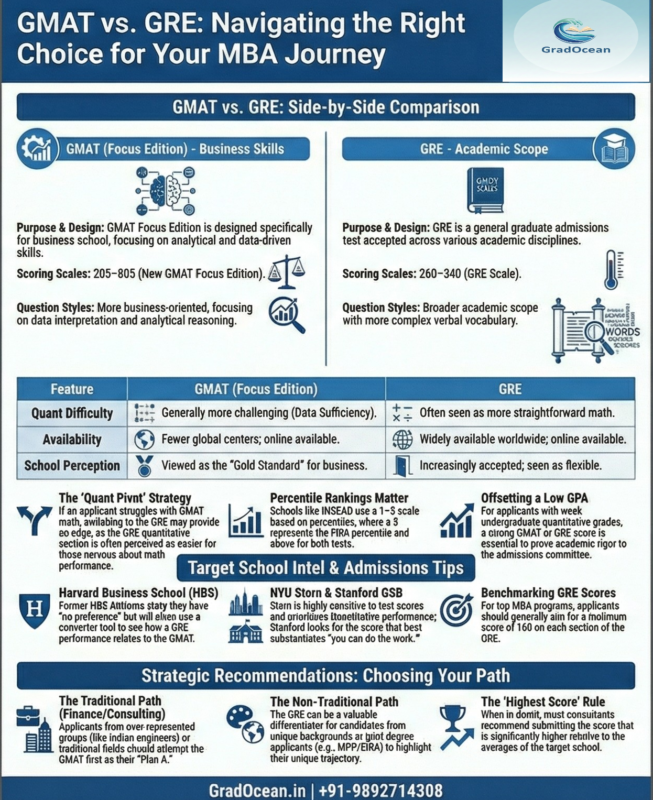
Even when schools state “no preference,” internal benchmarking often converts GRE performance into a GMAT-equivalent framework.
Admissions officers frequently use official concordance tools to understand how a GRE score compares to a GMAT score.
What this means for you:
You are not evaluated in isolation.
You are evaluated relative to a GMAT-calibrated standard of academic rigor.
If your GRE converts meaningfully below your target school’s median GMAT score, that gap will not go unnoticed.
Percentiles Matter More Than Total Scores
In MBA admissions, section percentiles often matter more than composite totals.
A high overall score with a weak quantitative percentile raises concerns about your ability to handle:
-
Financial accounting
-
Data analytics
-
Managerial economics
-
Core quantitative coursework
For competitive programs, you should aim for:
-
70th–80th percentile or higher in Quant
-
Balanced performance across sections
For GRE applicants, this typically translates to:
-
~160+ in Quant
-
~160+ in Verbal (for competitive programs)
Strong percentiles demonstrate academic readiness — which reduces perceived risk in your application.
When Should You Choose the GMAT?
The GMAT remains strategically advantageous in certain scenarios.
1. Traditional & Over-Represented Applicant Pools
If you come from:
-
Consulting
-
Investment banking
-
Private equity
-
Engineering-heavy backgrounds
-
Over-represented demographics (e.g., Indian male engineers)
The GMAT is often the safer “baseline” choice.
It reinforces your quantitative strength and signals business-school readiness in the most direct way.
2. If You’re Targeting Finance-Heavy Programs
For candidates pursuing:
-
Investment banking
-
Asset management
-
Private equity
-
Corporate finance
The GMAT can reinforce your analytical credibility.
Think of the GMAT as the “Plan A” for traditional MBA profiles.
When Is the GRE a Strategic Move?
The GRE can be powerful in specific contexts.
1. The Tactical Pivot
If you’ve attempted the GMAT multiple times and are consistently scoring below your target school’s median, pivoting to the GRE may unlock stronger performance.
Some candidates naturally perform better on GRE verbal reasoning and question structure.
2. Non-Traditional Backgrounds
If you come from:
-
Arts & humanities
-
Healthcare
-
Social impact
-
Public policy
-
Academia
The GRE aligns naturally with broader graduate education pathways and can complement your profile.
3. Joint Degree Applicants
For dual-degree paths (e.g., MBA + MPP, MBA + public policy, MBA + international studies), the GRE is often the more practical choice.
Are MBA Test Waivers a Smart Move?
With the rise of MBA test waivers, many candidates are tempted to bypass standardized exams entirely.
But waivers can be risky — especially for applicants with:
-
Low undergraduate quantitative grades
-
Limited math exposure
-
Non-quantitative academic backgrounds
If your transcript contains “cracks” in quantitative coursework, a strong GMAT or GRE score is often your best tool to offset that weakness.
A waiver removes the opportunity to prove academic readiness.
In many cases, a strong test score does more to strengthen your application than additional short-term coursework ever could.
Your Test Score as a Brand Signal
Ultimately, the best test is not about prestige.
It’s about positioning.
Ask yourself:
-
Does this score reinforce my academic capability?
-
Does it align with my target schools’ medians?
-
Does it reduce risk in my profile?
-
Does it complement my career narrative?
Your test score should function as a pillar of your application — not a liability that forces the committee to pause.
Final Thoughts: GMAT vs GRE in 2025
In today’s competitive MBA admissions landscape:
-
The GMAT remains the quantitative benchmark.
-
The GRE offers strategic flexibility.
-
Percentiles matter more than raw totals.
-
Waivers are not always advantageous.
-
Context matters more than convention.
The right choice is the one that strengthens your overall positioning.
When your file reaches the Admissions Committee, your academic readiness should already be a settled question.
That clarity allows your leadership story, career vision, and impact potential to take center stage.
If you are deciding between GMAT and GRE and want a personalized strategy aligned with your background and target schools, a structured evaluation can prevent costly missteps.
Because in elite MBA admissions, even your test choice is a strategic decision.