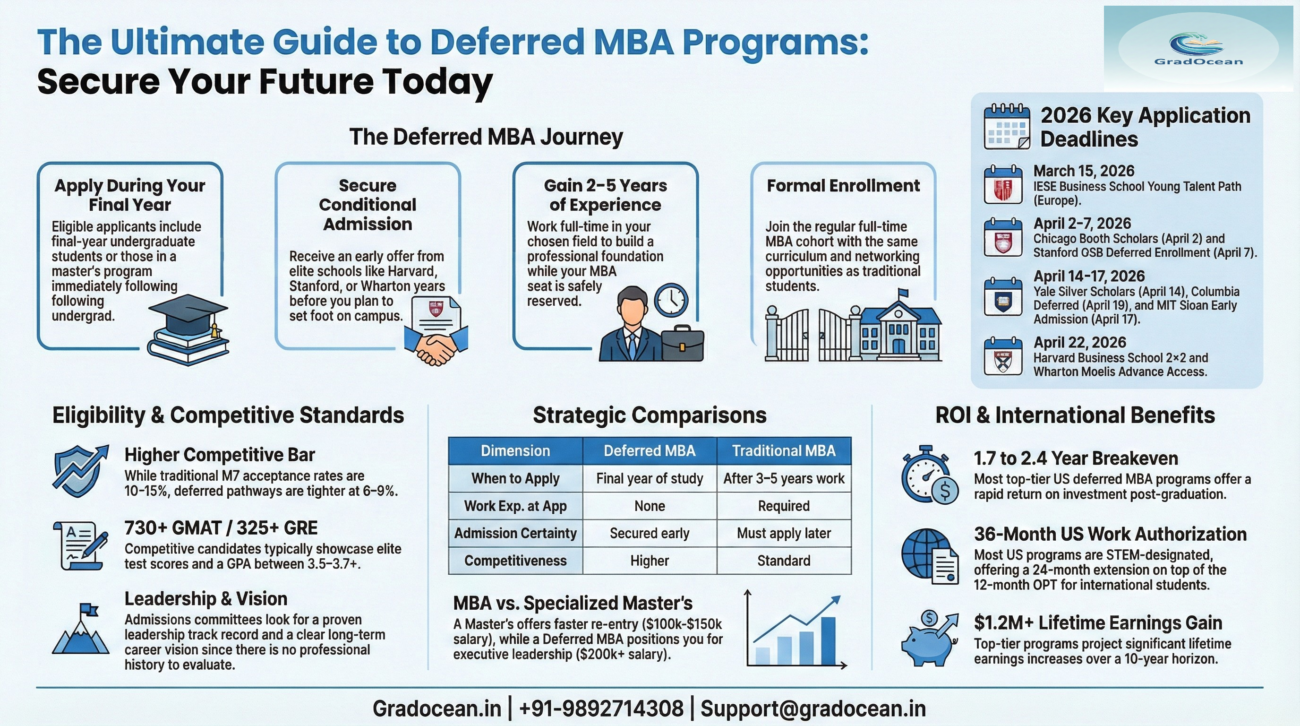



Over the past two decades, deferred MBA programs have transformed from a niche experiment into a mainstream admissions pathway at elite business schools. What began with the launch of the Yale School of Management Silver Scholars program in 2001 has evolved into a global trend. Today, nearly every M7 and several top European schools offer high-performing undergraduates the chance to secure an MBA seat years before they enroll.
But is a deferred MBA the right move for you? And how does it compare to a traditional MBA or a specialized master’s degree?
This guide breaks down everything you need to know — structure, deadlines, ROI, visa implications for international students, and the world’s leading programs.
What Is a Deferred MBA?
A deferred MBA allows students to apply during their final year of undergraduate or master’s study and secure conditional admission to a top MBA program.
Instead of enrolling immediately, admitted students work full-time for 2–5 years and then join the regular MBA cohort. Once they matriculate, they complete the same curriculum as traditional MBA students.
In short:
Admitted now → Work first → MBA later.
There is no “separate” degree. The MBA experience remains identical.
How Deferred MBA Programs Work
The typical journey looks like this:
-
Apply during senior year (undergrad or eligible master’s program).
-
Secure conditional admission.
-
Gain 2–5 years of professional experience.
-
Enroll in the full-time MBA.
Some schools offer structural variations. For example, the Yale School of Management Silver Scholars program begins with one year of MBA coursework, followed by full-time work, and then a return to campus for the final year.
2026 Deferred MBA Deadlines
Most 2026 intake deadlines cluster in April, aligning closely with Round 3 of traditional MBA admissions.
Here are key programs and timelines:
-
Stanford Graduate School of Business Deferred Enrollment – April 7, 2026
-
Yale School of Management Silver Scholars – April 14, 2026
-
Columbia Business School Deferred Enrollment – April 15, 2026
-
MIT Sloan School of Management Early Admission – April 17, 2026
-
Harvard Business School 2+2 – April 22, 2026
-
Wharton School Moelis Advance Access – April 22, 2026
-
Chicago Booth School of Business Scholars Program – April 2, 2026
-
University of Virginia Darden School of Business Future Year Scholars – April & July 2026
-
IESE Business School Young Talent Path – March 15, 2026
Most programs are open to international students, subject to English proficiency requirements.
Eligibility Requirements
Deferred MBA programs generally target:
-
Final-year undergraduate students
-
Students completing a master’s degree directly after undergrad
-
Individuals with minimal full-time experience
Typical expectations include:
-
Strong GPA (often 3.5–3.7+)
-
Competitive GMAT or GRE (730+ GMAT or 325+ GRE for M7 competitiveness)
-
Leadership track record
-
Clear long-term career vision
-
1–2 letters of recommendation
International applicants usually must submit TOEFL/IELTS unless their prior education was entirely in English.
Is Deferred More Competitive?
Yes — significantly.
While traditional MBA acceptance rates at M7 schools range around 10–15%, deferred pathways often admit only 6–9% of applicants.
Why?
-
Smaller cohorts
-
No professional track record to evaluate
-
Schools demand higher academic and leadership signals
You’re essentially asking the school to bet on your future.
GMAT or GRE for Deferred MBA?
All major programs accept both equally, including:
-
Harvard Business School
-
Stanford Graduate School of Business
-
MIT Sloan School of Management
-
Wharton School
-
Columbia Business School
-
Chicago Booth School of Business
There is no official preference. Your highest score matters more than the test format.
Deferred MBA vs Traditional MBA
| Dimension | Deferred MBA | Traditional MBA |
|---|---|---|
| When you apply | Final year of study | After 3–5 years of work |
| Work experience at application | None | Required |
| Admission certainty | Secured early | Must apply later |
| Competitiveness | Higher | Standard |
| Financial prep time | 2–5 years to save | Less time |
| Curriculum | Identical | Identical |
Both paths typically converge at similar post-MBA leadership roles.
Deferred offers certainty and flexibility. Traditional MBA offers proof of professional track record.
Deferred MBA vs Master’s Degree
A specialized master’s (MiM, Finance, Data Science) provides:
-
Faster re-entry into workforce
-
Lower cost ($20K–$60K typical)
-
Domain specialization
Deferred MBA provides:
-
Broader leadership trajectory
-
Higher long-term income potential
-
Executive pathway positioning
MBA graduates from top programs often earn $200K+ total compensation post-graduation, compared to $100K–$150K for many master’s-only graduates.
ROI of Deferred MBA Programs (2026 Data)
For international students, ROI depends heavily on visa pathways and compensation growth.
US Programs
Most US MBA programs are STEM-designated, offering:
-
12 months OPT
-
+24-month STEM extension
-
Total 36 months US work authorization
Breakeven periods for top deferred MBAs typically range from 1.7 to 2.4 years post-MBA, even after adjusting for international salary discounts (10–15%).
Highest lifetime earnings gains (10-year horizon):
$1.2M–$1.4M+ for top-tier US programs.
European Option
IESE Business School Young Talent Path remains the only widely verified deferred MBA pathway in Europe.
-
Lower investment (~$137K)
-
2.2-year breakeven
-
Strong consulting placement in Europe
Top Deferred MBA Programs Globally
United States (Tier 1)
-
Harvard Business School 2+2
-
Stanford Graduate School of Business Deferred Enrollment
-
Wharton School Moelis Advance Access
-
Columbia Business School Deferred Enrollment
-
MIT Sloan School of Management Early Admission
-
Chicago Booth School of Business Scholars
-
University of Virginia Darden School of Business Future Year Scholars
-
UC Berkeley Haas School of Business Accelerated Access
-
Northwestern University Kellogg School of Management Future Leaders
-
Emory University Goizueta Business School Early Admission
Europe
-
IESE Business School Young Talent Path
When Is a Deferred MBA Worth It?
Deferred MBA makes sense if:
-
You are certain you want an MBA eventually
-
You have a highly competitive academic profile
-
You value career exploration freedom
-
You want peace of mind early
-
You aim for long-term executive leadership
It may not be worth pursuing if:
-
You already have a $200K+ high-growth trajectory
-
You’re unsure about MBA necessity
-
Your profile is not competitive for top programs
Final Takeaway
Deferred MBA programs provide early access to elite networks, structured career flexibility, and long-term earning power. Both traditional and deferred pathways ultimately lead to similar management roles — but deferred gives you certainty upfront.
The real question is not whether deferred is “better.”
It’s whether you want to secure your seat now — or prove yourself first and apply later.
If you’re in your final year and competitive for M7 or top 15 schools, this pathway can be a strategic career accelerator.
And in elite admissions, timing is leverage.
Frequently Asked Questions (FAQs)
1. Do MBA programs prefer the GMAT over the GRE?
Most top MBA programs state there is no official preference. However, the GMAT remains the traditional benchmark for business education, and many admissions committees internally benchmark scores against GMAT medians.
2. How are GRE scores evaluated in MBA admissions?
Admissions committees often use official concordance tools to convert GRE scores into GMAT-equivalent ranges. Your performance is typically evaluated relative to the school’s published GMAT median.
3. Do percentiles matter more than total scores?
Yes. Section percentiles — especially in Quant — carry significant weight. Competitive programs generally expect strong quantitative percentiles (often 70th–80th percentile or higher) to demonstrate academic readiness.
4. When is the GMAT a better choice?
The GMAT is often advantageous for:
-
Applicants from consulting, finance, engineering, or other quantitative backgrounds
-
Overrepresented applicant pools
-
Candidates targeting finance-heavy career paths
It reinforces analytical credibility and aligns directly with business school benchmarking.
5. When should applicants consider the GRE?
The GRE can be a strong option if:
-
You consistently underperform on the GMAT
-
You have a non-traditional background (arts, healthcare, public policy, etc.)
-
You’re applying to dual-degree programs (MBA + MPP, MBA + international studies, etc.)
6. Is taking a test waiver a smart move?
Not always. If your undergraduate transcript shows weak quantitative performance, submitting a strong GMAT or GRE score can significantly strengthen your application. A waiver removes the opportunity to prove academic capability.
7. How should I decide between the GMAT and GRE?
Choose the test that:
-
Aligns with your strengths
-
Matches your target schools’ medians
-
Reinforces your academic readiness
-
Reduces risk in your overall profile
Your test choice is a strategic positioning decision, not just an exam preference.