-
For ambitious graduates, the transition from a generalist undergraduate degree to a high-impact career can feel uncertain. Traditionally, the choice was simple: start working immediately or gain 4–5 years of experience and pursue an MBA later. Today, that equation has changed.
The Master in Management (MiM) has emerged as a powerful alternative — a strategic accelerator designed specifically for candidates with 0–2 years of experience. Rather than waiting years to “qualify” for leadership education, the MiM offers early-career professionals access to world-class business training, elite networks, and high-paying roles within just 12–24 months.
As a Global Education Strategist, I see the MiM as a career hedge: it compresses years of traditional career progression into an intensive, structured, and globally immersive experience.
Career Security Before Graduation: Employment Outcomes That De-Risk Your Future
Unlike many postgraduate programs that report employment within three months of graduation, leading MiM programs are raising the bar — students are securing offers even before they complete the degree.
-
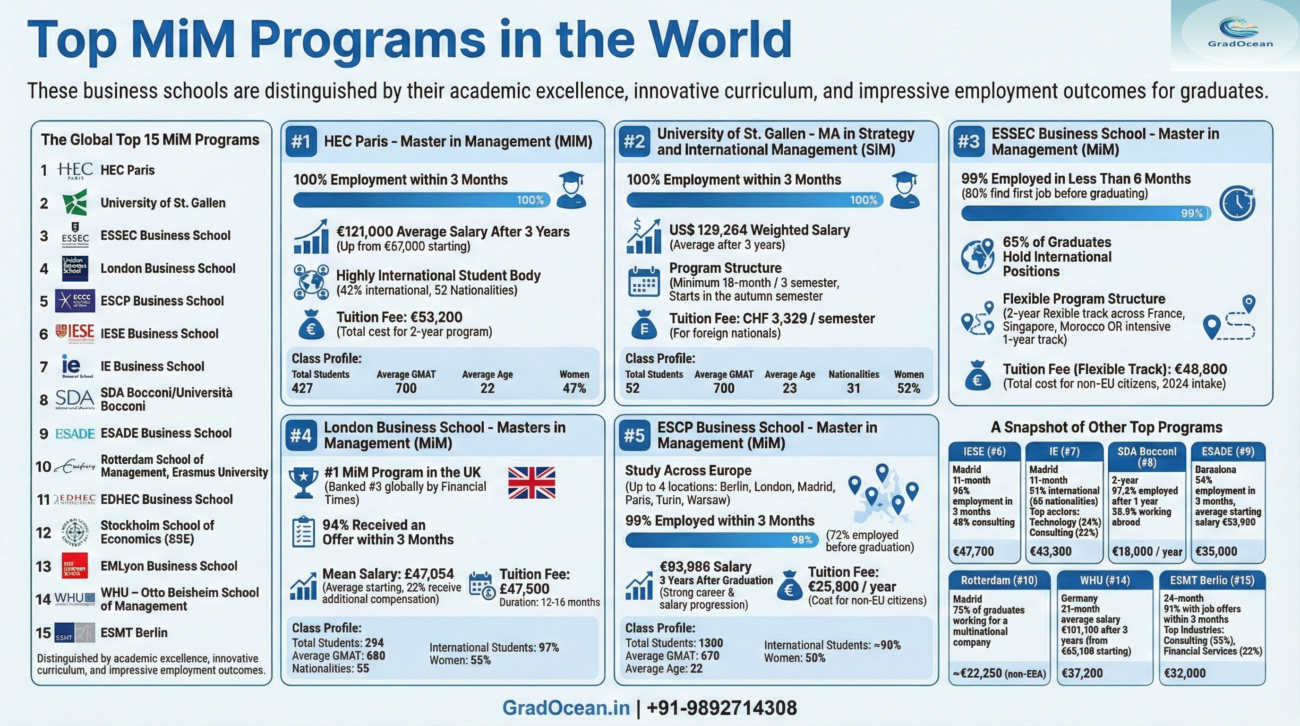
Emlyon business school reports that 87% of students accept job offers before graduation.
-
SDA Bocconi sees 83% of graduates employed by graduation day.
-
HEC Paris and University of St. Gallen both report 100% employment within three months.
For students worried about “entry-level anxiety,” these numbers represent something powerful: risk mitigation. The MiM doesn’t just help you find a job — it positions you to secure a career trajectory before you even receive your degree.
The MiM ROI: Faster Salary Growth Than Traditional Entry-Level Roles
One of the most common concerns about pursuing a MiM is tuition cost. But when analyzed strategically, the return on investment (ROI) tells a compelling story.
-
University of St. Gallen reports one of the highest weighted salaries globally at approximately US$129,000 three years post-graduation.
-
HEC Paris graduates see salaries grow from around €67,000 at graduation to €121,000 within three years.
-
WHU – Otto Beisheim School of Management reports salary growth from €65,100 to €101,100 in the same timeframe.
This trajectory shows accelerated human capital appreciation. Instead of climbing the traditional corporate ladder step by step, MiM graduates often enter at a higher starting point — and compound that advantage quickly.
In practical terms, the MiM can double your market value within 36 months.
Global Exposure: A Risk-Free Laboratory for International Careers
In today’s global economy, cross-cultural competence is not optional — it is essential.
ESCP Business School exemplifies this with its multi-campus model across Berlin, London, Madrid, Paris, Turin, and Warsaw. Students rotate between countries, gaining hands-on exposure to different business cultures.
Similarly, the MSc in International Management at Rotterdam School of Management leverages the CEMS Global Alliance network, connecting students to 30+ partner schools worldwide.
This structure functions as a safe testing ground for global leadership. Students learn to navigate negotiation styles, market dynamics, and organizational cultures across borders — before entering high-stakes corporate roles.
International Diversity: Building a Borderless Network
The true power of elite MiM programs lies not just in curriculum, but in peer networks.
-
London Business School reports that 97% of its MiM class is international, representing over 50 nationalities.
-
ESADE Business School has approximately 93% international representation.
Such diversity transforms the classroom into a microcosm of the global economy. Your classmates become future consultants, bankers, founders, and policymakers across continents.
For professionals targeting international mobility — whether Singapore, London, Dubai, or San Francisco — this network becomes a lifelong strategic asset.
Hyper-Specialization: Where Management Meets Technical Expertise
Modern MiM programs have evolved beyond general management training. Many now offer technical tracks aligned with high-demand industries.
-
EDHEC Business School offers a specialization in Data Science & AI for Business.
-
Stockholm School of Economics includes modules such as “Managing Data and AI in the Global Workplace.”
-
emlyon business school provides over 15 specialization options, including Digital Strategy and Sport Management.
This “technical management” positioning allows graduates to combine leadership capability with domain-specific expertise — a combination highly valued by employers in consulting, tech, and finance.
Purpose-Driven Leadership: The Integration of Ethics and Strategy
Today’s business leaders must balance profitability with responsibility.
The Strategy and International Management (SIM) program at University of St. Gallen integrates research, ethics, and global strategy through experiential projects and an intensive master’s thesis component.
At ESSEC Business School, a growing percentage of graduates are entering CSR and sustainability-oriented roles, reflecting a broader market shift toward responsible leadership.
Employers increasingly seek professionals who understand both shareholder value and societal impact — and MiM programs are adapting accordingly.
Who Should Pursue a MiM?
The Master in Management is particularly powerful for:
-
High-achieving graduates with 0–2 years of work experience
-
Candidates targeting consulting, finance, strategy, or tech roles
-
Students seeking international career mobility
-
Professionals who want accelerated salary growth
-
Individuals aiming for long-term leadership positions
If you are considering whether to “wait for an MBA” or act now, the real question may be: can you afford to delay structured acceleration?
Final Verdict: Is the MiM Worth It?
The elite MiM has firmly stepped out of the MBA’s shadow. It is no longer a backup option — it is a deliberate, strategic choice.
With near-guaranteed employment outcomes, rapid salary growth, global mobility, and technical specialization, the MiM offers a high-ROI pathway for early-career professionals.
For ambitious candidates unwilling to plateau at entry-level roles, the Master in Management is not just another degree.
It is a strategic pivot.
Frequently Asked Questions (FAQs) About the Master in Management (MiM)
1. What is a Master in Management (MiM) and who is it for?
A Master in Management (MiM) is a postgraduate business degree designed primarily for students with 0–2 years of work experience. Unlike an MBA, which requires significant professional experience, the MiM helps recent graduates build foundational business skills in strategy, finance, consulting, operations, and leadership.
Top institutions such as HEC Paris and London Business School have structured their MiM programs specifically for high-potential early-career professionals aiming for global careers.
2. How is a MiM different from an MBA?
The primary difference lies in work experience and career stage:
-
MiM: Designed for fresh graduates or professionals with limited experience (0–2 years).
-
MBA: Designed for mid-career professionals (typically 4–7+ years of experience).
While both degrees offer management education, the MiM focuses on building foundational leadership and analytical skills early, whereas an MBA focuses more on strategic leadership for experienced managers.
3. Is the MiM worth the investment in terms of ROI?
Yes — particularly at top-ranked institutions. Schools like University of St. Gallen and WHU – Otto Beisheim School of Management report significant salary growth within three years of graduation.
Graduates often experience accelerated compensation growth compared to peers who enter the workforce directly after undergraduate studies. The MiM effectively fast-tracks earning potential and career trajectory.
4. What are the employment outcomes after a MiM?
Leading MiM programs report exceptionally strong placement statistics:
-
emlyon business school sees a majority of students secure offers before graduation.
-
SDA Bocconi reports high employment rates by graduation.
-
HEC Paris reports full employment within three months.
These outcomes indicate that elite MiM programs significantly reduce post-graduation employment risk.
5. Can I pursue a global career after a MiM?
Absolutely. Many top MiM programs are highly international:
-
ESCP Business School offers multi-campus study across Europe.
-
ESADE Business School and London Business School have cohorts with over 90% international students.
This diversity builds a global professional network and enhances cross-cultural competence — key for international careers.
6. What industries hire MiM graduates?
MiM graduates are commonly recruited into:
-
Consulting (strategy & management consulting firms)
-
Investment banking & finance
-
Technology & product management
-
Corporate strategy roles
-
Sustainability and CSR roles
For example, ESSEC Business School has seen increasing placements in CSR and impact-driven roles, reflecting evolving employer demand.
7. Do MiM programs offer specializations?
Yes. Modern MiM programs now offer technical and industry-focused tracks.
-
EDHEC Business School offers a specialization in Data Science & AI for Business.
-
Stockholm School of Economics integrates AI and data-focused modules into management training.
These tracks allow students to combine leadership skills with technical fluency, making them more competitive in high-demand sectors.
8. Should I do a MiM now or wait for an MBA later?
If you are a high-achieving graduate with limited work experience and clear career ambition, a MiM can provide immediate acceleration. It helps you avoid stagnation in entry-level roles and builds a strong international foundation.
Many professionals who complete a MiM may still choose to pursue an MBA later — but from a significantly stronger career position.
The key question is not whether the MiM replaces an MBA, but whether it strategically positions you ahead of your peers early in your career.
Need Personalized Guidance for MiM Applications?
At GradOcean, we help students:
- Shortlist the right universities
- Maximize scholarships
- Build strong applications with expert mentorship
Email us at support@gradocean.in, call us at +91-9892714308, or connect with us directly through our contact page:
https://gradocean.in/contact-us/Start your academic journey with clarity and confidence
-