



An MBA resume is not just another document in your application—it is your first pitch to the admissions committee.
In a process where thousands of applicants compete for limited seats, your resume plays a decisive role in shaping the initial perception of your profile. Done right, it doesn’t just show what you’ve done—it signals who you are becoming as a future leader.
Why Your MBA Resume Matters More Than You Think
Admissions committees don’t spend minutes on your resume. They spend seconds.
In that short window, they are looking for clear signals:
- Career progression and growth
- Leadership potential
- Ability to create measurable impact
- Consistency across academics, work, and extracurriculars
More importantly, they are asking one question:
Will this person add value to the classroom?
Your resume sets the foundation for your entire application. Your essays, recommendations, and interview all build on the story it begins.
MBA Resume vs Job Resume: The Difference Most Applicants Miss
One of the most common mistakes is submitting a job-style resume.
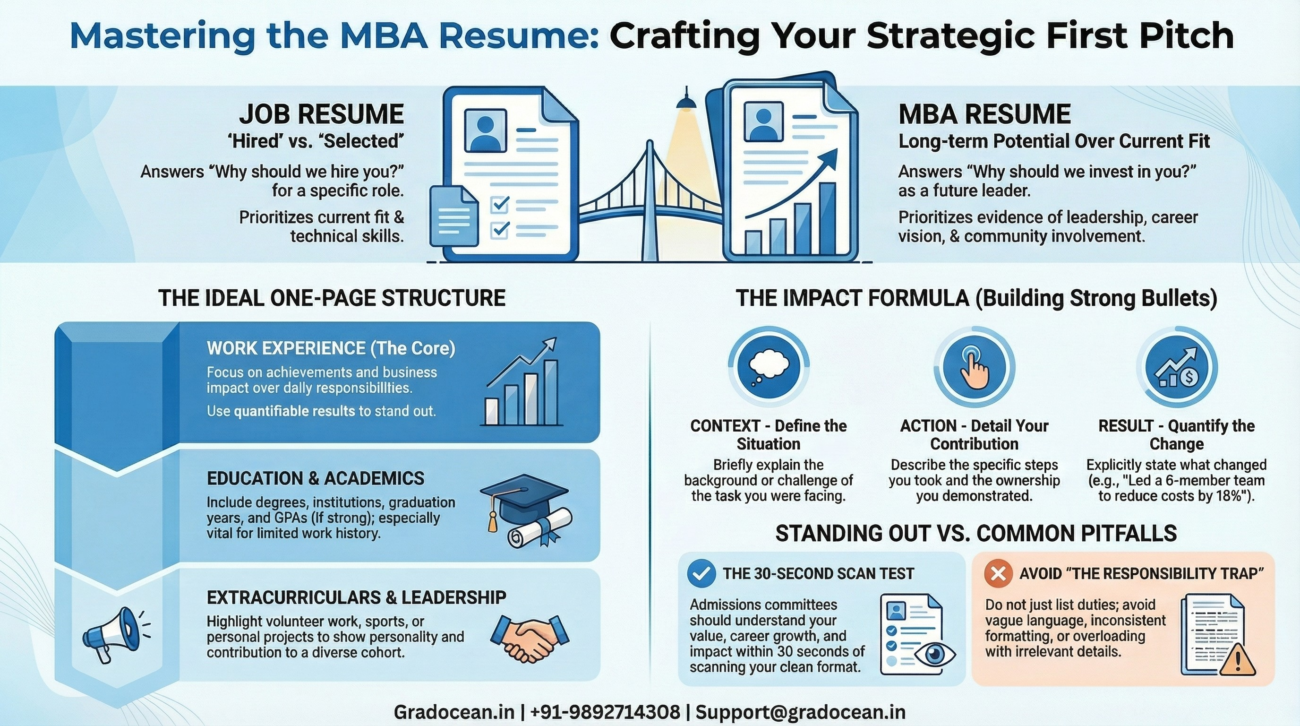
A job resume is designed to get you hired.
An MBA resume is designed to get you selected.
Key Differences:
- MBA resumes highlight impact and leadership, not just skills
- They focus on long-term potential, not just current role fit
- They include extracurriculars and leadership outside work
- They align with your career goals and narrative
Think of it this way:
Your job resume answers: Why should we hire you?
Your MBA resume answers: Why should we invest in you?
Ideal MBA Resume Structure
Top business schools prefer a one-page, highly scannable resume focused on outcomes.
1. Header
Include your name, phone number, and professional email ID.
2. Work Experience (Most Critical Section)
This is where your resume either stands out—or gets ignored.
Focus on:
- Achievements over responsibilities
- Leadership and ownership
- Business impact
- Quantifiable results
Strong example:
“Led a 6-member team to optimize operations, reducing costs by 18%”
Avoid vague statements that don’t demonstrate outcomes.
3. Education
Include:
- Degree and institution
- Graduation year
- GPA (if strong)
- Academic achievements
For early-career applicants, this section carries more weight.
4. Extracurriculars & Leadership
This is where differentiation happens.
Highlight:
- Leadership roles outside work
- Volunteer initiatives
- Sports, competitions, or personal projects
Remember: schools are not just selecting professionals—they are building a diverse cohort.
How to Write Strong Resume Bullets
Every bullet point should clearly communicate impact.
A simple and effective structure is:
- Context – What was the situation?
- Action – What did you do?
- Result – What changed because of you?
Example:
“Revamped marketing strategy, leading to a 40% increase in customer engagement”
The clearer the impact, the stronger your profile appears.
What Makes an MBA Resume Stand Out
Across successful applicants, a few patterns consistently emerge:
- Clear career growth (promotions, increasing responsibility)
- Evidence of leadership—even without formal titles
- Strong use of numbers to demonstrate impact
- Clean, highly readable format
Admissions committees should be able to scan your resume in 30 seconds and understand your value.
Common Mistakes to Avoid
Even strong candidates get rejected due to avoidable errors:
- Listing responsibilities instead of achievements
- Writing vague or generic bullet points
- Including irrelevant or outdated information
- Overloading the resume with excessive detail
- Inconsistent formatting
- Using the same resume for every school
Attention to detail matters more than most applicants realize.
How to Make Your CV Think Like a Consultant
If you want your resume to truly stand out, start thinking like a consultant.
Top business schools—and firms like McKinsey & Company or Boston Consulting Group—don’t just evaluate what you’ve done. They evaluate how you think.
Here are three frameworks that can elevate your CV significantly:
1. Structure Your Experience Using MECE
Consultants break problems into clear, non-overlapping buckets.
Apply the same logic to your resume.
Instead of repetitive bullets, group your work into distinct impact areas such as:
- Revenue Growth
- Process Improvement
- Stakeholder Management
- Team Leadership
This removes redundancy and shows structured thinking.
2. Focus on What Matters (80/20 Rule)
Not all work deserves equal space.
Most applicants dilute their profile by giving equal weight to routine tasks and high-impact projects.
Instead:
- Allocate most of your space to work that created real impact
- Highlight initiatives where you drove change
Your resume should reflect what moved the needle, not what filled your time.
3. Use Top-Down Communication
Consultants lead with the answer.
Your resume should too.
Avoid starting bullets with tools or tasks. Start with the result.
Weak:
“Used Python to analyze data and reduced costs by 10%”
Strong:
“Reduced operational costs by 10% by leveraging Python to automate legacy workflows”
This “Result–Action–Context” approach makes your CV sharper and more persuasive.
Final Takeaway
Your MBA resume is not just a summary—it is a strategic narrative of your journey.
It should clearly communicate:
- Where you started
- How you have grown
- The impact you have created
- Where you are headed next
The difference between a good application and a great one is rarely about adding more content.
It’s about presenting your story with clarity, structure, and intent.
When done right, your resume doesn’t just support your application—it drives it.