



For mid-to-senior professionals aiming to transition into strategic leadership, policy influence, or global executive roles, traditional MBA programs are often not the optimal pathway.
Instead, a distinct category of one-year, leadership-focused MBA and Fellows programs has emerged. These programs are specifically designed for professionals with significant experience (8–20+ years) and emphasize:
- Leadership transformation
- Strategic decision-making
- Global exposure and impact
This article provides a comprehensive overview of leading programs, along with in-depth admissions insights, GMAT/GRE expectations, and positioning strategies.
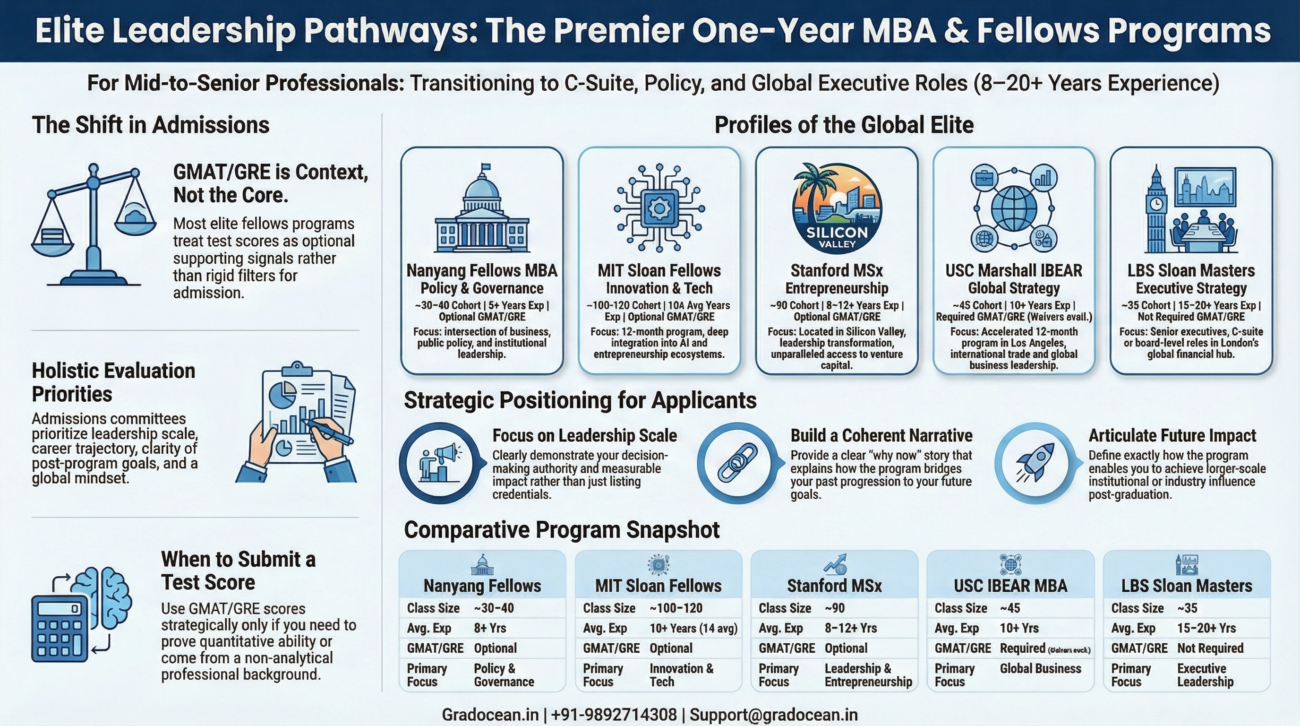
How Admissions Work: Beyond GMAT/GRE
A defining characteristic of these programs is their holistic and leadership-centric admissions approach.
GMAT/GRE: Context, Not Core
Across most programs:
- GMAT/GRE is optional or not required
- There are no rigid cut-offs
- Scores act as a supporting signal, not a primary filter
Admissions committees instead prioritize:
- Leadership impact and scale
- Career progression and trajectory
- Clarity of post-program goals
- Global exposure and mindset
When a Test Score Adds Value
Submitting a GMAT/GRE score can strengthen your application if:
- You need to demonstrate quantitative ability
- You come from a non-analytical background
- You are applying to more structured programs (e.g., USC IBEAR)
However, strong profiles often rely on alternative indicators such as:
- Professional certifications
- Data-driven or strategic roles
- Executive education
1. Nanyang Fellows MBA
Offered by Nanyang Technological University
Program Overview
The Nanyang Fellows MBA is a highly selective, one-year program designed for professionals with 8+ years of experience, particularly those working at the intersection of business, public policy, and governance.
Class Profile
- Average Work Experience: 8+ years
- Cohort Size: Small, highly selective (~30–40 participants)
- Audience: Mid-to-senior professionals
- Diversity: International, cross-sector
Admissions Insights
- GMAT/GRE: Optional
- Strong emphasis on leadership and policy exposure
- Interview is a critical evaluation stage
Positioning Strategy
Ideal candidates typically demonstrate:
- Experience in government, public sector, or large institutions
- Exposure to policy-making or strategic initiatives
- Regional or global leadership responsibilities
Distinctive Advantage
A unique MBA combining business leadership with public sector impact, making it particularly relevant for professionals targeting national or institutional leadership roles.
2. MIT Sloan Fellows MBA
Offered by MIT Sloan School of Management
Program Overview
The MIT Sloan Fellows MBA is a 12-month, full-time program for professionals with 10+ years of experience, focused on innovation, leadership, and global impact.
Class Profile
- Class Size: ~100–120 students
- Average Work Experience: ~14 years
- Average Age: ~35 years
- Nationalities: 40+
Admissions Insights
- GMAT/GRE: Optional (Executive Assessment also accepted)
- Emphasis on innovation, analytical thinking, and leadership impact
- Additional components include video statements and organizational context
Positioning Strategy
Strong candidates typically have:
- Experience leading complex, high-impact initiatives
- Exposure to technology, transformation, or innovation ecosystems
- A clear trajectory toward enterprise-level leadership
Distinctive Advantage
Deep integration with MIT’s ecosystem across:
- Technology
- Artificial intelligence
- Entrepreneurship
3. Stanford MSx Program
Offered by Stanford Graduate School of Business
Program Overview
The Stanford MSx is a one-year, full-time program designed for experienced professionals seeking leadership transformation and global career mobility.
Class Profile
- Class Size: ~90 students
- Average Work Experience: ~12 years
- Average Age: ~35 years
- Nationalities: 30+
Admissions Insights
- GMAT/GRE: Optional
- Highly holistic evaluation model
- Strong emphasis on essays and personal narrative
Positioning Strategy
Successful applicants typically demonstrate:
- A well-defined leadership identity and vision
- Exposure to innovation, entrepreneurship, or strategic roles
- A compelling “why now” and “why Stanford” story
Distinctive Advantage
Located in Silicon Valley, offering unparalleled access to:
- Startups and venture capital
- Global technology leaders
4. USC Marshall One-Year MBA (IBEAR)
Offered by USC Marshall School of Business
Program Overview
The USC Marshall IBEAR MBA is a 12-month accelerated program designed for professionals with 10+ years of experience, with a strong emphasis on global business and international strategy.
Class Profile
- Class Size: ~45 students
- Average Work Experience: ~13 years
- Average Age: ~37 years
- Countries Represented: ~17
Admissions Insights
- GMAT/GRE: Required (waivers available)
- More structured admissions process compared to Fellows programs
Positioning Strategy
Ideal candidates typically have:
- Significant international exposure
- Leadership experience in global or cross-border roles
- Clear post-MBA career direction
Distinctive Advantage
Located in Los Angeles, offering strong access to:
- Global trade
- Entertainment
- Technology industries
5. LBS Sloan Masters in Leadership and Strategy
Offered by London Business School
Program Overview
The LBS Sloan Masters is a 12-month program designed for senior executives with 15–20+ years of experience, focusing on leadership transformation and strategic influence.
Class Profile
- Class Size: ~35 students
- Average Work Experience: ~20 years
- Nationalities: 18+
Admissions Insights
- GMAT/GRE: Not required
- Strong emphasis on executive-level leadership and decision-making
Positioning Strategy
Successful applicants typically demonstrate:
- Significant leadership at organizational or industry level
- Experience in strategic decision-making roles
- A clear pathway toward C-suite or board-level positions
Distinctive Advantage
Based in London, a global hub for:
- Finance
- Consulting
- Multinational corporations
Comparative Snapshot
| Program | Class Size | Experience | GMAT/GRE | Primary Focus |
|---|---|---|---|---|
| Nanyang Fellows MBA | ~30–40 | 8+ yrs | Optional | Policy & leadership |
| MIT Sloan Fellows | ~100–120 | 10+ yrs | Optional | Innovation & tech |
| Stanford MSx | ~90 | 8–12+ yrs | Optional | Leadership & entrepreneurship |
| USC IBEAR MBA | ~45 | 10+ yrs | Required (waiver) | Global business |
| LBS Sloan Masters | ~35 | 15–20+ yrs | Not required | Executive leadership |
Strategic Positioning: How to Approach These Programs
1. Focus on Leadership, Not Credentials
Your application should clearly demonstrate:
- Scale of responsibility
- Decision-making authority
- Measurable impact
2. Build a Coherent Career Narrative
Admissions committees expect:
- A clear career progression story
- Strong reasoning for pursuing the program at this stage
3. Demonstrate Future Impact
The strongest candidates articulate:
- What they plan to do post-program
- How the program enables larger-scale impact
4. Use GMAT/GRE Strategically
- Submit scores only if they add value
- Do not rely on them as a primary differentiator
Final Thoughts
These programs are fundamentally different from traditional MBAs. They are designed not for entry-level transitions, but for accelerating experienced professionals into positions of influence.
Each program aligns with a distinct leadership pathway:
- Policy & institutional leadership → Nanyang Fellows
- Innovation & technology leadership → MIT Sloan Fellows, Stanford MSx
- Global business leadership → USC IBEAR
- Executive and board-level leadership → LBS Sloan
Ultimately, the decision is not just about admission—but about readiness for the level of leadership these programs demand.
Other Articles of Interest: