



Overview
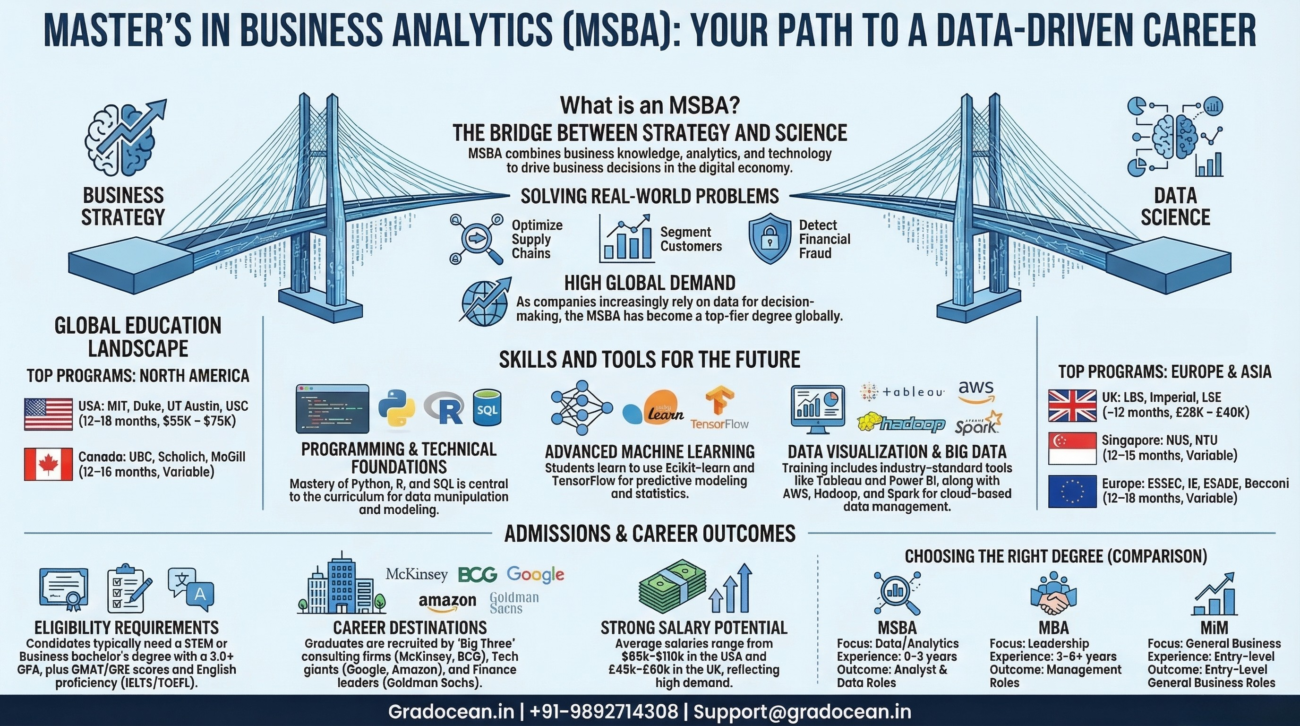
A Master’s in Business Analytics (MSBA) is a data-driven postgraduate program designed to help students bridge the gap between business strategy and data science. It equips you with the skills to analyze data, build predictive models, and drive business decisions in a rapidly evolving digital economy.
With companies increasingly relying on data for decision-making, MSBA has become one of the most in-demand degrees globally.
What is an MSBA?
An MSBA combines business knowledge, analytics, and technology to solve real-world problems such as customer segmentation, fraud detection, and supply chain optimization.
Key Areas Covered:
-
Programming (Python, R, SQL)
-
Machine learning & statistics
-
Data visualization (Tableau, Power BI)
-
Business strategy & decision-making
-
Capstone projects and internships
By the end of the program, students are equipped to make data-backed decisions and translate insights into business impact.
Who Should Pursue an MSBA?
This program is ideal for:
-
Fresh graduates (business, engineering, economics, math)
-
Early professionals (0–3 years experience)
-
Engineers looking to move into business roles
-
Professionals aiming for careers in analytics, product, or consulting
MSBA is particularly useful if you want to work at the intersection of data, technology, and business.
Top Countries & Universities for MSBA
🇺🇸 USA
-
Top schools: MIT, Duke, UT Austin, USC
-
Duration: 12–18 months
-
Average fees: $55K–$75K
🇬🇧 UK
-
Top schools: LBS, Imperial, LSE
-
Duration: ~12 months
-
Fees: £28K–£40K
🇨🇦 Canada
-
Top schools: UBC, Schulich, McGill
-
Duration: 12–16 months
🇸🇬 Singapore
-
Top schools: NUS, NTU
-
Duration: 12–15 months
🇪🇺 Europe
-
Top schools: ESSEC, IE, ESADE, Bocconi
-
Duration: 12–18 months
Tools & Skills You’ll Learn
MSBA programs focus heavily on practical, industry-relevant tools:
-
Programming: Python, R, SQL
-
Visualization: Tableau, Power BI
-
Machine Learning: Scikit-learn, TensorFlow
-
Big Data & Cloud: AWS, Hadoop, Spark
These skills prepare you for high-demand analytics roles across industries.
Eligibility & Admission Requirements
Typical requirements include:
-
Bachelor’s degree (STEM or business preferred)
-
GPA: ~3.0+ or 60–70%
-
GMAT/GRE (optional/required depending on school)
-
IELTS/TOEFL for international applicants
-
SOP, resume, and letters of recommendation
Most programs prefer candidates with 0–3 years of experience.
Career Opportunities After MSBA
Popular Roles:
-
Business Analyst
-
Data Analyst
-
Product Analyst
-
Decision Scientist
-
Analytics Consultant
Top Recruiters:
-
Consulting: McKinsey, BCG, Deloitte
-
Tech: Google, Amazon, Microsoft
-
Finance: Goldman Sachs, JPMorgan
Average Salaries:
-
USA: $85,000–$110,000
-
UK: £45,000–£60,000
-
Canada: CAD 70,000–85,000
MSBA offers strong ROI due to high demand for analytics talent globally.
MSBA vs MBA vs MiM
| Factor | MSBA | MBA | MiM |
|---|---|---|---|
| Experience | 0–3 yrs | 3–8+ yrs | 0–3 yrs |
| Focus | Data & analytics | Leadership | General management |
| Roles | Analyst, data roles | Management roles | Entry-level business |
Final Thoughts
If you’re looking to build a career in data-driven decision making, an MSBA is one of the most future-proof degrees today.
It’s best suited for candidates who:
-
Want to enter analytics, product, or consulting roles
-
Enjoy working with data and technology
-
Are early in their careers and want a high-ROI degree