



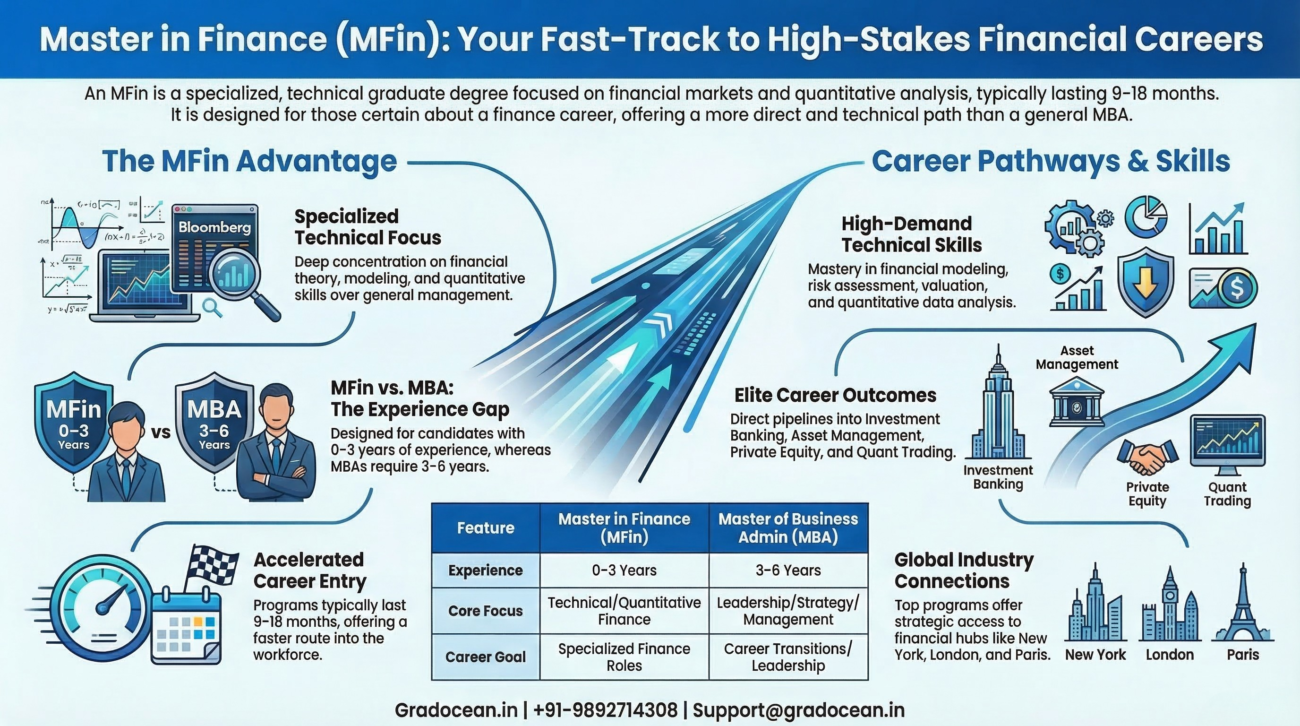
A Master in Finance (MFin) is a specialized graduate degree designed for students who want to build careers in financial services. Unlike an MBA, which covers broad management topics, an MFin focuses deeply on financial markets, investments, and quantitative analysis.
For candidates targeting roles in investment banking, asset management, trading, private equity, or corporate finance, an MFin can provide the technical skills and industry exposure needed to break into these competitive fields.
What Is a Master in Finance?
An MFin program focuses on advanced financial theory and quantitative skills used in modern financial markets.
Typical coursework includes:
-
Corporate finance
-
Financial modeling
-
Investment analysis
-
Derivatives and risk management
-
Quantitative finance and financial engineering
-
Data analysis and financial markets
Most MFin programs are relatively short compared to other graduate degrees, typically lasting 9–18 months.
Because of the technical nature of the curriculum, many programs strongly prefer applicants with backgrounds in finance, economics, mathematics, engineering, or statistics.
Who Should Consider an MFin?
The Master in Finance is usually designed for recent graduates or early-career professionals.
Typical candidates include:
-
Students who want to start careers in investment banking or asset management
-
Graduates from quantitative backgrounds such as engineering or mathematics
-
Candidates interested in financial modeling, trading, or fintech
-
Early-career professionals who want deeper finance expertise
Unlike MBA programs, MFin programs generally do not require extensive work experience.
MFin vs MBA: Key Differences
One of the most common questions applicants ask is whether they should pursue an MFin or an MBA.
Master in Finance
-
Highly specialized degree focused on finance
-
Usually for students with 0–3 years of experience
-
Strong emphasis on technical and quantitative skills
-
Popular for careers in investment banking, trading, and asset management
MBA
-
Broader management degree
-
Designed for professionals with 3–6 years of experience
-
Covers leadership, strategy, marketing, operations, and finance
-
Often used for career transitions into consulting, management, or leadership roles
If you are certain about a finance-focused career, an MFin may be the more direct path.
Top Master in Finance Programs in the World
Several business schools consistently rank among the best MFin programs globally, based on factors such as placement outcomes, alumni salaries, and employer reputation.
Top MFin Programs in the United States
Some of the most competitive programs include:
MIT Sloan – Master of Finance
One of the most prestigious MFin programs globally. It offers both 12-month and 18-month formats, strong quantitative training, and excellent placement into investment banks, hedge funds, and fintech firms.
Princeton University – Master in Finance
Known for its extremely selective admissions and strong quantitative curriculum. The program is offered through the Bendheim Center for Finance and has historically reported very strong placement rates and high starting salaries.
Carnegie Mellon University – MS in Computational Finance
A highly quantitative program that combines finance, mathematics, and computer science. It is especially well regarded for careers in quant trading, financial engineering, and risk management.
Columbia University – MS in Financial Engineering
Another elite program focused on financial modeling and quantitative finance, with strong connections to Wall Street.
Top MFin Programs in Europe
European business schools dominate many global rankings for pre-experience Master in Finance programs.
Some of the best programs include:
HEC Paris – Master in International Finance
Frequently ranked among the top finance programs worldwide, with strong placement into investment banking and consulting across Europe and London.
Oxford Saïd – MSc Financial Economics
A highly selective program that combines academic rigor with strong connections to global financial institutions.
London Business School – Masters in Financial Analysis
Designed for early-career candidates aiming for roles in investment banking, asset management, and consulting.
ESCP Business School – MSc Finance
Consistently ranked among the top finance programs globally and known for its multi-campus European structure and strong employer network.
Other Strong Global Programs
Additional well-known programs include:
-
ESSEC Business School – MSc Finance
-
Cambridge Judge Business School – Master of Finance
-
Bocconi University – MSc Finance
-
Tsinghua University – Master in Finance
Many of these programs offer strong access to financial hubs such as London, Paris, New York, and Hong Kong.
Career Opportunities After an MFin
Graduates from top MFin programs typically pursue roles such as:
-
Investment Banking Analyst
-
Equity Research Analyst
-
Asset Management Associate
-
Risk Analyst
-
Quantitative Trader
-
Corporate Finance Analyst
Top programs also maintain strong relationships with major financial institutions, which helps students secure internships and full-time roles.
Skills You Gain in an MFin Program
A Master in Finance develops both technical and analytical abilities needed in financial careers.
Key skills include:
-
Financial modeling and valuation
-
Data analysis and quantitative finance
-
Portfolio management
-
Risk assessment
-
Strategic financial decision-making
These skills are highly valued in global financial markets.
Final Thoughts
A Master in Finance can be an excellent option for students and early-career professionals who want to build a strong foundation in financial markets and investment strategies.
Because the degree is highly specialized, it is best suited for candidates who are certain about pursuing careers in finance. Those seeking broader leadership or management roles may find an MBA more appropriate.
Choosing the right program ultimately depends on your career goals, academic background, and long-term ambitions.
Need Personalized Guidance for MFin Applications?