



Executive Summary
The landscape of premier business education in the Asia-Pacific region is defined by a cluster of elite institutions located in Shanghai, Singapore, and Hong Kong. These programs—CEIBS, NTU, HKUST, NUS, HKU, and SMU—serve as critical bridges between Western management principles and deep Asian market intelligence.
Key takeaways from the analysis of these programs include:
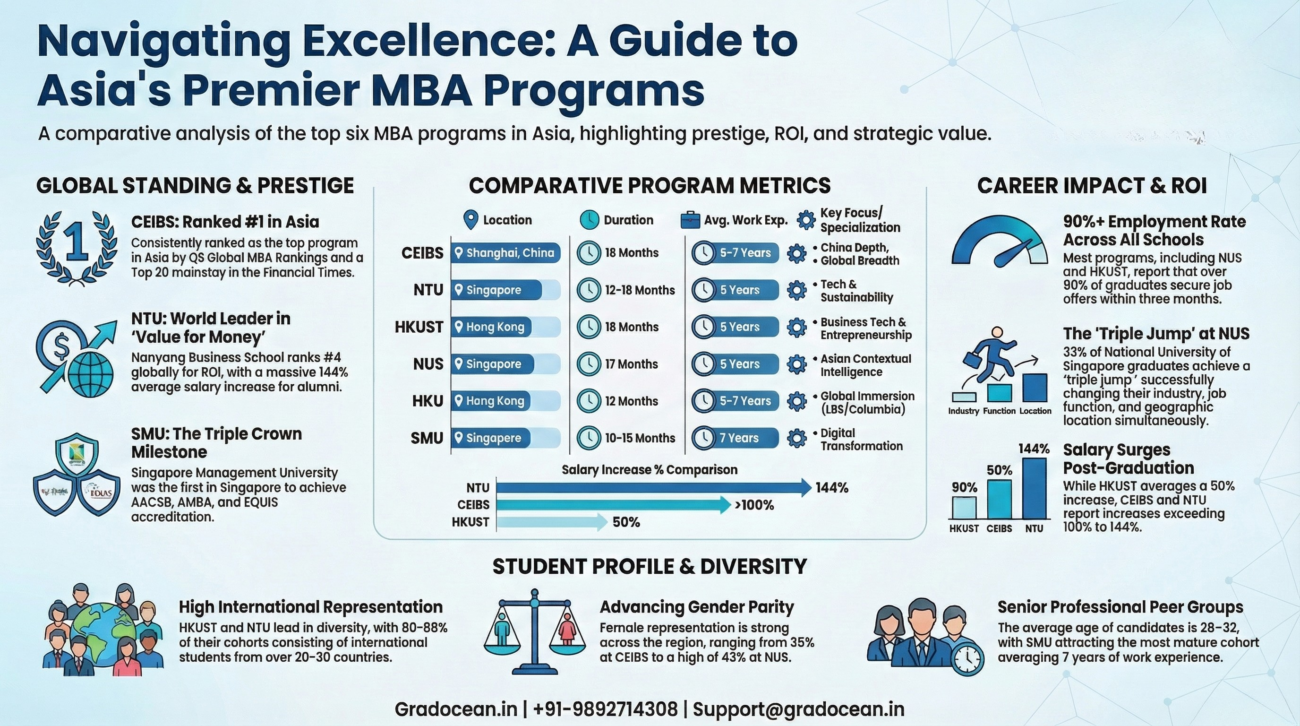
- Significant ROI: Graduates consistently achieve high salary increases, with NTU alumni reporting a 144% increase and CEIBS graduates exceeding 100% growth post-MBA.
- Strategic Regional Specialization: Each program leverages its unique location—Shanghai for China depth, Singapore for Southeast Asian/ASEAN expertise, and Hong Kong as a gateway to global finance.
- Curricular Innovation: Programs are increasingly integrating technology, digital transformation, and sustainability into core management frameworks.
- Global Integration: Despite their Asian focus, these institutions maintain high levels of internationalization, often with over 80% international student bodies and prestigious partnerships with Western schools like London Business School and Columbia Business School.
- Career Mobility: The programs facilitate aggressive career pivots, with NUS reporting that 91% of graduates change at least one career dimension (industry, function, or location).
Institutional Rankings and Strategic Value
The analyzed institutions represent the top tier of global management education, frequently appearing in the top ranks of the Financial Times and QS Global MBA assessments.
| Institution | Key Ranking Highlight | Regional Strategic Focus |
| CEIBS | Consistently Top 20 globally (FT) | “China Depth, Global Breadth”; Shanghai-based. |
| NTU | #22 globally (FT 2025); #4 for “Value for Money” | Gateway to ASEAN; Interdisciplinary (Tech/Sustainability). |
| HKUST | Top tier in Asia | Gateway to Asia; Focus on Tech & Innovation. |
| NUS | Top global rankings | “Asian contextual intelligence”; Strategic global hub. |
| HKU | Premier 12-month program | Asia-centric business in a global context. |
| SMU | #5 in Asia (QS 2025) | Digital transformation; Interactive seminar-style. |
Academic Structure and Curricular Focus
While all programs offer a foundation in general management, their structures and specializations vary to meet specific professional goals.
Specialized Track Offerings
- Digital and Tech Focus: SMU emphasizes digital transformation and business analytics. HKUST offers a specific track in Business Technology & Innovation.
- Sustainability: NTU has integrated sustainability into its core curriculum, offering a dedicated track in Sustainability & Innovation.
- Finance and Consulting: All programs maintain high-tier specializations in these areas, with HKU providing specific focus on Private Equity in Asia and CEIBS offering deep strategy and consulting frameworks.
Unique Program Structures
- HKU “6-3-3” Model: Six months of core courses in Hong Kong, three months of global immersion at London Business School or Columbia Business School, and three months of electives/capstone in Hong Kong.
- CEIBS Phases: A 16-month intensive structure divided into Core Foundation, Elective Specialization, and Experiential Learning (including the Integrated Consulting Project).
- SMU Seminar Approach: Utilizes an interactive, discussion-led pedagogy rather than traditional lectures, located in the heart of Singapore’s financial district.
- NUS Flexibility: Offers a 17-month full-time format and a 24–30 month part-time format for working professionals.
Admissions Profiles and Diversity
Admissions are highly selective, targeting experienced professionals with strong leadership potential.
Candidate Benchmarks
- Work Experience: The average range is 5–7 years across all programs. SMU tends to attract a more mature cohort (average age 31.5), while NUS and HKUST average 29.
- Academic Rigor: Competitive GMAT scores typically fall between 650 and 710.
- Gender Diversity: Female representation is a priority, ranging from 35% (CEIBS/HKU) to 43% (NUS).
- Internationalization: NTU and HKUST report that 80–88% of their cohorts are international, representing over 20–30 different nationalities.
Career Outcomes and Employment Statistics
The primary value proposition of these programs is their ability to facilitate rapid career advancement and high-stakes industry pivots.
Employment Rates and Top Recruiters
Most programs report employment rates of 90% or higher within three months of graduation.
- Top Industries: Consulting, Finance, and Technology remain the dominant sectors for placement.
- Leading Firms: Recruiters include McKinsey & Company, BCG, Goldman Sachs, Amazon, Google, Alibaba, and Tencent.
Salary Growth and ROI
| Program | Average Salary Post-MBA (USD approx.) | Reported Salary Increase |
| NTU | $186,832 | 144% |
| CEIBS | Varies by sector (400k-500k RMB) | 100%+ |
| HKUST | $102,000 – $115,000 | 50%+ |
| NUS | $82,002 | 91% (one career dimension change) |
| HKU | $120,000+ | High ROI via 12-month format |
Global Exposure and Networking Infrastructure
A hallmark of these Asian MBA programs is their extensive global reach and networking capabilities.
- International Exchange: HKUST maintains partnerships with over 40 schools, including INSEAD and UC Berkeley.
- Immersion Projects:
- CEIBS: Offers a three-week Global Business Project in foreign markets.
- HKU: Features a mandatory three-month exchange in London or New York.
- NUS: Includes a mandatory MBA Consulting Project within its experiential core.
- Alumni Networks:
- CEIBS: 25,000+ alumni in 70+ countries.
- NUS: 50,000+ global business school alumni (4,000+ specifically from the MBA).
- SMU: Access to a network of 3,000 companies.
Financial Investment and Support
The financial commitment for these programs reflects their global standing, though many are positioned as more cost-effective alternatives to US-based programs.
Tuition and Costs
- Highest Tuition: NUS (approx. S$99,953 inclusive of GST) and CEIBS (approx. 468,000 RMB).
- Competitive Mid-Range: HKU (HKD 588,000) and NTU (S$81,750).
- SMU Discount: Recently offered a 40% tuition discount for its 25th-anniversary intake.
Scholarship Opportunities
Extensive merit-based and diversity-focused scholarships are available at all institutions:
- Diversity & Inclusion: Specific awards for women in business and underrepresented regional candidates (e.g., ASEAN, APEC, Africa, Latin America).
- Merit Awards: Full or partial tuition waivers based on GMAT scores and professional records.
- Thematic Scholarships: Targeted awards for Entrepreneurship, Sustainability, and Social Impact.
Conclusion: Strategic Program Selection
The choice between these programs depends on the candidate’s professional trajectory:
- For China-specific leadership: CEIBS remains the dominant choice due to its “China Depth.”
- For a technology/sustainability focus with high ROI: NTU is uniquely positioned.
- For global finance and a gateway to the West: HKUST and HKU offer the strongest global exchange and financial hub proximity.
- For broad Asian leadership and career pivots: NUS offers the most comprehensive experiential and regional coverage.
- For industry-integrated, urban leadership in Singapore: SMU provides a mature, seminar-based environment.
Frequently Asked Questions About MBA in Asia (FAQs)
1. What are the top MBA programs in Asia (excluding India)?
Some of the leading MBA programs in Asia include **China Europe International Business School (CEIBS), Nanyang Technological University (NTU), Hong Kong University of Science and Technology (HKUST), National University of Singapore (NUS), The University of Hong Kong (HKU), and Singapore Management University (SMU).
These schools are globally recognized and consistently appear in top rankings such as the Financial Times Global MBA Rankings.
2. What is the average work experience required for top Asian MBA programs?
Most leading Asian MBA programs prefer candidates with 5–7 years of professional experience. The average age of students is typically between 29 and 32 years, depending on the program.
3. What GMAT score is required for top MBA programs in Asia?
Competitive applicants usually have GMAT scores between 650 and 710. However, admissions decisions also consider leadership experience, academic background, and career goals.
4. What career opportunities do graduates from Asian MBA programs pursue?
Graduates commonly move into industries such as:
-
Consulting
-
Finance
-
Technology
-
Strategy and leadership roles
Top recruiters include firms like McKinsey & Company, Boston Consulting Group, Goldman Sachs, Amazon, and Google.
5. How strong is the ROI of MBA programs in Asia?
MBA programs in Asia often deliver strong return on investment (ROI). For example, graduates from Nanyang Technological University report salary increases of up to 144%, while China Europe International Business School graduates frequently double their pre-MBA salaries.
6. How international are MBA programs in Asia?
Top Asian business schools are highly international. Many programs have 80–90% international students representing 20–30 nationalities, creating a diverse and globally connected learning environment.
7. How do I choose the right MBA program in Asia?
The best program depends on your career goals:
-
China-focused careers: China Europe International Business School
-
Technology and sustainability focus: Nanyang Technological University
-
Finance and global business exposure: Hong Kong University of Science and Technology or The University of Hong Kong
-
Broad Asia-focused leadership opportunities: National University of Singapore
Need Personalized Guidance for Asia MBA Applications?