



In elite MBA admissions, time is leverage.
Right now, there are roughly seven months between February and the critical Round 1 MBA deadlines in September. Most applicants will wait until July or August to begin a rushed, stressful sprint toward submission.
Strategic candidates do the opposite.
Starting your MBA application preparation in February is not simply about getting ahead — it’s about building a differentiated, leadership-driven profile that Admissions Committees expect from future executives.
When you start early, the process shifts from chaotic scrambling to structured execution.
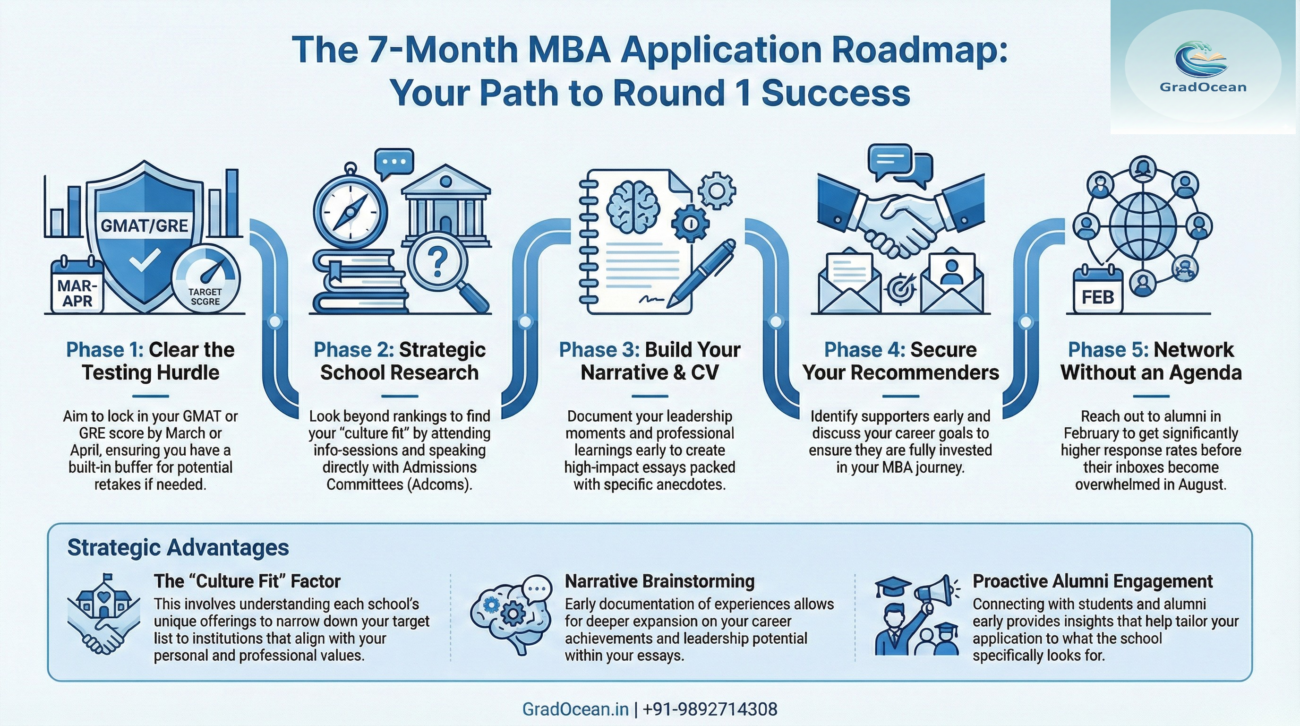
Here’s how to use the next seven months strategically.
1. Secure Your GMAT or GRE Score by Spring
The first pillar of any competitive MBA application is your standardized test score.
One of the biggest mistakes candidates make is delaying the GMAT or GRE until July or August. This creates unnecessary pressure and distracts from what truly wins admits — your narrative.
Target timeline:
Aim to finalize your GMAT or GRE score by March or April.
Why this matters:
-
You create a psychological buffer.
-
You protect Round 1 flexibility.
-
You have time for thoughtful retakes if required.
-
You avoid compromising essay quality due to test prep stress.
Late testing often traps candidates into rushed retakes or suboptimal submissions. Early completion keeps your strategy intact.
2. MBA Networking Strategy: Start Before the Crowd
MBA networking is not about transactional outreach. It is about relationship-building.
Reaching out to alumni and current students in February gives you a major advantage. At this stage:
-
Alumni inboxes are not flooded.
-
Current students are more responsive.
-
Conversations are deeper and more authentic.
By contrast, August outreach often feels generic and last-minute.
Early networking allows you to:
-
Understand culture fit beyond rankings.
-
Gather school-specific proof points.
-
Speak the school’s internal language in essays and interviews.
This insider clarity directly strengthens your “Why MBA?” and “Why This School?” essays.
3. Move Beyond Rankings: Build a Smart School Selection Strategy
Choosing MBA programs should not be a spreadsheet exercise.
An early start allows you to conduct real due diligence:
-
Attend official info sessions while schools are still in recruitment mode.
-
Engage with admissions teams.
-
Study curriculum structure, electives, and leadership programs.
-
Evaluate geographic and industry alignment.
Strong Round 1 applications are built on specificity.
Generic essays get rejected quickly.
Detailed, school-specific narratives stand out.
The February start ensures depth over superficiality.
4. Identify Leadership Gaps Before Your Profile Is “Locked”
The most compelling MBA applications are built on high-impact stories.
But powerful leadership examples are rarely discovered during a rushed August writing session.
Starting early allows you to audit your profile:
Leadership Gap Analysis
If you lack:
-
Cross-functional exposure
-
Team leadership
-
Strategic ownership
-
Community impact
You still have time to act.
You can:
-
Volunteer for a visible project.
-
Lead an internal initiative.
-
Take ownership of a measurable outcome.
By September, that initiative becomes a story — not a missed opportunity.
5. Refine Your CV and Career Narrative
MBA resumes are not job resumes.
They are leadership marketing documents.
Beginning in February gives you space to:
-
Quantify impact precisely.
-
Sharpen strategic positioning.
-
Align career progression with post-MBA goals.
-
Remove operational clutter and highlight executive potential.
The best essays evolve through multiple iterations.
That refinement requires time — not panic.
6. Engage Recommenders Early — Turn Them into Advocates
Strong recommendations are strategic assets.
Weak recommendations are silent application killers.
When you approach recommenders months in advance:
-
They feel invested, not rushed.
-
They understand your goals.
-
They align their narrative with yours.
Provide them with a structured briefing document including:
-
Key leadership achievements.
-
Career progression highlights.
-
Post-MBA goals.
-
Why you are targeting specific schools.
-
How their perspective complements your story.
Early alignment transforms recommenders from form-fillers into advocates.
The Round 1 Advantage: Execution vs Chaos
The MBA admissions process is a marathon, not a sprint.
Candidates who begin in August often experience:
-
Essay fatigue
-
Weak school research
-
Misaligned recommendations
-
Test score stress
-
Incomplete networking
Candidates who begin in February experience:
-
Strategic clarity
-
Narrative cohesion
-
Strong school fit articulation
-
Confident interview presence
-
Reduced stress
Admissions Committees can sense the difference.
Final Thought: Your Competitive Edge Starts Now
Round 1 MBA deadlines reward preparation.
The question is simple:
Will you be part of the last-minute scramble —
or the candidate who spent seven months building a compelling leadership narrative?
Your MBA application strategy for 2025 should not start in August.
It starts now.
If you’re planning to apply in Round 1 and want a structured MBA application roadmap tailored to your profile, building your strategy early can dramatically improve outcomes.
Because in elite admissions, timing is not just important.
It is strategic capital.
Need Help Assessing Your Fit?
At GradOcean, we work with professionals targeting MBA programs and help them:
-
Evaluate school fit strategically
-
Diagnose positioning gaps
-
Architect coherent application narratives
Email us at support@gradocean.in, call us at +91-9892714308, or connect with us directly through our contact page:
https://gradocean.in/contact-us/