



For years, MBA applications were fought on paper — carefully crafted resumes, strategically written essays, and endless rounds of editing.
But in MBA Admissions 2025, the battlefield has shifted.
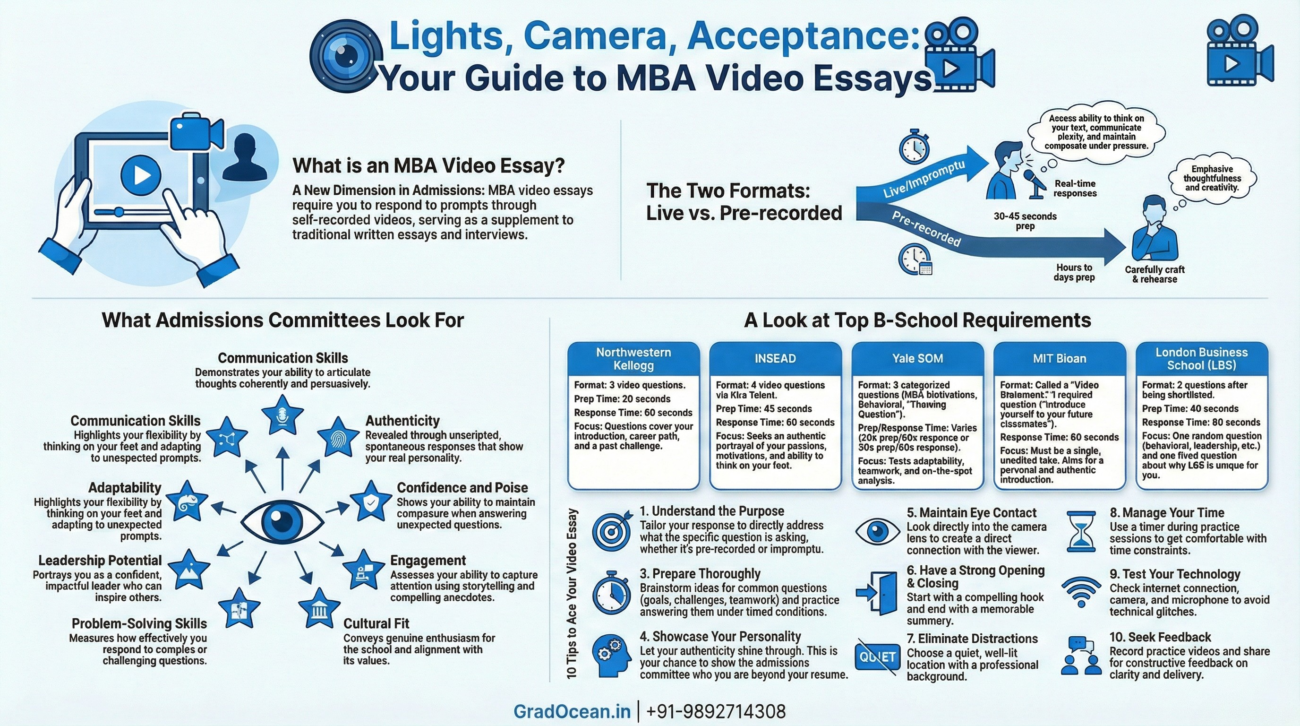
With schools like IESE Business School replacing traditional personal essays with mandatory video components — and leading programs such as Kellogg School of Management, INSEAD, and MIT Sloan School of Management strengthening their video requirements — the camera has become a decisive evaluation tool.
While written elements still matter, top-tier business schools are increasingly using video essays to look beyond the resume.
For many applicants, this shift creates anxiety. Speaking into a webcam feels far more vulnerable than refining paragraphs behind a keyboard.
But here’s the reality:
The video essay is not a hurdle. It is your opportunity to humanize your candidacy.
It’s Not Just an Interview — It’s a Quality Probe
Modern video essays are designed to assess far more than communication skills. Think of them as structured personality diagnostics.
Admissions committees evaluate two broad dimensions:
1. Interpersonal Qualities
-
Communication clarity
-
Authenticity
-
Engagement and presence
-
Cultural fit
-
Team orientation
2. Cognitive & Leadership Qualities
-
Confidence under pressure
-
Problem-solving ability
-
Leadership potential
-
Adaptability
-
Passion and drive
Most importantly, schools prioritize authenticity over scripting.
Unscripted responses reveal the real version of you — the one who shows up in meetings, case discussions, and group projects. Admissions committees want to understand whether your energy, maturity, and presence align with their campus culture.
Decoding the “Kira” Maze
Terminology varies:
-
Kellogg calls it a Video Essay
-
INSEAD labels it a Video Interview
-
MIT Sloan refers to it as a Video Statement
Despite the branding differences, many schools use the Kira Talent platform to administer these assessments.
However, don’t assume uniformity.
Each program customizes:
-
Preparation time
-
Response duration
-
Number of attempts
-
Question type
There are generally two formats:
Live / Impromptu: Tests thinking on your feet
Pre-recorded: Allows limited preparation
Regardless of format, the objective remains consistent:
Can you communicate clearly and professionally under real-time pressure?
The “Thinking Question”: Why Schools Test Cognitive Agility
Some schools deliberately use video essays to assess real-time analytical depth.
For example:
-
Yale School of Management uses “Group 3” thinking prompts — mini-case style questions with just 20 seconds of preparation and 60 seconds to respond.
-
Oxford Saïd Business School deploys competency-based questions with similarly tight preparation windows.
These are not random curveballs.
They test:
-
How you structure ambiguity
-
Whether you can articulate logic under time pressure
-
How composed you remain when the answer isn’t obvious
This mirrors real MBA classroom dynamics — especially in case-based environments.
Beyond Business: The Rise of the “Small Talk” Prompt
Interestingly, some of the most revealing questions have nothing to do with business.
-
Goizueta Business School may ask about your favorite song.
-
Vanderbilt Owen Graduate School of Management might ask how you recharge emotionally.
-
London Business School is known for creative prompts like:
-
Cats or dogs?
-
Describe the color red to someone who sees only in black and white.
-
Why?
Because leadership is relational.
In global business environments, trust is built through human connection — often beginning with informal conversations. Schools want to know:
Are you someone classmates would want on their team during a high-stakes project?
Relatability is not trivial. It is leadership capital.
The “One-Take” Reality
Pressure levels differ by school:
-
MIT Sloan School of Management requires a single, unedited take.
-
Some programs allow multiple attempts — but may change the question each time.
This is why polished memorization is risky.
Energy, composure, and authenticity matter far more than a perfect script.
Admissions committees are not looking for robotic delivery. They want a genuine moment of connection — proof that you are ready for the collaborative intensity of an MBA environment.
How to Approach the MBA Video Essay Strategically
Instead of fearing the camera, treat it as your differentiator.
Focus on:
-
Clear structure in your answers
-
Calm, measured pacing
-
Authentic storytelling
-
Strong eye contact and presence
-
Conversational tone, not performance mode
Remember:
You are not auditioning for a news anchor role.
You are demonstrating leadership presence.
The Bigger Picture: Your Human Edge
In a pool of high-GMAT, high-achieving candidates, differentiation rarely comes from numbers alone.
The video essay allows you to:
-
Showcase emotional intelligence
-
Demonstrate cultural awareness
-
Display conviction and clarity
-
Reveal personality beyond bullet points
In 2025, your “on-screen cultural fit” can become the deciding factor.
When the recording light turns red, the question isn’t:
“Did I memorize this perfectly?”
The question is:
“Did I show them the leader and teammate they would want in their classroom?”
If you’re preparing for MBA video essays and want structured guidance tailored to your target schools, a strategic rehearsal approach can convert anxiety into advantage.
Because in modern MBA admissions, presence is power.
Need Help Assessing Your Fit?
At GradOcean, we work with professionals targeting MBA programs and help them:
-
Evaluate school fit strategically
-
Diagnose positioning gaps
-
Architect coherent application narratives
Email us at support@gradocean.in, call us at +91-9892714308, or connect with us directly through our contact page:
https://gradocean.in/contact-us/