


The Financial Times Global MBA Rankings 2026 offer powerful data — but they don’t make decisions for you. Rankings measure historical outcomes for large groups. Your MBA decision requires personalized weighting based on your career goals, income level, geography, and risk tolerance.
Here’s a simplified framework to help you convert ranking data into a smart MBA ROI decision.
Step 1: Understand What Rankings Actually Measure
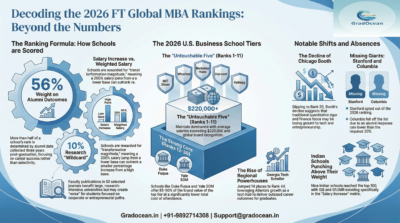
FT rankings heavily weight alumni outcomes (salary, salary increase, career progress). That’s useful — but incomplete.
They do not fully capture:
- Scholarship offers
- Local industry dominance
- Cultural fit
- Entrepreneurial ecosystems
- Recent program improvements
- Personal risk tolerance
That’s why two candidates can look at the same ranking table and choose completely different schools — and both be right.
Step 2: Use Candidate-Specific MBA Decision Frameworks
- The Career Switcher (Low Salary → High Growth)
Profile: NGO, teacher, government employee earning $30–50K targeting consulting/strategy.
What matters most:
- Salary Increase (40%)
- Career Services Strength (20%)
- Proven Transformation Track Record (15%)
Strong options:
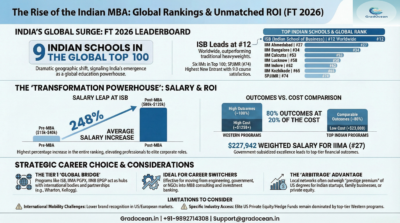
- Indian School of Business
- SPJIMR
- IIM Bangalore
- Duke Fuqua
- Cornell Johnson
Avoid:
- Extremely expensive programs (long ROI timeline)
- Weak career services
- Quant-heavy cultures where switchers struggle
For switchers, percentage growth matters more than prestige.
- The High Earner (Incremental Advancement)
Profile: Consultant, banker, tech professional earning $100K+.
What matters most:
- Alumni Network (35%)
- Brand Access
- Career Progress to Senior Roles
Strong options:
- Dartmouth Tuck
- IESE Business School
- Harvard Business School
- MIT Sloan School of Management
- Stanford (if available)
For high earners, network density beats salary percentage increase.
- The International Mobility Seeker
Profile: Wants flexibility across countries.
What matters most:
- International Mobility (30%)
- % International Students
- Global Alumni Network
Strong options:
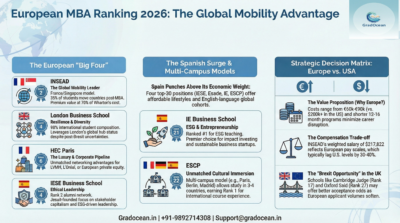
- INSEAD
- London Business School
- ESCP Business School
- CEIBS
- HEC Paris
Global exposure requires globally diverse cohorts.
- The Entrepreneur
Profile: Founder or aspiring startup builder.
What matters most:
- Alumni & Investor Network (40%)
- Startup Ecosystem Location
- Venture Capital Access
Strong options:
- MIT Sloan School of Management
- Stanford MBA
- Berkeley Haas
- INSEAD
- IE Business School
Entrepreneurs should ignore salary metrics — ecosystem matters more.
- The Diversity-Focused Candidate
Profile: Seeking inclusive culture and representation.
What matters most:
- Gender balance
- International diversity
- Student satisfaction
- Supportive alumni community
Strong options:
- ESCP Business School
- ESSEC Business School
- Yale School of Management
- IESE Business School
- Rotman School of Management
Culture influences long-term outcomes more than ranking position.
When to Ignore MBA Rankings Completely
- Regional Dominance Beats Global Rank
If you want Texas energy, McCombs School of Business, UT Austin may outperform higher-ranked schools for local hiring.
Most careers are regional — rankings are global.
- Scholarship > Rank Gap
A full scholarship at Rank 40 often beats full-pay at Rank 25.
Debt-free flexibility increases long-term optionality.
- Satisfaction > Marginal Salary Difference
Cranfield School of Management achieved one of the highest satisfaction scores despite mid-tier ranking.
After ~$120K income, happiness gains flatten. Culture matters.
- Specialized Rankings Matter More
Entrepreneurship, finance, or social impact rankings often predict outcomes better than overall rank.
- Rankings Are Backward-Looking
FT data reflects alumni 3 years post-MBA. Major curriculum or leadership changes may not show for years.
Always research recent program investments.
Final Takeaway: Rankings Are Inputs, Not Answers
The 2026 FT ranking confirms market trends:
- Tech ecosystems dominate (see MIT Sloan School of Management)
- Indian schools deliver massive transformation ROI
- European programs lead in mobility
- Niche specialization is increasing
But there is no universal “best MBA.”
The best MBA is:
- The one aligned with your salary baseline
- The one matching your geography
- The one fitting your risk tolerance
- The one consistent with your long-term career narrative
Rankings tell you what worked historically.
Your job is translating that data into your personalized ROI equation.
Choose strategy over status — and your MBA will become a career accelerator, not just a brand label.
Need Personalized Guidance for MBA Applications?
At GradOcean, we help students:
- Shortlist the right universities
- Maximize scholarships
- Plan education loans smartly
- Build strong applications with expert mentorship
Email us at support@gradocean.in, call us at +91-9892714308, or connect with us directly through our contact page:
https://gradocean.in/contact-us/
Start your academic journey with clarity and confidence.
Gonna try my luck at 123boom. Hope it lives up to the hype! Anyone else given it a go already? Let me know what you think! 123boom
RR999apk – APKs can be tricky, but always exciting to get the latest versions of games. Gonna be really careful with this download! Always proceed with caution! Check it out if you dare: rr999apk
Hey, anyone else been grinding on 9777cxgame lately? The gameplay’s pretty solid, and I’m actually having a blast. Check it out 9777cxgame!