



In today’s global economy, studying abroad is no longer just about prestige or university rankings. For most students and families, the real question is:
Does studying abroad actually deliver a strong Return on Investment (ROI)?
With rising tuition fees, currency fluctuations, and competitive job markets, choosing the right country has become a financial strategy—not an emotional decision.
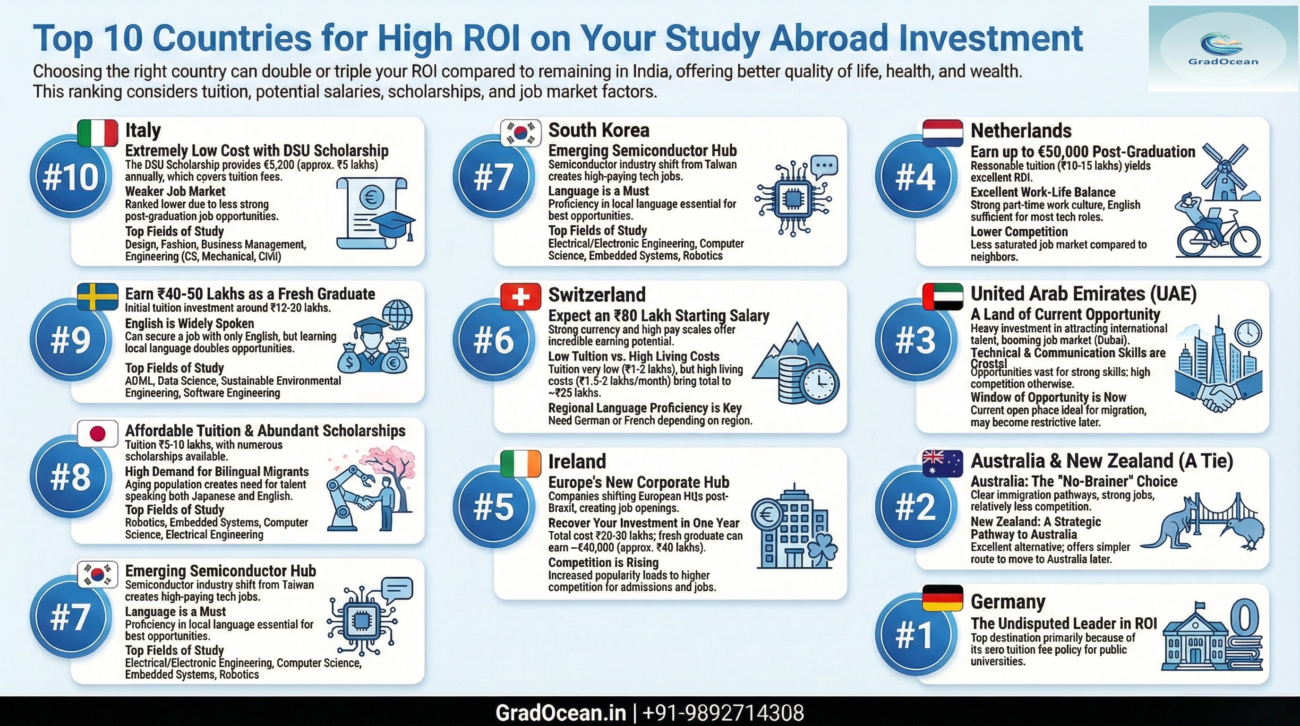
If you are planning for MS abroad, MBA abroad, or Fall 2026–2027 admissions, here are 10 countries where the cost-to-salary ratio, immigration pathways, and industry demand create genuine long-term value.
1. Germany – The Gold Standard for ROI
Germany continues to lead when it comes to affordable international education. Most public universities charge little to no tuition fees, significantly reducing your financial burden.
Why Germany stands out:
-
Near-zero tuition fees
-
Strong industrial economy
-
High demand for engineers and tech professionals
-
Opportunity to save ₹30–40 Lakhs compared to other destinations
For students prioritizing low debt and stable job markets, Germany offers one of the best ROI outcomes in Europe.
2. Switzerland – High Cost, Higher Reward
Switzerland has higher living expenses, but starting salaries are among the highest in Europe.
Key advantages:
-
Low tuition fees
-
Starting salaries can reach ₹70–80 Lakhs
-
Strong finance, consulting, and engineering sectors
The payback period can be extremely short if you secure employment in high-demand industries.
3. Italy – Scholarships That Reduce Financial Risk
Italy is often overlooked, but regional scholarships such as DSU can significantly reduce tuition and living expenses.
Best suited for:
-
Design and Fashion
-
Business Management
-
Mechanical, Civil, and Computer Engineering
Italy’s advantage lies in minimizing debt while gaining access to respected European institutions.
4. Sweden – High Salaries with Lower Competition
Sweden offers a strong tech ecosystem and is highly English-friendly.
Growing fields include:
-
AI and Machine Learning
-
Data Science
-
Software Engineering
-
Sustainable Engineering
While tuition costs exist, starting salaries can justify the investment. Learning Swedish can further enhance long-term career prospects.
5. Japan – Addressing the Talent Gap
Japan is experiencing a demographic shift, creating increased demand for skilled international professionals.
High-demand sectors:
-
Robotics
-
Embedded Systems
-
Electronics
-
Semiconductor Technology
For technically skilled students, Japan provides both global exposure and strong industrial growth.
6. South Korea – Semiconductor and Tech Expansion
South Korea is investing heavily in advanced manufacturing and technology sectors.
Opportunities include:
-
Electrical Engineering
-
Computer Science
-
Semiconductor Research
-
Advanced Manufacturing
As global supply chains evolve, Korea’s demand for specialized talent continues to rise.
7. Ireland – Europe’s English-Speaking Tech Hub
Post-Brexit, Ireland has become a key base for multinational companies.
Advantages:
-
English-speaking workforce
-
Strong tech presence
-
Gateway to the European market
However, selecting a reputable university is crucial to maximize ROI.
8. The Netherlands – Balanced Growth and Lifestyle
The Netherlands offers competitive salaries with relatively moderate education costs.
Why consider the Netherlands:
-
Education cost: approx. ₹10–15 Lakhs
-
Strong work-life balance
-
Growing demand in tech and business
English works well in tech roles, though local language skills help for managerial positions.
9. UAE – Tax-Efficient Career Growth
The UAE, particularly Dubai, offers a high-growth environment for skilled professionals.
Key benefits:
-
Tax-free income
-
Expanding finance and technology sectors
-
Strong infrastructure and business ecosystem
This market rewards high performers and specialized talent.
10. Australia & New Zealand – Structured Immigration Pathways
Australia remains a strong destination due to its transparent immigration pathways and diverse job market.
New Zealand can serve as an alternative route, offering flexible long-term residency options and access to regional labor markets.
The Shift from Prestige to ROI
The landscape of international education has evolved. Today, students must evaluate:
-
Tuition costs
-
Living expenses
-
Starting salaries
-
Industry demand
-
Immigration opportunities
-
Long-term earning potential
Choosing the right country is not about following past reputation—it’s about aligning with future economic demand.
Studying abroad can still accelerate wealth creation—but only if you choose strategically.
Final Thought
Before selecting your destination for MS or MBA abroad, ask yourself:
Are you choosing based on rankings…
Or based on realistic salary outcomes, debt levels, and global career mobility?
Making the right decision today can compound financially for decades.
Frequently Asked Questions (FAQs)
1. Which countries offer the best ROI for studying abroad in 2026–2027?
Countries such as Germany, Switzerland, Sweden, Ireland, the Netherlands, Japan, South Korea, UAE, Australia, and New Zealand offer strong ROI for international students. These destinations combine affordable tuition (in some cases zero tuition), high starting salaries, strong job markets, and clear immigration pathways. The best country for ROI depends on your field of study, career goals, and long-term settlement plans.
2. Is Germany still the most affordable country for international students?
Yes, Germany remains one of the most affordable study abroad destinations. Most public universities charge little to no tuition fees, significantly reducing total education costs. When combined with Germany’s strong industrial economy and demand for engineers and tech professionals, it continues to offer one of the best debt-to-income ratios for international students.
3. How do salary levels in Switzerland compare to study costs?
Switzerland has higher living expenses compared to other European countries, but starting salaries are among the highest in Europe. Graduates in finance, engineering, consulting, and technology can earn competitive salaries that allow them to recover their investment relatively quickly. For high-demand professionals, Switzerland offers one of the fastest ROI cycles globally.
4. Are Japan and South Korea good options for engineering and semiconductor careers?
Yes, Japan and South Korea are strong destinations for students pursuing robotics, electronics, computer science, and semiconductor-related fields. Both countries are investing heavily in advanced manufacturing and technology sectors. Due to demographic shifts and growing industry demand, skilled international graduates can find attractive career opportunities, especially if they develop local language proficiency.
5. Is studying in Ireland or the Netherlands worth the investment after Brexit?
Ireland has strengthened its position as an English-speaking gateway to Europe after Brexit, especially for tech and multinational companies. The Netherlands offers a balance of moderate tuition fees, strong salaries, and high quality of life. Both countries can provide solid ROI, particularly for students in technology, data science, engineering, and business-related fields. Choosing a reputable university remains crucial for maximizing outcomes.
6. Does studying in the UAE provide long-term career and salary benefits?
The UAE, particularly Dubai and Abu Dhabi, offers tax-free income and a rapidly growing business ecosystem. For highly skilled professionals in finance, consulting, technology, and management, the earning potential can be significant. However, success in the UAE market depends heavily on strong technical skills, industry relevance, and performance.
7. How should students evaluate ROI before choosing a country to study abroad?
To evaluate ROI effectively, students should analyze:
-
Total tuition fees
-
Living expenses
-
Average starting salaries in their field
-
Job market demand
-
Post-study work rights and immigration pathways
-
Long-term earning growth
Studying abroad should be viewed as a strategic financial decision. The goal is to minimize debt while maximizing salary growth, career mobility, and global exposure.
Need Personalized Guidance for Masters Abroad Applications?
At GradOcean, we help students:
- Shortlist the right universities
- Maximize scholarships
- Plan education loans smartly
- Build strong applications with expert mentorship
Email us at support@gradocean.in, call us at +91-9892714308, or connect with us directly through our contact page:
https://gradocean.in/contact-us/
Start your academic journey with clarity and confidence.