


- Introduction: The Career Pivot Dilemma
In an increasingly dynamic world where business models are disrupted overnight, the traditional two-year MBA is no longer the default path to leadership. Ambitious professionals now face a strategic crossroads: can a condensed, one-year program truly provide the “best-in-class knowledge” and “resilience” required to navigate this volatility?
The Indian School of Business (ISB) positions its Post Graduate Programme in Management (PGP) not merely as a degree, but as a high-impact learning environment designed to optimize the human capital of mid-career professionals. For those ready to become “game-changers,” the program acts as a rigorous catalyst for positive career pivots, connecting individuals to a robust global network within a high-pressure, 12-month residential framework.
- Takeaway 1: The Consulting Hegemony and the Rise of Specialization
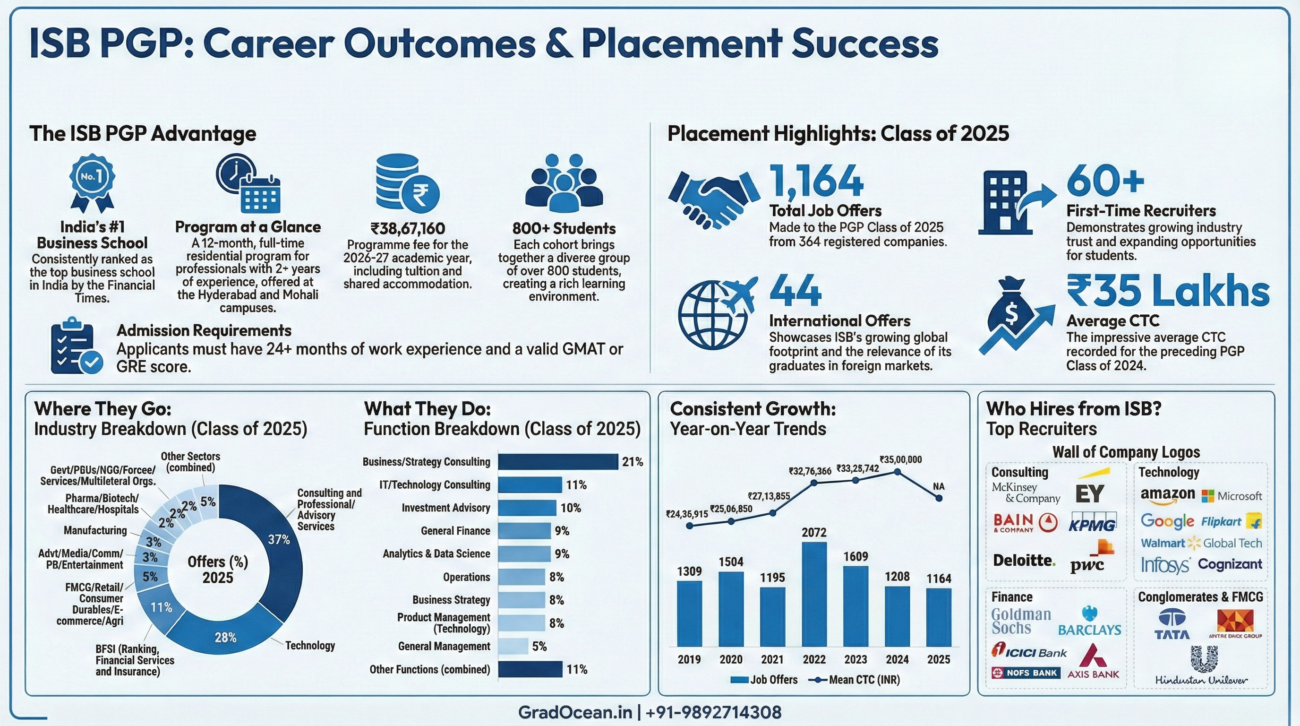
Consulting remains the undisputed bedrock of ISB’s placement ecosystem. In the Class of 2025, Consulting and Professional/Advisory Services secured 37% of all offers, maintaining its status as the primary destination for graduates. This “Consulting Hegemony” is underpinned by the consistent presence of the industry’s “Big Three”—McKinsey & Company, Boston Consulting Group (BCG), and Bain & Company.
However, the deeper narrative reveals a significant shift toward specialization. A look at the functional data shows a strategic split: while 21% of offers are for Business/Strategy Consulting, a substantial 11% are specifically for IT/Technology Consulting. This indicates that the consulting giants are no longer just looking for generalists; they are hiring at scale for digital transformation and strategy roles, aligning ISB’s curriculum directly with the demands of the modern corporate landscape.
“ISB offers best-in-class knowledge, global perspectives and rich experiences that help you create significant impact in your organisations and society.”
- Takeaway 2: The ROI Equation—High Stakes, Higher Returns
For a Strategic Career Architect, the MBA is a valuation exercise. The ISB PGP involves a significant financial commitment—the program fee for the 2026–27 academic year stands at ₹38,67,160—but the returns suggest a rapid break-even point.
- The Reward: The Class of 2024 recorded a high-water mark with an average CTC of INR 35 lakhs.
- The Floor and Ceiling: To manage expectations, one must look at the 80% CTC range. For instance, in Strategy Consulting, the 80% range spans from INR 27.2 lakhs to INR 45 lakhs, while Technology roles range from INR 28 lakhs to INR 45 lakhs.
This trend of “Sustained Salary Growth”—climbing from a mean of INR 24.35 lakhs in 2019 to INR 35 lakhs in 2024—proves the 12-month model’s efficiency. By minimizing the opportunity cost of time away from the workforce, ISB maximizes the immediate valuation jump for professionals with 2+ years of experience.
- Takeaway 3: The Tech and Data Pivot is No Longer “Alternative”
The “alternative” career path has become the mainstream. ISB has successfully evolved into a primary pipeline for digital-first careers, as evidenced by the 2025 Industry-Wise figures:
- Technology (Industry): 28% of total offers.
- Analytics & Data Science (Function): 9% of offers.
- Product Management (Technology Function): 7% of offers.
The “missing link” for many applicants is understanding that the tech pivot isn’t limited to tech firms like Amazon, Google, or Microsoft. By bridging the 11% of offers in IT/Technology Consulting with the 28% of offers in the Tech industry, it becomes clear that ISB is the preferred hub for those aiming to lead in AI, cloud computing, and data-driven decision-making across all sectors.
- Takeaway 4: A Blueprint for “Inclusionary Excellence”
ISB’s mission to groom future leaders is built on a foundation of diversity, but the architectural roadmap to entry is precise. Applicants must navigate a multi-level selection process requiring 24+ months of work experience and a valid GMAT or GRE score.
Once inside, the school fosters “Inclusionary Excellence” through nine scholarship categories designed to bring in diverse perspectives. These include:
- Armed Forces Scholarship and AIESEC partnerships.
- Merit-by-Diversity and Need-Cum-Merit awards.
- Specific support for graduates from social impact startups and NGOs who intend to pivot back into the public or government sectors.
This structural support ensures that the cohort—often exceeding 800 students—includes leaders from the military and government alongside traditional corporate high-flyers.
- Takeaway 5: The Global Resilience Factor
The true measure of a school’s “industry trust” is its performance during economic fluctuations. The 2025 placement season provides a compelling “Resilience Factor”: ISB secured 1164 job offers for a class size of 816 students. This translates to an impressive ratio of approximately 1.4 offers per student, providing a significant safety net for the cohort.
This resilience is further validated by:
- International Reach: 44 international offers across diverse geographies.
- Market Expansion: Participation from 60+ first-time recruiters, including established giants like Goldman Sachs, Barclays, and the Tata Group.
The sheer volume of offers despite a tightening global economy underscores the power of the ISB brand and its “robust global alumni network.”
- Conclusion: The Future of the High-Impact Professional
The data from ISB’s latest placement cycles confirms that the 12-month MBA is not just surviving—it is thriving as a high-velocity model for career transformation. By balancing the “Consulting Hegemony” with a deep integration into the technology and analytics sectors, ISB prepares its graduates to create “significant impact in organisations and society.”
As the business landscape continues to shift, the question for the ambitious professional is no longer about the duration of the degree, but about the speed of the pivot. Are you ready to optimize your career trajectory and navigate the complexities of this dynamic world?
Frequently Asked Questions (FAQs)
1. Is a one-year MBA from ISB sufficient for a major career pivot?
Yes. The ISB PGP is designed as a high-intensity, 12-month residential program that minimizes opportunity cost while maximizing skill acceleration. It is particularly effective for professionals with 2+ years of experience seeking rapid career transformation into consulting, technology, product, or strategy roles.
2. Why does consulting dominate ISB placements?
Consulting accounts for 37% of total offers, making it the largest recruiting sector. The presence of firms like McKinsey, BCG, and Bain ensures consistent hiring. However, there is increasing specialization within consulting, particularly in Business Strategy (21%) and IT/Technology Consulting (11%), reflecting demand for digital transformation expertise.
3. What is the ROI of the ISB PGP program?
With a program fee of approximately ₹38.67 lakhs (2026–27) and an average CTC of ₹35 lakhs (Class of 2024), many students experience a strong post-MBA salary jump. The 80% CTC range in major sectors such as Strategy and Technology spans roughly ₹27–45 lakhs, indicating a broad yet competitive compensation band.
4. Is ISB only suitable for consulting aspirants?
No. ISB has evolved into a strong pipeline for technology and data-driven roles. In 2025:
-
28% of offers came from the Technology industry
-
9% were in Analytics & Data Science
-
7% were in Product Management
The school supports both traditional consulting paths and modern tech-oriented leadership roles.
5. What kind of professionals typically join ISB?
Applicants must have 24+ months of work experience and a valid GMAT or GRE score. The cohort is diverse, often exceeding 800 students, including professionals from corporate, armed forces, public policy, NGOs, and global organizations.
6. Does ISB offer scholarships and financial support?
Yes. ISB provides multiple scholarship categories, including:
-
Merit-based and Need-Cum-Merit awards
-
Armed Forces scholarships
-
Diversity-focused scholarships
-
Support for candidates from social impact or public sector backgrounds
These initiatives aim to foster inclusionary excellence across industries and backgrounds.
7. How resilient is ISB’s placement ecosystem during economic downturns?
The 2025 placement cycle demonstrated strong resilience, with 1,164 offers for 816 students (approximately 1.4 offers per student). Additionally, 44 international offers and participation from 60+ first-time recruiters highlight the school’s sustained industry trust even in tighter economic conditions.