



Introduction: Beyond the Rankings
The “M7 Business Schools”—Harvard, Stanford, Wharton, and their elite peers—are universally recognized as the pinnacle of global business education. For decades, their names have been synonymous with prestige, influence, and unparalleled career opportunities. Aspiring MBA candidates around the world see them as the ultimate goal, the gold standard for a transformative education.
But beyond the famous names and top-tier rankings lies a more complex and nuanced reality. The common assumptions applicants make about these schools often obscure crucial details that can make or break an application strategy. A deep dive into what makes these institutions tick reveals several counter-intuitive truths. This article will reveal four of the most impactful takeaways that every prospective M7 applicant needs to understand.
- The “Elite” Label Hides a Shocking Gap in Acceptance Rates
The common assumption is that every M7 school is a fortress, with acceptance rates in the single digits making admission nearly impossible for all but a select few. The very idea of the M7 conjures images of extreme selectivity across the board.
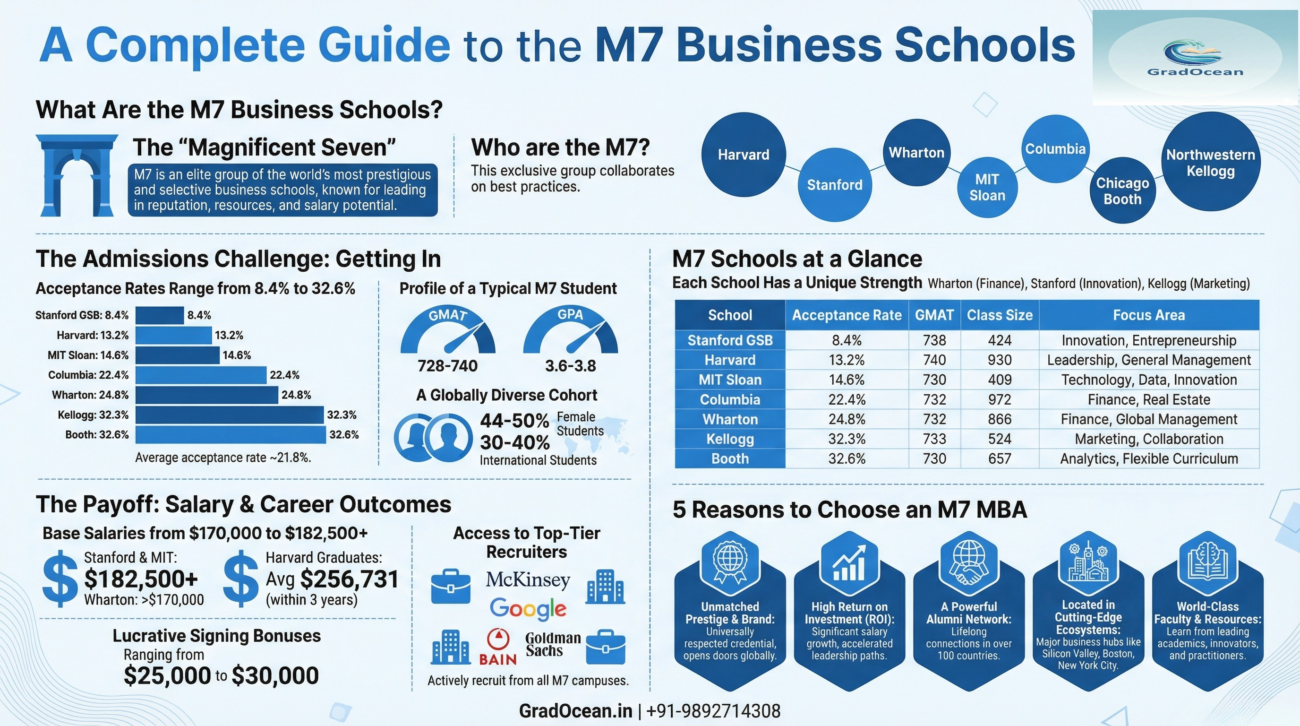
However, the data reveals a surprisingly wide range in how difficult it is to gain admission. The M7 acceptance rates range from a razor-thin 6.8% at Stanford to a far more accessible 29% at Chicago Booth. This gap of over 24 percentage points is a critical strategic insight, especially when compared to the group’s average acceptance rate of approximately 19%.
- Stanford GSB: 6.8%
- Harvard Business School: 11.2%
- MIT Sloan: 14%
- Columbia: 21%
- Wharton: 20.5%
- Kellogg: 28.6%
- Booth: 29%
This variance is incredibly important. It demonstrates that while all M7 programs are intensely competitive, some are statistically much more attainable than others. This data should fundamentally reshape your application portfolio, allowing you to balance ‘reach’ schools with high-yield elite options. You shouldn’t be discouraged by the single-digit reputation of some schools when others in the same elite tier have acceptance rates nearly four times higher.
- “M7” Isn’t Just a Nickname—It’s an Actual Club
Most people, including many MBA applicants, assume that “M7” or “Magnificent Seven” is just an informal industry nickname for the top-ranked business schools. It sounds like a media-coined term to group the perennial leaders in the rankings.
The surprising truth is that the M7 is a formal collaboration. The deans of these seven elite institutions actively work together. The M7 business schools “collaborate annually to share best practices” and operate under a shared forum known as the “Graduate Business Curriculum Roundtable.”
This formal brain trust is a key, often-overlooked reason the M7 continues to dominate global business education, collectively setting the agenda for curriculum innovation and recruitment standards. By sharing insights and aligning on policy, they maintain their collective edge and continue to define the future of graduate management education.
- Each School Has a Distinct “Personality” and Specialization
Given their collective prestige, it’s easy to view the M7 schools as interchangeable hubs of academic excellence. The reality is that each institution has a unique culture, curriculum, and “focus area” that sets it apart. These specializations are not just marketing—they are deeply embedded in each school’s faculty, resources, and recruiting pipelines.
| School | Focus Area |
| Harvard | Leadership, Gen Mgmt |
| Stanford | Innovation, Entrepreneurship |
| Wharton | Finance, Global Mgmt |
| Columbia | Finance, Real Estate |
| Kellogg | Marketing, Collaboration |
| Booth | Analytics, Flex Curriculum |
| MIT Sloan | Tech, Data, Innovation |
Simply targeting the M7 brand is not enough. Success depends on finding the specific program that best supports your individual career ambitions by aligning your personal goals with the school’s core strengths.
- Higher Selectivity Doesn’t Automatically Mean a Higher Salary
A powerful and persistent assumption in MBA admissions is that the harder a school is to get into, the higher the financial reward will be upon graduation. Applicants often use acceptance rate as a proxy for salary potential, believing that greater exclusivity directly translates to bigger paychecks.
However, the data shows a more complex picture. For example, Stanford GSB has the lowest acceptance rate in the M7 at just 8.4% and reports a graduate base salary of $182,500. In contrast, Harvard Business School, with a higher acceptance rate of 13.2%, reports a total compensation of $256,731 within three years of graduation.
This discrepancy highlights a crucial strategic insight: a school’s “personality” directly shapes its graduates’ career outcomes and compensation structures. Stanford, with its focus on “Innovation” and “Entrepreneurship,” places many graduates in startups where compensation is weighted towards equity, resulting in a lower immediate base salary. Conversely, schools that are heavy feeders into consulting and finance often report higher initial “total compensation”—a figure that typically incorporates base salary, signing bonuses (25K–30K is common), and other guaranteed pay—because those industries offer more front-loaded reward packages.
The key takeaway is to look beyond a single data point. An applicant’s potential ROI is a complex equation, and understanding how a school’s specialization aligns with industry-specific compensation models is essential for evaluating true career outcomes.
Conclusion: Choose Your Target, Not Just the Title
Looking beyond the powerful M7 brand reveals crucial nuances in acceptance rates, school culture, and career outcomes that can empower you to build a smarter application strategy. The Magnificent Seven are not a monolith; they are a collection of distinct institutions, each with its own strengths and opportunities.
The question isn’t just which M7 school is best—it’s which M7 school is built to amplify your specific version of success.
Frequently Asked Questions (FAQs)
1. What are the M7 Business Schools?
The M7 Business Schools (Magnificent Seven) are an elite group of MBA programs that include Harvard Business School, Stanford GSB, Wharton, MIT Sloan, Chicago Booth, Kellogg, and Columbia Business School. These schools collaborate formally and consistently rank among the top MBA programs globally for leadership development, career outcomes, and alumni influence.
2. Are all M7 MBA programs equally difficult to get into?
No. While all M7 schools are highly competitive, their acceptance rates vary significantly. Some programs admit fewer than 10% of applicants, while others accept closer to 25–30%. This wide gap means applicants should build a balanced MBA application strategy rather than assuming equal selectivity across all M7 schools.
3. What is the average acceptance rate for M7 MBA programs?
The average acceptance rate across M7 MBA programs is roughly around 15–20%, but individual schools vary widely. For example, Stanford GSB is known for single-digit acceptance rates, while schools like Chicago Booth and Kellogg typically have higher admission percentages. Understanding these differences is critical when planning your MBA application portfolio.
4. Is “M7” just a nickname for top MBA programs?
No. The M7 is not just a media label—it is a formal collaboration among the deans of the seven schools. They meet regularly to share best practices and discuss curriculum innovation through initiatives like the Graduate Business Curriculum Roundtable. This collaboration helps maintain their dominance in global MBA education.
5. Do all M7 schools offer the same MBA experience?
No. Each M7 MBA program has a distinct personality and specialization. For example:
-
Some focus heavily on leadership and general management
-
Others are known for finance and investment banking
-
Some emphasize entrepreneurship and innovation
-
Others specialize in analytics, technology, or marketing
Applicants should choose an M7 school based on career alignment, not just brand prestige.
6. Does a lower acceptance rate mean higher post-MBA salary?
Not necessarily. While highly selective schools often report strong compensation numbers, salary outcomes are influenced more by industry placement than admission difficulty. Schools that send many graduates into consulting and finance often report higher immediate total compensation, while entrepreneurship-focused schools may show lower base salaries but higher long-term equity upside.
7. How should I choose the right M7 MBA program for my career goals?
The best M7 MBA program is the one that aligns with your long-term career strategy. Instead of focusing only on rankings, applicants should evaluate:
-
School specialization (finance, tech, leadership, entrepreneurship)
-
Recruiting pipelines
-
Alumni network strength
-
Compensation trends by industry
-
Cultural fit and learning style
A strategic, data-driven approach significantly increases both admission success and long-term ROI.
Need Personalized Guidance for M7 MBA Applications?
At GradOcean, we help students:
- Shortlist the right universities
- Maximize scholarships
- Plan education loans smartly
- Build strong applications with expert mentorship
Email us at support@gradocean.in, call us at +91-9892714308, or connect with us directly through our contact page:
https://gradocean.in/contact-us/
Start your academic journey with clarity and confidence.